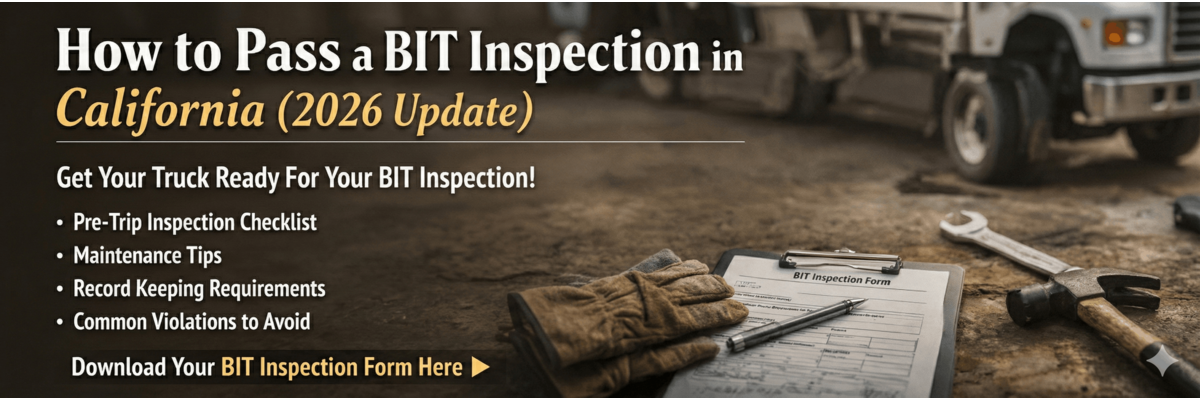
If you run trucks in California, those three letters—B.I.T.—probably make you sweat a little.
The Basic Inspection of Terminals (BIT) program is unique to California. It is not just a standard roadside check; it is the CHP (California Highway Patrol) coming into your house, opening your filing cabinets, and actively looking for reasons to shut you down. Unlike federal FMCSA audits which can feel random, the BIT program is systematic. If you operate a terminal in CA with vehicles over 10,000 lbs GVWR, they will come eventually.
We've helped hundreds of California fleets survive these audits. The honest truth? Fleets rarely fail because of bad mechanics. They fail because of sloppy paperwork.
This is not a generic "be safe" article. This is a field manual. Here is your detailed, no-nonsense guide to surviving a BIT inspection in 2026 without getting an "Unsatisfactory" rating.
Key Takeaways: CHP BIT Program
- The 90-Day Rule: Every commercial vehicle over 10,000 lbs GVWR operating in California must undergo a rigorous mechanical inspection every 90 days.
- Record Retention: You must keep BIT inspection reports and maintenance records for at least 24 months (DVIRs 90 days).
- The Digital Shift: Relying on a paper 90 day bit inspection form is the #1 reason fleets fail audits. Modern affordable electronic inspection systems for DOT compliance automate this tracking.
What are the California regulatory mandates and audit deficiencies for the last 90 days?
Under the 2026 California regulatory mandates enforced by the CHP, the leading audit deficiency during a terminal inspection is failure to maintain consecutive 90-day mechanical inspection records (BIT program). Enforcement actions are triggered immediately if a motor carrier cannot produce a complete, unbroken 90-day history of Driver Vehicle Inspection Reports and corresponding maintenance certifications.
Historically, fleet managers have struggled to track these exact intervals using paper calendars, leading to significant fines. An electronic DVIR system eliminates this deficiency by generating automated alerts before the 90-day window expires and securely archiving the digital records for the required 24-month retention period.
Who is exempt from the California BIT 90-day inspection in 2026?
Under the California Assembly Bill (AB) 3278 updates, commercial vehicles with a Gross Vehicle Weight Rating (GVWR) under 26,000 pounds are now exempt from the strict 90-day BIT inspection cycle and transition to standard annual federal inspections. Vehicles over 26,001 pounds, Hazmat carriers, and heavy vehicle combinations remain fully subject to the 90-day mandate.
For the full weight-class comparison table, DACH integration details, and split-fleet scheduling guidance, see our deep-dive: California BIT Program 2026: AB 3278 Weight Exemptions & 90-Day Rule Updates.
1. What Exactly is a BIT Inspection in California?
If you operate commercial vehicles in California, you are subject to the jurisdiction of the California Highway Patrol (CHP). The Basic Inspection of Terminals (BIT) program is their primary tool to ensure fleet safety. Unlike standard roadside inspections, a CHP terminal inspection happens at your home base. Auditors will walk into your office, demand your maintenance files, and review your 90-day inspection intervals.
Compliance Tip: Don't Confuse DVIRs with BIT Inspections
A daily pre-trip inspection (DVIR) ensures the truck is safe for that specific shift. A 90-day BIT inspection is a deep, mechanic-level evaluation of the vehicle's core components (brakes, steering, suspension) that must be documented and retained for 24 months.
2. The Danger of the "Free Printable" Form
Many new owner-operators search for a 90 day bit inspection form free printable online. While this saves money upfront, it creates a massive administrative burden. Paper records get lost, stained with grease, or misfiled. When the CHP auditor asks for Truck #4's history for the last two years, handing them a disorganized binder is a guaranteed path to a failed inspection and severe penalties. Moving to affordable electronic inspection systems for DOT compliance eliminates this risk.
3. Why Do Safety Checks Keep Getting Skipped or Forgotten?
If you ask a room full of safety directors, "why do safety checks keep getting skipped or forgotten?" the answers usually point to driver laziness. But the truth is rooted in bad operational design. When a driver is pressured to maximize their Hours of Service (HOS) and hit the road, a dense paper checklist feels like a bureaucratic hurdle rather than a safety measure.
On paper, skipping a check has zero immediate consequences. A driver can bypass the air brake test, check the "OK" box, and the paper accepts the lie. There is no physical barrier preventing them from starting the engine. Furthermore, if you operate in California and rely on a paper 90 day bit inspection form, the administrative burden on the driver doubles. They end up managing multiple pieces of paper, tracking mileage intervals manually, and trying to remember which terminal inbox gets which form. When compliance relies solely on human memory and goodwill, it fails.
4. The "90-Day Rule" is The Ultimate Trap
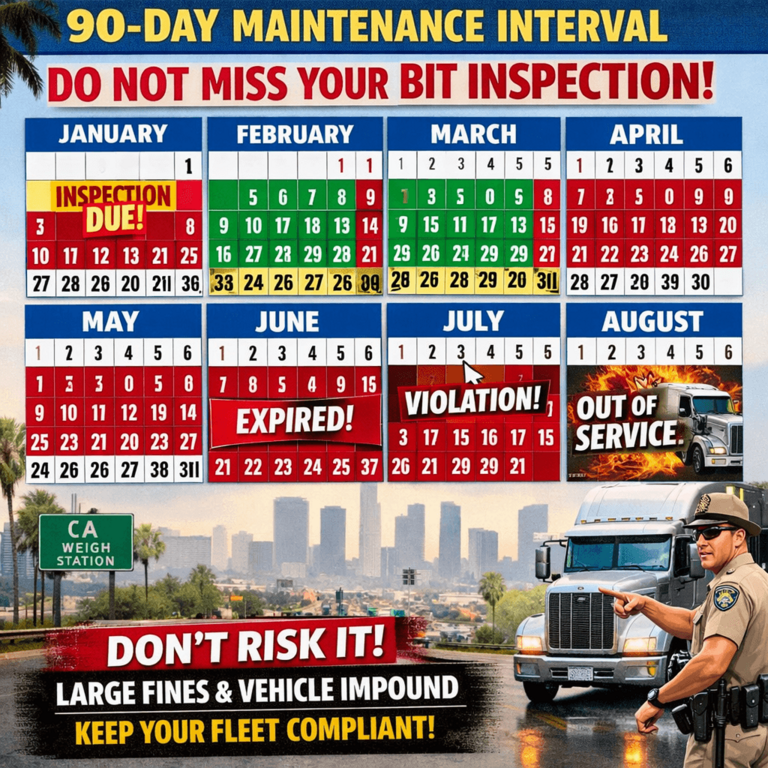
The absolute core of the BIT program is the 90-Day Mechanical Inspection. This is where 80% of fleets fail the audit before the officer even looks at a truck.
The law says every regulated vehicle (trucks AND trailers) must have a documented mechanical inspection every 90 days. Not 91 days. Not "when we had time." Not "it was parked in the yard."
The "Gap" Mistake (Real World Example)
Let's say you inspected a truck on January 1st. By law, the next one is due April 1st.
If you perform the inspection on April 5th, the CHP officer will circle that 4-day gap in red ink. Do that three or four times across your fleet history, and you are looking at a pattern of non-compliance. That leads to a failed audit.
Crucial Detail: If a truck is not being used, you must explicitly mark it "Out of Service" (OOS) in your records before the 90-day deadline expires. If you don't, the CHP assumes it was available for dispatch, and you are in violation.
Need the official form? Don't use a napkin. Download our Free BIT Inspection Form Template here to make sure you're covering the required brake and steering components.
5. The "Red Book" Check: What Officers Actually Look For
When the CHP Motor Carrier Specialist (MCS) arrives at your terminal, they usually follow a script based on the "Red Book" (Safety Compliance Manual). They aren't guessing; they are checking specific boxes.
The Big Three Documents You Must Have Ready:
- Maintenance Records (24 Months): You need to show lube, oil, and filter services, plus every repair ticket. If you bought a brake chamber, show the invoice AND the work order where it was installed. Missing the invoice? That's a problem.
- Driver Vitals (DMV Pull Notice): Are you enrolled in the EPN (Employer Pull Notice) program? If a driver got a DUI last weekend in their personal car, and you didn't know because you aren't enrolled, that's a violation. The CHP will check your current driver roster against the DMV database instantly.
- Daily DVIRs (90 Days): They want to see the daily Driver Vehicle Inspection Reports for the last 3 months. They will cross-reference these against your repair orders. If a driver noted "worn tires" on Monday, and there is no repair order for tires until Friday, why did the truck run on Tuesday, Wednesday, and Thursday?
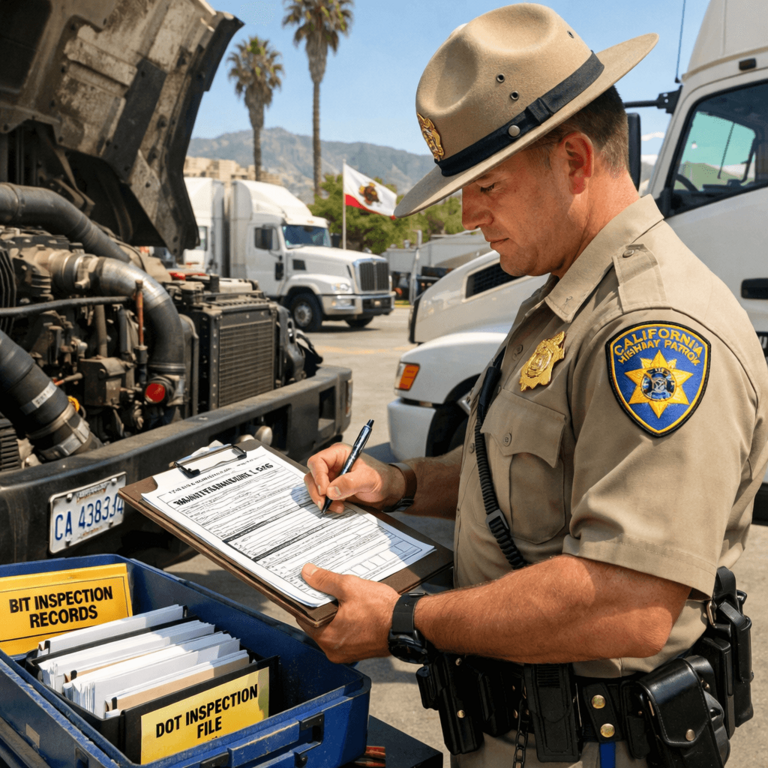
6. Decoding the Forms: CHP 362 vs. CHP 800
To pass a BIT inspection, you need to speak the language. There are two specific CHP forms that confuse fleet managers constantly.
CHP 362: The Driver's Hours
This relates to the drivers' time records. Even if you run local and use timecards instead of ELDs (Electronic Logging Devices), you must maintain true and accurate records of duty status.
Common Mistake: The CHP 362 form (or an equivalent software report) tracks total hours. The most common failure is applying Federal rules to California intrastate drivers. California allows 12 hours of driving in a 16-hour window, whereas Federal law is 11 in 14. If you mix these up on your timesheets, the officer will flag it as a violation of Title 13 CCR.
CHP 800: The Accident Register
Many fleets fail because they don't have this. You are required to maintain an "Accident Register" (CHP 800 form) for 3 years. Even if you have had zero accidents, you must have the file open and available to show the officer. A missing accident register suggests you are hiding something.
7. The "24-Hour Panic" Checklist (Pre-Audit)
If you get the call that the CHP is coming tomorrow, don't panic. Use this checklist to organize your terminal.
- Clean the Yard: Officers will walk your yard. If they see puddles of oil or tires with cords showing on parked trucks, the audit starts badly. Mark any broken trucks "Out of Service" with a physical tag immediately.
- Driver Roster Update: Ensure your driver list is current. If you fired "Bob" two months ago but he is still on the active roster you show the CHP, they will ask for his recent drug tests. Remove terminated drivers from the active list.
- The "Bad Apple" File: If you know one truck has terrible maintenance records, be prepared. Do not hide it, but have the repair orders ready that show you eventually fixed the problems. Showing "corrective action" is better than showing nothing.
8. "Pencil Whipping" Will Get You Criminally Charged
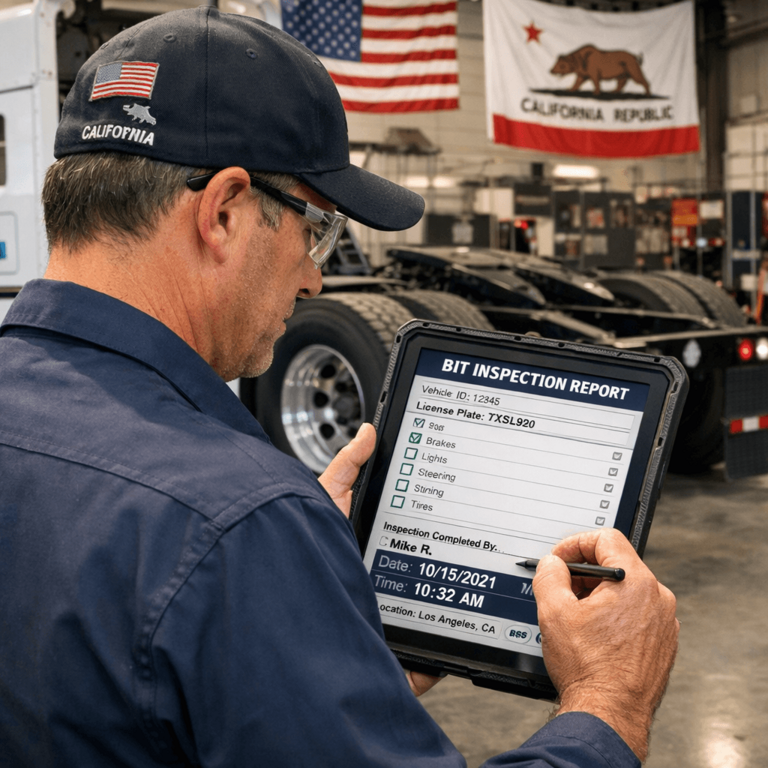
We see this scenario all the time. A fleet manager realizes an audit is coming next week, so they sit in the back office on a Saturday and furiously fill out 6 months of "90-day" inspections in one afternoon. They think they are saving the company.
The CHP knows. And they will catch you.
Here is how they spot fake records:
- Identical Penmanship: Did the "mechanic" use the exact same blue pen for inspections allegedly done in March, June, and September?
- The "Clean Paper" Test: Real paper forms that have been in a shop get greasy fingerprints, folded corners, and dust. Pristine, crisp white paper for a 6-month-old inspection is immediately suspicious.
- Mileage Logic: Did you record the mileage on the inspection form? Does it match the fuel logs and the driver's logbook for that exact day? If the inspection says 100,000 miles, but the fuel receipt from the same day says 102,000 miles, you are busted.
If they catch you falsifying records (California Vehicle Code 34501.12), the fines go from "expensive" to "criminal." It is fraud. Just don't do it.
9. The Digital Secret Weapon (Why Smart Fleets Switch)
The easiest way to pass a BIT inspection is to stop using paper altogether. In 2026, the CHP is very comfortable with digital records—in fact, they prefer them.
When you use software like PTI4YOU, the "Gap Mistake" is effectively impossible. The system alerts you 10 days before a 90-day inspection is due. It alerts you again at 5 days. It annoys you until you do it. It tracks the mileage automatically.
More importantly, it creates an "Audit Mode" profile. When the officer sits at your desk and asks for records for "Truck #402," you don't dig through dusty boxes. You type in "402" and hit print. You hand them a clean, chronological PDF of every inspection, repair, and DVIR for that specific unit. Officers love this because it makes their job faster. A happy officer is a lenient officer.
10. The 5 Most Common Immediate Failures
Based on recent 2025-2026 audit data, here are the top 5 reasons fleets get an "Unsatisfactory" rating immediately:
- Brake Adjustment: During the terminal inspection, the officer will crawl under a sample of your trucks. If 20% of your fleet has brakes out of adjustment, it’s an automatic failure.
- Missing Driver Pulse Check: Failure to enroll a new driver in the DMV Pull Notice program within 10 days of hiring.
- The "Deferred" Repair: A driver noted a "Check Engine Light" on a DVIR three weeks ago, and there is no record of a mechanic looking at it.
- Expired Medical Certs: A driver's medical card expired, and they drove a load the next day.
- Unauthorized Mechanics: The person signing your 90-day inspections isn't qualified or didn't sign the form.
11. Understanding the CSAT Score Formula
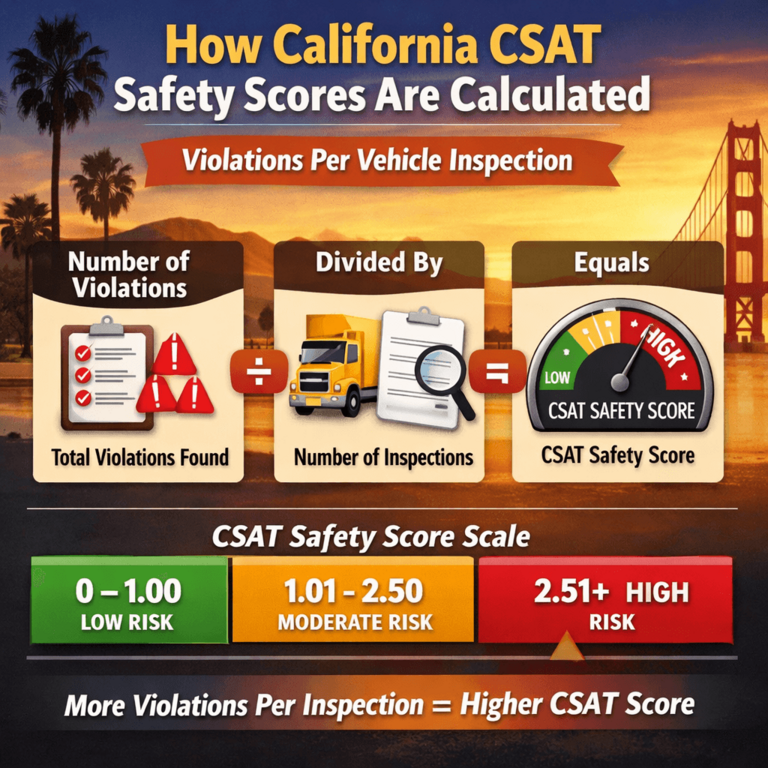
Before the audit happens, check your CSAT (Carrier Safety Assessment) score. This is not like a school test where 90% is an A. In the CSAT world, lower is better.
The score is calculated based on violations per inspection. If your Maintenance Score is above 20%, you are in the "Unsatisfactory" zone. This means if the CHP inspects 10 trucks and finds serious violations on 2 of them, you are already failing. Knowing your score before the officer arrives tells you how much leeway you have.
12. What Happens If You Fail? (The "Imminent Danger")
Getting an "Unsatisfactory" rating isn't just a slap on the wrist. It triggers a chain reaction:
- MCP Suspension: The CHP alerts the DMV to suspend your Motor Carrier Permit. No permit = no trucks on the road legally.
- Insurance Drop: Your insurance provider will see the rating and likely drop your coverage or double your premiums.
- Broker Blacklist: Most major brokers (CH Robinson, TQL, etc.) monitor safety scores. They will block your fleet from booking loads instantly.
13. FAQ: Common BIT Questions
What is a BIT inspection in California?
The Basic Inspection of Terminals (BIT) is a mandatory program by the California Highway Patrol (CHP) requiring commercial fleet operators to inspect their vehicles every 90 days and maintain strict maintenance records.
Is a 90 day bit inspection form free printable compliant?
Yes, a paper form is legally compliant, but managing multiple paper forms increases the risk of lost records and CHP fines. Moving to affordable electronic inspection systems for DOT compliance is highly recommended.
Do trailers need 90-day inspections too?
Yes. Any trailer or semi-trailer is subject to the same BIT maintenance intervals as the truck. Don't forget your dollies if you run doubles.
How long do I keep BIT records?
California requires maintenance records to be kept for 24 months. Daily DVIRs need to be kept for 90 days (unless a defect was found and repaired, then keep it longer to be safe).
Can I do the inspection myself?
Yes, if you are qualified. You don't need an outside shop, but the person signing the form must understand brake adjustments and safety components. If you miss a brake issue and that truck crashes, the liability is on you.
Is the BIT program different from the DOT audit?
Yes. The DOT (Federal) audit focuses heavily on Hours of Service and drug testing. The BIT (California) inspection focuses heavily on the mechanical condition of the vehicles and the maintenance records. You need to be ready for both.
What is a passing CSAT score?
A CSAT score is not pass/fail like a test, but rather a risk assessment. A score of 20% or higher in any category (Maintenance, Driver, etc.) is considered Unsatisfactory and can lead to MCP suspension. A score of 0-19% is satisfactory.
14. Final Advice: Be Boring
The goal of fleet maintenance is to be boring. You want predictable costs, predictable inspections, and boring audits where the officer looks at your clean files, nods, and leaves in an hour.
Excitement usually means fines.
If your filing cabinet is a mess of grease-stained papers, it's time to modernize. Switch to a digital system that tracks the 90-day clock for you and keeps the CHP happy.
Pass Your Next BIT Audit with Confidence
Stop worrying about the 90-day calendar. Let PTI4YOU track it for you.