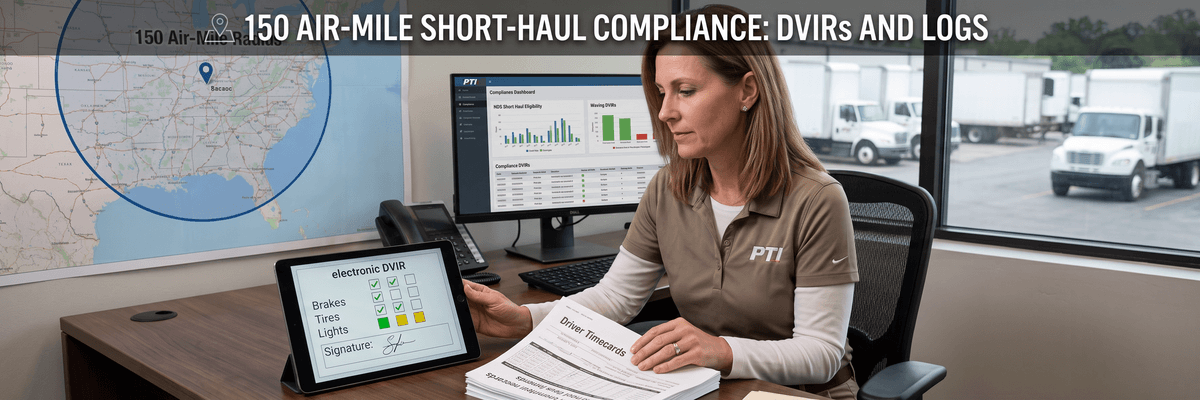
The Bottom Line Up Front: The 150 air-mile short-haul exemption does not eliminate daily vehicle inspection or DVIR compliance. It only relieves qualified drivers from keeping a full Record of Duty Status (RODS) with an ELD under 49 CFR Part 395. A short-haul carrier must still prove the driver met the exemption that day, keep required time records for six months, and maintain defensible inspection records under 49 CFR Part 396.
Key Takeaways
- Short-haul exemption is not a paperwork exemption: The 150 air-mile exception may remove the full ELD-based RODS requirement, but it does not erase DVIR, inspection, repair, or maintenance duties.
- Eligibility is day-by-day: A driver must stay within the radius, return to the normal work reporting location, be released within 14 consecutive hours, and have supporting time records.
- Time records must be retained: Carriers claiming 49 CFR §395.1(e)(1) must keep accurate short-haul time records for six months.
- Local fleets need proof: A defensible daily packet ties together the timecard, route evidence, inspection record, and defect resolution history.
- eDVIR plus digital timecards close the gap: PTI4YOU helps short-haul fleets prove inspection and exemption status without proprietary ELD hardware.
If your local fleet operates box trucks, service trucks, construction vehicles, beverage routes, municipal contractor units, or regional delivery equipment, the key question is not simply, "Are we ELD-exempt?" The better question is, "Can we prove why we were ELD-exempt on the day an officer, auditor, insurer, or attorney asks?"
This article explains what the federal short-haul exception actually covers, how the 150 air-mile radius log requirements work in daily operations, why "ELD-exempt" is not the same as "recordkeeping-exempt," and how an eDVIR plus digital timecard workflow can help a local fleet stay audit-ready without paying for ELD hardware it may not need.
What the 150 Air-Mile Short-Haul Exemption Actually Covers
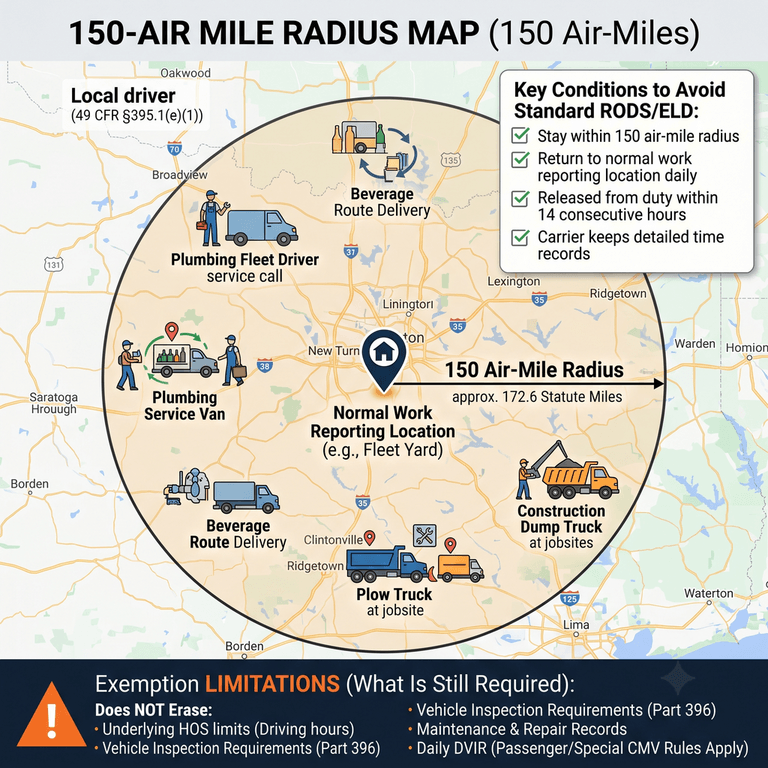
The 150 air-mile short-haul exemption under Title 49 CFR §395.1(e)(1) covers only a driver's obligation to maintain a standard RODS log when every short-haul condition is met. In plain English, a qualified local driver can avoid the traditional logbook grid and ELD requirement for that day if the driver stays local, returns to the normal work reporting location, is released from duty within 14 consecutive hours, and the carrier keeps the required time records.
In practical FMCSA hours of service short haul terms, the exception changes how the driver documents the day; it does not change the carrier's responsibility to prove the day qualified. The driver still has a duty status, a work reporting location, a release time, and a vehicle that must be inspected and maintained.
The exemption exists because many local drivers do not operate like over-the-road drivers. A plumbing fleet driver may leave the shop at 7:00 a.m., work service calls across one metro area, return to the same shop at 4:30 p.m., and go home. A beverage route driver may run the same regional delivery loop every day. A construction fleet may dispatch dump trucks from the same yard to nearby jobsites. FMCSA allows these operations to use simpler time records instead of full RODS when the regulation's conditions are satisfied.
The relief is narrow. The short-haul exception is an hours-of-service recordkeeping exception in Part 395. It does not erase the underlying hours-of-service limits, and it does not erase inspection, repair, and maintenance obligations in Part 396. Drivers still need to inspect vehicles. Carriers still need to control defects. If a reportable defect is found, it must be documented and handled correctly. Passenger-carrying CMVs have stricter daily DVIR reporting rules, and state, provincial, customer, or company policies may require a no-defect report even when federal property-carrier rules do not.
That distinction is where many local fleets get hurt. A driver can be perfectly correct that they do not need an ELD for a given local shift, while the carrier is still unable to prove the exemption or produce a credible inspection record. Roadside officers and auditors are not asking whether the fleet bought an ELD subscription. They are asking whether the fleet can prove compliance.
The Eligibility Criteria, Step by Step
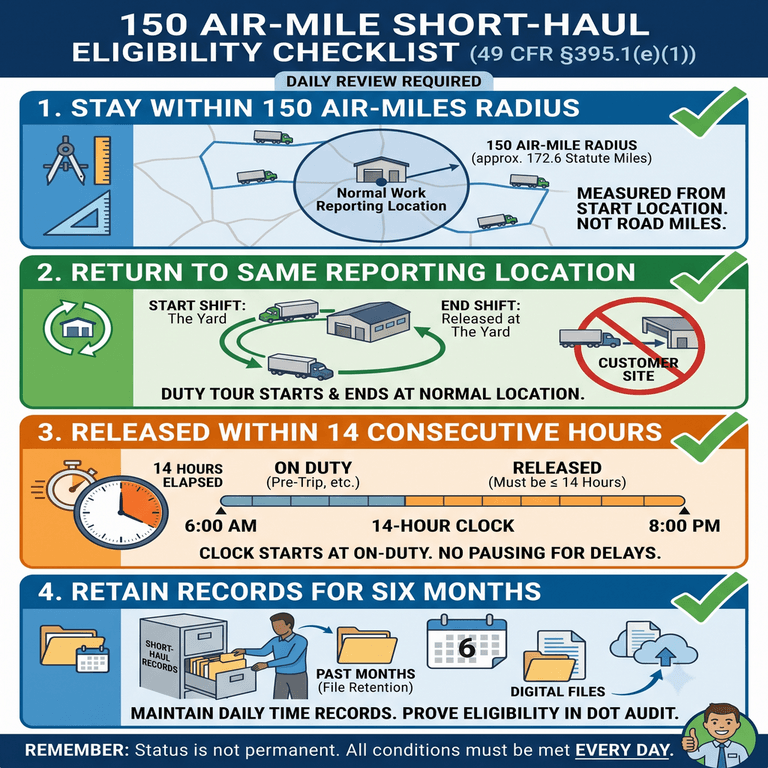
A carrier may claim the 150 air-mile short-haul exemption only when the driver meets every condition in 49 CFR §395.1(e)(1) for that specific day. Exemption status is not a permanent label attached to a truck, driver, or company. It is a day-by-day conclusion supported by records.
Exemption Eligibility At a Glance
| Eligibility Item | What FMCSA Requires | What the Carrier Should Be Able to Prove |
|---|---|---|
| Operating radius | The driver operates within a 150 air-mile radius of the normal work reporting location. | Routes, dispatch records, job tickets, geofenced timecards, or other records show the driver stayed within the permitted radius. |
| Same work reporting location | The driver returns to the normal work reporting location at the end of the duty tour. | The shift starts and ends at the same yard, terminal, branch, shop, or other normal reporting location. |
| 14-hour release | The driver is released from work within 14 consecutive hours after coming on duty. | Time records show the exact on-duty start time, release time, and total hours for the shift. |
| Time records | The motor carrier maintains accurate time records instead of requiring a RODS log. | Records show duty start, duty release, total daily hours, and required prior 7-day on-duty time for first-time or intermittent drivers. |
| Record retention | The carrier retains the short-haul time records for six months. | Back-office staff can retrieve six months of records quickly during a DOT audit or compliance review. |
1. The driver must stay within the 150 air-mile radius.
The 150 air-mile radius is measured from the driver's normal work reporting location, not from the driver's home, the first delivery stop, or the farthest customer on the route. One air mile is a nautical mile, so 150 air miles equals about 172.6 statute miles. This is not a 150-road-mile rule. The practical test is whether the driver stayed within the allowed straight-line radius from the reporting location.
For most local fleets, the radius is easy to respect but hard to prove after the fact if records are scattered. A dispatcher may know the driver stayed in the territory, but an auditor needs records. Route sheets, work orders, dispatch history, jobsite addresses, GPS breadcrumbs, and digital timecard location data can all help support the claim that the driver met the radius condition.
2. The driver must return to the normal work reporting location.
The driver must return to the normal work reporting location and be released from duty there. A driver who starts at the main yard, ends at a customer's facility, and leaves the truck at a different branch has a problem unless another exception applies. The short-haul rule is built around a local duty tour that starts and ends at the same normal reporting location.
This matters for regional distribution hubs with satellite yards, construction companies with temporary jobsites, and contractors that let drivers take vehicles home. A carrier should define the normal work reporting location clearly and train dispatchers not to break the exemption with casual one-off instructions.
3. The driver must be released within 14 consecutive hours.
The 14-hour window starts when the driver comes on duty, including time spent doing a pre-trip inspection, fueling, loading, attending a safety meeting, or waiting at the yard. Lunch, traffic, customer delays, and repair downtime do not pause the 14-hour clock. The driver must be released from duty within 14 consecutive hours after the shift starts.
This is one of the most common operational failure points for local fleets. A driver can remain inside the 150 air-mile radius all day and still lose the exemption because a late customer, weather delay, breakdown, or dispatch change pushes the shift past the 14-hour release limit.
4. The carrier must keep accurate time records for six months.
The short-haul exception works only if the carrier keeps accurate time records. Under 49 CFR §395.1(e)(1), the motor carrier must maintain records showing the time the driver reports for duty each day, the time the driver is released from duty each day, and the total number of hours the driver is on duty each day. For drivers used for the first time or intermittently, the carrier must also account for the driver's total time on duty during the preceding seven days as required by the hours-of-service rules.
A short haul exemption log template can be a starting point, but a template is only as strong as the process behind it. If the form is incomplete, illegible, missing release times, missing total hours, or stored in a binder nobody can find during an audit, it will not protect the carrier well.
The Local Compliance Trap
The local compliance trap is the false belief that ELD exemption equals compliance exemption. Short-haul drivers may be relieved from ELD-based RODS, but local fleets remain subject to safety inspection, vehicle maintenance, defect correction, hours-of-service, qualification, and recordkeeping obligations that can be tested at the roadside or during a DOT audit.
The misunderstanding often starts innocently. A small fleet owner hears that drivers operating inside 150 air miles do not need ELDs. Dispatchers then stop thinking in terms of logs, time records, and inspection documentation. Drivers get used to saying, "I am short-haul exempt," as if that sentence answers every compliance question an officer can ask.
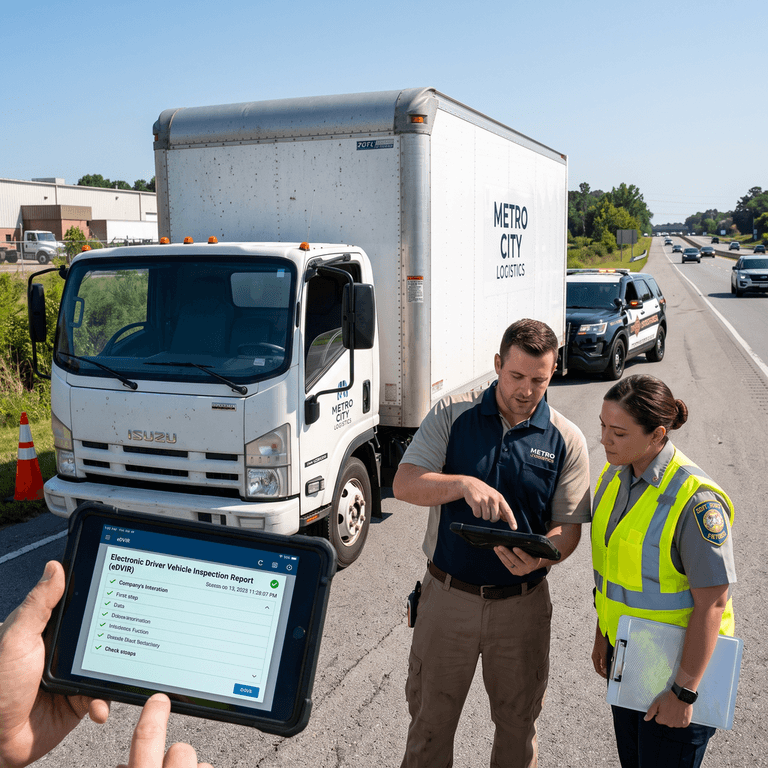
It does not. At a roadside inspection, the officer may ask why the driver is not using an ELD. The driver may properly explain that they operate under the short-haul exception. The next question can be about time records, vehicle inspection status, defects, repair documentation, registration, medical card status, cargo securement, or any other applicable requirement. An exemption from one type of logbook does not create immunity from the rest of the Federal Motor Carrier Safety Regulations.
Do Box Trucks Need DVIR?
Box trucks need DVIR and inspection compliance when they are commercial motor vehicles covered by FMCSA or applicable state/provincial rules. In U.S. interstate commerce, a vehicle is generally treated as a CMV under FMCSA rules when it has a GVWR, GCWR, gross vehicle weight, or gross combination weight of 10,001 pounds or more, is designed or used to transport passengers in regulated quantities, or transports hazardous materials requiring placards.
That means many local box trucks, step vans, utility trucks, and medium-duty service vehicles are not "just local trucks" from a compliance standpoint. A 16-foot or 26-foot box truck used commercially can easily cross the 10,001-pound threshold. Once the vehicle is a CMV, the carrier needs a real inspection and maintenance process even if the driver never leaves the metro area.
There is an important Part 396 nuance. For property-carrying CMVs, federal rules generally require a written or electronic post-trip DVIR when the driver discovers or is made aware of a defect or deficiency. Passenger-carrying CMVs must complete DVIRs daily even when no defect is found. Many carriers still require no-defect eDVIRs every day because a daily, timestamped inspection record is much easier to defend than a claim that "nothing was found" with no supporting proof. Canadian and provincial trip inspection requirements can also be more prescriptive for fleets operating north of the border.
The practical risk is simple: if a local delivery truck is stopped with a bald tire, inoperative lamp, air leak, brake issue, cracked mirror, missing emergency equipment, or other visible defect, the officer will not care that the route was local. The officer will look at the vehicle condition and the carrier's inspection process. If the defect should have been caught, documented, or repaired, the fleet can face violations, out-of-service orders, Vehicle Maintenance BASIC impact, and follow-up scrutiny.
The same issue becomes more serious after a crash. Post-incident investigations often focus on whether the vehicle was inspected, whether a defect was known, whether maintenance records were complete, and whether the carrier had a functioning safety process. A local fleet that cannot produce inspection and repair records is left relying on memory after the fact. That is a weak position in an audit, an insurance review, or litigation.
For a practical daily process, pair the short-haul timecard with a local truck driver compliance checklist and a documented inspection workflow. The goal is not paperwork for its own sake. The goal is a record that shows the driver inspected the vehicle, defects were captured, repairs were handled, and the fleet had control over its safety obligations.
How to Keep Time Records and Prove Exemption Status Without an ELD
Carriers can prove short-haul exemption status without an ELD by maintaining accurate daily time records and supporting route evidence that shows the driver met the 150 air-mile, same-location, and 14-hour conditions. FMCSA does not require a full ELD subscription simply because a carrier needs short-haul records. It requires the carrier to keep records that prove the exception was valid.
At minimum, a defensible short-haul record should show the driver's name, vehicle or unit number, normal work reporting location, duty start time, duty release time, total on-duty hours, date, and any supporting notes needed to explain the route or exception. For intermittent or first-time drivers, the carrier also needs prior seven-day on-duty information so the driver does not accidentally violate cumulative HOS limits.
Many fleets begin with a short haul exemption log template because it is familiar and inexpensive. A paper template can be legal if it is accurate, complete, retained, and retrievable. The problem is operational reliability. Paper timecards can be filled out late, rounded casually, lost in trucks, damaged by weather, or filed under the wrong driver. Manual math can make a 13.9-hour day look compliant when the actual release time crossed 14 hours.
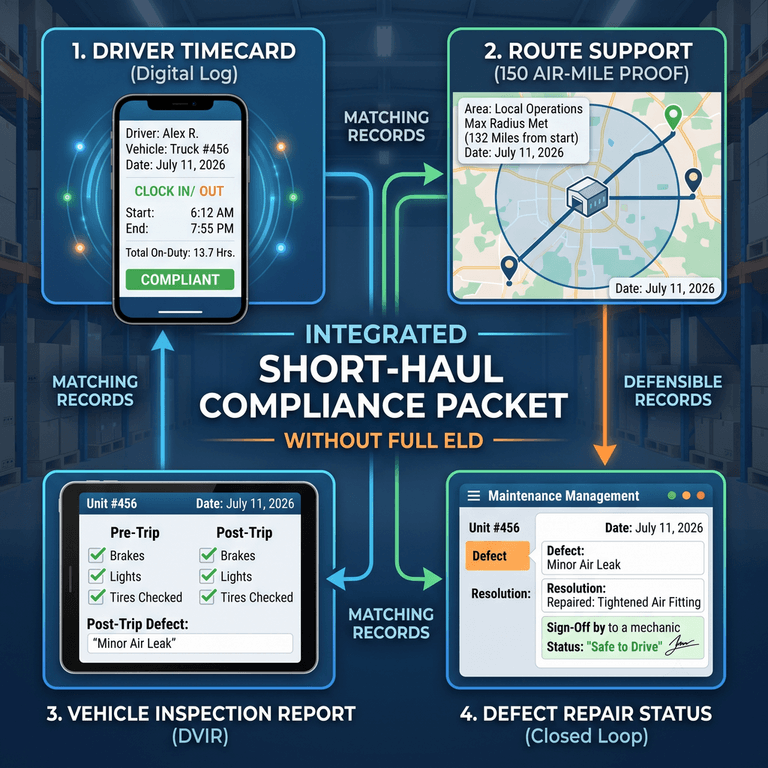
A better process is to treat short-haul proof as a daily compliance packet. The time record proves the driver stayed within the 14-hour release window. Dispatch or route records support the 150 air-mile radius. The inspection record shows the vehicle safety process happened. Repair documentation closes the loop when defects are found. Together, those records tell a coherent story during a DOT audit: this driver qualified for the exception, this vehicle was inspected, and this carrier had a controlled process.
For mobile local fleets, digital timecards are usually enough to remove most of the failure points without forcing the fleet into full ELD hardware. A driver clocks in on a phone at the yard, completes the inspection workflow, runs the route, reports defects if needed, and clocks out when released. The back office gets timestamps, driver identity, vehicle identity, and searchable records without sorting paper at the end of the week.
What should a short-haul compliance packet include?
A short-haul compliance packet should include the time record, route support, vehicle inspection record, and defect resolution history for the same driver, vehicle, and date. This does not need to be a complex binder. It needs to be a consistent record trail that a safety manager can retrieve quickly and explain clearly.
For a local delivery fleet, that packet might include the driver's digital clock-in at the warehouse, the assigned route or work orders, the completed pre-trip inspection, any post-trip defect report, the driver's clock-out at the same warehouse, and the total hours calculated for the day. For a construction fleet, it might include the yard clock-in, truck inspection, jobsite dispatch ticket, return-to-yard release time, and repair note if the driver found a tire, light, brake, coupling, or hydraulic issue.
The compliance value comes from matching records. If the timecard says the driver started at 6:12 a.m., the inspection record should not say the vehicle was inspected at 8:45 a.m. after the route started. If the driver reported a defect at the end of the shift, the maintenance record should show whether the vehicle was repaired, placed out of service, or reviewed before the next dispatch. Short-haul fleets do not fail audits because they lack fancy technology. They fail when the records do not line up.
That approach also works for fleets comparing ELD-heavy systems after searching for phrases such as "keeptruckin short haul logging." A short-haul fleet may still choose an ELD platform for broader telematics needs, but the compliance question should come first: if the fleet does not legally need ELDs for most daily routes, it should not have to buy proprietary hardware just to create timecards and inspection records.
What Happens If a Driver Exceeds the 14-Hour Limit
If a short-haul driver exceeds the 14-hour daily on-duty limit, the driver loses the 49 CFR §395.1(e)(1) short-haul exception for that day and must complete a standard RODS log for the entire duty period. The driver does not get to ignore the overage because the route was local, and the carrier should not try to fix the issue by changing the timecard after the fact.
Operationally, this means dispatch needs a fallback process before the exception is broken. If the driver is approaching the 14-hour release limit, the dispatcher may need to reassign stops, send another driver, bring the driver back to the reporting location, or prepare for the driver to complete a paper log. Waiting until the next morning to discover that a driver worked 14 hours and 20 minutes turns a manageable operations issue into a compliance record problem.
When the exception is lost, the RODS should cover the whole day, not just the portion after the 14-hour mark. The driver must account for duty statuses from the beginning of the shift. If the carrier uses ELDs for some vehicles, the driver may transition to the carrier's ELD process when required. If the driver is operating under the short-haul exception only occasionally exceeding it, paper RODS may be enough for that day.
The "8 days in 30" rule is the limit that prevents fleets from treating paper logs as a routine workaround. Drivers who are required to prepare RODS on more than eight days in any rolling 30-day period generally become subject to the ELD requirement. This is why local fleets should monitor exception breaks by driver, not just by truck. A driver who handles overflow regional runs, emergency service calls, or occasional out-of-radius routes can quietly cross the threshold if nobody is tracking the pattern.
A clean digital timecard system helps managers see the risk before it becomes a citation. If a driver's clock is approaching 14 hours, the system can make the issue visible. If a driver breaks the exception, the carrier can flag that day, collect the needed RODS, and count it toward the rolling 30-day ELD threshold.
The eDVIR Solution: Proving Compliance Without the ELD Price Tag
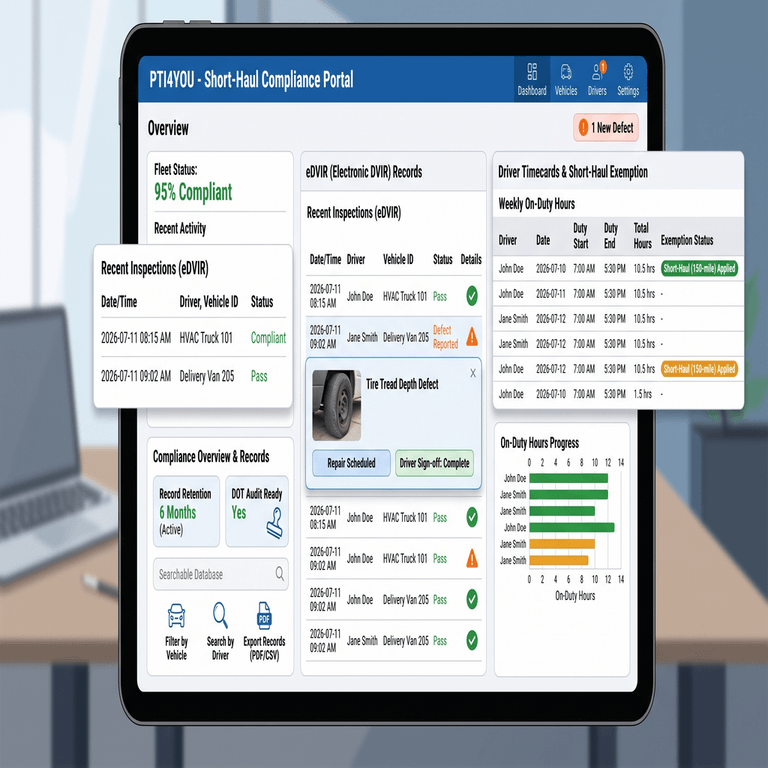
An eDVIR and digital timecard system gives short-haul fleets a practical way to prove compliance without buying full ELD hardware for vehicles that do not need it. The right workflow does not try to turn a local service fleet into an over-the-road telematics operation. It captures the records a local fleet actually needs: inspection completion, defect reporting, repair status, driver sign-off, duty start, duty release, and total on-duty hours.
This is where PTI4YOU fits the short-haul use case. PTI4YOU is built for small and mid-sized fleets that want audit-ready DVIR and DOT compliance records without proprietary hardware, multi-year lock-in contracts, or an enterprise telematics stack they may not use. Drivers can use their own phones or tablets, and managers can review records from the back office.
How does BYOD help short-haul compliance?
BYOD helps short-haul compliance by letting drivers complete required inspection and timecard tasks on devices they already carry. For a 10-truck HVAC fleet, a 25-unit landscaping contractor, or a 40-vehicle regional delivery operation, the difference is practical: no hardware installation schedule, no truck downtime for device mounting, and no need to equip every local unit with an ELD simply to collect inspection and time records.
How do digital timecards support 49 CFR §395.1(e)(1)?
Digital timecards support 49 CFR §395.1(e)(1) by recording the driver's duty start time, release time, and total on-duty hours in a consistent, searchable format. That directly supports the records a carrier must retain for six months to prove the short-haul exception. When managers can see total hours by driver and day, they can also catch routes that are drifting toward the 14-hour limit.
How does eDVIR support Part 396 inspection readiness?
eDVIR supports Part 396 inspection readiness by creating a timestamped inspection and defect record tied to the driver and vehicle. If a defect is found, photos, notes, repair status, and driver review can stay in one digital chain. When a roadside officer asks about a light, tire, brake, coupling device, or other safety item, the driver and manager are not searching through paper books or text messages.
The commercial value is straightforward. Local operators should not have to choose between expensive ELD subscriptions they may not need and paper records that fall apart under pressure. PTI4YOU gives short-haul fleets a focused electronic DVIR system with digital timecards, transparent pricing, and no proprietary hardware requirement. The result is a cleaner daily workflow for drivers and a more defensible compliance file for managers.
Frequently Asked Questions (FAQ)
Does the 150 air-mile short-haul exemption relieve drivers of completing daily DVIRs?
No, the 150 air-mile short-haul exemption does not relieve drivers or carriers of daily vehicle inspection and DVIR obligations under 49 CFR Part 396. The exemption may remove the need for a full Record of Duty Status through an ELD, but drivers must still inspect the vehicle, document defects when required, and carriers should keep a defensible daily inspection record.
What happens if a short-haul driver exceeds the 14-hour daily on-duty limit?
If a short-haul driver exceeds the 14-hour daily on-duty limit, the driver loses the 49 CFR §395.1(e)(1) exception for that day and must complete a standard Record of Duty Status, usually on paper unless the carrier uses an ELD. If the driver needs RODS on more than 8 days in any rolling 30-day period, the ELD mandate generally applies.
Do box trucks need a DVIR even if they are under 10,001 lbs?
A box truck generally needs FMCSA inspection and DVIR compliance when it is a commercial motor vehicle, such as a vehicle with a GVWR, GCWR, gross vehicle weight, or gross combination weight of 10,001 pounds or more in interstate commerce. A lighter box truck may fall outside federal CMV rules unless it hauls placarded hazardous materials or passengers, but state, Canadian, customer, and company policies can still require documented inspections.
What records prove a driver qualified for the short-haul exemption during an audit?
To prove a driver qualified for the short-haul exemption during an audit, the carrier must produce accurate time records retained for six months showing the driver's duty start time, release time, and total hours on duty for each day. The carrier should also be able to support the 150 air-mile radius and same work reporting location requirements with dispatch, route, job, GPS, or timecard records.
Can a fleet mix short-haul exempt drivers and ELD drivers?
Yes, a motor carrier can mix short-haul exempt drivers and ELD-required drivers within the same fleet. Exemption status is determined on a driver-by-driver, day-by-day basis, meaning a single driver could legally operate under the short-haul exemption on Monday and utilize an ELD for a long-haul interstate trip on Tuesday.
How long must short-haul time records be retained?
Motor carriers must retain the daily time records used to prove a driver's short-haul exemption eligibility for at least six months. Those records should show the driver's report time, release time, and total hours on duty for each day the exception is claimed.
Protect Your Short-Haul Exemption Status Today
Local fleets should not have to overbuy ELD hardware to prove a short-haul compliance posture, but they also cannot afford to rely on missing timecards, incomplete inspection books, or undocumented defect repairs. The safe middle ground is a simple daily system that proves the driver qualified for the exemption and proves the vehicle inspection process happened.
PTI4YOU gives small and mid-sized fleets a hardware-free way to collect eDVIRs, digital timecards, defect photos, repair updates, and searchable records. It is built for the operator who wants to survive a DOT audit and roadside inspection without turning a local fleet into a full telematics project.
Prove Your Short-Haul Compliance Posture
Stop relying on missing timecards and undocumented defect repairs. PTI4YOU pairs digital timecards with electronic DVIRs so short-haul fleets can prove exemption eligibility and inspection compliance in one searchable record.
Start your 15-day free trial today. No credit card required.
Start Your 15-Day Free Trial – No Credit Card RequiredZero setup fees. Zero hardware. 25-minute driver onboarding.