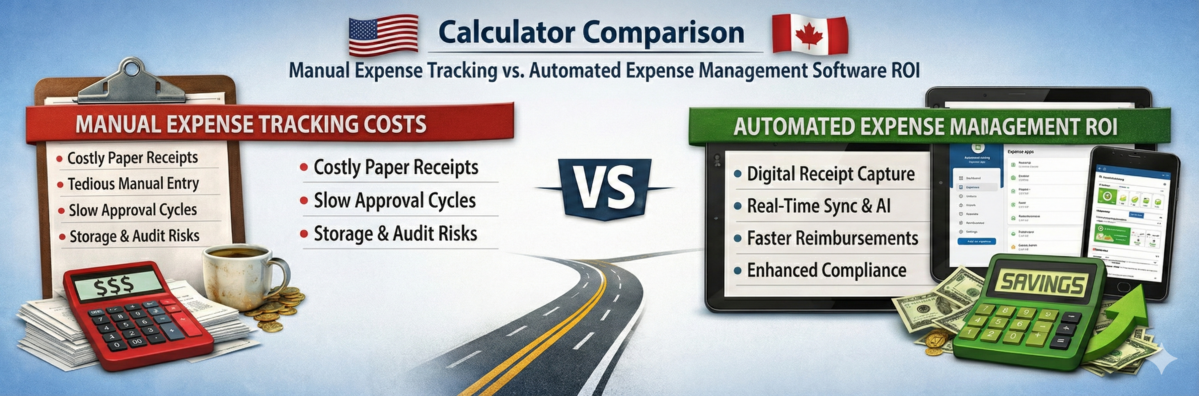
There is a dangerous myth in the trucking industry that persists even in 2026. It sounds like this:
"Why should I pay a monthly subscription for software when a paper DVIR book costs $5 at the truck stop?"
On the surface, the math seems simple. Paper is cheap. Software is an ongoing expense. But if you dig deeper into your Profit & Loss statement, a different story emerges. That $5 logbook is effectively an "iceberg cost." The price tag is just the tip; the massive costs of labor, storage, errors, and downtime are hidden beneath the surface.
In this guide, we are going to act as your CFO. We will strip away the marketing hype and look purely at the numbers. We will calculate the True Cost of Ownership (TCO) for paper vs. electronic DVIRs, specifically for small and medium fleets operating in the US and Canada.
1. The "Visible" Cost vs. The "Hidden" Labor

Let's start with the basics. Yes, paper forms are inexpensive to buy. But they are incredibly expensive to process.
The Admin Data Entry Tax
Every time a driver hands in a paper DVIR (Driver Vehicle Inspection Report), someone in your office has to touch it. In our experience working with fleets, the workflow usually looks like this:
- Driver rips out the white copy (often greasy or torn).
- Manager attempts to decipher handwriting (is that a "tire" issue or a "tarp" issue?).
- Manager manually types the defect into a spreadsheet or maintenance software.
- Manager files the physical paper in a cabinet for DOT retention.
The Cost: Even if this takes just 3 minutes per form, for a fleet of 20 trucks running 5 days a week, that is 5 hours of administrative labor every week. If you pay your admin $25/hour, you are spending $500+ per month just to move data from paper to computer.
With an electronic DVIR (eDVIR), this cost is $0. The data flows instantly from the driver's phone to your dashboard. (See how this works in our Reliable Software Guide).
2. The "Downtime" Cost: Reactive vs. Proactive
This is where fleets lose the most money. Paper is slow. In the logistics world, speed is currency.
Imagine a driver spots a frayed air line during a pre-trip inspection on Tuesday morning. On paper:
- He marks it on the form.
- The form stays in the truck cab until Friday when he returns to the terminal.
- The mechanic sees it Friday afternoon.
- The part isn't in stock.
- The truck sits idle all weekend and Monday waiting for parts.
The Real Cost: A truck sitting still earns $0. If that truck generates $1,000/day in revenue, that paper delay just cost you $2,000.
The Digital Advantage: With PTI4YOU, the driver snaps a photo of the air line on Tuesday morning. The mechanic gets an alert instantly. The part is ordered Tuesday afternoon and installed Friday night. The truck never misses a load.
3. The Risk Cost: Audits & "Pencil Whipping"
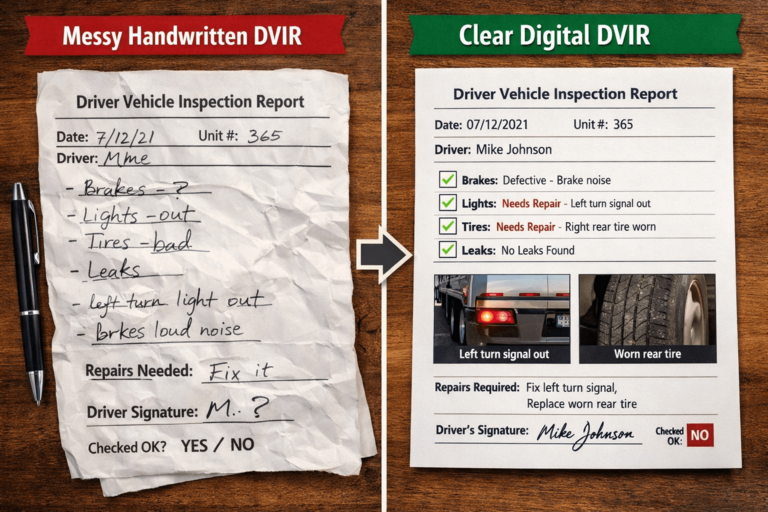
DOT officers and auditors are trained to spot "Pencil Whipping"—the act of a driver rapidly checking boxes without actually looking at the truck.
Paper Flaws:
- No Timestamps: A driver can fill out a week's worth of logbooks in the parking lot in 10 minutes. There is no proof of when it was done.
- Illegibility: If an auditor can't read it, it counts as a missing record.
- Missing Signatures: The "Mechanic's Certification" (required by FMCSA 396.11) is the most commonly missed step on paper forms.
⚠️ The Real Cost of Non-Compliance
It is not just about a generic "fine." According to the Uniform Fine Assessment (UFA) model used by the FMCSA, specific documentation errors carry heavy price tags in 2026:
- 396.11(b) - Failing to keep DVIR on file: Up to $1,388 per day, per violation.
- 396.11(c) - Failure to correct defects: Up to $16,864 for allowing a vehicle to operate with an unrepaired safety defect.
- 395.8(e) - False reports of records (Pencil Whipping): Criminal penalties and fines up to $13,900.
When you calculate "Paper vs. Electronic," you must factor in the insurance deductible you pay when a safety audit goes wrong.
4. The ROI Calculator: 20-Truck Fleet Case Study
Let's put actual numbers to this. We will compare a hypothetical fleet of 20 trucks over one year.
| Cost Category | Paper Method (Annual) | Electronic Method (Annual) |
|---|---|---|
| Materials (Books, pens, filing) | $600 | $0 |
| Admin Labor (Data entry/filing) Est. 5 hrs/week @ $25/hr |
$6,500 | $0 (Automated) |
| Software Subscription | $0 | ~$2,400* |
| Storage Costs (Cabinets/Space) | $200 | $0 (Cloud) |
| TOTAL ANNUAL COST | $7,300 + Risk | $2,400 |
*Note: Software pricing varies, but this estimate reflects typical small-fleet pricing models.
The Conclusion: Even paying for software, the digital route saves this fleet nearly $5,000 per year just in administrative efficiency. That doesn't even account for the money saved by preventing breakdowns or avoiding fines.
4a. The Hidden Cost of Storage
We listed "Storage" at $200 in the table, but that number hides a bigger obligation. FMCSA 396.11 requires carriers to retain DVIRs for at least one year, and the vehicle copy must be kept for the next driver. For a 20-truck fleet, that is thousands of sheets per year. You need filing cabinets, space, and a system to retrieve records when DOT or an auditor asks. Lose a folder, and you cannot prove compliance. With electronic DVIRs, records are stored in the cloud with automatic retention. Search is instant, and you never lose a form.
5. The "Switching Cost" Myth
So, if the math is so clear, why do fleets stick to paper? Fear.
Managers worry that drivers—especially veteran drivers—will struggle with technology. They worry about "training downtime."
This is where choosing the right software matters. As we discussed in our Small Fleet Guide, modern apps like PTI4YOU are designed with the "3-Click Rule." If a driver can send a text message or use Facebook, they can perform an inspection on our app. The training time is usually less than 15 minutes.
6. US vs. Canada: The Compliance Nuance
Another hidden cost of paper is keeping it up to date. Regulations change. A paper logbook printed in 2024 might not have the correct checklist items for 2026 regulations.
Expert Note on Cross-Border Fleets
If you operate in both the US and Canada, paper becomes a nightmare. Canada (NSC Standard 13) requires specific items on "Schedule 1" that aren't always on standard US FMCSA forms.
Electronic Benefit: Our software automatically detects which rules apply or provides a unified checklist that satisfies both FMCSA 396.11 and Canadian standards. You never have to worry if your driver is using the "wrong book."
7. Environmental Impact (The Bonus Benefit)
While profit is the priority, sustainability matters. A 20-truck fleet generates thousands of sheets of paper per year. Switching to digital isn't just cheaper; it reduces your carbon footprint. Many modern shippers are now asking carriers about their sustainability practices in RFPs. Being a "paperless fleet" can actually help you win business.
Frequently Asked Questions About DVIR Costs
Is a digital DVIR legally required for small fleets?
While the ELD mandate requires electronic logging devices for HOS, electronic DVIRs are not strictly mandatory for all—you can use paper. However, most small fleets switch to digital because it is the only reliable way to prove compliance with FMCSA 396.11 during an audit. Paper records often lack the required timestamp proof.
Can I just use a free PDF template?
Free PDFs save money on buying books, but they don't solve the storage or admin labor problem. You still have to print them, sign them physically, scan them back in, and store them. The labor cost remains the same as a logbook ($500+/month for a 20-truck fleet).
Does electronic software reduce insurance premiums?
Indirectly, yes. Many insurance providers offer better rates to fleets that can demonstrate a robust "Safety Management Plan." Using a digital system like PTI4YOU shows underwriters that you have a proactive maintenance culture, which can assist in negotiating renewals.
What happens if the app goes offline? Do I lose the data?
Reliable modern software uses "Store-and-Forward" technology. If a driver is in a dead zone, the inspection is saved locally on the device. As soon as the truck reaches a cell signal, the data uploads automatically. With paper, if a driver loses the book, that data is gone forever.
Final Verdict: Stop Paying the "Paper Tax"
The argument for paper DVIRs relies on looking only at the $5 purchase price. But as a business owner, you know that the most expensive tool is the one that wastes your time.
Electronic DVIRs offer:
- Lower Operating Costs: Save thousands in admin labor.
- Better Uptime: Fix defects faster with real-time alerts.
- Audit Confidence: Clean, legible, searchable records.
Calculate Your Own Savings
You don't need a spreadsheet to see the difference. Try PTI4YOU risk-free and see how much time your team saves in just one week.
$0 Setup. No Credit Card Required for Trial.