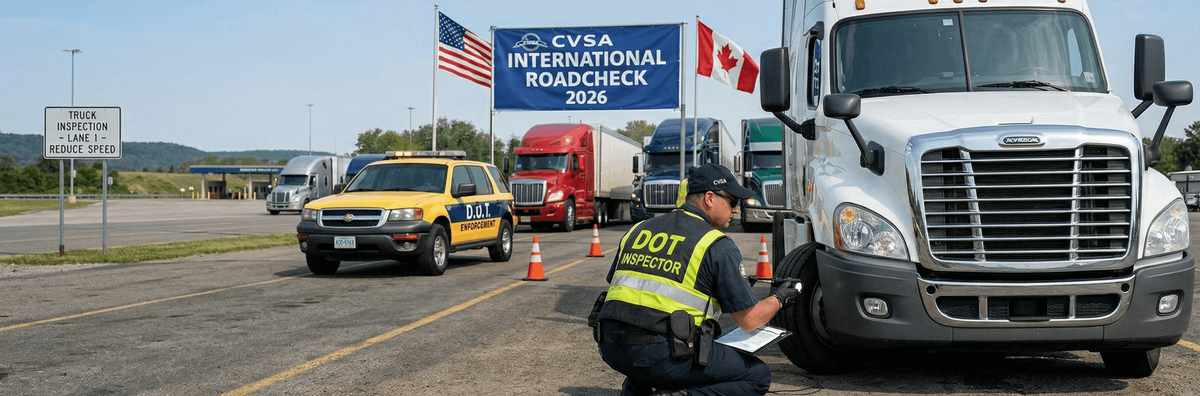
What is the 2026 CVSA International Roadcheck?
Every year, the Commercial Vehicle Safety Alliance (CVSA) orchestrates the largest targeted enforcement program on commercial motor vehicles in the world. Known as the International Roadcheck, this 72-hour high-visibility blitz takes place across the United States, Canada, and Mexico.
During these three days, an average of 15 commercial vehicles are inspected every minute. Inspectors are out in full force at weigh stations, border crossings, and roving patrols. For 2026, the CVSA has clearly delineated two primary focus areas: Hours of Service/ELD Compliance and Cargo Securement. If your fleet is caught off-guard in either of these categories, you face immediate Out-of-Service (OOS) violations, crippling downtime, and skyrocketing insurance premiums.
If you have been searching for the most reliable pre trip inspection software to ensure your fleet survives this audit unharmed, the time to upgrade your paper processes is now.
Key Takeaways: 2026 Roadcheck Strategy
- ELD Data Transfers: Inspectors will test your drivers' ability to electronically transfer log data via Web Services or Email. Ignorance of the device is an automatic violation.
- Cargo Securement: 50% Working Load Limit (WLL) rules will be rigorously enforced. Worn straps, missing edge protectors, and inadequate tie-downs will lead to immediate OOS orders.
- DVIR Synchronization: A robust electronic dvir system provides the exact timestamps and inspection trails that prove to an auditor that pre-trip cargo checks were legitimately performed.
Anatomy of a Level I Inspection
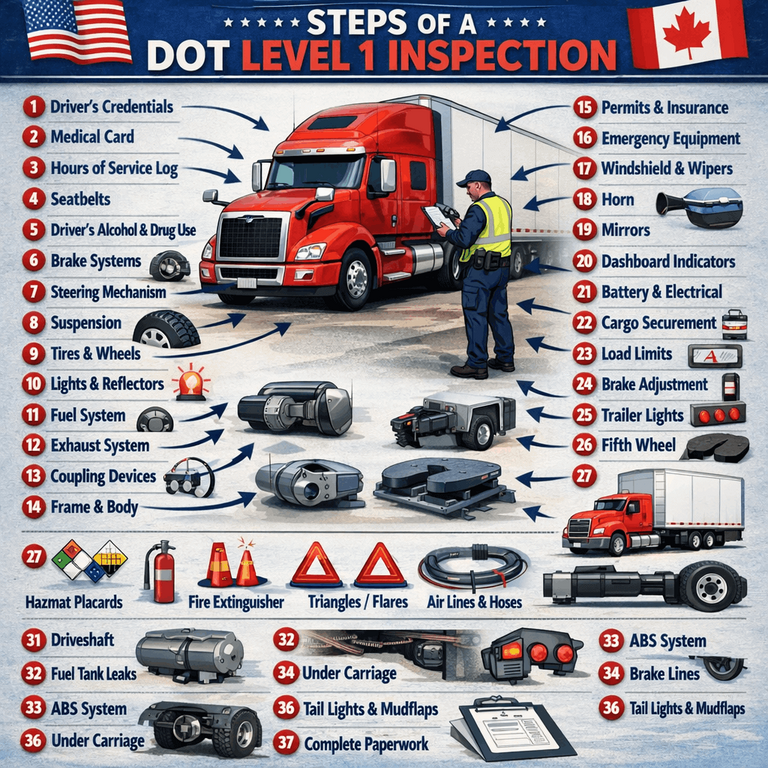
During the Roadcheck, the vast majority of stops will result in a North American Standard Level I Inspection. This is the most comprehensive inspection a commercial motor vehicle can undergo. It is a 37-step procedure encompassing both the driver's operating credentials and the mechanical fitness of the vehicle.
The inspector will approach the cab and request the driver’s commercial driver’s license (CDL), Medical Examiner’s Certificate, Record of Duty Status (ELD), and the most recent Driver Vehicle Inspection Report (DVIR). Once the paperwork is cleared, the inspector moves to the physical vehicle, checking the braking system, lighting devices, steering mechanisms, suspension, tires, and, crucially for 2026, how the cargo is tied down inside or on the trailer.
What Truck Components Are Inspected?
Fleet managers often ask which parts of the vehicle get the most scrutiny. During a Level I inspection, the inspector systematically checks these critical areas:
- Braking system: Pushrod travel, slack adjusters, air leaks, chafed hoses, brake chamber condition.
- Steering & suspension: Kingpins, ball joints, tie rods, springs, U-bolts, shock absorbers.
- Tires & wheels: Tread depth, sidewall damage, cuts, cracks, lug nut torque, rim condition.
- Lighting & reflectors: Headlights, turn signals, brake lights, clearance lamps, reflectors.
- Coupling devices: Fifth wheel, pintle hook, safety chains, slack in connections.
- Cargo securement: Tie-downs, WLL tags, edge protectors, load blocks (2026 focus area).
Level I vs II vs III: What's the Difference?
While the Roadcheck focuses on Level I inspections, drivers may also encounter Level II or Level III stops during the blitz or year-round. Understanding the differences helps fleet managers prepare their teams correctly.
- Level I (North American Standard): The most comprehensive. Full 37-step inspection of driver credentials and vehicle mechanical fitness. Includes driver documents, vehicle inspection, and cargo securement. This is what inspectors will typically conduct during Roadcheck.
- Level II (Walk-Around Driver/Vehicle): A scaled-down version. The inspector performs a walk-around inspection of the vehicle and checks driver documents. It does not require the inspector to go under the vehicle. Typically used when time or resources are limited.
- Level III (Driver-Only): Focuses solely on the driver. CDL, medical certificate, HOS records (ELD/RODS), and DVIR. No physical vehicle inspection. Often used at weigh stations or during traffic stops when the officer wants to verify driver compliance quickly.
If your driver is pulled over for a Level III during Roadcheck and the inspector finds a clean ELD and DVIR, they may upgrade to a Level I for a full vehicle check. That is why having both driver documents and vehicle condition in perfect order is non-negotiable.
Focus Area 1: ELD Compliance & Hours of Service
Hours of Service (HOS) violations consistently rank as the number one driver-related out-of-service violation year after year. The transition to Electronic Logging Devices (ELDs)—mandated by the FMCSA ELD rule—was supposed to eliminate logbook falsification, but it introduced a new set of technological compliance issues.
The 8-Day Paper Log Backup Rule: Carriers must maintain an 8-day supply of blank paper logs in every cab. Why? If an ELD malfunctions, the driver must immediately switch to paper and annotate the malfunction. The driver can operate for up to 8 days on paper while the carrier repairs or replaces the device. During Roadcheck, if an inspector asks for the paper backup and the driver cannot produce it, that is a violation. Ensure every truck has a sealed packet of blank RODS forms in the glove compartment or document holder.
What if the ELD Breaks During the Roadcheck? If the device physically fails mid-inspection—screen goes blank, won't power on, or cannot transfer data—the driver must annotate the malfunction on a paper log immediately. The inspector will expect to see the malfunction documented, the driver's attempt to use paper logs, and evidence that the carrier was notified. Drivers who panic and claim "it was working this morning" without proper annotation risk an OOS order. Train your drivers: malfunction = annotate, switch to paper, call dispatch.
During the 2026 Roadcheck, inspectors are trained to look for three specific ELD failures:
- Inability to Transfer Data: When an inspector asks a driver to transfer the ELD file via Telematic (Web Services/Email) or Local Transfer (USB/Bluetooth), the driver must know exactly which buttons to press. "I don't know how to do it, my dispatch handles that" is an immediate 395.24(d) violation.
- Unassigned Driving Time: Inspectors will pull the engine diagnostics. If the truck moved for 45 minutes on Sunday without a driver logged in, the current driver and the carrier are held liable for failing to annotate or assume that unassigned mileage.
- Missing Instruction Manuals: Drivers must have a physical or digital user manual, an instruction sheet for data transfer, an instruction sheet for ELD malfunctions, and an 8-day supply of blank paper logs in the cab.
How Electronic DVIRs Bridge the Gap with ELDs
Inspectors are no longer just looking at ELDs in isolation; they are cross-referencing them against your Driver Vehicle Inspection Reports (DVIRs). If a driver uses a paper DVIR and writes down that their pre-trip inspection took place at 06:00 AM, but the ELD shows the truck in "Off Duty" status until 06:15 AM, the inspector has proof of a falsified log document.
Adopting an electronic dvir app is the ultimate defense. The software locks the GPS location and perfectly syncs the timestamp of the DVIR submission with the ELD's "On Duty - Not Driving" event. When an auditor looks at the two digital records, the timeline matches to the exact second, removing all suspicion.
Focus Area 2: Cargo Securement Rules Masterclass
The second focus of the 2026 Roadcheck is Cargo Securement, governed heavily by FMCSA Part 393 Subpart I. Improperly secured cargo is not just a regulatory failure; it is a massive public safety hazard. A shifting 40,000-pound steel coil will effortlessly tear through the cab of a truck during hard braking.
What Is a Working Load Limit (WLL) in Cargo Securement?
The Working Load Limit (WLL) is the maximum load weight that a specific tie-down assembly — such as a synthetic strap, steel chain, or wire rope — can safely accommodate. Federal DOT regulations in 49 CFR 393 dictate that the aggregate WLL of all tie-downs used on a flatbed trailer must collectively equal at least 50% of the total weight of the cargo being secured.
Inspectors will be looking at several critical components of your securement setup:
1. Working Load Limit (WLL) Calculations
The aggregate Working Load Limit of any securement system must be at least 50% of the weight of the cargo being secured. If you are hauling a 20,000 lb generator, the combined WLL of the straps or chains holding it down must equal at least 10,000 lbs. If a strap has a worn or missing WLL tag, the inspector is required by law to assign it a default value, which is usually drastically lower than the actual capacity, instantly pushing you into a violation.
2. Condition of Securement Devices
Tie-downs (chains, straps, wire rope, cordage) must not contain knots, damaged links, or obvious signs of distress. If a synthetic webbing strap has a cut that exceeds 3/4 of an inch, it is defective. Edge protection is strictly enforced; if a strap runs over a sharp edge of a metal payload without a plastic or rubber edge guard, the inspector will issue an OOS order.
3. Minimum Number of Tie-Downs
The length and weight of the article determine the minimum number of tie-downs:
- Articles 5 feet or less in length, and 1,100 lbs or less: 1 tie-down.
- Articles 5 feet or less in length, and over 1,100 lbs: 2 tie-downs.
- Articles over 5 feet but less than 10 feet: 2 tie-downs.
- Articles longer than 10 feet: 2 tie-downs, plus 1 additional tie-down for every extra 10 feet.
Expert Insight: The $14,000 Load Shift Disaster
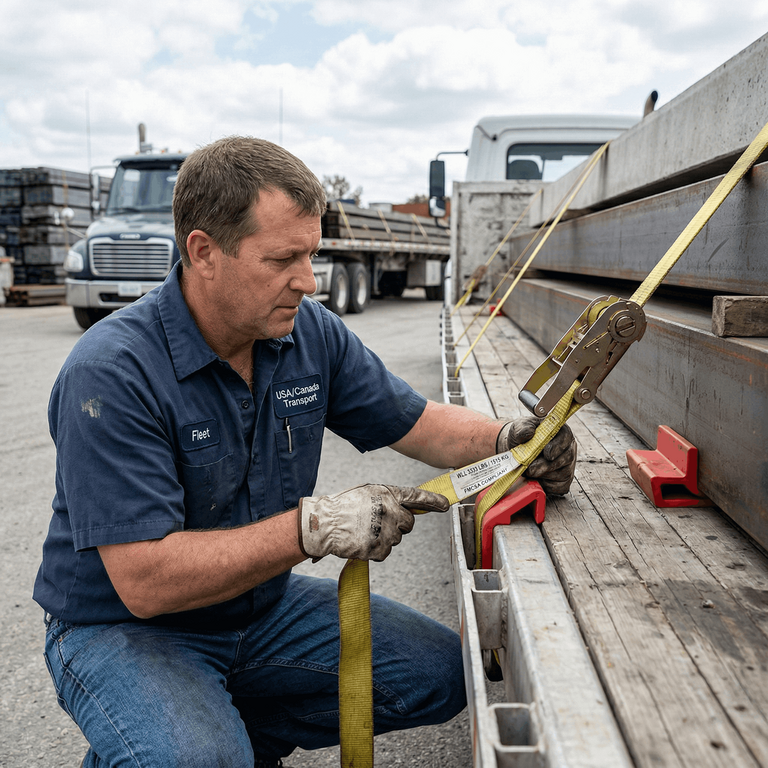
During a previous CVSA inspection blitz in Ohio, a flatbed driver was hauling architectural steel beams. The driver had applied the correct number of straps based on length, and the Working Load Limit math was flawless. However, the driver failed to check the tension of the straps after the first 50 miles of driving (a requirement under FMCSA 392.9).
The steel beams had settled and shifted slightly due to road vibration, causing the rear two straps to lose tension. When the truck pulled into the weigh station, an inspector noticed the loose webbing flapping in the wind. Upon closer inspection, because the cargo had shifted, the load was resting directly against the unprotected cab bulkhead.
The resulting Out-of-Service order delayed the critical construction delivery by 24 hours. The fleet was fined for improper securement, the driver received a massive CSA point penalty, and the customer penalized the carrier for late delivery. The total estimated cost of this oversight was over $14,000. Incorporating a mandatory cargo-check prompt into your driver vehicle inspection report software for the mid-trip check forces the driver to walk around and physically touch every strap, preventing this exact scenario.
Other Top Reasons for Out-of-Service Violations
While ELDs and Cargo Securement are the stars of the 2026 show, inspectors will not ignore glaring mechanical defects. Historically, the top vehicle out-of-service violations include:
- Brake Systems (25% of all OOS): Out of adjustment brakes, chafing air hoses, and audible air leaks.
- Tires (19% of all OOS): Tread depth below 4/32 of an inch on steering tires, flat tires, or exposed cords.
- Lighting Devices: Inoperative turn signals, brake lights, or missing reflectors.
A high-quality pre trip inspection software guides drivers through checking all these components systematically, ensuring nothing is bypassed.
The True Financial Cost of an OOS Violation
Calculating the ROI of Preparedness
Many fleet owners hesitate to invest in affordable electronic inspection systems for DOT compliance because they view it as an unnecessary monthly expense. However, let's look at the financial math of a single cargo securement Out-of-Service event during the Roadcheck:
- Direct DOT Fine: Ranging from $1,000 to $3,500 depending on the severity of the securement failure.
- Roadside Repair/Service Call: If a driver needs new chains or edge protectors delivered to the weigh station, expect a $500–$800 mobile service fee.
- Lost Revenue (Downtime): A truck sitting OOS for 12-24 hours costs an average of $800 to $1,200 in lost gross revenue.
- Insurance Premium Increase: A bad roadside inspection elevates your CSA Basic scores, which insurance underwriters use to price your renewals. A single OOS event can hike premiums by 10-15%, costing thousands annually.
Total Hidden Cost: $4,000 - $8,000+ per occurrence. Implementing a digital DVIR ecosystem for $100 a month pays for itself instantaneously by preventing just one of these roadside disasters.
Pre-Roadcheck Driver Briefing Checklist
Safety managers should schedule a mandatory driver briefing the week before the Roadcheck blitz begins. Use this checklist to ensure no critical topic is missed:
- Attitude and professionalism: Remind drivers that inspectors are doing their job. Stay calm, cooperative, and respectful. A defensive or hostile attitude can escalate a routine stop into a full audit.
- Documents on the dashboard: CDL, medical certificate, and ELD instruction sheet should be readily accessible—not buried in a duffel bag. Inspectors appreciate drivers who have everything ready.
- ELD data transfer drill: Every driver must demonstrate they can initiate a Web Services or Email transfer. Run a mock transfer in the yard before the blitz.
- DVIR and cargo check: Emphasize that the most recent DVIR must be complete and legible. For flatbed and open-deck loads, drivers must verify strap tension and edge protectors at every stop.
- 8-day paper log backup: Confirm every truck has blank RODS forms. Drivers must know where they are and how to use them if the ELD fails.
- Cab cleanliness: A cluttered cab suggests poor housekeeping and can lead to a more thorough inspection. Encourage drivers to tidy up before hitting the road.
How to Prepare Your Fleet for Roadcheck 2026
Preparation is not achieved the night before the blitz begins. Safety managers must instill proactive habits weeks in advance. Follow this four-step roadmap to ensure your fleet is ready:
- Conduct Mock Level I Inspections: Run your drivers and vehicles through a full 37-step Level I inspection in your own yard. Simulate the pressure of an audit to catch obvious defects before the DOT does.
- Audit ELD Data Transfers: Sit in the cab with every single driver. Ensure every driver knows exactly how to navigate their ELD device to initiate a data transfer to an inspector via Web Services or Email. Have them practice the specific button presses.
- Replace Worn Cargo Tie-Downs: Conduct a comprehensive inventory of all chains, straps, binders, and bungee cords. If a strap has a cut, tear, or frayed edge, replace it immediately to avoid a securement violation. Throw away gear without legible WLL tags.
- Adopt Electronic DVIR Software: Transition from paper clipboards to an electronic DVIR system. Configure custom digital pre-trip checklists that specifically prompt drivers to verify cargo securement devices and edge protectors before departing.

Frequently Asked Questions
When is the CVSA International Roadcheck 2026?
The 2026 CVSA International Roadcheck typically takes place over a 72-hour period in mid-May. During this time, commercial motor vehicle inspectors conduct high-volume, high-visibility roadside inspections across North America.
What is the specific focus of the 2026 CVSA Roadcheck?
The focus areas for the 2026 Roadcheck are Hours of Service/ELD compliance and Cargo Securement. Inspectors will heavily scrutinize ELD data transfer capabilities, driver logs, and the physical tie-downs of freight.
What is a Working Load Limit (WLL) in cargo securement?
The Working Load Limit (WLL) is the maximum load that a tie-down (like a chain or strap) can safely handle. FMCSA requires that the aggregate WLL of all tie-downs used must be at least 50% of the weight of the cargo being secured.
How can an electronic DVIR system help me prepare?
A compliant electronic DVIR system forces drivers to document cargo securement checks and syncs timestamps with ELDs, proving to auditors that comprehensive pre-trip inspections were performed, reducing the risk of OOS violations.
Final Thoughts: Proactive Compliance Wins
The CVSA International Roadcheck is not designed to trick motor carriers; it is designed to enforce the safety standards that keep highways secure. By focusing intensely on ELD compliance and cargo securement, inspectors aim to eliminate exhausted drivers and hazardous, shifting loads.
Your best defense is an aggressive offense. Throw out the paper clipboards that allow for skipped steps and falsified times. Arm your drivers with modern pre trip inspection software that forces accountability and provides real-time data back to your maintenance and safety teams.
Survive the 2026 Roadcheck with Zero Violations
Don't let a damaged strap or a missing DVIR signature ruin your CVSA Roadcheck outcome. Digitize your pre-trip processes, integrate cargo securement checklists, and stay audit-ready 24/7 with PTI4YOU.
Start your 15-day free trial today. No credit card required.
Start Your 15-Day Free Trial – No Credit Card RequiredZero setup fees. Zero hardware. 25-minute driver onboarding.