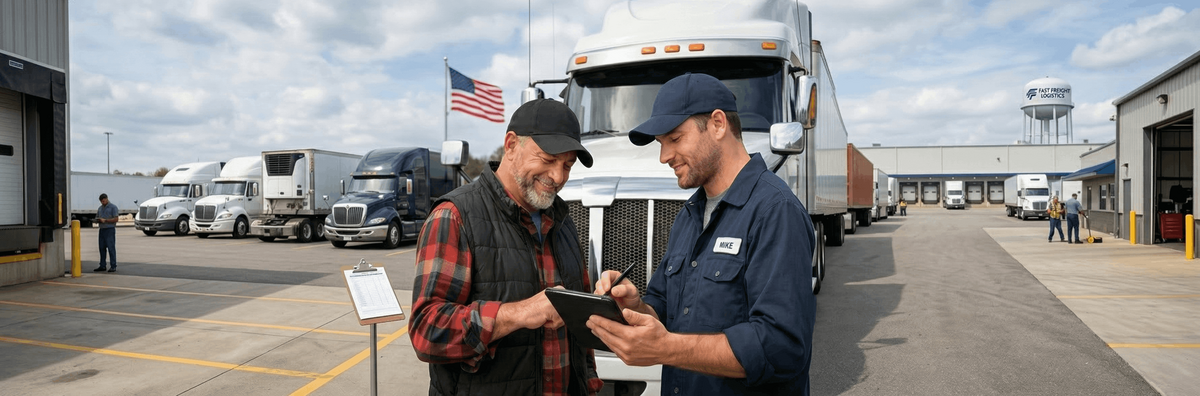
The Hidden Trap in DVIR Compliance
If there is one regulation that consistently trips up commercial motor carriers during a Department of Transportation (DOT) audit, it is the strict enforcement of FMCSA Rule 396.11. This specific Federal Motor Carrier Safety Administration mandate governs the creation, review, and retention of the Driver Vehicle Inspection Report (DVIR). While most drivers understand the basic concept of a daily pre-trip and post-trip inspection, the legal complexities begin when a defect is actually found.
Many fleets operate under the false assumption that once a mechanic fixes a broken taillight or replaces a worn tire, the compliance process is complete. This is legally incorrect. Under the eyes of the DOT, a defect repair is not finalized until the "Three-Signature Cycle" is fully executed. Failing to secure all three specific sign-offs creates a dangerous gap in your maintenance records, exposing your company to severe fines, Out-of-Service (OOS) orders, and devastating civil liabilities in the event of an accident.
Let's deeply decode how 49 CFR § 396.11 mandates this process, why traditional paper forms are a liability, and how implementing an electronic dvir system guarantees bulletproof dot compliance.
Key Takeaways: The 396.11 Workflow
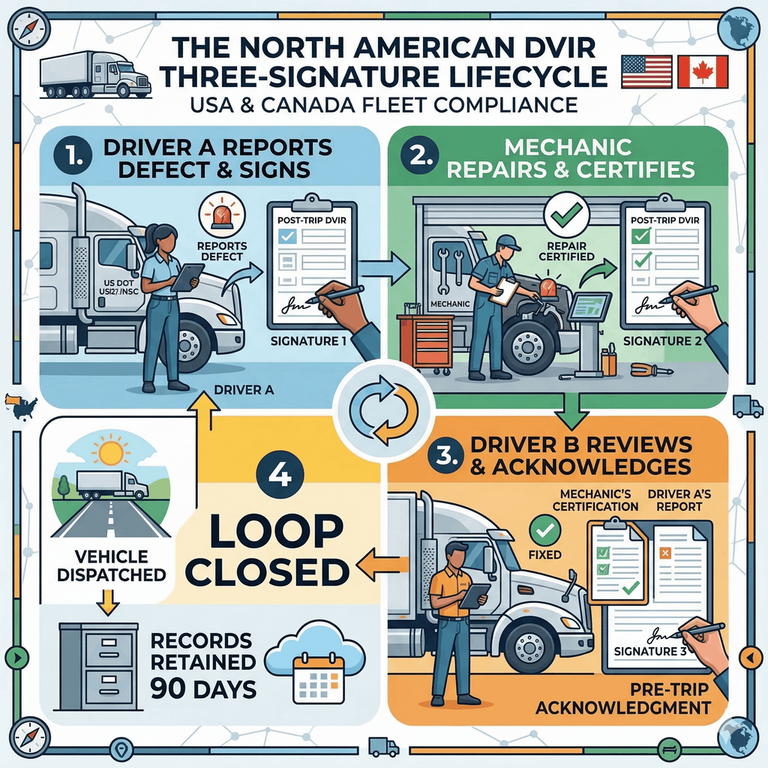
- Signature 1 (The Report): The driver who identifies the defect must sign the original DVIR, officially documenting the issue.
- Signature 2 (The Certification): The motor carrier or mechanic must certify, via signature, that the defect was either repaired or that repair was deemed unnecessary for safe operation.
- Signature 3 (The Acknowledgment): The *next* driver to operate the vehicle must review the DVIR and sign it, acknowledging the repairs before turning the key.
- The Digital Shift: Managing this multi-day, multi-person workflow on paper is nearly impossible at scale. Using pre trip inspection software automates routing, locks out non-compliant drivers, and timestamps every signature.
What is FMCSA Rule 396.11?
Found within the extensive Code of Federal Regulations, FMCSA Rule 396.11 outlines the exact responsibilities of motor carriers and drivers regarding equipment reporting. The rule explicitly requires that every driver prepare a report in writing at the completion of each day's work on each vehicle that the driver operated.
However, the FMCSA made a significant change to this rule to reduce the paperwork burden on fleets. A "No-Defect DVIR"—where the driver inspects the vehicle and finds absolutely nothing wrong—no longer requires submission or retention for non-passenger carriers. The rule now strictly focuses on vehicles where a safety-compromising defect is discovered.
When a defect *is* found, the full weight of 396.11 activates, transforming a simple daily checklist into a legally binding chain of custody document that must be meticulously tracked and retained for 90 days.
Are electronic signatures legal for FMCSA 396.11 compliance in 2026?
Yes. With the FMCSA Final Rule (Docket FMCSA-2025-0115) effective March 23, 2026, the use of electronic DVIRs and digital signatures is fully codified. This regulation aligns with federal E-SIGN and GPEA laws, explicitly removing any legal ambiguity about the need for "wet" ink signatures in the driver, mechanic, and reviewing-driver cycle.
The Anatomy of a Lawful DVIR
To satisfy the regulatory requirements, a Driver Vehicle Inspection Report cannot be a simple note passed to a mechanic. Section 396.11(a)(1) mandates that the report must cover, at a minimum, the following parts and accessories:
- Service brakes, including trailer brake connections
- Parking (hand) brake
- Steering mechanism
- Lighting devices and reflectors
- Tires, horn, and windshield wipers
- Rear-vision mirrors
- Coupling devices (Fifth wheels, pintle hooks)
- Wheels and rims
- Emergency equipment
If any of these components are compromised, the driver must explicitly state the nature of the defect on the report. Vague descriptions like "truck is driving weird" are unacceptable and will be flagged during an audit. This detailed report initiates the complex three-signature cycle.
Safety-Compromising vs. Cosmetic Defects: Know the Difference
One of the most common sources of confusion during the three-signature cycle is determining whether a noted defect is "safety-compromising" or merely "cosmetic." This distinction is critical because it directly affects whether the vehicle can be legally dispatched and how the mechanic fills out their certification.
A safety-compromising defect is any condition that would affect the safe operation of the vehicle or could result in a mechanical breakdown on the highway. Under 49 CFR § 396.7, a motor carrier shall not require or permit a person to drive a vehicle that is in such a condition that its operation is likely to cause an accident or breakdown. Examples of safety-compromising defects include:
- Brake system failures: Air leaks exceeding 3 psi per minute, pushrod travel beyond the adjustment limit, inoperative brake chambers, or chafed hoses near heat sources.
- Steering deficiencies: Excessive play in the steering wheel (greater than 10 degrees on manual steering), loose tie rod ends, or a cracked steering gear housing.
- Tire hazards: Tread depth below 4/32 of an inch on a steering tire, exposed cords, sidewall bulges, or a flat tire on any axle.
- Lighting failures: Inoperative headlights, non-functioning brake lights, or missing required reflectors that compromise nighttime visibility.
- Coupling device defects: A cracked fifth wheel plate, a missing safety chain, or excessive wear on a pintle hook latch.
Cosmetic defects, on the other hand, do not impair the safe operation of the vehicle. A scratched bumper, a dented fender that does not interfere with tire clearance, or a broken cup holder inside the cab are examples. When a mechanic reviews such a defect, they may certify on the DVIR that "repair is unnecessary for the safe operation of the vehicle." They still must sign the certification (Signature 2), and the next driver still must review and acknowledge it (Signature 3). The full cycle must be completed regardless of severity.
The danger zone lies in ambiguous defects. A driver writes "squealing noise from left front wheel." Is that a worn brake pad about to expose the rotor, or is it a stone caught between the dust shield and the rotor? Until a qualified mechanic physically inspects the vehicle and makes a determination, that truck cannot be dispatched. Fleets that dispatch vehicles based on assumptions rather than certifications are walking into an audit trap.
Signature 1: The Initial Driver's Report
The cycle begins at the end of a shift (or during a pre-trip if a defect wasn't previously noted). The driver completes their physical inspection and notes a defect—for example, a dangerously low tread depth on a drive tire or an audible air leak in the brake system.
The Legal Action: The driver must document the defect and apply the first signature. By signing, the driver is legally declaring to the motor carrier that the vehicle possesses a deficiency that may affect the safety of operation or result in a mechanical breakdown.
The Operational Challenge: In a paper-based system, this signed piece of paper must physically make its way from the truck cabin to the maintenance shop. If the paper is lost, spilled on, or left on a dashboard, the carrier is completely unaware of the safety hazard. A digital electronic dvir system eliminates this delay by instantly pushing the signed defect report directly to the mechanic's digital dashboard.
Pre-Trip vs. Post-Trip: When 396.11 Triggers the Cycle
A frequent point of confusion among fleet managers is exactly when during the driver's shift the three-signature cycle can be triggered. The answer is: at any point, but the legal obligations differ slightly depending on the timing.
Post-trip inspection (end of shift): This is the scenario that 49 CFR § 396.13 and 396.11 primarily address. The driver completes their route, performs the inspection at the terminal, finds a defect, and files the written report. The vehicle sits in the yard overnight while the mechanic addresses the issue. This is the cleanest workflow because the vehicle is stationary, giving all parties time to complete the cycle before the next dispatch.
Pre-trip inspection (start of shift): If a driver discovers a defect during their pre-trip check that was not previously noted on the last DVIR, they must immediately document it and sign the report (Signature 1). At this point, the vehicle cannot be driven until the mechanic has evaluated the defect. Some fleets make the critical mistake of allowing a driver to "just note it and go" because they assume the pre-trip is informational only. This is incorrect. The moment a defect is documented on a DVIR, the full three-signature cycle is activated regardless of when during the shift it was discovered.
En-route discovery: If a driver discovers a defect while on the road—such as a brake warning light illuminating or an audible air leak developing—they must stop at the nearest safe location and document it. A driver who knowingly operates a vehicle with a safety-compromising defect faces personal liability under 49 CFR § 392.7, which prohibits drivers from operating unsafe equipment regardless of carrier directives.

Signature 2: The Mechanic's Certification
Once the carrier receives the DVIR noting a defect, the vehicle theoretically enters a holding pattern. Before that vehicle can be legally dispatched again, the motor carrier or its authorized representative (the mechanic) must address the report.
According to 396.11(a)(3), the carrier must do one of two things:
- Repair the defect: Fix the issue to ensure the vehicle is in safe operating condition.
- Certify repair is unnecessary: A qualified mechanic evaluates the noted defect and determines that it does not currently compromise the safety of operation (e.g., a cosmetic scratch on a bumper that a driver mistakenly flagged as a structural issue).
The Legal Action: Regardless of whether a repair was made or deemed unnecessary, the mechanic must apply the second signature to the DVIR, certifying the action taken. This is the carrier's official declaration that they have performed their due diligence.
Signature 3: The Next Driver's Acknowledgment
This is where the vast majority of compliance violations occur. The vehicle is fixed, the mechanic has signed off, and the truck is parked back on the ready line. The next morning, a different driver (or even the same driver) is assigned to that truck.
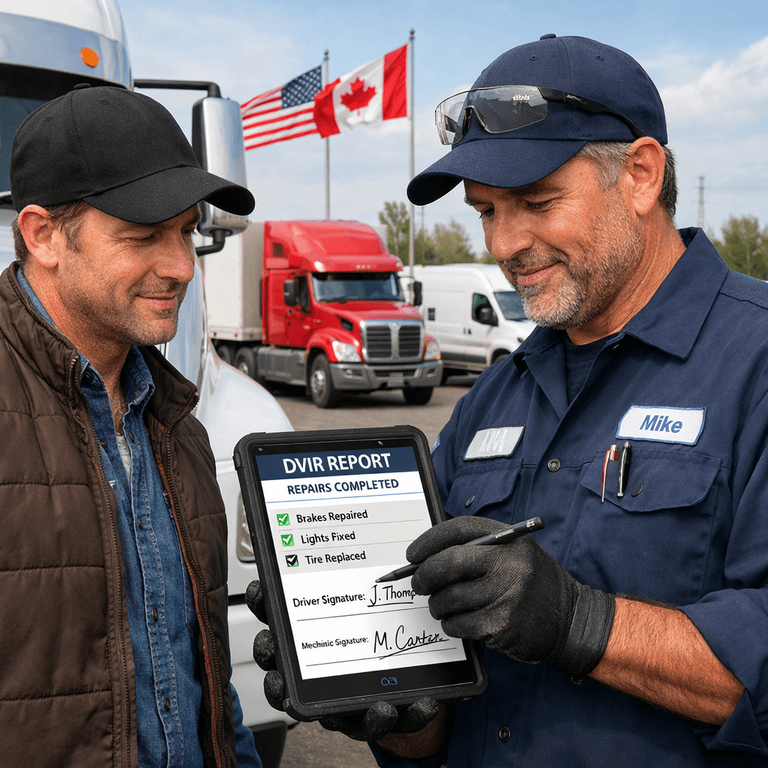
Before the driver can legally begin their shift, they are required by 396.11(a)(3)(ii) to review the last DVIR filed for that vehicle if it contained a defect. The driver must physically review the document, verify that the required repairs were completed, and then sign the report to acknowledge that they have reviewed the certification of repairs.
The Legal Action: The third signature is the ultimate failsafe. It forces the driver taking control of the vehicle to confirm that they are not inheriting a dangerous problem. Without this third signature, the DVIR loop remains open, and the motor carrier is out of compliance.
Why the Third Signature is the Most Forgotten Element
In a fast-paced logistics environment, the third signature is frequently missed because of human error and broken communication chains. Consider the logistical reality of a slip-seat operation: Driver A reports a brake issue on Friday evening. The mechanic fixes it on Saturday morning and signs the paper DVIR, leaving it in the shop office. On Monday morning, Driver B is assigned the truck. Driver B performs a pre-trip, assumes the truck is fine, and drives off.
During an audit, the DOT inspector will pull that specific DVIR. They will see Driver A's signature and the mechanic's signature. They will look for Driver B's signature. Because the paper was left in the office and not placed back in the truck cab for Driver B to review, the third signature is missing. Violation issued.
Paper vs. Electronic DVIRs: Why Paper Fails the Test
The three-signature cycle highlights exactly why traditional paper logbooks are fundamentally incompatible with modern fleet efficiency and dot compliance. Managing paper DVIRs requires physical proximity and flawless human memory.
- Physical Routing: The paper must move from the truck, to the mechanic, and back to the truck without being lost, stained, or torn.
- Legibility: Auditors cannot verify signatures that are illegible scribbles. Paper forms are notorious for grease-smudged, unreadable handwriting.
- Time-Lag: A paper DVIR provides no real-time visibility to dispatchers. A truck might be dispatched before the mechanic has had a chance to apply the second signature.
- Storage and Retrieval: Carriers must keep these records for three months. Sifting through boxes of carbon-copy paper during an audit is a massive drain on administrative resources.
How Software Fixes the "Missing Signature" Problem
Adopting an electronic dvir system completely eliminates the operational friction of the three-signature cycle. Here is how modern pre trip inspection software handles the workflow flawlessly:
- Instant Notification: When Driver A submits a defect on their mobile device and signs electronically, the shop manager receives an instant push notification. There is zero delay in communication.
- Digital Workflow: The mechanic logs into their web portal or tablet, reviews the exact defect (often accompanied by photos taken by the driver), completes the repair, and applies their electronic signature. The status of the vehicle changes from "Out of Service" to "Repaired."
- The Mandatory Gate: This is the crucial feature. When Driver B logs into the app the next morning and selects that specific truck, the software blocks them from starting a new inspection until they review the previous defect. A pop-up forces Driver B to review the mechanic's notes and apply the third electronic signature. The loop is closed automatically, securely, and chronologically.
By forcing the workflow through software gates, you entirely remove human forgetfulness from the compliance equation. You are no longer hoping a driver remembers to check the glovebox for yesterday's paperwork.
Exceptions to the 396.11 Rule
While the three-signature rule applies to the vast majority of commercial motor carriers, the FMCSA does outline a few specific exceptions where the strict reporting requirements are modified:
- Driveaway-Towaway Operations: Vehicles involved in driveaway-towaway operations (where the vehicle being driven is the commodity being delivered) have specific exemptions due to the transient nature of the trip.
- Single-Vehicle Owner-Operators: If a motor carrier operates only one commercial motor vehicle, the formal written defect reporting process is somewhat redundant, as the driver, mechanic, and carrier are often the same person. However, these operators must still ensure the vehicle is safe to operate under general maintenance rules.
- Passenger-Carrying Vehicles: Drivers of passenger-carrying CMVs are explicitly required to prepare a report in writing at the completion of each day's work, even if no defect is found. The "no-defect exemption" applies primarily to property-carrying vehicles.
Penalties, Fines, and CSA Score Impact
The DOT takes the DVIR process incredibly seriously because it is the primary method of preventing mechanical failures on public highways. Violations of 396.11 carry severe consequences for both the driver and the motor carrier.
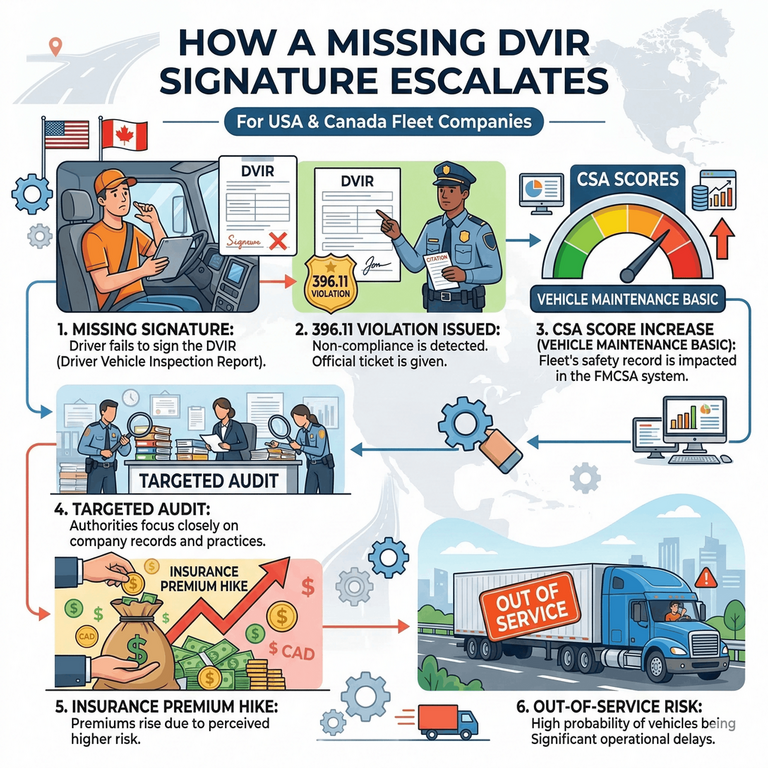
If an inspector at a weigh station or during a terminal audit discovers that a vehicle was operated with an uncertified defect, or that the three-signature cycle was not completed, they will issue a violation. These violations directly impact a carrier's Compliance, Safety, Accountability (CSA) score within the Vehicle Maintenance BASIC category.
High CSA scores trigger targeted interventions, comprehensive compliance reviews, and increased roadside inspection frequency. Furthermore, if a missing signature involves a critical safety item (like brakes or steering), the inspector has the authority to issue an immediate Out-of-Service (OOS) order, paralyzing the vehicle and stranding the freight until a certified mechanic travels to the site to execute a repair and legally apply the second signature.
Real-World DOT Audit: A Step-by-Step Walkthrough
Understanding what happens during a DOT compliance review eliminates the fear factor and exposes exactly where paper-based fleets fail. Here is a realistic scenario based on composite data from fleet compliance consultations.
A 45-truck carrier receives notice of a scheduled Compliance Review from the FMCSA. On the day of the audit, the investigator arrives at the terminal and requests three months of Driver Vehicle Inspection Reports for a random sample of 15 vehicles. The investigator is specifically trained to look for 396.11 violations by verifying the three-signature chain on every DVIR that contained a noted defect.
The investigator selects Truck #27. On February 3, Driver A documented "loud grinding noise when applying service brakes." On February 4, the mechanic replaced the worn brake pads and signed the certification. The investigator then cross-references the dispatch system: Truck #27 was dispatched to Driver C on February 5. The investigator locates the February 3 DVIR and scans for Driver C's review signature. It is blank. The loop was never closed.
The investigator notes this as a 396.11(c) violation. They repeat this process for every defect-containing DVIR in the sample. Out of 40 defect reports across 15 trucks, the investigator finds 12 missing third signatures and 3 instances where the mechanic signed a shop work order but never signed the actual DVIR document. The result: 15 documented violations, a proposed civil penalty exceeding $12,000, and a downgrade from "Satisfactory" to "Conditional" safety rating—which immediately triggers a 10-20% insurance premium increase at the carrier's next renewal.
The entire audit took four hours. Every single violation could have been prevented by an electronic dvir system that refuses to release a vehicle until all three signatures are digitally captured in the correct sequence.
Training Drivers to Complete the Signature Cycle
Technology alone is not enough. Even the most sophisticated pre trip inspection software cannot compensate for a driver who does not understand why each signature matters. Fleet safety managers must invest time in structured training that connects the legal requirements directly to the driver's daily experience.
Make the "why" personal: Drivers respond more effectively when they understand that the third signature is not bureaucratic busywork—it is their personal legal shield. If Driver B signs the DVIR acknowledging that the brakes were repaired, and the brakes subsequently fail 200 miles down the highway, Driver B can point to the mechanic's certification and their own review as proof that they performed due diligence. Without that signature, Driver B has zero legal protection.
Simulate the workflow in training: During onboarding, physically walk new drivers through the three-signature cycle using your electronic dvir system. Have them submit a mock defect, watch a trainer (acting as the mechanic) certify the mock repair, and then have the new driver practice the review-and-acknowledge step on the app. Repetition builds muscle memory, so the process becomes automatic rather than an afterthought at the end of a 14-hour day.
Address the "not my problem" mentality: In slip-seat operations where multiple drivers share the same vehicle, there is a pervasive attitude that yesterday's DVIR belongs to yesterday's driver. Counter this by explaining that the FMCSA holds the carrier responsible for ensuring the cycle is completed. If management tolerates unsigned DVIRs, they are accepting the fine on behalf of the entire organization. Establishing a zero-tolerance policy—backed by electronic enforcement—eliminates the grey area.
Trailer Swaps and Drop-and-Hook Operations
One of the most operationally complex scenarios for 396.11 compliance occurs in drop-and-hook operations, where Driver A drops a loaded trailer at Terminal B on Monday, and Driver C hooks that same trailer three days later at a completely different facility. The question that fleet managers consistently struggle with is: who is responsible for the DVIR on that trailer during the gap?
Under FMCSA regulations, the motor carrier is ultimately responsible for ensuring that every commercial motor vehicle under its control is maintained in safe operating condition. When Driver A drops the trailer and completes their post-trip DVIR noting a defect—say, a cracked mudflap bracket or a flickering clearance lamp—the three-signature cycle begins at that moment. The mechanic at Terminal B must inspect the trailer, certify the repair (or certify it is unnecessary), and sign the DVIR. Three days later, when Driver C arrives to hook the trailer, they must review the most recent DVIR before departing.
The operational breakdown happens when the paper DVIR is left in a folder at the dispatch office at Terminal A, while the trailer physically sits at Terminal B. Driver C hooks the trailer, performs their own pre-trip, and finds no new issues. They assume the trailer is clean and drive away. But the original defect from Monday was never formally closed because the paper never followed the trailer. During an audit, the investigator sees Driver A's defect, the mechanic's certification, but no review signature from Driver C—or any subsequent driver. That is a violation.
An electronic dvir system solves this by attaching the DVIR digitally to the trailer's unique ID or license plate number rather than to a physical piece of paper. When Driver C selects that trailer in the app, the outstanding defect automatically surfaces on their screen, forcing them to review and acknowledge before the system allows them to begin their trip. The location of the trailer is irrelevant because the compliance chain lives in the cloud.
For fleets that operate large intermodal yards with hundreds of trailers cycling through multiple terminals per week, this digital linking is not a luxury—it is the only realistic method of maintaining 396.11 compliance without dedicating an entire administrative team to manually tracking paper DVIRs across facilities.
How to Handle DVIRs for Leased and Rented Equipment
Carriers that lease vehicles from companies like Ryder, Penske, or other full-service leasing providers face a unique challenge regarding the mechanic's signature (Signature 2). The critical question is: when a defect is reported on a leased vehicle, who is responsible for certifying the repair on the DVIR?
The answer depends entirely on the terms of the lease agreement. Under 49 CFR § 390.13, the motor carrier operating the vehicle is ultimately responsible for compliance—even if they do not own the equipment. If your lease agreement with Ryder specifies that Ryder handles all maintenance and repairs, a Ryder mechanic will physically fix the defect. However, the FMCSA still expects someone to sign the certification of repair on the DVIR before the vehicle is dispatched.
In practice, this creates two common scenarios:
- Full-service lease with on-site shop: The leasing company's mechanic repairs the vehicle and signs the DVIR certification directly. This is the cleanest workflow because the mechanic is physically present at the carrier's terminal.
- Full-service lease with off-site shop: The vehicle must be taken to the leasing company's service center for repair. The leasing company's mechanic fixes the issue and signs their own repair documentation—but the DVIR certification may not be signed because the leasing company uses a separate work order system. The carrier must ensure that the DVIR itself (not just the leasing company's internal paperwork) receives the mechanic's certification signature before the vehicle returns to service.
The most dangerous compliance gap occurs when a carrier assumes that the leasing company's internal repair records satisfy the 396.11 requirement. They do not. The DOT auditor will ask specifically for the DVIR document with three signatures. A Ryder work order showing the repair was completed is helpful evidence, but it does not legally close the signature loop on the carrier's DVIR. Fleet managers who operate leased equipment must establish a written protocol with their leasing partner that explicitly requires the leasing mechanic to sign the carrier's DVIR—or designate an internal qualified person to review and certify the repair upon the vehicle's return.
How to Audit Your Own Fleet for 396.11 Compliance
The best defense against a DOT fine is a proactive internal audit. Fleet managers should not wait for an inspector to find the holes in their paperwork. Here is a practical framework for auditing your own three-signature compliance:
- Pull a Defect Sample: Select 20 historical DVIRs from the past 90 days that contained noted defects. Do not pick the perfect ones; look for complex issues that took several days to fix.
- Verify the First Signature: Ensure the driver clearly described the issue and signed the report on the day the defect was found.
- Check the Repair Timeline: Cross-reference the DVIR with shop repair invoices or mechanic timecards. Ensure the mechanic signed the DVIR (Signature 2) certifying the repair before the vehicle was dispatched again.
- Hunt for the Third Signature: Look at the dispatch log. Identify the driver who took the truck on its very next trip. Verify that that specific driver signed the original DVIR (Signature 3) acknowledging the repair prior to their departure.
If you are using paper forms and you find missing signatures during this internal audit, you have a systemic compliance failure. Transitioning to an electronic dvir system is the most rapid and cost-effective method to correct the course.
49 CFR 396.11 Driver Vehicle Inspection Report Retention: Is it 3 Months?
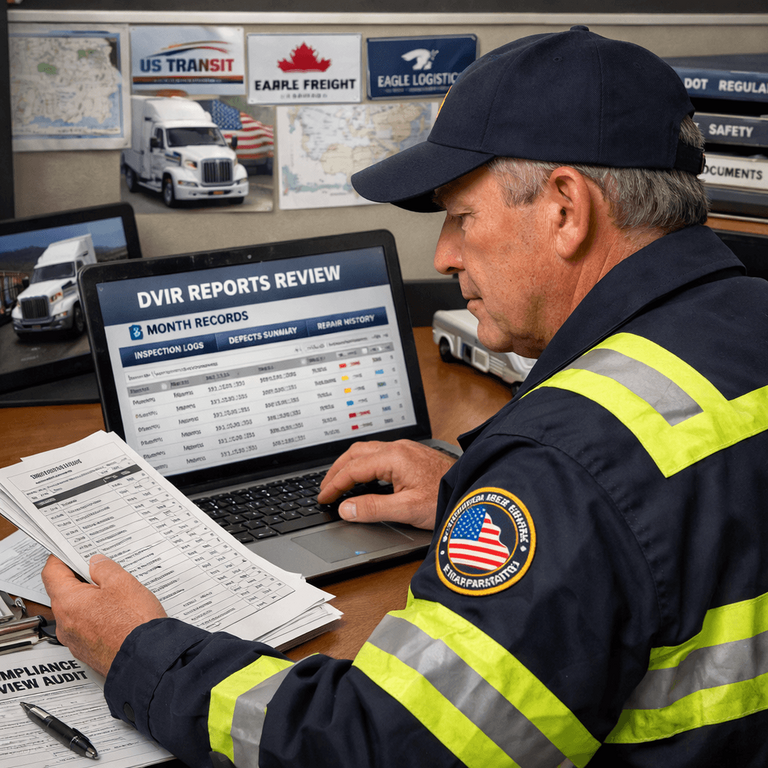
Yes. Under 49 CFR 396.11, motor carriers are legally required to retain the original Driver Vehicle Inspection Report, the mechanic's certification of repairs, and the reviewing driver's signature for a minimum of 3 months (90 days) from the date the written report was prepared.
Failing to produce these 3-month historical logs during a targeted DOT Compliance Review is one of the primary reasons carriers face documentation fines. The inherent flaw of paper logbooks is the high risk of loss or physical damage over this 90-day window. An electronic DVIR system automates this retention policy: digital reports are archived in the cloud with tamper-evident timestamps, so an unbroken 3-month history is instantly retrievable during any desktop audit — neutralizing the risk of retention violations.
Frequently Asked Questions
What is the FMCSA three-signature rule?
The FMCSA three-signature rule, strictly outlined in 49 CFR 396.11, requires three specific sign-offs when a vehicle defect is reported: 1) The original driver reporting the defect, 2) The mechanic or carrier certifying that the repair was made or is unnecessary, and 3) The next driver reviewing the repaired vehicle before operation.
Do you always need three signatures on a DVIR?
No. If a driver conducts a daily post-trip inspection and finds absolutely no defects or deficiencies that would affect the safety of operation, only the single signature of that reporting driver is required (and for property-carrying vehicles, the physical report doesn't even need to be retained). The three-signature cycle is only triggered when a defect is formally documented.
How long must motor carriers retain DVIR records?
Under FMCSA regulations, motor carriers must retain the original Driver Vehicle Inspection Report (DVIR), the certification of repairs, and the certification of the driver's review for three months (90 days) from the date the written report was prepared.
Can an electronic signature be used for FMCSA 396.11 compliance?
Yes, the FMCSA fully accepts electronic signatures on digital DVIR platforms, provided the system securely attributes the signature to the specific individual (driver or mechanic) and the records are readily accessible upon the request of a DOT inspector.
Final Thoughts: Automate the Cycle
Compliance with FMCSA 396.11 is not about generating paperwork; it is about creating a verified, legally accountable chain of communication regarding vehicle safety. The three-signature cycle guarantees that the driver, the mechanic, and the carrier are all aligned before a multi-ton commercial vehicle enters a public roadway.
Relying on paper to manage this critical workflow in 2026 is an unnecessary risk. By leveraging robust pre trip inspection software, fleets can automate the signature routing, eliminate skipped steps, and ensure that every single defect is documented, repaired, and acknowledged with total transparency.
Stop Failing DVIR Audits Due to Missing Signatures
Don't let a misplaced piece of paper compromise your DOT compliance rating. PTI4YOU's intelligent electronic DVIR platform automatically enforces the three-signature rule, locking drivers out of non-compliant vehicles until repairs are acknowledged.
Start your 15-day free trial today and bulletproof your maintenance records. No credit card required.
Start Your 15-Day Free Trial – No Credit Card RequiredZero setup fees. Zero hardware. 25-minute driver onboarding.