
The Strictest State Just Updated Its Rules
California has long held the title for the strictest commercial motor vehicle regulations in North America. Unlike the rest of the country, which primarily relies on annual federal DOT checks and random roadside stops, California brings the audit directly to your doorstep. At the heart of this regulatory framework is the Basic Inspection of Terminals (BIT) program administered by the California Highway Patrol (CHP).
In 2026, the CHP is strictly enforcing the sweeping changes brought forward by California Assembly Bill (AB) 3278. This legislation fundamentally alters the famous 90-day inspection rule, redefines which vehicles require constant mechanical oversight, and tightly integrates state driver licensing with federal drug databases. If your fleet operates in California, relying on outdated knowledge or a 90 day bit inspection form free printable downloaded years ago is a guaranteed path to an Unsatisfactory rating, massive fines, and potential shutdown.
Let's break down exactly what bit inspection california entails in 2026 and how adopting the right pre trip inspection software can save your operating authority.
Key Takeaways: 2026 BIT Program Changes
- AB 3278 Weight Exemption: Vehicles under 26,001 lbs GVWR are largely exempt from the strict 90-day inspection rule, reverting to federal annual inspection standards.
- Lifetime CDL Bans: AB 3278 mandates lifetime CDL disqualification for convictions related to human trafficking using a CMV.
- DACH Integration: The CA DMV is now legally required to prohibit commercial operation immediately upon receiving a violation notice from the federal Drug and Alcohol Clearinghouse (DACH).
- Death of the Paper Form: The complexities of managing split inspection schedules make adopting an electronic dvir system the only scalable way to pass a CHP audit.
What is the California BIT Program?
Federal DOT compliance does not replace state-level inspection programs. The California BIT program (established in 1988) requires motor carriers to undergo routine, performance-based inspections of their terminals. A "terminal" is broadly defined as any location where a fleet houses and maintains its commercial vehicles.
Unlike a Level I roadside inspection where a single truck is evaluated, a BIT audit evaluates your entire safety culture. The CHP investigator will walk into your office and request comprehensive documentation spanning months or years. They evaluate three main pillars:
- Maintenance Records: Proof of preventative maintenance, daily DVIRs, and the critical periodic mechanical inspections.
- Driver Records: Hours of Service (HOS) logs, medical certificates, and Employer Pull Notice (EPN) enrollment.
- Safety Management: Hazardous materials compliance, injury and illness prevention programs (IIPP), and drug/alcohol testing protocols.
Who is Exempt from the California BIT 90-Day Inspection Under AB 3278?
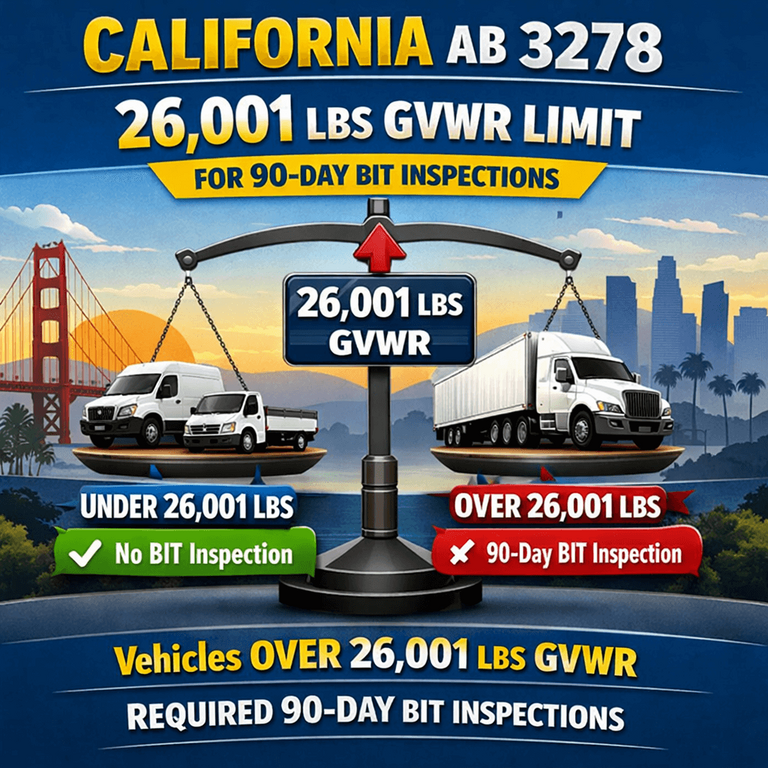
Under the AB 3278 regulations enforced in 2026, commercial vehicles with a Gross Vehicle Weight Rating (GVWR) under 26,001 lbs are legally exempt from the rigid 90-day mechanical inspection cycle and revert to standard annual federal DOT inspections. Vehicles 26,001 lbs and above, passenger buses, hazardous materials transports, and trailers in combination with CMVs must strictly maintain the 90-day schedule.
For decades, California Vehicle Code (CVC) Section 34505.5 mandated that almost any commercial vehicle over 10,000 lbs GVWR had to undergo a deep mechanical inspection every 90 days. This placed an immense administrative and financial burden on operators of lighter commercial vehicles, such as local delivery box trucks and utility vans.
Enter Assembly Bill 3278.
Effective January 1, 2025 (and acting as the primary enforcement standard for 2026 audits), AB 3278 removed "subdivision (j)" vehicles from the 90-day requirement. What does this mean in plain English?
- 26,000 lbs GVWR and under: Generally EXEMPT from the 90-day inspection cycle. These vehicles now only require a standard FMCSA Annual Inspection (49 CFR § 396.17) every 12 months.
- 26,001 lbs GVWR and above: REQUIRED to maintain the strict 90-day inspection cycle.
- Exceptions (Always require 90-day): Regardless of weight, vehicles transporting hazardous materials requiring placards, passenger vehicles carrying 10+ people, and combination vehicles (tractors pulling trailers) remain subject to the 90-day rule.
2026 California BIT Inspection Requirements by Asset Type
| Vehicle Type / Weight Class | Mandatory Inspection Frequency | Governing Regulatory Standard |
|---|---|---|
| Light/Medium Duty (Under 26,001 lbs GVWR) | Annually (Every 12 Months) | Federal FMCSA Annual DOT Standard |
| Heavy Duty (26,001 lbs GVWR and above) | Every 90 Days | California BIT Program (CVC 34505.5) |
| Hazmat Transport (Placard Required) | Every 90 Days | California BIT Program (Strict Exception) |
| Passenger Buses (10+ Passengers) | Every 90 Days | California BIT Program (Strict Exception) |
| Trailers in Combination with CMVs | Every 90 Days | California BIT Program |
The "Split Fleet" Compliance Nightmare
While AB 3278 was designed to ease the burden on carriers, it created a new logistical headache: The Split Fleet. If your company operates a mix of 14,000 lb delivery trucks and 80,000 lb tractor-trailers, you now have two entirely different compliance schedules running simultaneously.
Fleet managers relying on whiteboards, Excel spreadsheets, or a 90 day bit inspection form free printable are failing audits at record rates. An auditor will ask to see the periodic inspections for Unit 12 (a 14k lb truck) and Unit 45 (a heavy tractor). If you accidentally apply the annual schedule to Unit 45, you are instantly in violation. Conversely, if you waste mechanic hours performing unnecessary 90-day deep dives on your lighter fleet, you are burning thousands of dollars in shop time.
This is where affordable electronic inspection systems for DOT compliance prove their ROI. Modern software automatically tags vehicles based on GVWR and triggers the correct preventative maintenance alerts based on the AB 3278 logic engine.
Interstate vs. Intrastate: How AB 3278 Applies
A common misconception among fleet operators is that the California BIT program only affects trucks registered in California. This is incorrect. The BIT program applies to any motor carrier that operates commercial vehicles within the state, regardless of where the company is domiciled. If your fleet is based in Nevada or Arizona but regularly runs loads into Los Angeles or the San Francisco Bay Area, you are subject to CHP terminal audits and the AB 3278 rules.
Conversely, California-registered carriers that exclusively haul interstate freight are still bound by the BIT inspection schedules for any vehicles they park and maintain at a California terminal. The key distinction is between the federal FMCSA annual inspection (49 CFR § 396.17) and the state-level 90-day cycle. A truck that crosses state lines is subject to both federal and California standards simultaneously. The stricter rule always prevails, meaning the 90-day cycle still governs heavy vehicles even if your federal annual inspection is current.
For intrastate-only carriers (those operating solely within California borders), the BIT program is the primary enforcement mechanism. These carriers do not typically face federal compliance reviews from the FMCSA but will encounter CHP auditors on a regular cycle determined by their safety performance rating. Understanding which regulatory umbrella applies to each truck in your fleet is critical for avoiding double penalties from both state and federal agencies.
Anatomy of a 90-Day Mechanical Inspection
For the heavy vehicles that still fall under the 90-day mandate, the inspection is not a casual walk-around. It is a comprehensive mechanical evaluation performed by a qualified mechanic. CVC Section 34505.5 specifies that the inspection must cover, at minimum:
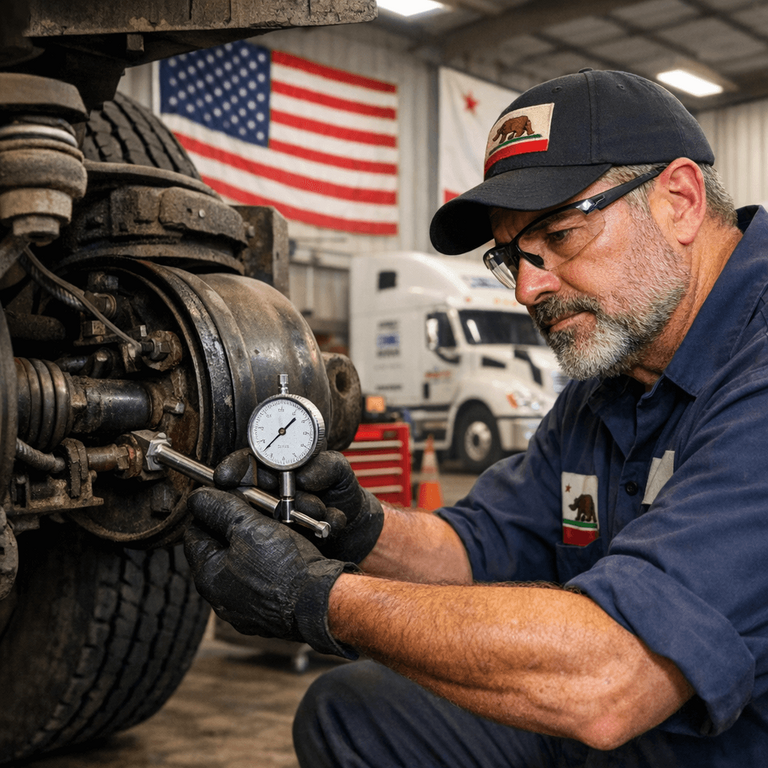
- Brake Adjustments: Pushrod travel must be physically measured and documented. Slack adjusters evaluated.
- Brake System Components: Checking for chafing air lines, audible air leaks, and brake pad/shoe thickness.
- Steering and Suspension: Evaluation of kingpins, tie rods, leaf springs, and U-bolts for fatigue or failure.
- Tires and Wheels: Checking tread depth (4/32 on steers, 2/32 on drives/trailers), sidewall integrity, and lug nut torque.
- Vehicle Connecting Devices: Fifth wheels, pintle hooks, and safety chains must be defect-free.
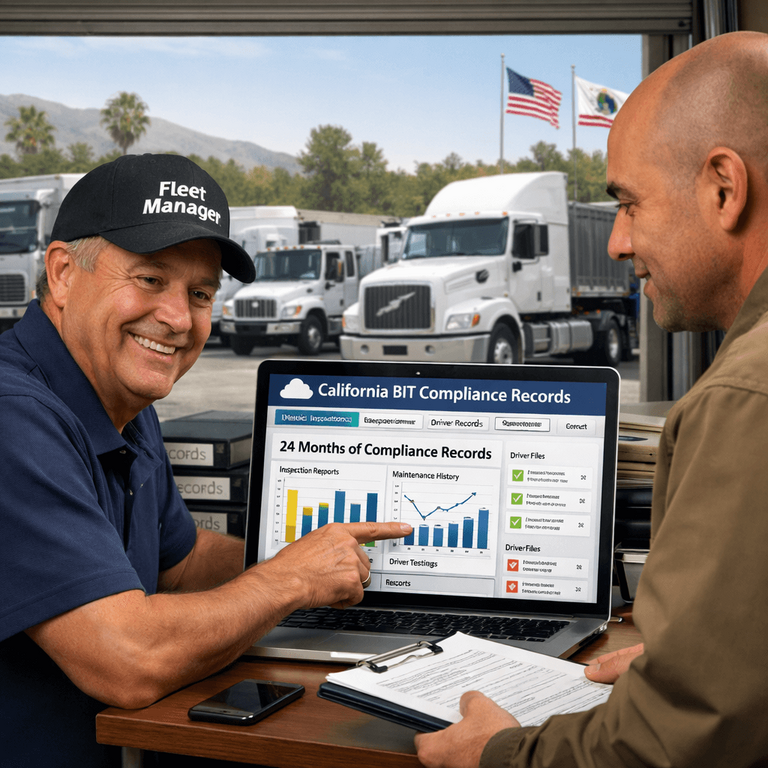
Crucial Documentation Rule: The inspection report must contain the date of the inspection, the nature of repairs performed, the specific identification of the vehicle, and the signature of the authorized representative attesting that the repairs were completed. These records must be maintained at the terminal for a minimum of 24 months.
Driver DVIRs vs. Mechanic BIT Inspections: Know the Difference
One of the most dangerous compliance errors a fleet can make is confusing the daily Driver Vehicle Inspection Report (DVIR) with the 90-day mechanical BIT inspection. These are two completely different legal requirements, performed by different people, with different scopes.
A daily DVIR is performed by the driver before and after each trip under federal regulation 49 CFR § 396.11. It is a walk-around visual and functional check covering brakes, lights, tires, coupling devices, and other safety items. Any driver with a valid CDL can complete a DVIR. The purpose is to identify obvious defects before the truck enters traffic.
The 90-day mechanical BIT inspection is an entirely different beast. Under CVC 34505.5, this inspection must be performed by a qualified mechanic — someone who holds the proper certifications and tools to measure brake pushrod travel, test air systems under pressure, and evaluate suspension component wear using calibrated instruments. A driver cannot legally perform this inspection unless they are also a certified mechanic. The CHP auditor will verify the credentials of whoever signed the 90-day report. If a fleet allows a non-qualified individual to sign off on a periodic inspection, every truck inspected by that person is retroactively non-compliant.
Using pre trip inspection software that clearly separates the daily DVIR workflow from the scheduled mechanic inspection workflow eliminates any confusion. The system assigns tasks to the correct personnel and blocks unauthorized users from completing reports they are not qualified to sign.
Expert Insight: The Fatal "Gap Mistake"
The number one reason fleets fail a CHP audit is the "Gap Mistake." The law states the inspection must occur at least every 90 days. It is a rolling calendar, not fixed quarters.
Scenario: You perform a BIT inspection on a heavy tractor on January 1st. The next inspection is due on or before April 1st. However, on March 25th, the truck blows an engine and is parked against the back fence of your yard. It sits there for two months waiting for parts.
On May 15th, a CHP auditor arrives. They pull the file for that tractor. The last inspection was January 1st. Over 130 days have passed. You argue, "But the truck hasn't moved!" The auditor doesn't care. Unless you explicitly documented that vehicle as "Out of Service" prior to the April 1st deadline, you are in violation of the 90-day rule. An electronic dvir system tracks this automatically, allowing a manager to flag a truck as OOS with one click, preserving the compliance timeline legally.
Beyond the Truck: AB 3278's Impact on Driver Records
While the weight exemptions grabbed the headlines, AB 3278 quietly introduced massive changes to how California handles commercial driver disqualifications. The state laws were updated to perfectly mirror federal mandates.
- Human Trafficking Ban: AB 3278 requires California courts to report to the DMV any conviction involving a CMV in the act of human trafficking. The penalty is a lifetime disqualification from operating a commercial motor vehicle. No exceptions.
- Federal DACH Integration: The DMV is now explicitly prohibited from issuing, renewing, or upgrading a commercial learner's permit or CDL if they receive notice from the federal Drug and Alcohol Clearinghouse (DACH) that the driver is prohibited from operating.
During a BIT audit, the CHP will cross-reference your driver roster with your California Employer Pull Notice (EPN) records and DACH queries. If you dispatched a driver who had an unresolved DACH violation, the fines to the motor carrier are severe.
Deep Dive: The Employer Pull Notice (EPN) Program
The Employer Pull Notice (EPN) program is a California DMV service that allows motor carriers to receive automatic notifications whenever one of their enrolled drivers has a DMV activity event. This includes license suspensions, DUI arrests, at-fault accidents, negligent operator points, and now — thanks to AB 3278 — DACH Clearinghouse prohibition notices.
When a driver accumulates a certain number of negligent operator points (generally 4 points in 12 months, 6 in 24, or 8 in 36), the DMV flags the driver as a "negligent operator" and the EPN system immediately alerts the enrolled employer. The carrier must then take action — reassign, retrain, or terminate — and document that action. During a BIT audit, the CHP will ask you to produce your EPN enrollment confirmation for every active CDL driver and demonstrate that you acted on any alerts received.
The critical trap for fleet managers is that EPN enrollment is not optional under the BIT program — it is mandatory. If you hired a new driver three weeks ago and have not yet enrolled them in EPN, the auditor will cite you for a driver qualification file deficiency. Modern electronic dvir system platforms can integrate with your HR onboarding workflow to flag any new hire who has not yet been enrolled, closing this compliance gap before the CHP discovers it.
How Does AB 3278 Integrate with the Drug and Alcohol Clearinghouse (DACH)?
In 2026, AB 3278 legally mandates the California DMV to immediately suspend commercial operating privileges upon receiving a violation notice from the federal Drug and Alcohol Clearinghouse (DACH). Fleet managers must use the Employer Pull Notice (EPN) program to actively track these automated suspensions and ground affected personnel instantly to avoid severe audit deficiencies and driver-qualification-file violations.
Under federal DACH rules, a driver who tests positive for a controlled substance, refuses a test, or otherwise enters "prohibited" status is flagged in the Clearinghouse. Prior to AB 3278, California's notification pipeline between the federal DACH and the state DMV had observable delays. The new statute closes that gap: any CDL holder flagged in DACH must be prohibited from operating a commercial motor vehicle in California with near-real-time enforcement. During a BIT audit, CHP investigators will cross-reference your driver roster against both the DACH query log and your EPN enrollment records — carriers that dispatched a flagged driver after the DACH notice was issued face civil penalties plus potential criminal referral.
The True Financial Cost of an Unsatisfactory Rating
What Happens When You Fail a BIT Audit?
If the CHP issues an "Unsatisfactory" rating due to missing 90-day inspections, falsified DVIRs, or un-enrolled drivers, the consequences are swift and expensive.
- Immediate Fees & Fines: Civil penalties can range from $1,000 to over $10,000 depending on the severity and number of occurrences (e.g., missing 24 months of brake inspection records).
- CPUC/DMV Suspension: The CHP can recommend that the DMV suspend your Motor Carrier Permit (MCP). Without an active MCP, you cannot legally operate a commercial truck in California. Your freight stops moving immediately.
- Increased Audit Frequency: A satisfactory rating might keep the CHP away for up to 6 years (under the old schedule, now heavily performance-driven). An unsatisfactory rating guarantees they will be back in 120 days or less to ensure compliance, keeping your operations under a microscope.
- Insurance Impact: Insurance underwriters use DOT and BIT performance data. A failed terminal inspection can trigger a policy non-renewal or a 20-30% premium hike.
ROI takeaway: Investing in a compliant pre trip inspection software platform is no longer optional in California; it is a basic cost of doing business to protect your revenue stream.
Step-by-Step: Preparing for a 2026 CHP BIT Audit
If you receive a phone call from the CHP scheduling a terminal inspection, panic is not a strategy. For the full day-of-audit field guide — including pencil-whipping red flags, yard walk-through tactics, and the "Gap Mistake" timeline — see our companion field guide: How to Pass a BIT Inspection in California. Follow these steps to ensure you are ready:
- Audit Your Vehicle Weight Classes: Review your fleet roster immediately. Identify exactly which vehicles are under 26,001 lbs GVWR (now on an annual schedule) and which are over (still on the 90-day schedule). Update your maintenance calendars to reflect the AB 3278 changes so you don't present the wrong data to the auditor.
- Digitize Your Maintenance Records: Transition away from carbon-copy paper forms. Use electronic dvir system to track daily pre-trip inspections and automatically schedule and store the 90-day mechanic checks. Ensure every repair invoice is digitally attached to the corresponding defect report.
- Verify EPN and DACH Compliance: Log into your California Employer Pull Notice portal and your federal DACH account. Ensure every single driver on your active roster has been queried annually and that no suspended licenses have slipped through the cracks.
- Clean and Organize Your Terminal Yard: First impressions matter to a CHP inspector. Tag any broken equipment as 'Out of Service' immediately with physical tags and in your software. An inspector walking into a yard with leaking oil and flat tires on active trucks will start the audit with a heavy negative bias.
Frequently Asked Questions
What is the California BIT Program?
The Basic Inspection of Terminals (BIT) program is a California-specific mandate enforced by the CHP. It uses a performance-based system to evaluate a motor carrier's safety compliance, focusing on vehicle maintenance records, the 90-day mechanical inspection cycle, and driver qualification files.
How did AB 3278 change the 90-day BIT inspection rule?
Effective January 1, 2025, and strictly enforced in 2026, AB 3278 removes vehicles with a Gross Vehicle Weight Rating (GVWR) under 26,001 lbs from the mandatory 90-day mechanical inspection cycle. These lighter vehicles now only require the standard FMCSA annual DOT inspection.
Are trailers required to have a 90-day BIT inspection?
Yes. Trailers used in combination with a CMV subject to the rule, as well as specific vehicles like those transporting hazardous materials or buses, must still undergo the rigorous 90-day mechanical inspection regardless of weight exemptions.
How long must I keep BIT inspection records?
Motor carriers must maintain the 90-day mechanical inspection reports and all associated maintenance and repair invoices for a minimum of 24 months. Daily pre-trip DVIRs must be kept for at least 90 days.
Final Thoughts: Digitize to Survive
The 2026 updates to the California BIT program emphasize a critical reality: regulatory complexity is only increasing. Between managing the AB 3278 split fleet rules, tracking DACH violations, and ensuring perfect 90-day mechanical compliance, human memory and paper filing cabinets are no longer sufficient tools for a safety manager.
If you want to ace your next CHP terminal audit, it is time to upgrade. A robust electronic dvir system creates an unalterable digital trail that proves to any auditor you are running a safe, highly compliant operation.
Automate Your California BIT Compliance
Stop stressing over missed 90-day intervals and lost paper forms. Let PTI4YOU handle the compliance heavy lifting with our top-rated electronic DVIR and maintenance scheduling app, built perfectly for California fleets.
Start your 15-day free trial today. No credit card required.
Start Your 15-Day Free Trial – No Credit Card RequiredZero setup fees. Zero hardware. 25-minute driver onboarding.