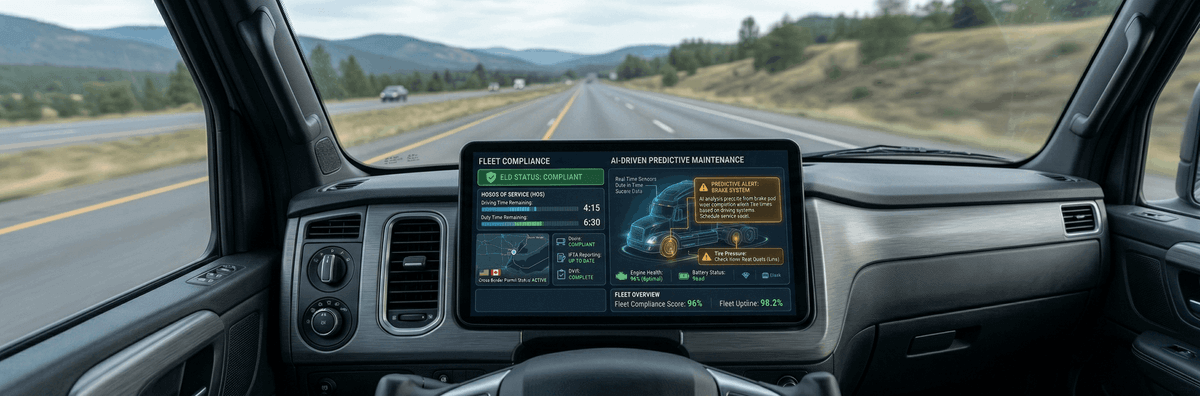
Introduction: The AI Revolution in DOT Compliance
As we navigate through 2026, the commercial transportation industry is experiencing a technological renaissance. The days of relying solely on paper logbooks, reactive maintenance strategies, and manual data entry are rapidly coming to an end. The catalyst for this massive industry shift? Artificial Intelligence (AI) and Big Data Analytics. For small and medium-sized fleets operating across the United States and Canada, adopting AI-driven compliance tools is no longer a luxury reserved for enterprise mega-fleets—it is an absolute operational necessity to survive increasingly stringent FMCSA interventions and NSC Standard 13 regulatory audits.
Historically, fleet compliance was fundamentally a backward-looking discipline. Safety managers spent hours sifting through carbon-copy Driver Vehicle Inspection Reports (DVIRs), trying to decipher illegible handwriting just to figure out what broke on a truck three days ago. By the time the data was processed, the commercial vehicle had often already suffered a critical failure on the highway, resulting in a costly DOT out-of-service (OOS) violation or, worse, a catastrophic collision.
Today, the integration of advanced machine learning algorithms into the standard electronic dvir system has flipped that paradigm entirely. Instead of reacting to the past, fleets are now predicting the future. Software platforms continuously ingest terabytes of data from daily inspections, engine telematics, and historical repair logs to identify invisible patterns. This monumental leap from analog paperwork to intelligent automation is redefining what it means to operate a safe, compliant, and highly profitable motor carrier business in 2026.
Key Takeaways
- AI has transformed DOT compliance from a reactive, paper-based chore into a proactive, predictive science that saves fleets millions in preventative maintenance.
- Computer vision technology within pre trip inspection software is actively eliminating "pencil whipping" by automatically analyzing driver-uploaded photos for mechanical defects.
- The FMCSA is increasingly utilizing big data to conduct off-site "desktop audits," making pristine, digitally verifiable electronic records mandatory for survival.
- Small to medium fleets can easily adopt these enterprise-grade AI tools through affordable, cloud-based SaaS platforms like PTI4YOU without requiring massive internal IT infrastructure.
- API-ready inspection data closes the gap between TMS, ELD, and maintenance systems—reducing duplicate entry while improving CSA-focused defect closure and audit defensibility.
The Shift from Reactive to Predictive Maintenance (AI in DVIR)
Perhaps the most immediate and profound financial impact of AI in fleet management is the evolution of predictive maintenance. Traditional fleet maintenance operates on two basic models: reactive (fix it when it breaks) and preventative (fix it on a rigid schedule based on mileage). Both are incredibly inefficient. Reactive maintenance guarantees unexpected downtime and massive towing bills, while rigid preventative schedules often result in replacing perfectly good parts prematurely, wasting capital.
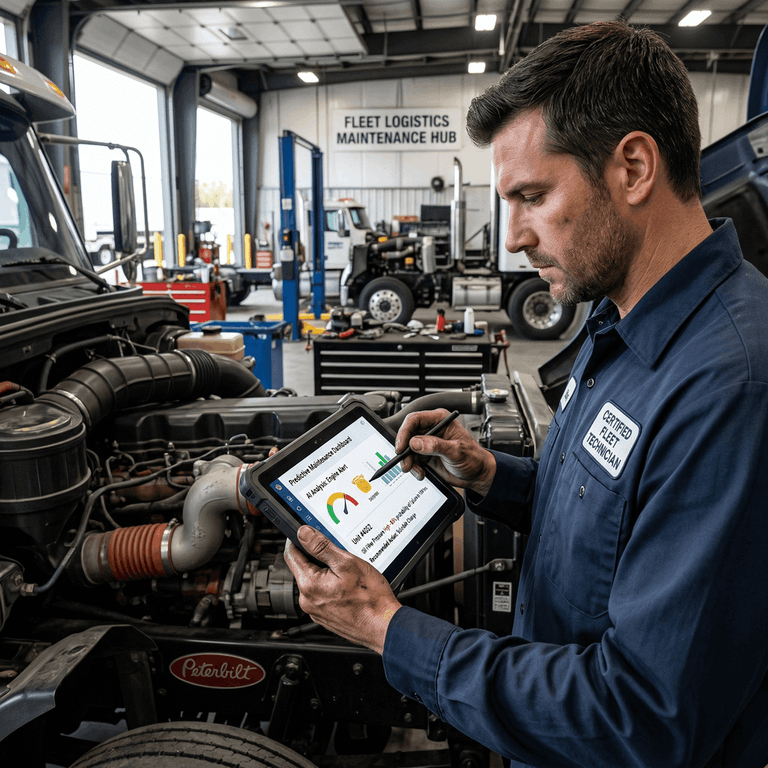
AI introduces a third, vastly superior model: Predictive Maintenance. By leveraging an advanced electronic dvir system, fleet managers are now equipped with predictive analytics that calculate the exact remaining useful life of a component.
Here is how it works in practice: Every morning, drivers perform their digital pre-trip inspections. They log minor observations—perhaps a slight fraying on an air brake hose or a minor fluctuation in voltage. Historically, these minor notes were ignored until a catastrophic failure occurred. However, an AI-powered system aggregates these daily micro-observations and cross-references them with real-time IoT (Internet of Things) sensor data from the truck's Engine Control Module (ECM) and historical failure rates across thousands of similar vehicles in the cloud database.
The machine learning model recognizes the pattern. It flags the fleet manager's dashboard with an alert: "Vehicle 402 has an 87% probability of alternator failure within the next 1,500 miles. Route to shop immediately." The part is ordered before it breaks, the truck is routed to the terminal precisely when the part arrives, and the repair is completed during scheduled off-hours. This eliminates roadside breakdowns, safeguards the carrier's CSA scores, and ensures total compliance with FMCSA 396.11 repair regulations.
Automated Defect Recognition (ADR): Computer Vision in Pre-Trip Inspections
For decades, the Achilles heel of fleet safety has been human error and intentional negligence, colloquially known as "pencil whipping." Even the best paper forms cannot stop a fatigued driver from checking off every box from the comfort of their cab without ever looking at the brakes. While basic digital DVIR apps introduced GPS timestamps to prove the driver walked around the truck, the next frontier in 2026 is Automated Defect Recognition (ADR) powered by Computer Vision.
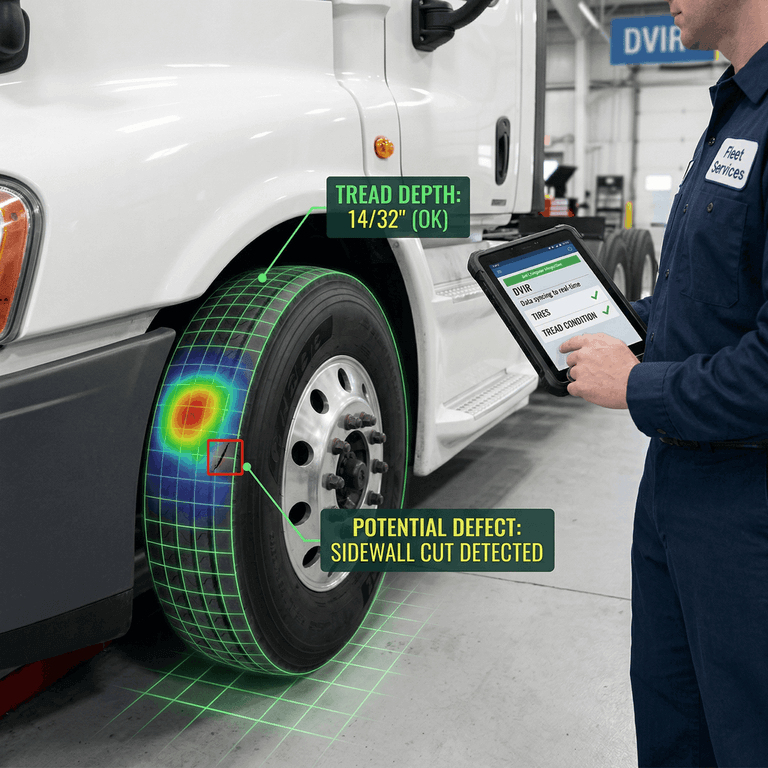
Computer vision utilizes deep learning neural networks to teach computers how to "see" and interpret digital images. When a driver uses a modern pre trip inspection software app, they are prompted to take mandatory photos of critical components—such as tire tread, glad hands, and fifth-wheel couplings.
In 2026, the software does not just passively store these photos in the cloud. The AI instantly processes the image locally on the smartphone. It can detect if a tire's tread depth has fallen below the DOT legal limit of 4/32 of an inch for steer tires. It can identify micro-fissures in brake chamber pushrods. It can even verify that the photo submitted is actually of the specific truck assigned, preventing drivers from uploading stock photos from their camera roll.
If the computer vision algorithm detects a severe safety violation that the driver missed (or attempted to ignore), it can automatically override the driver's "All Clear" submission, flag the vehicle as Out-Of-Service, and instantly notify the maintenance director. This removes the subjective burden from the driver, mathematically eliminating pencil whipping and ensuring perfect adherence to physical safety standards.
Core AI Capabilities in Modern eDVIR Systems
In 2026, artificial intelligence transcends data collection and actively intervenes to prevent mechanical failures. Modern eDVIR platforms use machine learning for predictive maintenance, neural-network computer vision for tire and defect analysis, and anomaly detection to flag falsified inspections — addressing the two costliest pain points in logistics: unplanned downtime and regulatory fines.
| Technology Capability | Mechanism of Action | Fleet Benefit & ROI |
|---|---|---|
| Predictive Maintenance Forecasting | Machine learning analyzes historical DVIR defect logs, real-time IoT sensor inputs, and ECM diagnostics to identify degradation patterns. | Forecasts part failures (alternators, air brake valves, etc.) days before they occur, enabling scheduled replacement instead of emergency roadside towing. |
| Computer Vision Tire Inspection | Neural networks process smartphone photos from the pre-trip walk-around to estimate tread depth and identify sidewall anomalies. | Matches or exceeds manual gauge accuracy, removes human subjectivity, and ensures tires are replaced before triggering a DOT violation. |
| Anomaly Detection (Anti-Fraud) | Correlates inspection completion times, GPS geofencing proximity to the asset, and accelerometer data. | Flags suspicious "pencil whipped" inspections to safety managers instantly, protecting CSA scores from negligence claims. |
AI-Powered Telematics and Hours of Service (HOS) Optimization
Compliance is not strictly limited to the mechanical condition of the vehicle; managing the physical condition of the human operator is equally critical. The FMCSA’s Hours of Service (HOS) regulations exist to combat driver fatigue, but calculating optimal routes while balancing available drive hours has historically been a logistical nightmare for dispatchers.
In 2026, AI has deeply integrated with Electronic Logging Devices (ELDs) and dispatch routing software to create dynamic, highly optimized workflows. AI algorithms analyze a driver's available HOS clock in real-time, cross-referencing it with predictive traffic models, live weather patterns, and historical loading dock wait times at specific warehousing facilities.
If a driver is approaching their 14-hour on-duty limit, the AI does not just send a generic warning. It dynamically reroutes the vehicle to the nearest, safest truck stop that is statistically proven to have available parking at that exact time of day. Furthermore, advanced AI systems are now monitoring driving behavior via telematics (harsh braking, rapid acceleration, lane drifting) to identify micro-signs of fatigue long before the driver hits their legal driving limit. This preemptive safety layer is a game-changer, drastically reducing the likelihood of fatigue-related accidents and ensuring that compliance is aligned perfectly with true human safety.
The Impact of Big Data Analytics on FMCSA Compliance Reviews
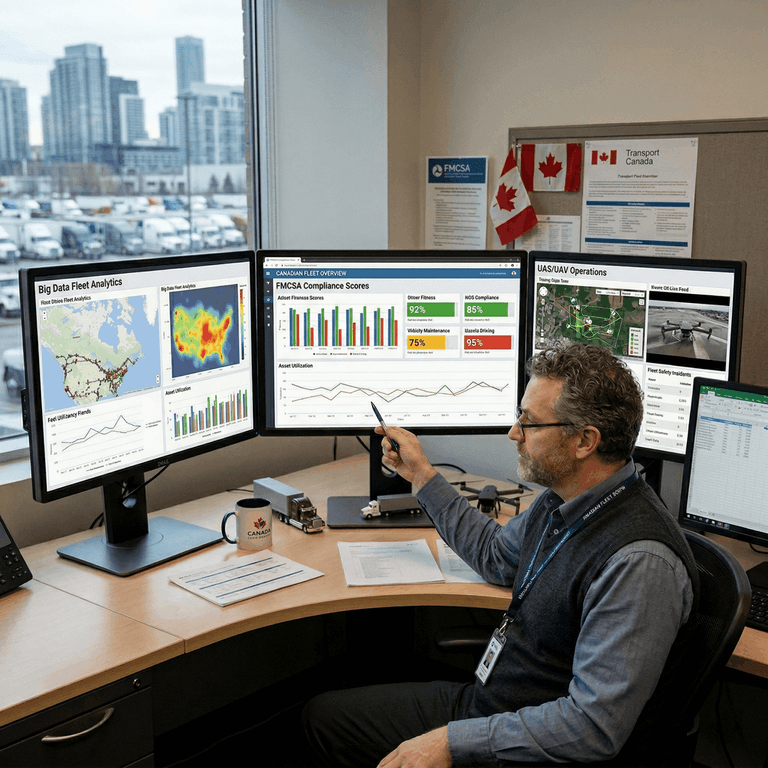
While fleets are utilizing AI to improve operations, regulatory bodies are not resting on their laurels. The FMCSA has massively overhauled its auditing protocols. The era of the physical, on-site investigator digging through filing cabinets in a carrier's terminal is fading. Instead, 2026 is the year of the highly aggressive "Desktop Audit" or Off-Site Compliance Review.
The DOT now utilizes its own big data analytics engines to constantly monitor carrier data. They ingest inspection reports from weigh stations across the country, ELD data feeds, crash reports, and toll transponder pings. If their algorithm detects a discrepancy—for example, if a toll was crossed in a specific state, but the driver's logbook showed them in the sleeper berth—an automated audit is instantly triggered.
When the DOT demands records, they expect digital, structured data that can be parsed by their algorithms. If a fleet responds by scanning handwritten paper DVIRs to a PDF, they instantly invite deeper scrutiny. To survive this new regulatory reality, fleets must fight fire with fire. Using an advanced electronic dvir system provides fleets with instantaneous, audit-ready data. Fleet safety managers can use their own analytics dashboards to pre-audit their records, identifying missing mechanic signatures or incomplete forms before the DOT ever knocks on the virtual door.
The Financial ROI of AI-Driven Fleet Compliance
For fleet owners and CFOs, the ROI of fleet management software is no longer measured in “nice dashboards.” In 2026, it is measured in avoided towing invoices, preserved delivery SLAs, and defensible data when insurers and plaintiffs ask hard questions. Boards approve AI spend when finance can tie it to a handful of concrete levers: fewer unplanned events, lower liability exposure, and measurable labor efficiency.
Preventative vs. predictive: the true cost of a roadside failure
Preventative maintenance replaces parts on a calendar; predictive maintenance replaces them when data says the failure curve is bending. The gap shows up brutally in cash flow. A single Class 8 roadside breakdown routinely stacks emergency towing, after-hours labor, hotel and repower costs, missed appointment windows, and contractual penalties—often before the first wrench turns. Predictive workflows do not eliminate every surprise, but they shift a large share of repairs into scheduled shop windows where you control parts sourcing, bay time, and driver swaps. When AI correlates DVIR notes, fault codes, and prior work orders, fleets reduce fleet maintenance costs by intervening days or weeks before the failure shows up on an interstate shoulder.
Insurance: empirical safety data that underwriters can price
Commercial auto underwriters in 2026 increasingly ask for evidence, not anecdotes. Carriers that can export structured histories—clean inspection trails, closed defect loops, telematics-backed coaching, and reduced OOS exposure—are better positioned to argue for fleet insurance premium reduction or renewal stability in hard markets. AI does not replace an actuary, but it produces the longitudinal proof points (frequency, severity trends, and remediation speed) that differentiate a disciplined motor carrier from a “paper compliant” one.
Labor optimization for mechanics and safety managers
Every hour a safety manager spends reconciling illegible DVIRs or chasing a third signature is an hour not spent on targeted coaching or vendor QA. Every hour a technician spends diagnosing “driver said weird noise” without photos or codes is billable time burned. AI-driven workflows automate triage: prioritized defect queues, photo-enriched work orders, and exception-based alerts so staff focus on vehicles that actually need human judgment. Over a multi-shop operation, that compounds into several hours per week per role—enough to defer a hire or reallocate capacity to PM lanes that extend asset life.
Overcoming Data Silos: API Integrations and TMS Connectivity
IT directors and fleet systems owners are tired of paying for three platforms that refuse to talk to each other: a TMS for planning, an ELD for hours, and a clipboard—or a legacy PDF—for inspections. Fragmentation guarantees duplicate data entry, stale asset records, and blind spots when a trailer changes hands mid-lane. In 2026, procurement teams explicitly score open architecture fleet software and integration roadmaps alongside feature checklists.
Modern electronic DVIR platforms expose fleet software API layers (typically REST with OAuth2-style authentication) so inspection outcomes, defect severity, photo metadata, and mechanic sign-offs can flow into the systems of record your business already runs. That is how you connect ELD with DVIR narratives in one operational picture: HOS context from the ELD, mechanical context from the DVIR, and dispatch context from the TMS—without forcing dispatchers to open four browser tabs at 2:00 a.m.
Practical integration patterns include: webhook notifications when a vehicle is marked not safe to operate; nightly or near-real-time sync of unit numbers and VINs from the TMS master; pushing closed repair events back to maintenance modules; and attaching inspection PDFs to customer portals when regulated shippers require documentation. Mentioning compatibility with major ELD providers matters because many fleets standardize on a telematics stack first; the inspection layer must ingest device IDs, geofences, and driver identifiers without brittle CSV imports. PTI4YOU is built as a cloud-native compliance hub so your AI-enriched inspection data is not trapped in a mobile silo—it becomes fuel for ERP, TMS, and BI tools your CFO already trusts.
Deep Dive: How AI Directly Improves CSA BASIC Scores
If you are searching for how to improve CSA scores, start with the mechanism FMCSA uses to prioritize carriers: BASICs (Behavior Analysis and Safety Improvement Categories)—percentiles derived from roadside inspections, crashes, and investigation results, normalized against peer groups. AI does not “game” BASICs; it reduces the upstream behaviors and documentation failures that produce bad points in the first place.
Vehicle Maintenance BASIC: catching defects before the scale house does
The Vehicle Maintenance BASIC punishes lights, brakes, tires, and coupling defects that inspectors love to write. Computer vision on steer and drive tire photos, coupled with structured DVIR workflows, pushes defects into repair queues while the truck is still at the terminal. Predictive signals from ECM and inspection history reduce the odds that a marginal brake component fails under a heat cycle on a mountain grade. Fewer violations and fewer OOS events directly dampen maintenance-related intervention risk.
Unsafe Driving BASIC: telematics that convert noise into coaching
The Unsafe Driving BASIC reflects moving violations and, critically, the patterns that precede them. AI-assisted telematics prioritizes harsh braking, speed variability, and night-driving risk clusters so safety teams intervene with specific drivers—not fleet-wide email blasts. When fatigue proxies (sustained steering corrections, long idle-after-midnight clusters) trigger supervisor review, you address behavioral drift before it becomes a citation or a camera event on social media.
Crash Indicator and litigation: why pristine digital records matter
The Crash Indicator BASIC is not something you “train away” in a morning meeting; it reflects reportable crashes relative to exposure. Where AI-backed compliance earns its keep is in the months after an incident: synchronized DVIR history, photo evidence of component condition, geotagged inspections, and closed-loop mechanic signatures. That stack becomes your defensible narrative in post-accident litigation and carrier oversight conversations—demonstrating a contemporaneous culture of inspection, not a reconstructed binder assembled under subpoena.
Data Security and Cybersecurity in AI Fleet Platforms
As cabs become sensor-rich and inspection apps collect fleet data—GPS traces, facially neutral but sensitive photos, HOS-adjacent timestamps—security is a board-level issue, not an IT footnote. A breach that leaks driver routes or customer delivery patterns can trigger regulatory notification obligations, contract penalties, and reputational damage that dwarf the monthly SaaS fee.
Leading platforms in 2026 design around cloud DVIR data privacy principles: encryption in transit (TLS 1.2+), encryption at rest for object storage, and role-based access control (RBAC) so a terminal clerk, mechanic, and auditor see only the slices of data their job requires. Audit logs that prove who viewed or exported a DVIR matter when opposing counsel asks whether records could have been altered casually.
Ask vendors how they handle key management, penetration testing cadence, and whether they maintain or are pursuing SOC 2-aligned controls—terms procurement teams now grep for in RFPs. Redundancy is equally operational: hosting on durable AWS or Azure regions with automated backups means a lost phone never equals a lost inspection during an FMCSA snapshot request. Your fleet data security posture should be as resilient as your tire program—because in 2026, ransomware and data integrity attacks are as real as brake fade.
Canadian NSC Standard 13 and Cross-Border AI Compliance
For fleets operating in Canada, or US carriers crossing the northern border, compliance complexity doubles. Commercial vehicle safety in Canada is strictly governed by the National Safety Code (NSC), particularly Standard 13 regarding daily trip inspections. Unlike the broad FMCSA guidelines, NSC Standard 13 mandates highly prescriptive schedules (Schedule 1, 2, and 3) that dictate exactly what must be checked based on the vehicle type.
Managing this regulatory juxtaposition manually is prone to devastating errors. However, artificial intelligence DOT compliance systems seamlessly handle border crossings. When a truck equipped with intelligent pre trip inspection software crosses the geofenced border into Ontario or British Columbia, the AI automatically recognizes the jurisdictional shift. It instantly updates the driver's mobile application interface, swapping out the US FMCSA compliance templates for the exact Schedule required by NSC Standard 13.
This dynamic, geofenced automation ensures that drivers never accidentally use the wrong inspection form, completely insulating the carrier from severe cross-border regulatory fines and impounds.
Addressing the Driver Shortage: How AI Improves Retention and Safety Culture
The logistics industry continues to grapple with a chronic shortage of qualified commercial drivers. Recruiting is expensive, but retention is paramount. One of the most overlooked benefits of deploying AI and automated compliance tools is the direct positive impact on driver satisfaction.
Drivers inherently despise administrative paperwork. Spending 30 minutes in the cold rain filling out redundant carbon-copy forms is a massive pain point. AI-driven apps reduce this friction dramatically. Voice-to-text NLP (Natural Language Processing) allows a driver to simply speak their inspection notes into their phone. Predictive templates pre-fill known vehicle data. Computer vision handles the heavy lifting of measuring component tolerances.
Furthermore, AI introduces intelligent gamification into fleet safety culture. By analyzing telematics and inspection thoroughness, AI platforms can automatically generate driver safety scores. Fleet managers can use these transparent, unbiased metrics to reward their top performers with bonuses. When drivers realize the software is there to protect their licenses, streamline their days, and actively reward safe behavior, they embrace the technology rather than resist it.
Case Study: How a 50-Truck Mixed Fleet Adopted AI Inspections (Hypothetical)
Midwest Logistics & Freight (a composite example for illustration) operates roughly fifty power units split between refrigerated OTR, regional flatbed, and dedicated yard spotting. Until 2025, their compliance program relied on triplicate paper DVIRs, a shared inbox at the terminal, and a part-time safety coordinator who spent Mondays scanning forms into a folder “for later.” Roadside inspections were “mostly fine”—until they were not. A cluster of tire and lighting violations in a single quarter pushed their Vehicle Maintenance percentile into alert territory and forced the owner to cancel expansion bids with a shipper that audits carriers quarterly.
The fleet’s root problems were familiar: pencil whipping on cold mornings, inconsistent photo documentation, and mechanics signing repairs without a time-stamped trail tied to the original driver report. DOT correspondence asked for ninety days of DVIR history on specific units; the carrier produced incomplete PDFs and hand-written notes. Legal counsel’s message was blunt—paper might be “legal,” but it was not defensible.
The turnaround plan had three technical pillars. First, they rolled out a cloud electronic DVIR with mandatory photo capture on steer tires, airlines, and fifth wheels, using computer vision to reject dark or off-angle shots before submission. Second, they connected telematics feeds so predictive alerts could fuse ECM trends with driver-noted “minor” defects. Third, they opened API integrations so inspection status synced nightly into their TMS—dispatchers stopped assigning loads to units with open brake defects.
Six months later—again, as a modeled outcome rather than a guarantee for any reader’s operation—leadership reported roughly a 40% reduction in OOS-related roadside events tied to tires and lights, and shop foremen estimated a 15% improvement in mechanic efficiency because work orders arrived with photos, codes, and prioritized severity. The safety coordinator reclaimed roughly eight hours per week previously lost to scanning and phone tag. The moral for owners and safety directors: AI’s value shows up both in spreadsheets and in the quiet absence of 2:00 a.m. phone calls.
5 Steps to Implement AI-Driven Compliance in Your Fleet
Understanding the theoretical power of AI is easy; deploying it practically within a mid-sized operation requires a structured strategy. Here is exactly how fleets can transition to a 2026-ready operational model.
-
Step 1: Audit Your Current Data Collection Methods
Before AI can help you, you need clean, structured data. Assess how your fleet currently records inspections. If you are still relying on loose paper in a cardboard box, your immediate first step is transitioning to a baseline electronic DVIR system to begin generating machine-readable digital data.
-
Step 2: Upgrade to a Cloud-Based SaaS Platform
You do not need to hire a team of data scientists to build this technology in-house. Select a modern fleet management platform that actively integrates machine learning APIs, such as PTI4YOU. Ensure the software offers predictive analytics dashboards and supports automated mechanic defect workflows.
-
Step 3: Integrate Telematics and IoT Sensors
Connect your new electronic DVIR software directly to your existing vehicle telematics (ELDs, engine diagnostic ports, tire pressure monitoring systems). AI predictive models require this real-time input to make accurate preventative maintenance forecasts.
-
Step 4: Train Drivers on Computer Vision Tools
Introduce your drivers to the advanced AI features within their mobile inspection app. Host a training seminar teaching them how to take clear, well-lit, correctly angled photos of critical vehicle components so the computer vision algorithms can accurately assess wear and tear without error.
-
Step 5: Transition to Exception-Based Management
Once the AI system is live and ingesting data, you must change your management style. Stop micromanaging every single clear inspection. Use your analytics dashboard to practice 'exception-based management'—focusing 100% of your safety department's time entirely on the predictive alerts, flagged safety risks, and operational anomalies highlighted by the AI engine.
Frequently Asked Questions (FAQ)
How is AI used in fleet management in 2026?
In 2026, AI is primarily used in fleet management for predictive maintenance (forecasting part failures before they happen), automated defect recognition via computer vision during pre-trip inspections, route optimization, and analyzing vast amounts of telematics data to predict and prevent DOT compliance violations.
What is predictive maintenance in trucking?
Predictive maintenance utilizes machine learning algorithms to analyze historical DVIR data, real-time IoT sensor inputs, and engine diagnostics to precisely predict when a specific commercial vehicle component (like an alternator or an air brake relay valve) is likely to fail. This allows fleets to replace parts proactively, preventing catastrophic roadside breakdowns and saving immense capital.
Can an electronic DVIR system use AI to stop pencil whipping?
Yes. Modern electronic DVIR systems leverage AI and computer vision architecture. If a driver takes a photo of a tire during a digital inspection, the AI instantly analyzes the image for adequate tread depth and structural sidewall damage. Coupled with unalterable GPS geofencing and timestamp analytics, AI makes it virtually impossible for a driver to fake or "pencil whip" a physical vehicle inspection.
Is AI fleet management software affordable for small fleets?
Absolutely. While early AI tools required massive enterprise hardware investments and on-premise servers, cloud computing has entirely democratized the technology. In 2026, specialized SaaS platforms like PTI4YOU deliver powerful AI analytics and automated compliance workflows to small and medium fleets for a low, highly scalable monthly subscription fee per vehicle.
Will AI replace human fleet safety managers?
No. AI removes repetitive enforcement work—chasing signatures, scanning paper, and manually hunting for missing inspections—so directors can focus on coaching, vendor management, and strategic risk reduction. The job becomes more analytical, not obsolete.
How accurate is computer vision for truck tire inspections?
With proper lighting, distance, and a square-on camera angle, 2026-era models often match careful gauge-based tread readings and consistently outperform rushed visual guesses in the field. Apps that coach drivers to retake bad photos close the gap between algorithm capability and real-world cab conditions.
What happens if a digital DVIR app loses cellular connection?
Choose software with a true offline mode: complete inspections without bars, store photos and signatures securely on-device, then auto-sync when the network returns. Ask vendors how they prevent duplicate submissions and preserve audit timestamps across sync delays—especially for teams that run rural lanes or indoor yards.
Conclusion: Embracing the Future with PTI4YOU
The intersection of artificial intelligence, big data analytics, and regulatory compliance has completely redefined the standard operating procedures of the transportation industry in 2026. Fleets that cling to paper-based, analog processes will inevitably succumb to the massive financial strain of unexpected maintenance costs and aggressive, algorithmic DOT audits.
Embracing AI is not about replacing human drivers or safety managers; it is about providing them with tools that grant superhuman foresight. By deploying an advanced electronic dvir system, fleet managers can predict the future of their assets, ensure absolute cross-border compliance, and cultivate a deeply ingrained culture of technological safety.
Future-Proof Your Compliance Strategy with PTI4YOU
Don't let your fleet get left behind in the analog age. PTI4YOU provides a state-of-the-art, DOT-compliant eDVIR platform designed specifically to harness the power of digital data for small to medium fleets. Eliminate paperwork, eradicate pencil whipping, and leverage deep analytics to ace your next FMCSA audit.
Step into 2026. Start your 15-day free trial today. No credit card required.
Start Your 15-Day Free Trial – No Credit Card RequiredZero setup fees. Zero hardware. 25-minute driver onboarding.