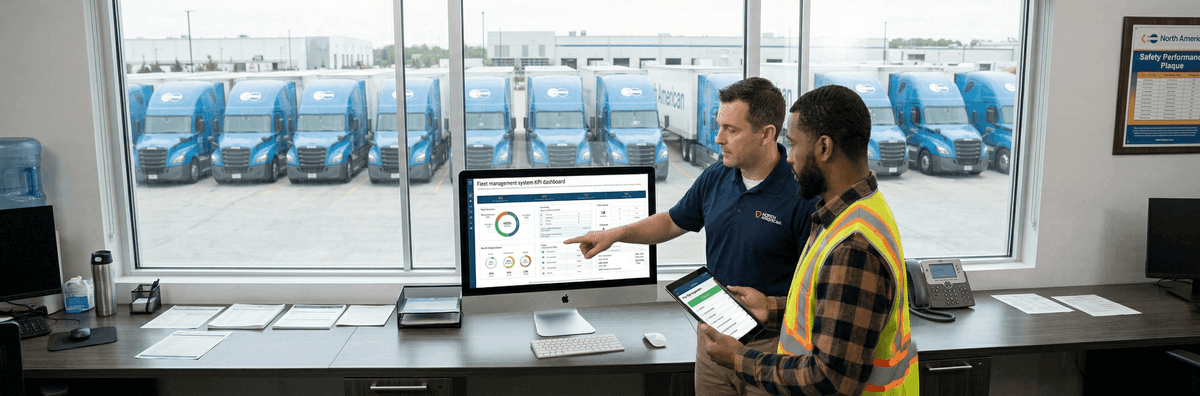
Introduction: The Death of Paper DVIRs in 2026
If you are managing a small or medium-sized commercial motor vehicle (CMV) fleet in 2026, you already know that relying on carbon-copy paper inspection books is a dangerous, outdated game. The landscape of federal regulatory compliance has evolved at breakneck speed. On February 19, 2026, the Federal Motor Carrier Safety Administration (FMCSA) published a highly anticipated Final Rule under Docket No. FMCSA-2025-0115, officially codifying and actively encouraging the use of Electronic Driver Vehicle Inspection Reports (eDVIRs). The rule specifically clarified how electronic signatures are validated under the E-SIGN Act and GPEA rules, making digital files just as legally binding—and much more preferred—than paper logs.
For fleet managers, this signifies a massive shift. When a DOT auditor requests 90 days of Driver Vehicle Inspection Reports (DVIRs), handing them a greasy, illegible cardboard box of papers is no longer acceptable. The industry standard has officially shifted to the electronic dvir system. Modern software provides pristine, searchable, time-stamped digital records that pass FMCSA desktop audits with flying colors. The challenge for small and medium fleets is no longer deciding whether to digitize, but rather choosing the best pre trip inspection software 2026 has to offer without breaking the bank or getting locked into restrictive hardware contracts.
Key Takeaways
- The February 2026 FMCSA Final Rule officially validated and encouraged the use of electronic signatures and digital DVIRs, rendering paper logs functionally obsolete.
- Finding the right pre trip inspection software requires balancing cost, ease of use for drivers, and a robust mechanic portal to satisfy the FMCSA's mandatory "three-signature cycle."
- Enterprise telematics solutions like Motive and Geotab are powerful but can be expensive and overly complex for fleets under 50 vehicles.
- Dedicated apps like PTI4YOU offer a highly focused, cost-effective alternative to eliminate "pencil whipping" through GPS timestamps and mandatory photo uploads.
Why Small and Medium Fleets Struggle with Compliance
Operating a fleet of 5 to 50 trucks is one of the most challenging ventures in the logistics space. Unlike enterprise mega-fleets that employ dedicated safety departments, compliance managers, and legal teams, small fleet owners wear multiple hats. You are the dispatcher, the mechanic liaison, the HR director, and the DOT safety manager all at once. In this high-pressure environment, daily compliance tasks like the pre-trip and post-trip inspection often fall through the cracks.
Under 49 CFR 396.11, every driver must prepare a written report at the completion of each day's work for each vehicle operated if a defect is found. Before dispatch the next morning, 49 CFR 396.13 requires the driver to review and sign the previous day's DVIR to acknowledge that reported defects were repaired. When using paper, this creates a logistical nightmare. Drivers lose forms, handwriting is completely illegible, and the critical communication loop between the driver who found the defect and the mechanic who fixed it is broken. If an FMCSA investigator uncovers this broken chain during a Compliance Review, your company faces massive civil penalties, a downgraded safety rating, and potentially devastating "Nuclear Verdicts" in the event of an accident.
Small fleets desperately need an electronic pre trip inspection solution that automates this workflow. However, many small carriers make the mistake of assuming that to get an app, they must purchase a $100-per-month, per-truck enterprise ELD (Electronic Logging Device) suite. This is a massive misconception. In 2026, there are highly capable standalone applications specifically built for the operational realities of medium-sized fleets.
Key Features to Look for in Pre Trip Inspection Software
Before diving into specific brand comparisons, it is vital to understand the foundational architecture that makes an app reliable. When evaluating an electronic dvir system, do not be swayed by flashy marketing jargon. Look for these absolute non-negotiable features:
- Offline Functionality: Trucks operate in rural areas, oil fields, and mountain passes where 5G cellular service does not exist. Your software must allow the driver to complete the inspection offline and automatically sync the data to the cloud the moment a connection is re-established.
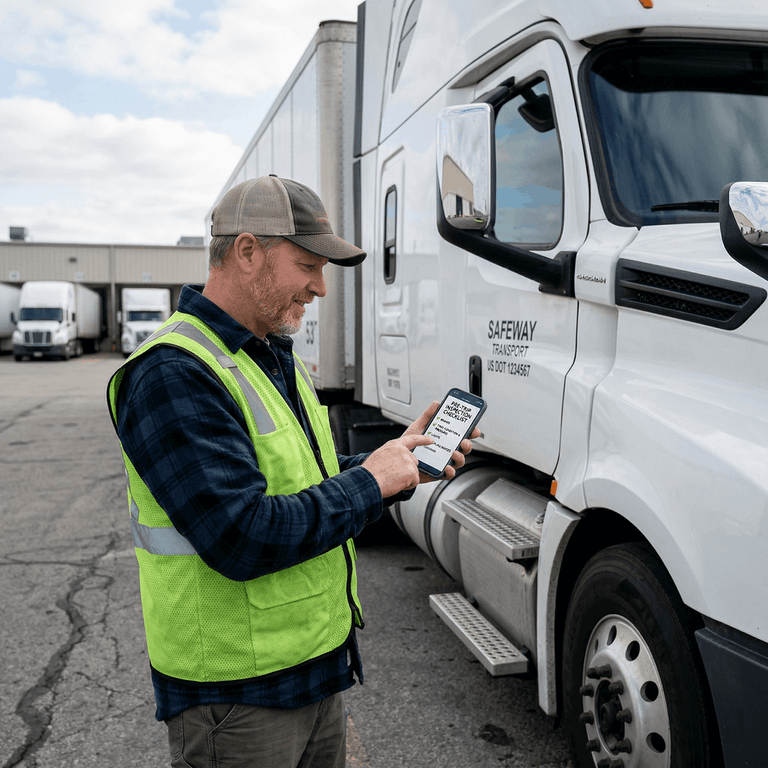
- Anti-Pencil Whipping Technology: The app must utilize the device's native GPS and camera. If a driver claims they inspected the trailer tires, the app should force them to take a live, time-stamped photo of the tread. GPS geofencing ensures the driver is actually standing near the truck, not filling out the form from their living room couch.
- The FMCSA Three-Signature Loop: The software must seamlessly connect the driver, the mechanic, and the subsequent driver. When a defect is logged, a digital work order must trigger in the mechanic's portal. The mechanic signs off digitally, and the app forces the next driver to co-sign the repair before allowing them to begin their shift.
- Customizable Forms: A standard semi-truck requires a different inspection checklist than a refrigerated reefer trailer, a flatbed, or heavy construction equipment. The platform must allow the fleet manager to build custom, drag-and-drop digital checklists.
- Instant Audit Reporting: If the DOT knocks on your door, you need to be able to generate a pristine, filtered PDF report of the last 90 days of inspections with three clicks.
What Are the Best DVIR Apps for Commercial Fleets in 2026?
The top electronic DVIR apps for 2026 are PTI4YOU (best for small and medium fleets requiring zero hardware lock-in), Whip Around (best for external vendor maintenance tracking), Motive (best for enterprise all-in-one ELD telematics), Fleetio (best for total cost of ownership analytics), and Geotab (best for deep engine diagnostics). The correct choice depends on fleet size, hardware budget, and compliance priorities.
2026 DVIR Software Competitor Comparison Matrix
| Software Provider | Ideal Fleet Size & Focus | Hardware Required? | Pricing Structure | Anti-Pencil-Whipping Tech |
|---|---|---|---|---|
| PTI4YOU | Small & Medium Fleets (1–100 trucks) | No (BYOD / Cloud SaaS) | Transparent monthly per asset | High (GPS geofencing, photo mandates) |
| Motive | Large enterprises wanting an ELD ecosystem | Yes (Vehicle Gateway required) | Premium + long-term contracts | High (AI dashcam integration) |
| Whip Around | Fleets needing external vendor work orders | No | Tiered (can be costly for small fleets) | Medium |
| Fleetio | Operations with deep parts inventory | No | Per asset (risk of alert fatigue) | Medium |
| Geotab | Data engineers needing ECM diagnostics | Yes (Geotab GO device) | Enterprise subscription | High |
Why Small Fleets Are Switching from Motive to PTI4YOU
While Motive (formerly KeepTruckin) offers a remarkably robust all-in-one logistics suite, it comes with extreme operational overhead. Small and medium fleets are frequently forced into multi-year contracts and must purchase proprietary hardware, often starting at over $150 per ELD device, just to access basic inspection modules. PTI4YOU serves as the premier Motive alternative for small fleets by offering a "Zero Hardware Lock-In" guarantee. Drivers simply use their existing personal smartphones (BYOD), allowing operators to achieve 100% DOT and California BIT compliance without absorbing the crushing enterprise price tag.
The following sections break down each platform in detail so you can match the right tool to your operation.
1. PTI4YOU: Best Overall for Small & Medium Fleets
While massive tech conglomerates try to build software that does a hundred things adequately, PTI4YOU was engineered from the ground up to do one thing flawlessly: bulletproof DVIR and DOT compliance. It is the absolute best solution on the market for fleets ranging from 1 to 100 trucks that need to guarantee regulatory compliance without being forced into buying expensive proprietary telematics hardware.
Pros:
- Hyper-Focused Compliance: Perfect alignment with FMCSA Rule 396.11 and the stringent California BIT Program (AB 3278).
- Zero Hardware Lock-In: It operates strictly as a cloud-based SaaS application on your drivers' existing iOS or Android smartphones. You don't need to purchase $300 tablets.
- Advanced Anti-Fraud: Proprietary geofencing and required live-photo uploads make it physically impossible for a driver to "pencil whip" an inspection.
- Cost-Effective: Transparent, low monthly pricing tailored for tight-margin fleets.
Cons:
- It is a specialized compliance tool. If your fleet is looking for integrated AI dashcams or automated IFTA fuel tax reporting within the exact same app, you will need a heavier, more expensive enterprise suite.
2. Whip Around
Founded to streamline maintenance, Whip Around is a highly respected, comprehensive fleet management platform. It offers an excellent digital pre trip inspection interface and connects seamlessly with mechanics for work order management.
Pros:
- Incredible user interface (UI) that is easy for drivers to adopt.
- Deep integration capabilities with partners like Platform Science, telematics providers, and fuel cards.
- Dynamic reporting and analytics dashboards that provide deep insights into fleet uptime and recurring defects.
Cons:
- The pricing tiers can become aggressively expensive for very small fleets (under 15 vehicles) because you are paying for robust inventory and purchase order features that a small operator may never use.
3. Motive (Formerly KeepTruckin)
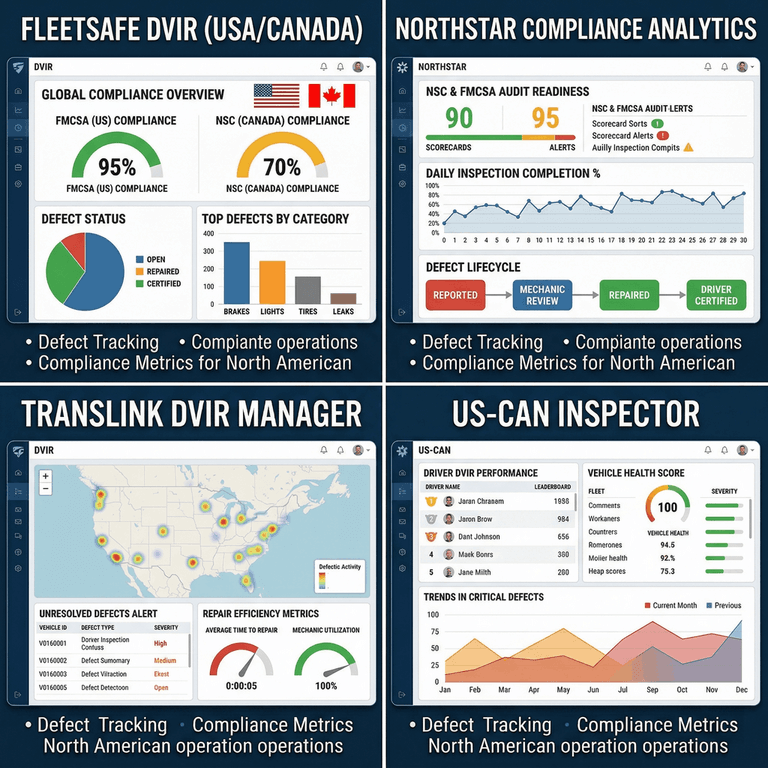
Motive is an absolute powerhouse in the logistics technology space. They provide an all-in-one suite that covers ELD compliance, DVIRs, GPS tracking, and their newly released AI Dashcam Plus. It is a fantastic system if you want everything under one single corporate umbrella.
Pros:
- The Motive Driver App smoothly handles HOS (Hours of Service) and DVIR in one seamless workflow.
- Incredible AI safety features that actively monitor driver fatigue and following distance.
- Massive ecosystem that integrates with their proprietary fuel cards to minimize fraud.
Cons:
- To use the Motive DVIR effectively, you generally need to be fully bought into the Motive hardware ecosystem (Vehicle Gateway devices). For a small fleet just looking to replace paper inspections, this is a massive, multi-year financial commitment that is often overkill.
4. Fleetio
Fleetio approaches the market from a deep maintenance perspective. Their primary goal is to help fleets run like well-oiled machines by managing total cost of ownership, preventative maintenance (PM) schedules, and parts inventory. Their DVIR capability is robust, but it is viewed as an input mechanism to feed their larger maintenance algorithms.
Pros:
- Exceptional maintenance tracking. A failed DVIR instantly kicks off an automated work order routing to internal shops or outsourced third-party vendors.
- The Fleetio Go mobile app (recently updated in early 2026) allows drivers to scan barcodes to instantly pull up asset profiles and begin their electronic pre trip inspection.
Cons:
- The sheer complexity of the software can cause "alert fatigue" for a small fleet operator. If you do not have a dedicated shop manager to process the data, Fleetio's deep feature set is largely wasted.
5. Geotab (Geotab Drive)
Geotab is the global giant of vehicle telematics, trusted by massive enterprise fleets and government agencies. Their DVIR solution is integrated deeply into the Geotab Drive mobile application, tying inspection data directly to engine diagnostics.
Pros:
- Unmatched engine diagnostic data. If a driver reports a brake issue, the fleet manager can cross-reference the DVIR with live telematics data pulling directly from the truck's ECM.
- Highly reliable server uptime and massive enterprise scalability.
Cons:
- Geotab's interface is historically built for engineers and data analysts, making it slightly clunky and less intuitive for the average truck driver compared to dedicated apps like PTI4YOU. It also requires the installation of the Geotab GO device.
The True Cost of "Free" Electronic DVIR Systems
Many ELD providers offer a "free" basic DVIR module bundled within their standard Hours of Service application. While this sounds appealing to budget-conscious fleet owners, these bare-bones systems often harbor hidden costs. A basic ELD add-on typically provides a simple digital checklist without any verification mechanics.
If the app does not force the driver to take photos, does not track the time spent on the inspection, and does not have a dedicated sign-off portal for your mechanic, it is just a digital piece of paper. It does nothing to improve safety or prevent falsification. When a driver performs a fake 30-second inspection on a "free" app and misses a critical air leak, the resulting DOT out-of-service fine (averaging over $1,300 per violation in 2026) instantly destroys any money you saved on software subscriptions. For a deeper breakdown of this math, review our guide on the hidden costs of paper vs. electronic DVIRs.
How an Electronic DVIR System Solves Pencil Whipping
The term "pencil whipping" refers to the dangerous industry practice where a driver quickly checks off every box on a paper DVIR without actually walking around and inspecting the commercial vehicle. It is driven by tight delivery schedules and driver fatigue. Unfortunately, a paper book cannot stop a driver from sitting in the cab, drinking a coffee, and signing a form that says the brakes were checked.
An advanced electronic dvir system structurally eliminates this fraud. When a driver initiates an inspection in an app like PTI4YOU, the system logs the exact GPS coordinates. As they progress through the list, the app mandates that the driver upload live photos of critical components (e.g., the fifth-wheel coupling, glad hands, tire tread depth). The software timestamps each photo, proving to management—and to the DOT—that a thorough, physical walk-around was conducted. To explore the psychology and severe legal consequences of this practice, read our deep dive on the hidden cost of pencil whipping.
Understanding the FMCSA 396.11 Three-Signature Cycle
One of the most complex regulatory hurdles for small fleets is managing the FMCSA 396.11 requirement, specifically the communication of defects. The regulation mandates a strict three-signature cycle:
- Signature 1 (The Initial Driver): The driver discovers a defect (e.g., a cracked windshield) during their post-trip inspection, notes it on the DVIR, and signs the report electronically.
- Signature 2 (The Mechanic/Carrier): The fleet management team receives the report. The vehicle is routed to the shop. The mechanic replaces the windshield. Under federal law, the mechanic must sign the DVIR certifying that the repair was made.
- Signature 3 (The Next Driver): The following morning, the next driver assigned to that truck must review the DVIR, see the mechanic's certification, and sign off that they acknowledge the vehicle is now safe to operate.
Managing this cycle on paper is nearly impossible, as forms get lost between the terminal yard and the mechanic bay. A dedicated pre trip inspection software digitalizes this entire loop. The moment the first driver clicks submit, the mechanic receives a push notification. The moment the mechanic signs off, the next driver's app is updated. This creates a flawless, perfectly timed audit trail. Learn more about decoding FMCSA 396.11 and the electronic DVIR.
California BIT Program 2026 Updates (AB 3278)
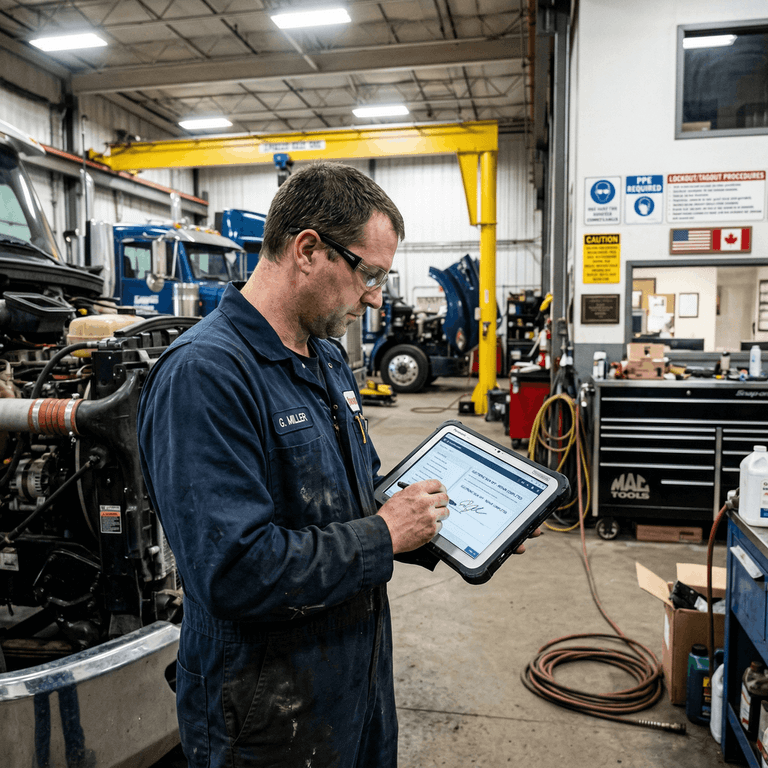
For fleets operating in or traveling through California, standard federal regulations are just the baseline. The California Highway Patrol (CHP) enforces the strict Basic Inspection of Terminals (BIT) program. Following the passage of AB 3278 and recent 2026 operational updates, the scrutiny on 90-day periodic maintenance inspections has intensified drastically.
Under the updated BIT program, CHP investigators conduct exhaustive, unannounced reviews of your maintenance records. If they find missing 90-day inspection forms or uncertified daily DVIRs, your terminal can be placed out of service. Transitioning to a digital pre trip inspection system like PTI4YOU (which features specialized, pre-built CA BIT inspection templates) ensures that every single 90-day inspection is documented, stored in the cloud securely, and instantly available for a CHP auditor to review on a cleanly formatted PDF. Discover more details in our guide to the California BIT Program 2026 Updates.
5 Steps to Roll Out an Electronic Pre Trip Inspection App
Transitioning a fleet from legacy paper books to a modern digital system does not have to be painful. By following this 30-day framework, you can ensure high driver adoption and immediate compliance improvements.
-
Step 1: Audit Your Current Paper Processes
Analyze your current DVIR workflow. Identify where forms physically get lost in your terminal, calculate how long it takes for a mechanic to receive a handwritten defect report, and tally the hidden administrative costs of storing 90 days of physical paper records in filing cabinets.
-
Step 2: Choose the Right Pre Trip Inspection Software
Select an electronic DVIR system that fits your specific fleet size. Avoid expensive, complex ELD lock-in if you primarily need compliance. Ensure the chosen app fully supports the FMCSA 396.11 three-signature cycle and has a dedicated, easy-to-use mechanic portal.
-
Step 3: Digitize Your Custom Forms
Do not rely on generic templates if your fleet is unique. Use the software's backend portal to recreate your specific vehicle inspection checklists. Ensure you have distinct forms built for heavy-duty semi-trucks, dry van trailers, refrigerated units, and specialized construction equipment.
-
Step 4: Train Drivers and Mechanics
Technology is useless without adoption. Host a mandatory training session showing drivers how to download the app onto their smartphones, execute a digital pre trip inspection, take necessary photos of defects, and sign electronically. Simultaneously, show mechanics how to receive digital work orders and sign off on repairs.
-
Step 5: Monitor the Compliance Dashboard
Once the system goes live, rely on the fleet manager dashboard to monitor daily compliance. Track individual inspection durations to catch any drivers attempting to speed-run through the process, and pull audit-ready summary reports to ensure 100% compliance across your terminal.
Frequently Asked Questions (FAQ)
What is the best pre trip inspection software 2026?
For small and medium fleets, PTI4YOU is widely considered the best pre trip inspection software in 2026 due to its laser-focus on FMCSA and California BIT compliance, cost-effectiveness, and advanced anti-pencil-whipping features like mandatory photo uploads and GPS tracking. Larger enterprise fleets often lean toward heavy telematics suites like Motive or Fleetio.
Is an electronic DVIR system required by the FMCSA?
While paper DVIRs are technically still legal, the FMCSA strongly encourages the use of an electronic DVIR system. The February 19, 2026 Final Rule explicitly clarified electronic signature validation under E-SIGN and GPEA rules, effectively making digital pre trip inspections the preferred industry standard to prevent log falsification and streamline off-site DOT audits.
How does an electronic pre trip inspection prevent pencil whipping?
An electronic pre trip inspection stops pencil whipping by requiring the driver to be physically present near and engaged with the vehicle. Modern software uses real-time GPS geofencing, precise timestamp validation, and app-based prompts for mandatory photo uploads of specific vehicle components (like tire tread or air brake lines) to ensure the inspection was physically completed.
Can small fleets afford digital pre trip inspection software?
Absolutely. While legacy ELD systems charged exorbitant fees for hardware bundles, modern cloud-based apps like PTI4YOU operate on a low monthly SaaS subscription model accessible from any smartphone. The minor monthly cost is vastly offset by the elimination of paper logbooks, reduced administrative labor, and the prevention of multi-thousand-dollar DOT violation fines.
Conclusion: Upgrade Your Fleet Compliance Today
The year 2026 marks the definitive end of the paper inspection era. With the FMCSA actively paving the legal runway for electronic record-keeping, relying on easily lost, easily faked carbon-copy books is a massive liability. Whether you choose the enterprise heft of Motive, the deep maintenance tracking of Fleetio, or the highly specialized, cost-effective compliance power of PTI4YOU, adopting an electronic dvir system is the most important operational upgrade you can make this year.
Protect your fleet's safety rating, keep your drivers accountable, and ensure your vehicles are always road-ready. Take the step toward digital compliance today and experience the peace of mind that comes with perfect, audit-ready data.
Automate Your Fleet Compliance with PTI4YOU
Stop risking your business on lost paper logs and pencil-whipped inspections. PTI4YOU provides the ultimate DOT-compliant eDVIR platform designed specifically for small to medium fleets. Digitize your records, enforce physical compliance with GPS and photos, and easily pass your next FMCSA or California BIT audit.
Start your 15-day free trial today. No credit card required.
Start Your 15-Day Free Trial – No Credit Card RequiredZero setup fees. Zero hardware. 25-minute driver onboarding.