Introduction: The Silent Epidemic in Fleet Maintenance
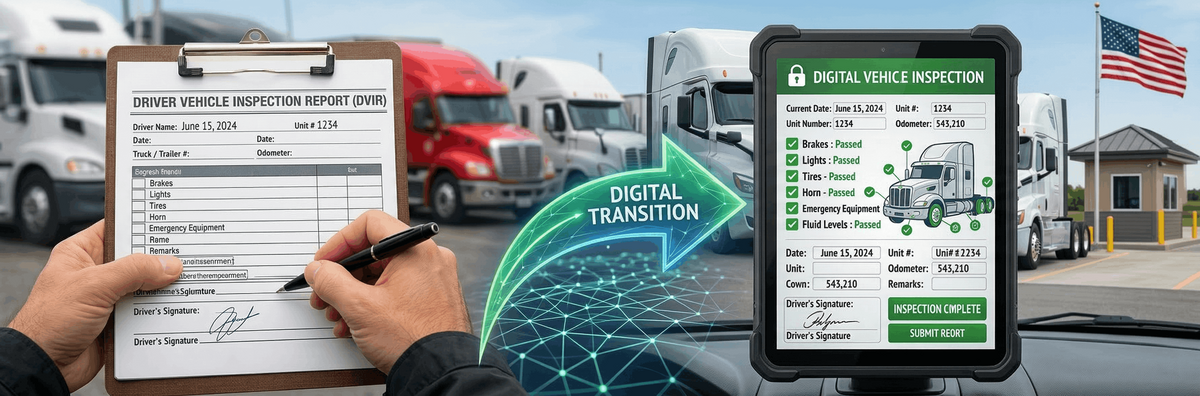
Pencil whipping is the fraudulent practice of a commercial driver rapidly checking off boxes on a Driver Vehicle Inspection Report (DVIR) and signing it without physically verifying the safety condition of critical components. Falsifying a DVIR violates 49 CFR 390.35, triggers immediate Out-of-Service orders, and — under the FMCSA Final Rule (Docket No. FMCSA-2025-0115) effective March 23, 2026 — is directly detectable through electronic audit trails that paper logs cannot provide.
Key Takeaways: The 2026 Reality of Pencil Whipping and Fake DVIRs
- Definition: Pencil whipping means a driver signs a mandatory pre-trip or post-trip DVIR without performing the physical walk-around inspection required under 49 CFR § 396.11 and § 396.13.
- FMCSA penalties & CSA impact: Falsifying inspections violates 49 CFR 390.35. Under the 2026 CSA scoring overhaul, "Driver Observed" maintenance failures (bald tires, inoperative lights, audible air leaks) carry double weight and trigger immediate Out-of-Service orders.
- 2026 regulatory paradigm: Following the FMCSA Final Rule (Docket No. FMCSA-2025-0115), effective March 23, 2026, paper logs are functionally obsolete. Electronic DVIRs (eDVIR) with cryptographic digital signatures under E-SIGN and GPEA are now the legally codified standard.
- DVIR retention: Motor carriers must retain DVIRs, repair certifications, and reviewing-driver signatures for at least 3 months (90 days) per 49 CFR 396.11.
- Technological prevention: Modern pre-trip inspection software definitively eliminates pencil whipping through GPS geofencing, cryptographic digital signatures, mandatory live photo captures, and minimum duration enforcement.
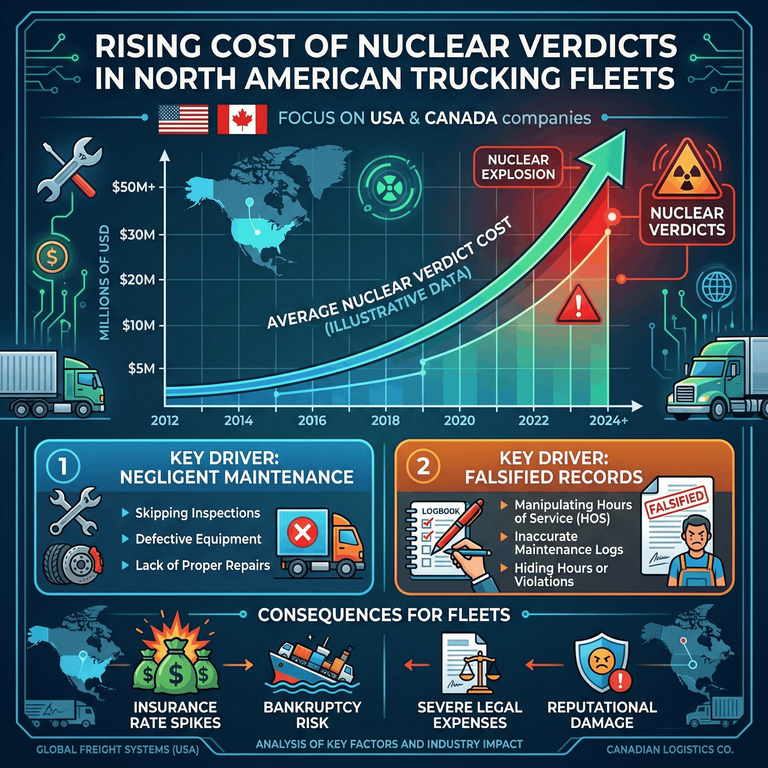
- Litigation exposure: Plaintiff attorneys subpoena paper DVIRs to prove "Reptile Theory" negligence and secure multi-million-dollar Nuclear Verdicts — an exposure that timestamped electronic records neutralize.
This comprehensive guide breaks down the psychological root causes of inspection fraud, the catastrophic legal liabilities of fake DOT inspections, the specific federal and California (AB 3278) mandates enforced in 2026, and exactly how transitioning to a modern electronic dvir system provides absolute compliance defense.
What Is Pencil Whipping Meaning in Trucking?
In the commercial trucking industry, pencil whipping means the illegal practice of a driver rapidly checking off boxes on a Driver Vehicle Inspection Report (DVIR) and signing it without conducting the actual physical inspection of critical components like brakes, tires, coupling devices, and lights. It is treated under federal law as a falsification of safety records.
The term "pencil whipping" originated in military and aviation maintenance, referring to someone using a pencil to "whip" through a checklist, signing off on tasks without verifying the equipment's condition. In the context of commercial motor vehicles (CMVs), it occurs when a driver prepares a mandatory inspection report — either the pre-trip under 49 CFR § 396.13 or the post-trip under 49 CFR § 396.11 — and marks all systems as "satisfactory" without physically looking at them or testing them.
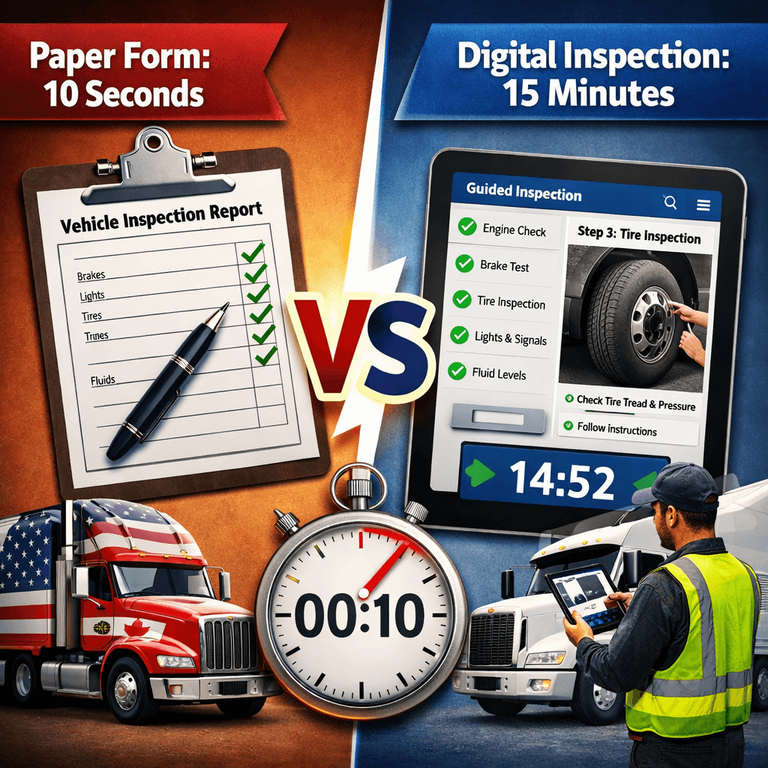
A typical 18-wheeler has over 50 specific components that require visual or physical verification daily: tire tread depth measured with a gauge, audible air brake leaks detected with the engine off, coupling devices such as fifth-wheel locking jaws physically tested, and lighting and reflectors verified clean and operable. A proper, thorough pre-trip inspection takes 15 to 20 minutes for an experienced professional; a pencil-whipped inspection takes about 15 seconds. Under strict 2026 federal enforcement protocols, pencil whipping is treated as a severe falsification of safety records, frequently leading to multi-million-dollar "Nuclear Verdicts" when plaintiff attorneys apply Reptile Theory to prove systemic corporate negligence following a collision.
Why Do Safety Checks Keep Getting Skipped or Forgotten?
Commercial vehicle safety checks keep getting skipped or forgotten primarily due to conflicting compensation structures, strict Hours of Service (HOS) constraints, fear of maintenance downtime, and driver complacency caused by repetitive paper-based processes. When investigating fake DVIRs, safety directors consistently identify four systemic root causes for pencil whipping and inspection fraud.
To solve the problem, fleet managers must first understand the psychology and operational pressures that lead a driver to falsify a federal document. Drivers generally do not pencil whip because they are malicious; they do it due to systemic industry pressures and human nature:
- Mileage-based compensation limits. The vast majority of over-the-road (OTR) drivers are paid by the mile, not by the hour. Time spent inspecting a truck in the yard is viewed as unpaid administrative labor. Under strict delivery windows, impatient dispatchers, and diminishing Hours of Service (HOS), a 20-minute inspection feels like a penalty that cuts directly into the paycheck.
- Fear of maintenance downtime. In many fleet cultures, reporting even a minor defect means the truck goes into a backed-up shop immediately. The driver is then left in the terminal lounge losing income for hours or days. Drivers intentionally pencil whip minor defects (air leaks, worn wiper blades, flickering clearance lights) hoping to have them fixed "next week" on home time.
- The "Boy Who Cried Wolf" syndrome (complacency). A driver running the same dedicated route in the same well-maintained truck who performs 100 consecutive pre-trip inspections with zero defects inherently begins to categorize the task as useless bureaucracy. The psychological perception of risk diminishes, and the inspection becomes a rubber-stamp rather than a life-saving protocol.
- Adverse environmental conditions and miserable paperwork. Heavy rain, snow, extreme cold, or pitch-black pre-dawn yards create severe environmental friction. The temptation to remain in a warm cab and draw a straight line down a carbon-copy paper inspection form — rather than standing outside with a flashlight and clipboard — is overwhelming when the form itself offers no verification loop.
If You Have to Make a Vehicle Inspection Report, Must You Sign It?
Yes. Under FMCSA regulation 49 CFR 396.11, if you are required to make a Driver Vehicle Inspection Report (DVIR) for a commercial motor vehicle, you must sign it. The report is functionally invalid, and the vehicle cannot be legally dispatched, until the driver's signature is affixed to certify the vehicle's condition.
Decoding the FMCSA 396.11 Three-Signature Cycle
Pencil whipping most often occurs at the signature phase. However, modern compliance requires more than just the driver's initial sign-off. To fully resolve a mechanical defect and maintain strict DOT compliance, fleets must complete a closed-loop "three-signature cycle":
- Signature 1 — The driver: The commercial driver must sign the post-trip DVIR to officially document and submit any safety defects discovered during their shift.
- Signature 2 — The mechanic or motor carrier official: The signature of the motor carrier official means they legally certify that the documented defect has been repaired, or that the reported defect does not adversely affect the safe operation of the vehicle.
- Signature 3 — The next reviewing driver: The subsequent driver must review the previous DVIR and sign it prior to operating the vehicle, acknowledging that the repairs were completed and the truck is safe to drive.
For a full walkthrough of automating this cycle, see our companion guide on the FMCSA 396.11 three-signature cycle and the FMCSA 396.11 driver signature rule.
The 2026 Digital Signature Mandate (FMCSA-2025-0115)
With the implementation of the FMCSA Final Rule (Docket No. FMCSA-2025-0115) effective March 23, 2026, the industry has fundamentally shifted. The rule explicitly codifies the use of electronic DVIRs (eDVIR) and legalizes digital signatures from drivers and mechanics under the federal E-SIGN Act and GPEA. By replacing illegible "wet" signatures on paper with cryptographically secure, timestamped digital signatures, electronic inspection software eliminates the regulatory ambiguity that historically allowed pencil whipping to thrive.
Deep Dive: FMCSA Regulations 390.35 and 396.11
When a driver signs a DVIR, they are not just filling out an internal company checklist; they are signing a federally mandated legal document. The FMCSA treats the falsification of these documents as a severe offense that undermines the entire safety framework of the industry.
Under 49 CFR § 390.35 (Making or causing to make fraudulent or intentionally false statements or records), it is explicitly illegal to falsify any record required by the FMCSA. This includes logbooks, medical certificates, and crucially, DVIRs. The regulation states that no motor carrier, its agents, officers, representatives, or employees shall make or cause to make a fraudulent or intentionally false entry on any required application, certificate, report, or record.
Furthermore, 49 CFR § 396.11 (Driver vehicle inspection report(s)) outlines exactly what must be inspected and documented. It requires the report to identify the vehicle and list any defect or deficiency discovered by or reported to the driver which would affect the safety of operation of the vehicle or result in its mechanical breakdown. When a driver pencil whips a DVIR, they are violating both 396.11 (by failing to report existing defects) and 390.35 (by creating a fraudulent record claiming no defects exist).
The penalties for these violations are not merely slaps on the wrist. Civil penalties for falsifying records can run into the thousands of dollars per occurrence. More importantly, these violations severely damage a carrier’s Compliance, Safety, Accountability (CSA) score. Falsification violations carry maximum severity weights in the CSA methodology, triggering targeted interventions, comprehensive compliance reviews, and greatly increasing the likelihood of trucks being pulled in for Level 1 roadside inspections.
How Long Must You Retain DVIR Records? (49 CFR 396.11 Retention Rules)
According to 49 CFR 396.11, motor carriers are legally required to retain the original Driver Vehicle Inspection Report (DVIR), the certification of repairs, and the certification of the reviewing driver for a minimum of 3 months (90 days) from the date the written report was initially prepared.
During a targeted DOT compliance review or safety audit in 2026, inspectors will immediately demand access to your 90-day retention logs. When a motor carrier relies on paper-based processes, these three months of critical documents are frequently lost, stained with grease, or missing entirely — triggering immediate compliance violations and fines. Implementing an electronic DVIR application ensures all 90 days of inspection history are automatically and securely archived in a cloud database, instantly retrievable for auditors and eliminating the risk of lost paperwork.
Anatomy of a Pencil-Whipped Disaster (Brakes, Tires, Coupling)
To understand the true cost of pencil whipping, we must look at what happens when specific, critical components are ignored during a fake inspection. The Commercial Vehicle Safety Alliance (CVSA) consistently reports that brake system violations and tire defects account for the vast majority of Out-of-Service (OOS) orders. Here is how pencil whipping leads to catastrophic failure in these specific areas:
1. The Air Brake System
A proper air brake test is a multi-step process that requires the driver to test the static air loss rate, the applied air loss rate, the low air warning alarms, and the tractor protection valve pop-out. It also requires a visual inspection of the brake pads, drums, and slack adjusters. A driver cannot "see" an internal air leak by just looking at the truck. If a driver pencil whips the brake section and fails to notice an air line that is rubbing against the frame rail, that line can rupture on a steep downgrade, leading to a total loss of braking power and a runaway truck scenario.
2. Tire Tread and Sidewall Integrity
Federal law requires a minimum of 4/32 of an inch tread depth on steer tires and 2/32 of an inch on drive and trailer tires. A pencil-whipped inspection involves a driver kicking the tire with a boot—or worse, just looking at it from the cab mirror. A boot kick will not reveal a subtle sidewall bulge, an embedded nail, or tread that has worn slightly below the legal limit on the inside dual tire. At 70 miles per hour, an underinflated or structurally compromised steer tire is a blowout waiting to happen, often causing the driver to instantly lose control and cross the median.
3. Fifth Wheel and Coupling Devices
The connection between the tractor and the trailer is arguably the most critical physical link on the vehicle. A proper pre-trip requires the driver to get under the trailer with a flashlight to physically verify that the fifth wheel locking jaws are completely wrapped around the kingpin and that the release lever is seated. A driver who pencil whips this step by merely listening for the "click" when backing up runs the massive risk of a dropped trailer. A trailer detaching on a busy interstate is one of the most lethal accidents in the industry, and it is almost 100% preventable with a physical inspection.
How Does the 2026 CSA Scoring Overhaul Penalize Fake DVIRs?
The 2026 CSA (Compliance, Safety, Accountability) overhaul splits the Vehicle Maintenance BASIC into two categories — "Driver Observed" and standard Vehicle Maintenance — so that defects a driver should have caught on a walk-around (bald tires, inoperative lights, audible air leaks) carry double weight and trigger immediate Out-of-Service orders, directly punishing pencil whipping.
In 2026, the FMCSA executed a fundamental restructuring of the CSA Safety Measurement System (SMS) methodology. A paradigm-shifting change for safety directors is the strategic reorganization of the Vehicle Maintenance BASIC category, engineered specifically to target and punish pencil whipping:
| Compliance Category (2026 Update) | Definition & Impact on Fleet Scoring |
|---|---|
| Vehicle Maintenance: Driver Observed | Violations a driver should reasonably detect during a standard walk-around pre-trip (bald tires, heavily worn brake pads, inoperative exterior lighting, audible air-line leaks). These violations prove the driver pencil-whipped the DVIR. Under the 2026 methodology, they carry double weight, triggering immediate Out-of-Service orders and targeted DOT interventions. |
| Vehicle Maintenance (Standard) | Deeper mechanical issues typically identified only by a certified mechanic during routine maintenance or a Level 1 roadside inspection (internal out-of-adjustment brakes, internal transmission issues, hidden wiring faults). |
When a DOT inspector logs high-frequency "Driver Observed" violations (lighting and reflectors, tire and wheel failures) at a roadside stop, it creates an undeniable digital breadcrumb trail. Plaintiff attorneys leverage these exact violations during post-crash litigation to prove systemic negligence. Advanced electronic pre-trip inspection software is the only viable proactive defense to protect your fleet's CSA score and prevent Nuclear Verdicts.
Nuclear Verdicts and the Insurance Industry's Response
If a commercial vehicle is involved in an accident resulting in injury or death, plaintiff attorneys will immediately subpoena the fleet's maintenance records, ELD data, and DVIRs. This is where the practice of pencil whipping transitions from a regulatory headache to a company-ending financial disaster.
According to the American Transportation Research Institute (ATRI), the average size of a trucking verdict has skyrocketed, giving rise to the "Nuclear Verdict"—awards exceeding $10 million. Plaintiff attorneys no longer simply argue that the driver made a mistake on the road; they employ the "Reptile Theory" to attack the motor carrier's safety culture. They seek to prove that the company prioritized profits over public safety by turning a blind eye to negligent maintenance.
The "Spoliation of Evidence" Trap: If a crash occurs and the carrier claims they "lost" the paper DVIRs for that week, or if the DVIRs are illegible, attorneys will argue "spoliation of evidence"—accusing the carrier of destroying proof of negligence. If the attorneys do acquire the paper DVIRs, they will hire experts to scrutinize them. If an expert can demonstrate that a driver signed off on a 50-point inspection in 60 seconds (by cross-referencing ELD movement data), the attorney will prove the DVIR was pencil-whipped. This establishes a clear pattern of systemic negligence, enraging juries and leading directly to punitive damages designed to punish the carrier.
Because of this massive liability, commercial insurance underwriters in 2026 are cracking down. Insurance companies are increasingly requiring fleets to utilize telematics and electronic dvir systems as a condition of coverage, or to receive preferred premium rates. Insurers know that paper logs cannot be trusted, and they are unwilling to underwrite the massive risk of a pencil-whipped fleet without charging exorbitant premiums.
How DOT Auditors Spot Pencil Whipped Paperwork
Some drivers believe that as long as the paper looks neat, the DOT won't know the difference. In 2026, this is a fatal misconception. DOT investigators are highly trained forensic auditors who know exactly how to spot the "breadcrumbs" of a fake inspection during a terminal compliance review.
Auditors cross-reference the paper DVIR against immutable data sources. Here is exactly what they look for:
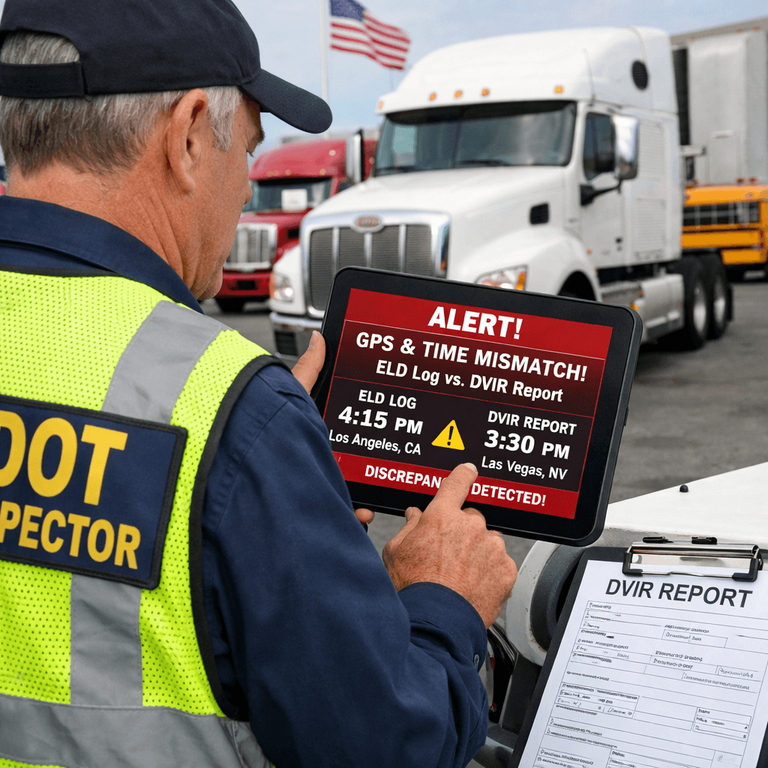
- Timestamp Mismatches: If a paper DVIR is time-stamped at 7:00 AM, but the driver's Electronic Logging Device (ELD) shows the truck shifted into drive and hit 40 MPH at 7:02 AM, the auditor knows the 15-minute inspection was faked. It is physically impossible.
- Location Discrepancies: Auditors will pull toll booth records, fuel receipts, and GPS telematics. If a driver claims on their paper log that they were doing a post-trip inspection at the terminal at 5:00 PM, but a fuel receipt shows they were purchasing diesel 40 miles away at 5:05 PM, the DVIR is fraudulent.
- The "Perfect Pen" Syndrome: If an auditor pulls a month's worth of daily DVIRs and notices that the ink color, pen pressure, and signature exactness are identical across 30 days of forms, they know the driver sat down on a Sunday and pre-filled out the entire month's worth of inspections in one sitting.
A single discrepancy between a physical receipt and a written log renders the DVIR fraudulent. Finding one fake log gives the auditor probable cause to trigger a deeper, targeted audit of the entire fleet, resulting in massive fines.
Paper vs. Electronic DVIRs: Why Paper Encourages Fraud
Traditional paper DVIRs actively facilitate pencil whipping because they lack any form of verification or accountability loop. A piece of paper is a static, dumb document. It cannot tell you where the driver was standing when they signed it, how long it took them to read the checklist, or if they even looked at the truck.
Paper forms heavily suffer from the "straight-lining" effect. Drivers will literally take a pen and draw a single vertical line down all the checkboxes in one swift motion, applying a messy signature at the bottom. The paper is then tossed into a filing cabinet or a shoebox in the dispatch office, remaining unchecked and unverified until a DOT auditor requests it months later. By the time management realizes a driver has been pencil whipping their logs for six months, it is far too late to correct the behavior. By transitioning to a cloud-based electronic dvir system, fleet managers instantly gain visibility, accountability, and real-time control over the entire inspection process.
7 Ways Pre-Trip Inspection Software Eliminates Pencil Whipping
You cannot manage what you cannot measure. Modern pre trip inspection software relies on telematics and mobile hardware to force physical compliance. Here is exactly how technology eradicates pencil whipping from your fleet.
-
Geofencing and GPS Location Tracking
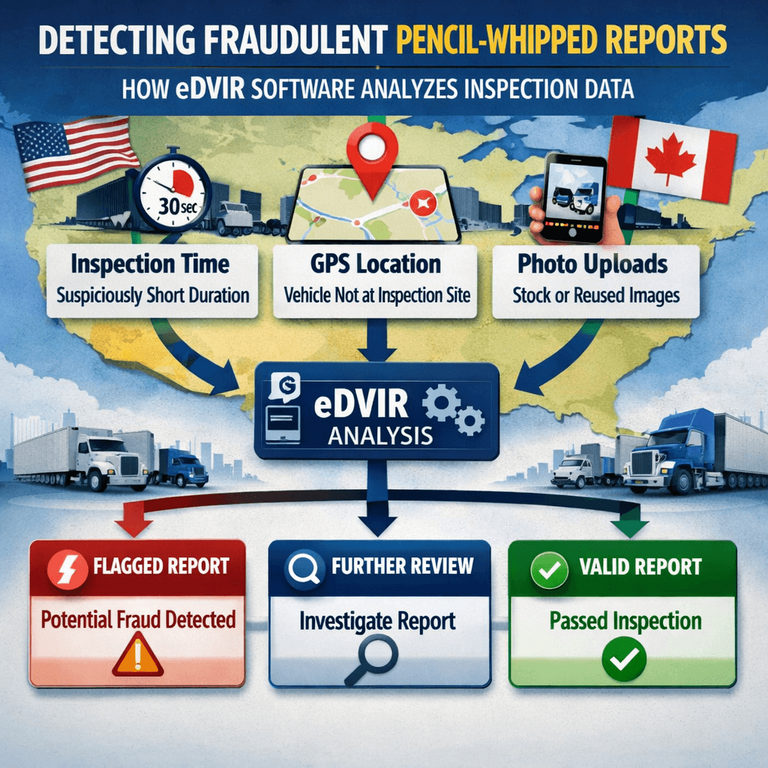
When a driver initiates a DVIR on their mobile device, the app instantly pings their smartphone's GPS location. The software compares the driver's location to the vehicle's telematics unit (or terminal geofence). If the driver is sitting in the breakroom drinking coffee while the truck is parked 300 yards away in the back lot, the app will flag the discrepancy and refuse to allow the inspection to begin. The driver must be physically next to the vehicle to execute the compliance task.
-
Minimum Duration Requirements (Time on Task)
An electronic system timestamps the exact second the inspection starts and stops. Fleet managers can set a mandatory minimum duration (e.g., 12 to 15 minutes). If a driver tries to rapid-fire tap through all 50 items and hits "Submit" in 45 seconds, the app will reject the submission, flag the attempt as a violation, and immediately notify the safety manager of the rushed inspection. It mathematically enforces time-on-task.
-
Mandatory Photo Evidence
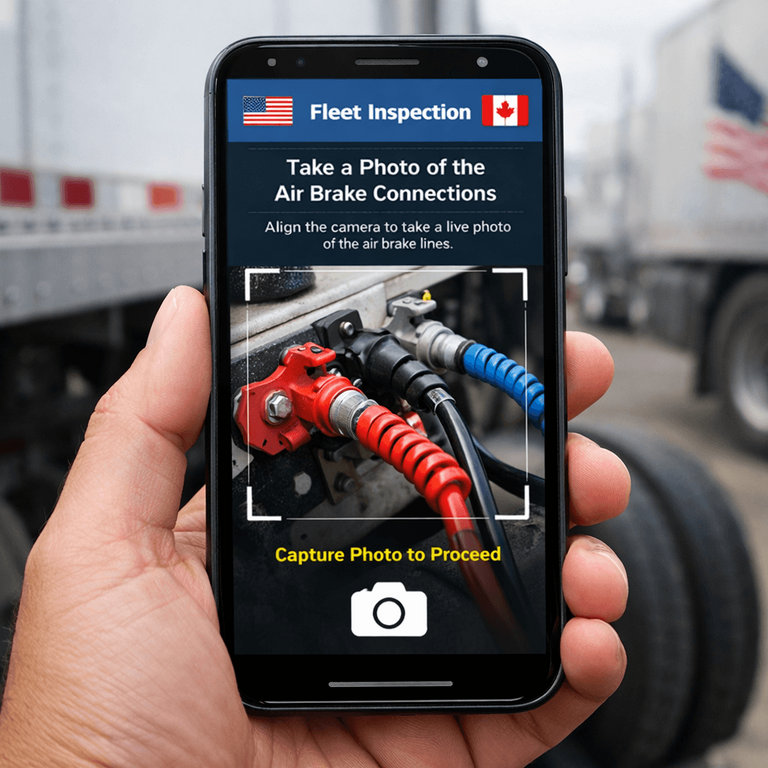
To definitively prove a driver actually looked at a component, the software can be configured to require mandatory photo uploads for critical safety items. For example, the app might prompt: "Take a photo of the left front steer tire tread." Crucially, robust apps disable the phone's camera roll upload feature—meaning the driver cannot upload a photo they took three weeks ago. They must take a live photo in real-time, within the app, to proceed.
-
Randomized Inspection Checklists
Muscle memory is the absolute enemy of compliance. If the checklist is the exact same every single day, drivers learn exactly where to tap the screen without reading the prompts. High-end eDVIR platforms randomize the order of the checklist daily. Today, tires are first; tomorrow, lights are first. This cognitive friction forces the driver to read the prompt, break their autopilot mode, and actually engage with the task at hand.
-
Digital Signature Authentication
A scrawled initial on a piece of paper is incredibly hard to verify in court. Electronic systems require a secure login (often utilizing biometric face ID, fingerprint scanners, or secure PIN codes on modern smartphones) before the final signature can be applied. This creates an undeniable digital chain of custody that holds up during an audit or a legal dispute.
-
Automated Supervisor Alerts
If an electronic DVIR detects an anomaly—such as a failed photo upload, a geofence violation, or an inspection completed in an impossibly short time—it instantly triggers an email, SMS, or dashboard alert to the safety director. The manager can intervene over the radio and demand a reinspection before the truck ever leaves the terminal yard.
-
Seamless Maintenance Integration
When a defect is actually found and reported, an electronic system automatically creates a digital work order for the mechanic shop. It completely eliminates the friction of a driver having to track down a mechanic to hand them a dirty piece of paper. The three-signature cycle mandated by FMCSA 396.11 is handled entirely in the cloud, routing signatures from the driver, to the mechanic, and to the next driver seamlessly, guaranteeing full compliance.
How Does California AB 3278 Affect Pencil Whipping Audits?
California's Biennial Inspection of Terminals (BIT) program under Assembly Bill 3278 requires vehicles with a GVWR of 26,001 lbs and above, passenger buses (10+ capacity), combination tractor-trailers, and all hazmat vehicles to complete a 90-day mechanical inspection cycle enforced by CHP. Falsifying or skipping those 90-day reports guarantees catastrophic audit deficiencies — the exact outcome pencil whipping produces.
For motor carriers operating terminals within California, avoiding pencil whipping is not merely a federal requirement — it is critical for surviving the rigorously enforced BIT program administered by the California Highway Patrol (CHP). Under 2026 enforcement of AB 3278, the audit landscape has shifted based on precise weight exemptions:
- Exempt vehicles: Commercial vehicles with a Gross Vehicle Weight Rating (GVWR) of 26,000 lbs and under are largely exempt from the 90-day BIT inspection cycle, reverting to standard federal annual inspections.
- Required vehicles: Vehicles at 26,001 lbs GVWR and above, passenger buses (10+ capacity), combination vehicles (tractors with trailers), and all vehicles hauling hazardous materials (Hazmat) remain strictly bound to the 90-day inspection cycle regardless of weight.
AB 3278 also mandates immediate lifetime CDL disqualifications for human trafficking convictions and forces integration with the Drug and Alcohol Clearinghouse (DACH). Electronic inspection technology automatically tracks these weight thresholds and 90-day deadlines with predictive alerts, ensuring no vehicle falls out of compliance. For the full regulatory breakdown and pass-rate playbook, see our California BIT program 2026 updates guide and the how-to-pass-California-BIT-inspection playbook.
ROI: Preventative Maintenance vs. Catastrophic Breakdown
Some fleet owners hesitate to implement strict inspection software because they fear it will slow operations down. This is a false economy. The Return on Investment (ROI) of stopping pencil whipping is massive when you calculate the true cost of catastrophic breakdowns.
Catching a frayed alternator belt during a mandatory 15-minute digital pre-trip inspection allows the shop to replace a $40 part in 30 minutes at the terminal. If that same belt is pencil-whipped and snaps on Interstate 80 in Wyoming, the carrier is now paying for a $600 emergency roadside service call, a $300 towing fee, and facing 8 hours of lost driver productivity and a delayed freight claim. Pre-trip inspection software transforms reactive, emergency maintenance into planned, cost-effective preventative maintenance.
How Do You Move Reluctant Fleets from Paper to Digital DVIRs?
Transitioning drivers from familiar paper logbooks to digital pre-trip inspection software requires a structured four-week change-management strategy: education first, then a pilot with respected drivers, then dual logging, then a hard cutover with dashboard monitoring. This sequence reduces friction and permanently eliminates pencil whipping.
Implementing a rigid electronic system that physically prevents pencil whipping will face pushback from veteran drivers accustomed to the "old ways." Fleet managers must handle the transition tactfully to ensure high adoption rates and maintain driver morale. Use this proven 30-day rollout strategy:
- Week 1 — The "Why" Phase (education): Do not just hand drivers a tablet and demand compliance. Hold a safety meeting explaining why the change is happening. Frame the technology as a tool to protect the driver's CDL and personal liability. Explain that if an inspector finds a bald tire at roadside, the electronic DVIR with photo timestamps proves the driver did their job — shielding them from personal fines.
- Week 2 — The Pilot Program: Select 3 to 5 of your most tech-savvy, respected drivers to test the app daily and gather their feedback. When they tell the rest of the fleet that the app saves them the hassle of walking to the shop in the rain to drop off paperwork, internal resistance will soften.
- Week 3 — Soft Launch (dual logging): Have the entire fleet use the digital app alongside paper logs for a few days to build confidence. Address any login issues, forgotten passwords, or camera permission glitches without penalizing the drivers for compliance errors.
- Week 4 — Hard Cutover and Dashboard Monitoring: Remove all paper DVIR booklets from the trucks. From this day forward, only digital submissions are accepted. The safety director must actively monitor the analytics dashboard, immediately calling drivers who attempt to "speed-run" a 50-point inspection in under 2 minutes.
Developing a Zero-Tolerance Safety Culture
Software is an incredibly powerful tool, but safety is ultimately a culture. A digital DVIR app cannot stop pencil whipping if management routinely ignores the alerts it generates. If the software flags 10 "rushed" inspections on Monday, and the safety manager says nothing, the drivers will quickly realize the system is a paper tiger.
Fleet executives must establish a strict, publicly known matrix of consequences for falsified inspections. For example, a first offense (an inspection completed under the minimum time) might require an immediate phone call and mandatory retraining; a second offense might result in a written warning; a third offense might result in suspension. Conversely, publicly reward drivers who consistently submit thorough, high-quality inspections with clear photos. When drivers see that management actively monitors the dashboard and takes the data seriously, the fleet culture shifts from compliance-avoidance to compliance-adherence.
The Role of AI in Future Inspection Compliance (2026 Trends)
As we navigate 2026, Artificial Intelligence is taking DVIR fraud prevention to the next level. We are seeing the early adoption of AI-driven image recognition within fleet maintenance applications. Instead of a human manager having to manually verify the hundreds of photos drivers upload daily, AI algorithms instantly scan the uploaded photo to verify it is actually a picture of a tire, and calculate the estimated tread depth based on visual markers.
Furthermore, predictive AI models are analyzing inspection durations and driver behaviors. If a driver takes exactly 11 minutes and 30 seconds to complete an inspection every single day for a month, the AI flags this robotic consistency as highly suspicious, prompting a manual review by safety personnel. The technology gap between static paper logs and AI-enhanced digital compliance has never been wider, making it virtually impossible to fake an inspection on a modern platform.
How to Audit Your Own Fleet for Pencil Whipping
Do not wait for a DOT inspector or an accident attorney to uncover systemic fraud in your operations. If you are still using paper forms, you need to conduct a proactive internal audit immediately. Pull 50 random DVIRs from the last month and perform the following forensic checks:
- Look for "straight-lining" (a single continuous pen stroke down the checkbox column). This is a guaranteed indicator of a fake inspection.
- Cross-reference the timestamp on the DVIR against the driver's ELD movement log. Is it physically possible they completed a 15-minute walkaround based on when the truck started moving?
- Check the consistency of handwriting. Is the driver filling out a week's worth of DVIRs in advance using the same pen on a single desk? Are there grease smudges on the paper, or is it suspiciously pristine?
- Compare reported defects against roadside inspection violations. If your DVIRs show zero defects, but your CSA score shows a high rate of tire and light violations caught at weigh stations, your drivers are pencil whipping.
If you identify these red flags, your fleet is at extreme financial and legal risk. It is time to modernize your workflow.
Frequently Asked Questions (FAQ)
What is pencil whipping meaning in trucking?
In the commercial trucking industry, pencil whipping means the illegal practice of a driver rapidly checking off boxes on a Driver Vehicle Inspection Report (DVIR) and signing it without conducting the actual physical inspection of critical components like brakes, tires, coupling devices, and lights. It is treated under federal law as a falsification of safety records.
If you have to make a vehicle inspection report, must you sign it?
Yes. Under FMCSA regulation 49 CFR 396.11, if you are required to make a DVIR for a commercial motor vehicle, you must sign it. The report is functionally invalid, and the vehicle cannot be legally dispatched, until the driver's signature is affixed. Under FMCSA-2025-0115 (effective March 23, 2026), the signature may be a cryptographic digital signature under E-SIGN/GPEA.
How long must you retain DVIR records under 49 CFR 396.11?
Motor carriers are legally required to retain the original DVIR, the certification of repairs, and the certification of the reviewing driver for a minimum of 3 months (90 days) from the date the written report was initially prepared. Electronic DVIR systems archive all 90 days automatically in the cloud, eliminating lost paperwork during DOT audits.
How do DOT auditors catch fake DVIRs?
DOT auditors detect fake paper DVIRs by cross-referencing toll receipts, ELD data, and fuel records against the time the inspection was supposedly done. If a driver logged a 20-minute inspection while the ELD shows the truck moving at 65 MPH, the auditor will issue severe violations for false logs.
How does an electronic DVIR system prevent pencil whipping?
An electronic DVIR system uses GPS geofencing, undeniable timestamps, mandatory live photo captures for specific components, randomized checklist ordering, and minimum duration limits to mathematically prove that the driver was physically present and took the required time to inspect the vehicle.
What are the penalties for a falsified pre-trip inspection?
Falsifying a DVIR is a direct violation of FMCSA regulations (49 CFR 390.35). Penalties include immediate Out-of-Service orders, heavy civil fines for the carrier, maximum-severity points against the carrier's CSA Vehicle Maintenance BASIC score, and potential termination for the driver.
Conclusion: Protect Your Fleet with Digital Compliance
Pencil whipping is not a harmless shortcut; it is a critical vulnerability that jeopardizes driver safety, public well-being, and the financial stability of your motor carrier. Relying on paper forms in an era of strict data auditing and multi-million dollar nuclear verdicts is an operational liability you can no longer afford to ignore.
By implementing a robust electronic dvir system, fleet operators can instantly replace guesswork with hard, undeniable data. When you mandate GPS check-ins, time-stamping, randomized checklists, and live photo evidence, you remove the opportunity for fraud entirely. You shift your fleet from a culture of reactive paperwork generation to a culture of proactive safety. Ensure your fleet is ready for any roadside inspection, federal audit, or legal inquiry by digitizing your compliance today.
Stop Pencil Whipping Dead in Its Tracks
Protect your fleet from DOT fines and nuclear verdicts. PTI4YOU's intelligent eDVIR platform forces compliance with mandatory photo captures, GPS geofencing, and automated time-tracking. Know for a fact that your trucks are safe before they hit the road.
Start your 15-day free trial today. No credit card required.
Start Your 15-Day Free Trial – No Credit Card RequiredZero setup fees. Zero hardware. 25-minute driver onboarding.