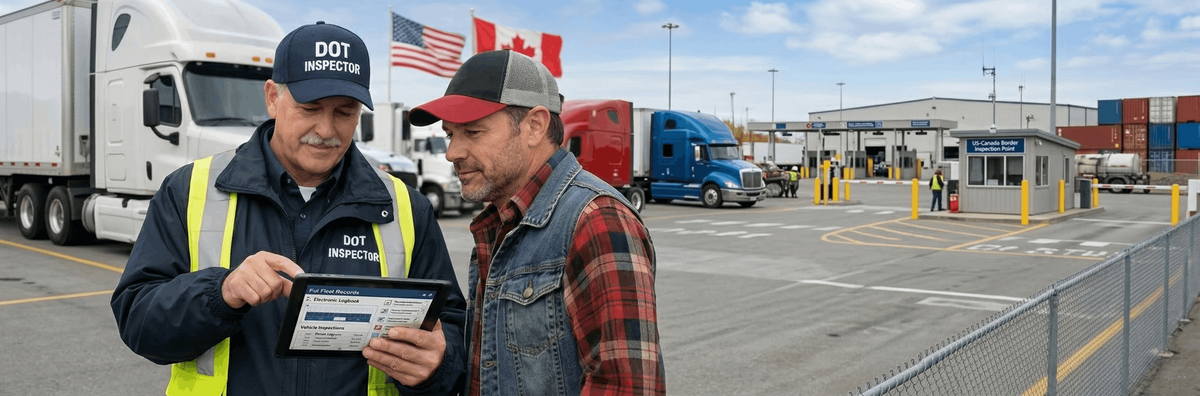
Introduction: The New Era of FMCSA Enforcement (2026 Context)
There are few phrases in the commercial trucking industry that induce more sheer anxiety for a fleet manager than receiving an official notification letter from the Federal Motor Carrier Safety Administration (FMCSA) announcing an impending DOT Compliance Review. A DOT Safety Audit is not a casual check-in; it is an exhaustive, forensic examination of a motor carrier's operational records, safety culture, vehicle maintenance history, and driver qualification files. It is the ultimate stress test of your company's regulatory compliance and your commitment to highway safety.
As we navigate through 2026, the landscape of federal enforcement has evolved drastically. Gone are the days when a safety director could simply hand an auditor a stack of dusty filing boxes filled with disorganized, carbon-copy paper logs and hope they would lose interest. Today's FMCSA investigators are armed with sophisticated, data-driven algorithms, artificial intelligence tools, and immediate access to cloud-based telematics databases. They can cross-reference toll records against Electronic Logging Device (ELD) entries in seconds, completely obliterating any attempts at record falsification or "pencil whipping".
Failing a compliance review doesn't just result in a slap on the wrist. It triggers catastrophic financial penalties, immediate "Out-of-Service" (OOS) orders for your entire fleet, sky-rocketing commercial insurance premiums, and the devastating loss of lucrative freight contracts with major shippers. This comprehensive guide will dissect the anatomy of a DOT Compliance Review, explore the most common violations fleets are committing this year, and provide a foolproof, step-by-step framework to ensure your operation earns the coveted "Satisfactory" safety rating.
Key Takeaways
- A DOT Compliance Review evaluates a motor carrier across six critical factors, ranging from financial responsibility to hazardous materials handling.
- The FMCSA is heavily shifting toward off-site audits (desktop audits), mandating that carriers upload digital records via secure portals rather than relying on paper files.
- Falsified ELD logs and pencil-whipped Driver Vehicle Inspection Reports (DVIRs) remain the fastest ways to fail an audit and trigger an Unsatisfactory rating.
- A proactive transition to electronic DVIR (eDVIR) software and digital Driver Qualification (DQ) file management mathematically eliminates the majority of paperwork violations.
What Exactly is a DOT Compliance Review?
Under 49 CFR Part 385, a Compliance Review (CR) is defined as an on-site or off-site examination of a motor carrier's operations. The primary purpose of this review is to determine whether the carrier meets the basic safety fitness standard outlined by the FMCSA. It is important to distinguish this from a random roadside inspection (like a Level 1 CVSA inspection); a Compliance Review is an investigation into the systemic, corporate-level safety management controls of the entire organization.
The auditor's goal is to answer a single, fundamental question: Does this motor carrier have adequate safety management controls in place to ensure ongoing compliance with the Federal Motor Carrier Safety Regulations (FMCSRs) and Hazardous Materials Regulations (HMRs)? If the auditor finds that a company routinely ignores maintenance schedules, hires unqualified drivers without checking their backgrounds, or implicitly forces drivers to violate Hours of Service (HOS) limits to meet strict delivery deadlines, they will conclude that the carrier is unfit to operate on public highways.
The Algorithmic Triggers (CSA and ISS Scores)
The FMCSA does not possess the manpower to audit every registered motor carrier annually. With hundreds of thousands of active USDOT numbers, they must utilize a highly targeted, data-driven approach to select carriers for review. In 2026, the primary trigger is the motor carrier's performance within the Compliance, Safety, Accountability (CSA) program.
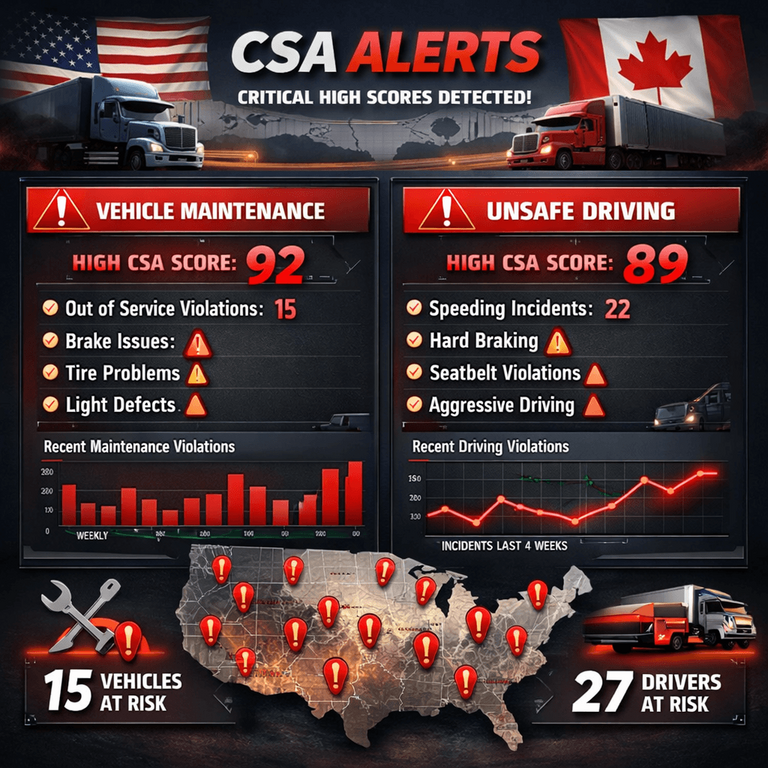
Your fleet is constantly being evaluated based on roadside inspection data, crash reports, and investigation results from all 50 states. This data is fed into the Safety Measurement System (SMS), which organizes your performance into seven distinct Behavior Analysis and Safety Improvement Categories (BASICs):
- Unsafe Driving: Speeding, reckless driving, improper lane changes, and texting while driving.
- Crash Indicator: Histories of state-reported crashes (regardless of fault, though preventability can be contested).
- Hours-of-Service (HOS) Compliance: Operating while fatigued, falsifying ELD logs, or driving past the 11/14-hour limits.
- Vehicle Maintenance: Brakes out of adjustment, bald tires, defective lights, and failure to make required repairs noted on DVIRs.
- Controlled Substances/Alcohol: Use or possession of drugs/alcohol, or failing to implement a testing program.
- Hazardous Materials Compliance: Leaking containers, improper placarding, and missing shipping papers.
- Driver Fitness: Operating with invalid CDLs, expired medical cards, or missing DQ files.
If your fleet consistently scores above the FMCSA's intervention threshold (e.g., 65% for Unsafe Driving) in one or more of these BASICs, your Inspection Selection System (ISS) score will spike into the "Inspect" category (scores 75-100). A high ISS score acts as a massive red flag, alerting auditors that your fleet requires immediate federal intervention. Beyond poor CSA scores, other common triggers include:
- Involvement in a Catastrophic Crash: Any crash resulting in a fatality, severe multi-vehicle injuries, or massive environmental spills will almost always trigger an immediate, mandatory compliance review, often within days of the incident.
- Whistleblower Complaints: If a disgruntled driver reports to the DOT via the National Consumer Complaint Database that management is forcing them to drive over their legal hours or operate vehicles with known, severe brake defects, the FMCSA is legally obligated to investigate the complaint.
- New Entrant Audits: All newly registered motor carriers must undergo and pass a mandatory New Entrant Safety Audit within their first 12 months of operation to secure permanent operating authority.
Deep Dive into the Six Factors of Compliance
When the DOT auditor begins their investigation, they do not randomly search for violations. They follow a strict, standardized methodology that evaluates your fleet across six distinct regulatory categories, known in the industry as the "Six Factors." Failing any single critical factor can severely damage your final safety rating.
Factor 1: General Requirements (Parts 387 and 390)
This factor examines the foundational administrative and financial aspects of your business. The auditor will demand proof of adequate financial responsibility (insurance). For standard freight carriers, this usually means possessing an MCS-90 endorsement proving at least $750,000 in public liability coverage, scaling up to $1,000,000 or $5,000,000 for specific hazardous materials. Additionally, they will verify that all commercial motor vehicles (CMVs) are properly marked with your legal company name and a valid, visible USDOT number.
Crucially, the auditor will request your Accident Register. Under 49 CFR 390.15, you must maintain a register documenting all DOT-recordable crashes from the previous three years. A crash is DOT-recordable if it results in a fatality, an injury requiring immediate medical treatment away from the scene, or one or more vehicles incurring disabling damage that requires a tow truck. Failing to maintain this register is an instant violation.
Factor 2: Driver Qualifications (Parts 382, 383, and 391)
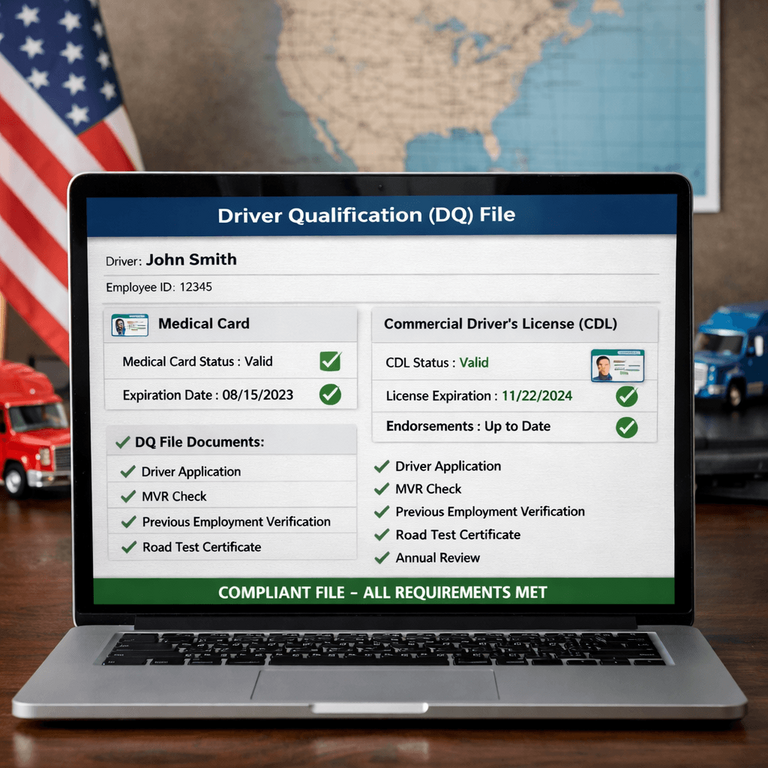
This is historically one of the most heavily penalized sections of an audit due to the sheer volume of paperwork required. You must prove that every person operating a truck for your company is legally qualified, medically fit, and sober. The auditor will thoroughly inspect your Driver Qualification (DQ) files. For an auditor reviewing a 50-truck fleet, they will likely request 10 to 15 DQ files at random.
A complete, compliant DQ file must include:
- A specialized application for employment (standard retail applications are non-compliant).
- Documented inquiries into the driver's previous three years of employment history (specifically asking previous employers about drug/alcohol violations and accident history).
- Motor Vehicle Records (MVRs) spanning both the pre-employment phase and the required annual review.
- A valid medical examiner's certificate linked to the driver's CDL.
- Proof of proper CDL endorsements (e.g., Tanker, Doubles/Triples, HazMat).
Furthermore, the auditor will scrutinize your Drug and Alcohol testing program. In 2026, strict adherence to the FMCSA Drug and Alcohol Clearinghouse is absolute. You must prove that you conducted full pre-employment queries and annual limited queries on every single driver to verify they do not have unresolved drug or alcohol violations preventing them from performing safety-sensitive functions. For the exact penalty amounts, consent form requirements, and a step-by-step walkthrough of the annual query process, see our guide to FMCSA Clearinghouse annual queries and compliance.
Factor 3: Operational / Hours of Service (Part 395)
Driver fatigue is a leading cause of catastrophic highway accidents, making the Hours of Service (HOS) rules a primary target during any audit. The auditor will review your fleet's ELD data for the past six months. They are looking for violations of the 11-hour driving limit, the 14-hour duty window, the 60/70-hour weekly limits, and the mandatory 34-hour restart provisions. They will also look heavily at "Unassigned Driving Time"—miles driven by the truck where no driver was logged into the ELD, a common tactic used to hide over-hours driving.
Critically, the auditor will not simply trust the digital ELD output. They will demand supporting documents—such as fuel receipts, toll booth tickets, scale tickets, dispatch records, and bills of lading. They will meticulously cross-reference the timestamps on these physical documents against the driver's ELD status. If a fuel receipt from an Ohio truck stop is time-stamped at 2:00 PM, but the driver's ELD shows they were in "Off-Duty" status in Indiana at that exact moment, the auditor has definitive proof of log falsification. This is treated as a critical, severe violation demonstrating a complete breakdown of safety management controls.
Factor 4: Vehicle Maintenance (Parts 393 and 396)
A carrier cannot be considered safe if their equipment is falling apart on the highway. Under 49 CFR Part 396, you are legally required to systematically inspect, repair, and maintain all CMVs subject to your control. During the audit, the investigator will pull maintenance files for specific trucks, usually targeting those that have recently failed roadside inspections or been involved in accidents.
The auditor will look for three main components:
- Preventative Maintenance (PM) Schedule: Proof that you have a proactive schedule (e.g., oil changes every 25,000 miles, brake adjustments every 30 days) and that you are actually adhering to it.
- Annual Inspections: Retention of valid Annual Vehicle Inspections (which must be kept for 14 months) performed by qualified inspectors.
- Driver Vehicle Inspection Reports (DVIRs): You must retain post-trip DVIRs for a minimum of 90 days. If a driver noted a defect (like a bald steer tire or an audible air brake leak), the auditor must see the corresponding mechanic's signature certifying the repair was completed before the truck was dispatched again. This is where paper forms notoriously fail fleets due to lost documents and illegible signatures, making electronic DVIR software absolutely essential for passing Factor 4.
Factor 5: Hazardous Materials (Parts 171-177 and 180)
If your fleet transports hazardous materials (HazMat), you will face a specialized, intense layer of scrutiny based on the Pipeline and Hazardous Materials Safety Administration (PHMSA) regulations. The auditor will ensure that your drivers possess the proper HazMat endorsements, that all shipping papers are perfectly formatted and accessible within arm's reach in the cab, that vehicles are correctly placarded according to the hazard class, and that your company has provided mandatory, specialized HazMat training (initial and recurrent every 3 years) to all employees who handle, package, or transport the materials.
Factor 6: Accidents (Part 390.15)
Finally, the auditor will evaluate your fleet's crash rate mathematically. The DOT calculates your "Recordable Accident Rate" by dividing the number of DOT-recordable accidents by your total fleet mileage over the past 12 months, multiplying the result by one million. If your rate exceeds 1.5 accidents per million miles (or 1.7 for urban/local delivery carriers), you will fail this factor, heavily contributing to a potential downgrade in your overall safety rating.
The Evolution to Off-Site (Desktop) Audits
Historically, a DOT audit involved an investigator physically arriving at your terminal, occupying your conference room for three to five days, and demanding massive stacks of paper files. However, post-2020 and solidly into 2026, the FMCSA has shifted heavily toward off-site audits (also known as desktop audits).
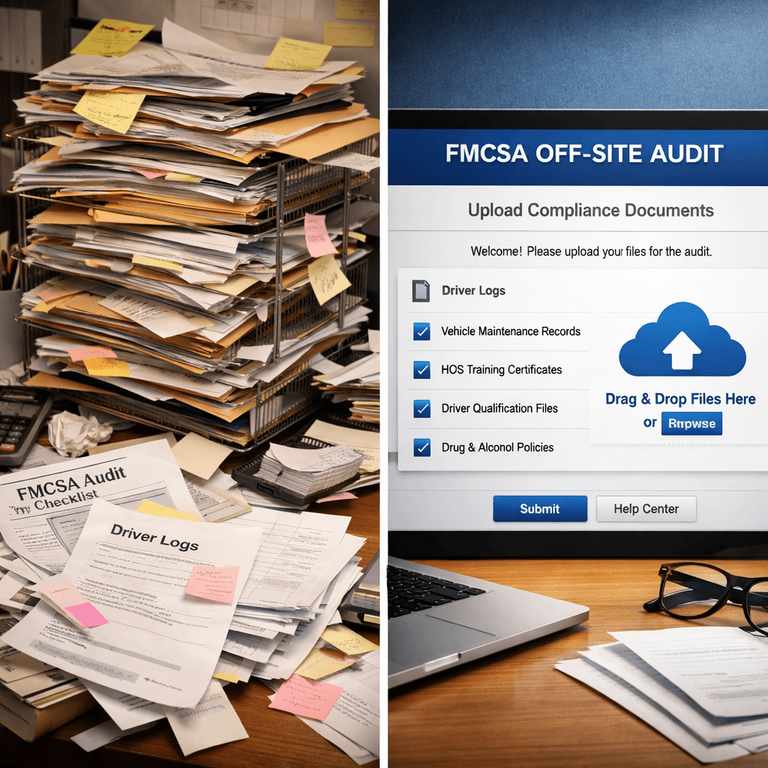
In an off-site audit, the FMCSA sends a letter requesting that you digitally upload specific, targeted documents (such as 10 random driver DQ files, 3 months of ELD data, and 90 days of DVIRs for 5 specific trucks) to a secure federal portal within 48 to 72 hours. The investigator reviews the documents remotely from their regional office.
While this process is significantly less disruptive to your daily terminal operations, it creates a massive operational hurdle for fleets still relying on paper. If a fleet receives a 48-hour deadline to upload 300 pages of DVIRs, and those DVIRs are currently sitting in a cardboard box covered in grease stains, the administrative panic is overwhelming. Someone has to spend hours scanning and organizing illegible paperwork. Fleets utilizing comprehensive digital management systems can satisfy an off-site document request with a few clicks of a mouse, instantly generating organized PDFs.
The Top 10 Critical DOT Audit Violations of 2026
Despite the severe consequences, fleet managers continue to make the same operational mistakes year after year. Understanding the most frequently cited critical violations is your best defense against committing them. In 2026, auditors are consistently issuing severe penalties for the following infractions:
- Failing to Implement an Alcohol and/or Drug Testing Program (382.115): Operating without joining a DOT-compliant consortium or failing to conduct random testing at the required annual percentages (currently 50% of the driver pool for drugs and 10% for alcohol).
- Using a Driver Before Receiving a Pre-Employment Drug Test Result (382.301a): Allowing a new hire to drive a commercial vehicle before the official negative laboratory results have been received by the safety director. A "rapid test" is not sufficient.
- False Reports of Records of Duty Status (395.8e): Drivers manipulating their ELDs, unplugging devices, editing statuses maliciously, or claiming "Personal Conveyance" improperly to hide actual driving time and circumvent the 11-hour limit.
- Incomplete Driver Qualification Files (391.51b2): Missing critical background checks, failing to verify previous employment, or operating with drivers whose medical examiner certificates have expired.
- Failing to Require Drivers to Prepare DVIRs (396.11a): The systemic failure of a fleet to collect and retain daily post-trip inspection reports. This is often caused by the culture of "pencil whipping" where drivers skip the inspection entirely, leaving no paper trail.
- Using a CMV Not Periodically Inspected (396.17a): Dispatching a truck or trailer that has not passed a comprehensive, qualified annual DOT inspection within the preceding 12 months. The sticker must be visible, and the long-form paper must be in the cab or the terminal.
- Failing to Keep Minimum Records of Inspection and Vehicle Maintenance (396.3b): The inability of the shop manager to produce a detailed file for each truck showing its preventative maintenance history, oil changes, brake adjustments, and tire replacements.
- Operating a CMV While Declared Out-of-Service (386.72): This is an egregious, "fatal" error. If a roadside inspector places a truck OOS for a severe brake defect, and the carrier allows the driver to drive away before the repair is completed by a mechanic and verified, the DOT will pursue maximum punitive action, often targeting the safety director personally.
- Failing to Query the Clearinghouse (382.701a): Hiring a driver without conducting a full query in the FMCSA Drug and Alcohol Clearinghouse to ensure they do not have a recorded violation (like a refused test or positive drug screen) at a previous employer.
- Allowing a Driver to Exceed the 14-Hour Duty Limit (395.3a2): Forcing or permitting a driver to operate a CMV after the 14th consecutive hour after coming on duty has elapsed. Dispatching a driver when you know they cannot complete the run legally is a severe carrier violation.
A 5-Step Pre-Audit Survival Guide for Fleets
A comprehensive 5-step strategic framework for fleet managers and safety directors to prepare their operations for an impending FMCSA DOT compliance review.
-
Step 1: Centralize and Digitize All Fleet Records
Transition all Driver Qualification (DQ) files, Hours of Service (HOS) logs, and Driver Vehicle Inspection Reports (DVIR) from paper cabinets into a secure, searchable cloud-based platform. Ensure that you have 6 months of logs and 12 months of DVIRs readily accessible. The faster you can provide pristine, digital records to an investigator, the more confidence they will have in your organizational competence.
-
Step 2: Reconcile ELD Data with Supporting Documents
Cross-reference your drivers' Electronic Logging Device (ELD) records against toll receipts, fuel card transactions, scale tickets, and bill of lading timestamps. Identify and address any discrepancies that could indicate falsified logs or hidden driving time. If you find drivers manipulating the "Personal Conveyance" status, issue immediate written warnings and retrain them before the federal auditor uncovers the fraud.
-
Step 3: Audit the Drug and Alcohol Clearinghouse
Log into the FMCSA Clearinghouse portal and verify that an annual limited query was conducted for every employed CDL driver within the last 365 days. Additionally, ensure that pre-employment full queries were completed before any new driver was dispatched in a CMV. Missing these queries is one of the fastest ways to fail Factor 2.
-
Step 4: Conduct a Comprehensive Internal Mock Audit
Perform a simulated DOT audit using the FMCSA's six-factor criteria. Randomly pull 10% of your drivers' DQ files and maintenance records. Look for missing medical examiner certificates, lapsed annual vehicle inspections, or pencil-whipped daily DVIRs. Assign a tough, impartial staff member to play the role of the DOT auditor to ensure your staff understands the pressure of a real review.
-
Step 5: Implement a Corrective Action Plan (CAP)
If you discover severe violations during your mock audit, do not try to hide them. Immediately suspend non-compliant drivers, schedule emergency maintenance for neglected vehicles, and document these proactive corrective measures to show the DOT investigator that your safety culture is functioning. An auditor is much more lenient when they see that management caught a mistake and independently corrected it prior to the federal intervention.
Safety Ratings and the Corrective Action Plan (CAP)
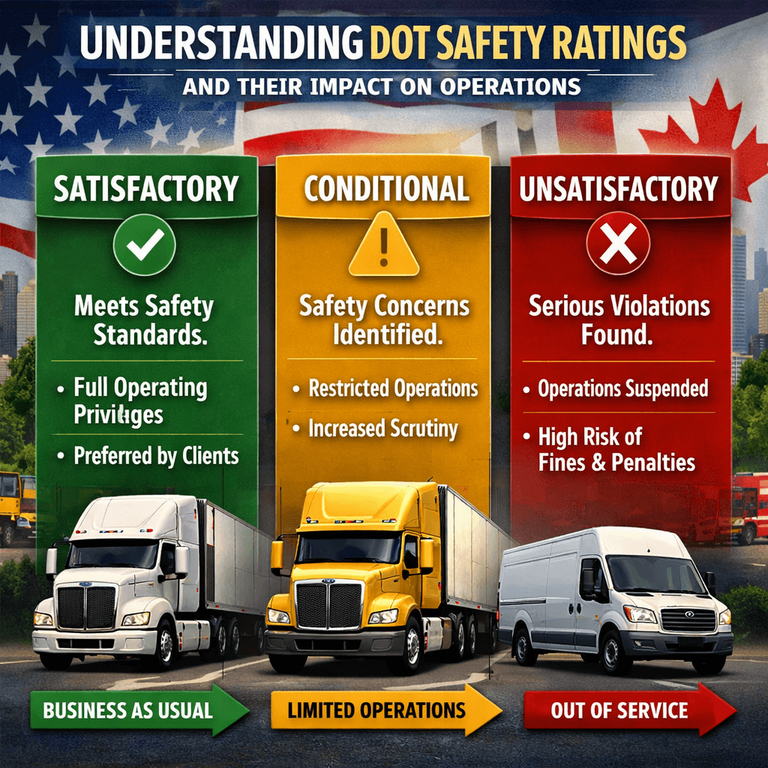
At the conclusion of the compliance review, the investigator will calculate your violations and issue one of three official safety fitness ratings, which will be published on the public SAFER database for the entire logistics industry to view.
1. Satisfactory: This is the golden standard. It indicates that the motor carrier has functional, effective safety management controls in place that meet or exceed federal requirements. A Satisfactory rating allows you to bid on premium freight contracts and helps keep your insurance premiums stable.
2. Conditional: This rating acts as a severe warning. It indicates that the carrier has inadequate safety controls, but not yet to the point where they are an imminent hazard to the public. While you can legally continue to operate, a Conditional rating is a massive business liability. If you receive this rating, you must immediately file a Corrective Action Plan (CAP) under 49 CFR 385.17. A CAP is a detailed, written document explaining exactly how you have fixed the problems (e.g., "We fired the non-compliant safety manager and purchased PTI4YOU software to enforce DVIRs"). If the FMCSA approves your CAP, they may upgrade you back to Satisfactory or Unrated.
3. Unsatisfactory: This is a company-ending event. An Unsatisfactory rating means the carrier poses an unacceptable risk to highway safety. Motor carriers transporting standard freight are given 60 days (45 days for HazMat or passenger carriers) to make sweeping, verifiable safety improvements. If the FMCSA does not accept the proposed upgrades within that timeframe, the carrier's DOT number is revoked, an Out-of-Service order is issued, and the entire fleet is legally prohibited from moving commercial freight.
The Financial Domino Effect of a Conditional Rating
Beyond the direct civil penalties levied by the FMCSA—which can easily exceed tens of thousands of dollars depending on the severity and frequency of the violations—failing an audit opens your fleet up to a devastating financial domino effect.
First, Freight Loss. Many elite freight brokers and major shippers (like Amazon, Walmart, and C.H. Robinson) have strict internal policies forbidding them from loading freight onto trucks owned by Conditional carriers. Overnight, your sales team will find that 50% of your customer base has abandoned you.
Second, Nuclear Verdicts. If one of your trucks is involved in an accident resulting in serious injury, plaintiff attorneys will immediately subpoena your official DOT safety rating and audit history. If the attorney demonstrates to a jury that you previously received a Conditional rating due to poor vehicle maintenance (Factor 4) or false logs (Factor 3), they will successfully argue a case of systemic negligence. They will paint your company as an organization that prioritized profit over public safety, ignoring federal warnings. This specific legal strategy is responsible for crash verdicts skyrocketing past the $10 million mark, immediately bankrupting underprepared motor carriers.
Third, Insurance Premiums. Commercial insurance underwriters constantly monitor the SAFER system. If they see your rating drop to Conditional, they perceive you as a high-risk entity. Upon your policy renewal, you can expect premium increases ranging from 30% to 100%, or worse, an outright cancellation of your policy.
Automating Compliance with Technology
The days of relying on an overworked safety manager attempting to track the expiration dates of 100 different medical certificates on a cluttered whiteboard are over. The only mathematically reliable way to guarantee that your fleet is prepared for a sudden, unexpected DOT audit is through the uncompromising implementation of compliance software.
When you utilize an electronic DVIR system like PTI4YOU, you completely eliminate the anxiety of Factor 4 (Vehicle Maintenance). The software uses GPS geofencing and mandatory photo uploads to physically prevent drivers from "pencil whipping" their inspections. If a defect is found, the system automatically routes the digital report to the mechanic shop, enforcing the FMCSA's mandatory three-signature cycle. When the DOT auditor requests your maintenance records, you do not have to dig through dirty file cabinets; you simply generate a clean, time-stamped, undeniable PDF report directly from the cloud dashboard.
Furthermore, integrating your ELD with a robust fleet management system allows safety directors to receive automated alerts the second a driver approaches an HOS violation or unplugs a device, allowing for immediate corrective action *before* the DOT ever gets involved. Technology transforms compliance from a terrifying, reactive scramble into a calm, proactive daily routine.
Frequently Asked Questions (FAQ)
What triggers a DOT compliance review?
A DOT compliance review is typically triggered by poor CSA (Compliance, Safety, Accountability) scores, a high Inspection Selection System (ISS) score, a high frequency of roadside Out-of-Service (OOS) violations, involvement in a fatal or catastrophic crash, or a formal whistleblower complaint filed by a driver regarding unsafe fleet practices.
What is the difference between an off-site and on-site DOT audit?
An off-site audit (desktop audit) requires the carrier to digitally upload requested documents (like DQ files, ELD logs, and DVIRs) to the secure FMCSA safety portal for remote review by an investigator. An on-site audit involves a DOT investigator physically visiting the carrier's terminal to inspect physical files, interview staff, and potentially inspect vehicles in the yard.
How long do I need to keep DVIR records for a DOT audit?
Under FMCSA regulations (49 CFR 396.11), motor carriers must retain all post-trip Driver Vehicle Inspection Reports (DVIRs), along with any corresponding certification of repairs signed by a mechanic and the subsequent driver, for a minimum of 90 days from the date the report was prepared.
What happens if my fleet receives a Conditional safety rating?
A Conditional safety rating indicates that the FMCSA has identified inadequate safety management controls. While you can legally still operate, a Conditional rating will drastically increase your commercial insurance premiums, cause you to lose freight contracts with major shippers and brokers, and subject your trucks to frequent, targeted roadside inspections. You must submit a Corrective Action Plan (CAP) to seek an upgrade.
Conclusion: Replace Fear with Preparedness
A DOT Compliance Review is a daunting process, but it does not have to be a death sentence for your commercial trucking business. The FMCSA’s goal is not to bankrupt honest operators; their goal is to ensure the absolute safety of the motoring public. By understanding the six factors of evaluation, recognizing the most common violations of 2026, and actively shifting your compliance management from paper to digital platforms, you can transform an audit from a terrifying threat into a simple administrative chore.
Don't wait until the official audit notification arrives in your mail to start caring about compliance. Adopt robust safety management controls, hold your drivers accountable, conduct strict mock audits, and leverage modern fleet software today to guarantee your place on the road tomorrow.
Ace Your Next DOT Audit with PTI4YOU
Stop stressing over lost paperwork, missing medical cards, and pencil-whipped inspections. PTI4YOU provides the ultimate DOT-compliant eDVIR and fleet maintenance platform designed specifically to satisfy FMCSA auditors. Digitize your records, enforce physical compliance with GPS and photos, and protect your hard-earned safety rating.
Start your 15-day free trial today. No credit card required.
Start Your 15-Day Free Trial – No Credit Card RequiredZero setup fees. Zero hardware. 25-minute driver onboarding.