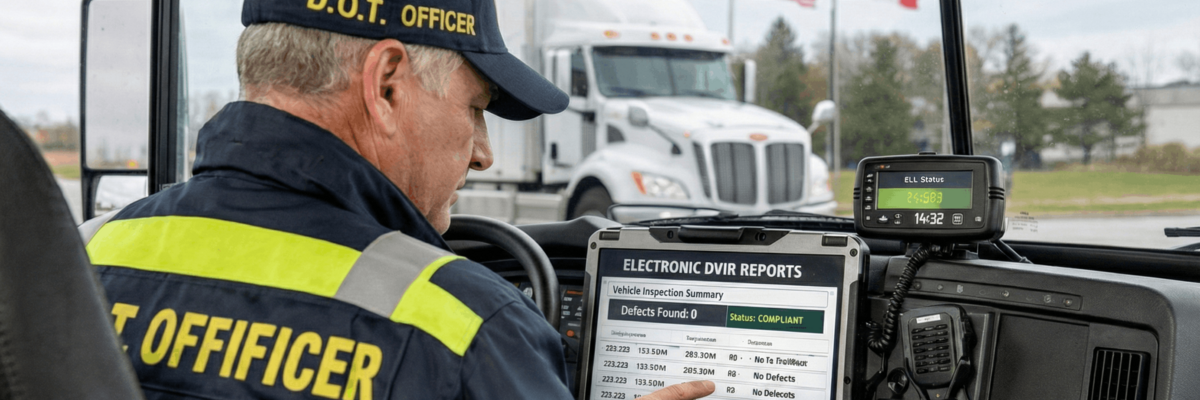
There is a specific sound that haunts every fleet manager. It's the velcro riiiiip of a DOT officer opening their ticket book on the side of the highway.
We're well into 2026 now, and let's be honest: the FMCSA isn't playing games anymore. With digital enforcement becoming standard and data matching becoming instant, they are catching errors that used to slide by in the "paper log" days. For small and medium fleets, one bad compliance review isn't just a headache. It's a "Conditional" safety rating that can double your insurance premiums overnight or disqualify you from high-value loads. If you operate in California, you also need to worry about the CHP BIT inspection program—which has its own set of traps.
But here is the thing that drives us crazy at PTI4YOU: Most violations are totally, 100% avoidable.
We’ve been in the trenches during terminal audits. We've seen the looks on managers' faces when they realize a simple missing signature—repeated 50 times—is going to cost them $8,000. These aren't mechanical failures. They are unforced errors. They are lazy paperwork mistakes.
Let's cut through the legalese and look at the "Big 5" violations that are burning holes in fleet budgets right now, and how to fix them before the auditor shows up.
1. The "Ghost Signature" (396.11(c))

This is the undisputed champion of audit failures. It's the "Zombie Truck" problem—a truck that was fixed, but legally, is still broken.
The Scenario: A driver comes in on Tuesday and reports a cracked mirror on the post-trip DVIR. The shop is busy, but they swap the mirror in 10 minutes. The truck goes back on the line for Wednesday's route.
The Violation: The mechanic forgot to sign the "Certification of Repairs" line. Or, maybe worse, the Wednesday driver didn't check the Tuesday report and failed to sign the "Reviewing Driver" line.
Under 49 CFR 396.11(c), you have to close the loop. It’s a mandatory three-step dance:
- Step 1: Driver A identifies the defect.
- Step 2: Mechanic repairs (or certifies repair is unnecessary) and signs.
- Step 3: Driver B reviews the repair and signs before driving.
If Step 3 is missing, the FMCSA treats that truck as if it was never fixed. You are operating an unsafe vehicle on paper, even if it's brand new in reality. Multiply that by 20 trucks, and you have a pattern of non-compliance.
The Mechanic's Dilemma: "What if we don't have the part?"
This is where fleets get into trouble. If you don't have the part, you CANNOT just leave the DVIR open and drive the truck. You have two choices:
- Choice A: Mark the truck Out of Service (OOS) until the part arrives.
- Choice B: If it's a non-safety item (like A/C or a radio), the mechanic must sign certifying that the repair is "Unnecessary for Safe Operation."
If you drive it without one of those two declarations, you are in violation.
The Fix: Paper forms don't have a brain. They can't stop a driver from leaving the yard. Smart electronic DVIR software puts up a digital wall. The next driver literally cannot start their day until they see the mechanic's note and tap "I Accept Repairs." It forces compliance before the wheels turn.
2. The "Tick and Flick" Inspection
You know the drill. It’s Friday afternoon. It's raining. Ideally, a driver should take 10-15 minutes to do a proper pre-trip. But they're "burning daylight." So they do the "Radio Check"—they sit in the cab, turn up the radio, tick "No Defects" on every box, and roll out in 45 seconds.
How They Catch You: Auditors aren't stupid. They have software now that overlays your DVIR timestamps with your ELD (Electronic Logging Device) data. If your ELD says you went "On-Duty Not Driving" at 06:00:00 and the truck started moving at 06:01:30, you didn't check the tires. You didn't check the lights. You faked it.
This isn't just a record-keeping fine. This falls under 395.8(e) — False Reports. That carries criminal weight. If that truck gets into a wreck later that day due to a blown tire, that 90-second inspection is what the plaintiff's lawyer will put on the big screen in court.
💡 Field Note: The "Clean Report" Trap
Beware the driver who never finds a defect. If a truck has 200,000 miles on it and the last 90 DVIRs are all perfect, that's a red flag to an auditor. Trucks break. Lightbulbs burn out. A diligent driver should be finding small things occasionally.
The Fix: You need an app that tracks Inspection Duration. If a driver tries to submit a 50-point inspection in under 2 minutes, the system should flag it for the safety manager immediately. You catch the lazy behavior internally before the DOT catches it on the roadside. Learn more about why drivers skip pre-trips and how to fix it.
3. The "Thermal Paper" Nightmare (396.11(b)(2))

Let's say your maintenance team is perfect. But 60 days later, an auditor walks in and asks to see the DVIR for Truck #402 from December 12th.
You walk to the filing cabinet. You dig through a shoebox of greasy, coffee-stained papers. And then you find it—a crumpled thermal receipt from a handheld printer. But guess what? It's blank. Thermal paper fades in heat. If that slip was sitting on a dashboard in Arizona for a week, the ink is gone.
The Violation: Failure to retain records for 3 months. If you can't produce a legible copy, it doesn't exist. Period.
Roadside vs. Terminal Audits
It's important to understand the difference. At the roadside, the officer only cares about today. Do you have the previous inspection in your hand (or on your phone)?
At the terminal, the auditor cares about history. They want to see the "story" of the truck over the last 90 days. If you have gaps, illegible papers, or coffee stains covering the signature line, you fail.
The Fix: Cloud storage is cheaper than a filing cabinet and safer than thermal paper. Electronic records are saved forever (or at least the required duration). When an auditor asks for Truck #402, you type "402" into your dashboard, hit print, and hand them a crisp, legible PDF history. It shows you are organized, which usually makes the auditor dig less deep. See our cost comparison of paper vs. electronic DVIRs to understand the real savings.
4. "Bad Tire" (The Vague Description)
We see this on reports all the time. A driver writes two words: "Bad tire."
Okay... which one? The steer? The drive? The trailer? Inside or outside? Is it bald? Is the sidewall separated? Is it just low on air?
The Violation: Regulation 396.11 requires the report to identify the defect. "Bad tire" is a hint, not an identification. This leads to the "Mechanic's Guessing Game." The mechanic walks out, kicks the left steer tire, thinks it feels okay, and signs it off. Meanwhile, the inside right drive tire has a nail in it.
You've just sent a dangerous truck back on the highway because the communication was trash.
The Fix: Mandatory Photo Uploads. This is the single biggest advantage of digital DVIRs. Don't let drivers get away with lazy typing. Make them snap a picture. A photo of a separated sidewall removes the guesswork. It proves to the mechanic exactly what to fix, and it proves to the DOT exactly what was found.
5. The "Orphaned Trailer"
Truckers love their tractors. They name them. They polish the chrome. They check the oil levels religiously. But that trailer behind them? It's often treated like a rental car.
The Violation: 49 CFR 396.11 applies to every commercial motor vehicle, including intermodal chassis and trailers. If a driver drops a trailer at a warehouse and picks up a new one at noon, a separate inspection is required for that new asset.
We often see audits where a fleet has 100% compliance on power units and maybe 20% on trailers. Drivers assume "I checked the rig this morning, I'm good." They aren't good. That is an "Unsatisfactory" rating waiting to happen.
The Fix: Your software workflow needs to handle "Drop and Hook" easily. It should allow a driver to keep their truck inspection open while swapping trailers, without forcing them to restart the whole log-in process. If you make it hard, they won't do it. Make it one click.
Bonus: The "Deferred Repair" Trap
This is a subtle one that catches smart fleets. A driver reports a cracked windshield. It's not obstructing vision, so it's not an Out-of-Service defect. You decide to fix it next week.
However, every single day that truck goes out, the new driver sees the crack. If they report it again, and you ignore it again, it looks like negligence. You need a system that marks defects as "Scheduled for Repair" or "Deferred" so that subsequent drivers see it's been acknowledged, but they don't have to re-flag it every morning.
The "Nuclear Verdict" Risk (Why This Matters)
We talk about fines like $1,000 or $5,000. But that's peanuts compared to the real risk.
In the legal world, there is a term called the "Nuclear Verdict." This is when a jury awards $10 million+ in a trucking accident lawsuit. If your truck is involved in a serious accident, the plaintiff's attorney will subpoena your DVIRs for the last 6 months.
If they find "Tick and Flick" inspections... if they find missing signatures... if they find that a driver reported "bad brakes" three times and there is no record of repair... that is gross negligence. That is how companies go bankrupt. Proper DVIRs are your cheapest insurance policy against liability.
Summary: How to Sleep Better at Night
You can try to police these 5 violations with a clipboard, a red pen, and a lot of yelling at safety meetings. You can spend your weekends cross-referencing paper logs vs fuel receipts.
Or, you can just use a tool that makes these mistakes impossible.
PTI4YOU was built to stop these exact headaches:
- ✅ It enforces the Mechanic/Driver signature loop (no skipping steps).
- ✅ It flags "too fast" inspections instantly.
- ✅ It stores everything in the cloud, immune to coffee spills and fading ink.
- ✅ It demands photos for defects, ending the guessing game.
Audit-Proof Your Fleet for $0
Don't wait for the violation ticket. Try the system that keeps the DOT happy.
Start your 15-day free trial today. No credit card required.
Start Your 15-Day Free Trial – No Credit Card RequiredZero setup fees. Zero hardware. 25-minute driver onboarding.
Frequently Asked Questions
Does a driver need to carry previous DVIRs in the truck?
No, not physically. The driver only needs to have access to the last DVIR for that vehicle to review it before driving. They do not need to carry a 3-month binder of paper in the cab. Digital access on a phone works perfectly and satisfies the rule.
If no defects are found, do I still need a report?
Yes. 396.11 requires a report to be completed at the end of the day regardless of whether defects were found. If the vehicle is clean, you check "No Defects," sign it, and submit. A missing report is a violation, even for a brand new truck.
Can I use a generic checklist?
Technically yes, but it's risky. The regulations list specific parts (brakes, lights, steering, tires, horn, wipers, mirrors, coupling devices, wheels/rims, emergency equipment) that must be checked. If your generic form misses one of those required categories, the inspection is invalid.
How do you keep track of trucking expenses alongside inspections?
Many modern DVIR solutions, including PTI4YOU, are integrating expense tracking. This allows drivers to log fuel receipts or repair costs right after an inspection, keeping all vehicle data in one "digital file folder" so you can see the Total Cost of Ownership (TCO) per unit.
What is the fine for not having a DVIR?
Fines vary based on severity and history, but a general recordkeeping violation can be up to $1,388 per day per violation. Falsifying records (making them up) is much steeper, often exceeding $13,000.