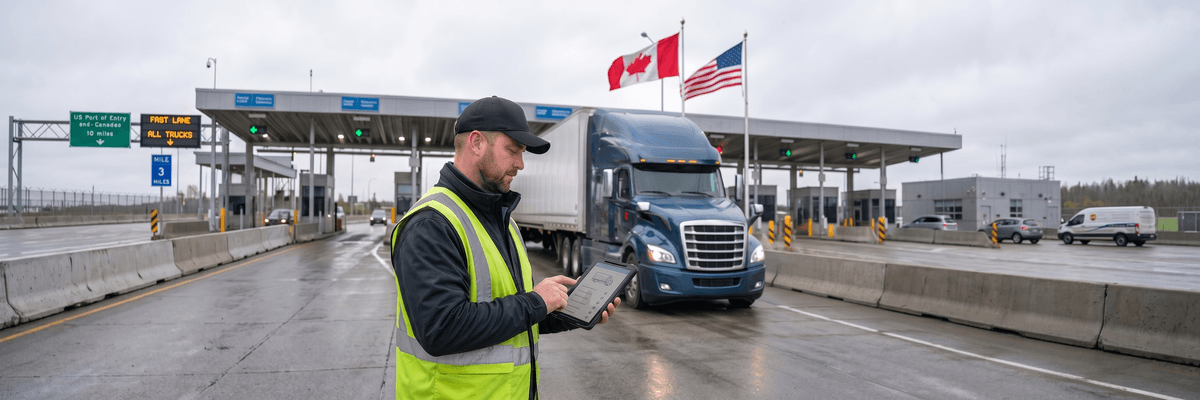
Key Takeaways: Canadian NSC Standard 13 Compliance
- Mandatory Daily Reports: Unlike US FMCSA rules, NSC Standard 13 requires a written or electronic trip inspection report every 24 hours—even when no defects are found.
- Minor vs. Major Defects: Canadian law rigidly categorizes defects. A Major defect means the vehicle must be immediately taken out of service—no exceptions.
- 6-Month Record Retention: Canadian carriers must retain inspection reports for a minimum of 6 months, double the US federal 90-day requirement.
1. Introduction: The 2026 Cross-Border Compliance Landscape
In 2026, the logistics pipeline between the United States and Canada remains one of the most lucrative, yet heavily regulated, trade corridors in the world. For cross-border trucking companies, operating fluidly between two distinct federal jurisdictions requires immense operational discipline. As regulatory bodies on both sides of the border tighten their enforcement standards, relying on outdated compliance methods is no longer a viable business strategy.
The complexity of cross-border fleet compliance has reached a boiling point. While US-based fleets are intimately familiar with the new FMCSA regulations governing Driver Vehicle Inspection Reports (DVIRs), many are caught completely off guard by the stringent, daily requirements of the Canadian NSC Standard 13 trip inspection rules. Ignorance of these laws is not a valid defense at a Canadian weigh station, and failing to produce the correct documentation results in crippling fines, Out-of-Service (OOS) orders, and severe damage to a carrier's safety rating.
To survive and thrive in this environment, fleet managers and owner-operators must adapt. The rise of electronic trip inspection canada software is fundamentally changing how fleets manage this duality. This ultimate guide will demystify Canadian truck inspection rules, comprehensively outline the differences between US DOT and Canadian NSC compliance, and provide a clear roadmap for adopting digital inspection tools that keep your trucks moving seamlessly across the border.
2. What Is NSC Standard 13?
To understand Canadian fleet compliance, you must first understand the National Safety Code (NSC). Created by the Canadian Council of Motor Transport Administrators (CCMTA), the NSC is a comprehensive set of 16 safety standards designed to ensure the safe operation of commercial vehicles across all Canadian provinces and territories.
NSC Standard 13 specifically governs daily commercial vehicle trip inspections. Its primary mandate is remarkably straightforward: to ensure that unsafe commercial vehicles are identified and removed from Canadian roadways before they can cause accidents.
Unlike the United States, where the Federal Motor Carrier Safety Administration (FMCSA) dictates a unified national code, the CCMTA provides the framework (Standard 13), but it is the individual provinces—such as the Ministry of Transportation of Ontario (MTO) or Saskatchewan Government Insurance (SGI)—that adopt, legislate, and enforce these standards. This means that while the core requirements of NSC Standard 13 remain consistent nationwide, provincial inspection requirements can feature slight, yet highly consequential, variations.
Standard 13 mandates that a driver, or a qualified person, must conduct a thorough visual and operational inspection of the vehicle every 24 hours. They must reference a specific list of components (known as a Schedule) and officially document the condition of the vehicle. If a defect is found, the legislation dictates a strict reporting and repair protocol designed to prevent the devastating consequences of deferred maintenance.
3. DOT vs NSC Standard 13: Key Compliance Differences
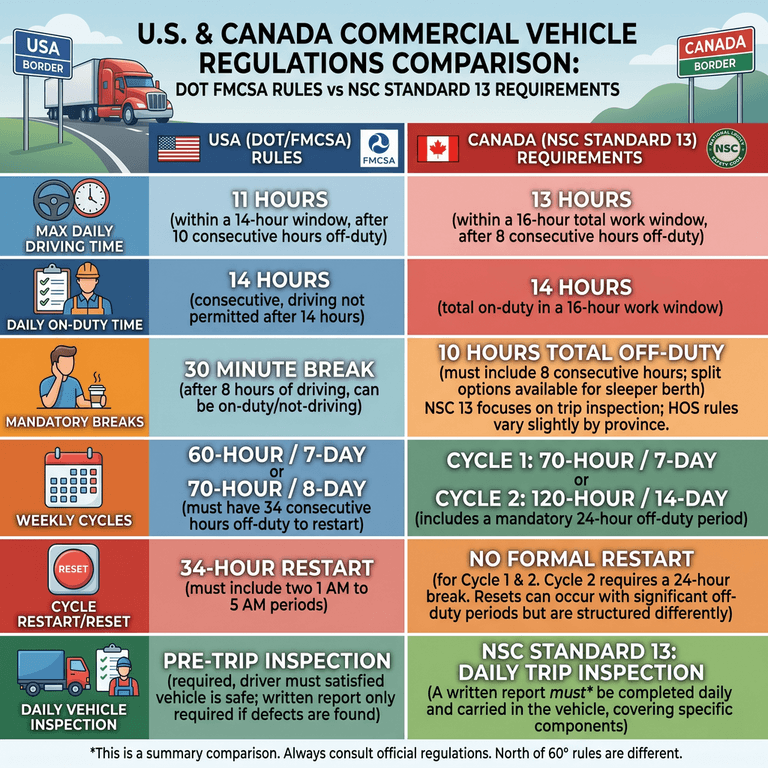
Understanding the critical differences between US DOT rules and Canadian NSC Standard 13 is vital for cross-border fleets.
One of the most dangerous assumptions a US fleet manager can make is that a standard FMCSA DVIR is fully compliant in Canada. FMCSA vs NSC inspection requirements represent two completely different philosophies of regulatory enforcement. Here is a detailed breakdown of the dot vs nsc compliance differences:
Mandatory Reporting Requirement
- US FMCSA (DOT): Under current US federal rules (with exceptions for passenger-carrying vehicles), a driver is generally only required to submit a formal, written DVIR at the end of the day if a defect is found. (Note: Many fleets mandate daily DVIRs as company policy to avoid common DVIR violations, but federal law only mandates it upon defect discovery).
- Canadian NSC Standard 13: A written or electronic trip inspection report is mandatory every 24 hours, regardless of whether a defect is found. If you operate a truck in Canada without a completed report for that 24-hour period, you are immediately in violation of the law.
Defect Classifications
- US FMCSA (DOT): Defects are generally categorized based on whether they affect the safe operation of the vehicle, often referencing the CVSA North American Standard Out-of-Service Criteria.
- Canadian NSC Standard 13: Defects are rigidly codified into two explicit categories within the inspection schedules: Minor Defects and Major Defects.
- Minor Defect: The driver must record the defect on the inspection report and immediately notify the motor carrier. The driver is allowed to continue driving the vehicle, but the carrier must repair it before the next inspection cycle.
- Major Defect: The driver must record the defect, immediately notify the carrier, and stop driving immediately. The vehicle cannot be operated on any highway until the major defect is repaired.
Record Retention Requirements
- US FMCSA (DOT): Motor carriers must retain original DVIRs and certifications of repairs for 90 days (3 months).
- Canadian NSC Standard 13: Record retention is significantly longer. The motor carrier must keep the trip inspection reports, defect notifications, and repair records at their principal place of business for a minimum of 6 months. Additionally, the driver must possess the current day's inspection report, and depending on the province, the previous day's report in the cab of the truck.
Out-of-Service (OOS) Violations: Legal Consequences Compared
When a vehicle is placed Out of Service, the consequences extend far beyond a single traffic stop. Understanding the legal ramifications on both sides of the border is essential for effective cross-border fleet compliance.
In the United States, an OOS violation triggers a cascade of enforcement actions. The vehicle is immediately immobilized at the inspection site until the critical defect is repaired. The violation is recorded in the FMCSA's Safety Measurement System (SMS), directly impacting the carrier's Compliance, Safety, Accountability (CSA) score. High CSA scores attract targeted audits and compliance reviews. Financially, OOS violations carry civil penalties ranging from $1,270 to $16,000 per violation under 49 CFR Part 386, and knowing violations involving imminent hazards can reach $19,514. Repeated OOS violations within a 24-month period can trigger an automatic safety rating downgrade to "Conditional" or "Unsatisfactory," effectively preventing the carrier from operating interstate.
In Canada, the enforcement consequences are equally severe but structured differently. When a commercial vehicle is placed Out of Service at a Canadian inspection station—whether at a provincial scale house, a roadside blitz checkpoint, or a border crossing—the vehicle is physically impounded until repairs are completed and verified by an authorized inspector. In Ontario, the violation generates demerit points against the carrier's Commercial Vehicle Operator's Registration (CVOR), which is a public record accessible to shippers and insurance underwriters. Accumulating excessive CVOR points triggers a mandatory Carrier Intervention, which can include facility audits, increased insurance premiums (often by 30–50%), and potential suspension of operating privileges within the province.
The financial penalties in Canada also differ by province. Ontario's Highway Traffic Act allows fines of up to $50,000 per violation for commercial vehicle offenses. In Alberta, penalties under the Traffic Safety Act can reach $25,000 for operating a defective commercial vehicle. British Columbia's Motor Vehicle Act imposes fines up to $10,000 alongside potential vehicle seizure for repeat offenders. Importantly, in every Canadian province, an OOS violation for a major defect identified under NSC Standard 13 creates a permanent record that auditors reference during facility inspections for years afterward.
For cross-border carriers, the compounding effect is particularly devastating. A single OOS event in Canada generates negative records in both the Canadian provincial enforcement database and the FMCSA's SAFER system, since cross-border inspection data is shared between the two countries under the US-Canada memorandum of understanding. This means that a tire violation at a scale house in Thunder Bay, Ontario can directly influence your CSA percentile ranking back in the United States, affecting your ability to secure freight contracts with safety-conscious shippers.
| Requirement | US FMCSA (DOT) | Canadian NSC Standard 13 |
|---|---|---|
| Daily Written Report | Required only if a defect is found | Mandatory every 24 hours |
| Defect Categorization | General safety/OOS criteria | Strictly defined: Minor vs. Major |
| Carrier Record Retention | 3 Months (90 days) | 6 Months |
| In-Cab Documentation | Current day's report (if defect noted) | Current schedule & current day's report |
4. Understanding Canadian Inspection Schedules
When a driver conducts an nsc standard 13 trip inspection, they cannot simply walk around the truck and guess what to look at. They must utilize a highly specific, standardized checklist known as a "Schedule." Understanding these schedules is paramount for commercial vehicle inspections Canada.
Schedule 1 Trip Inspection
The Schedule 1 trip inspection is the most common checklist used in Canada. It applies to trucks, tractors, and trailers. It explicitly lists every vehicle component that must be inspected (e.g., air brakes, coupling devices, exhaust system, steering, suspension) and precisely defines what constitutes a minor defect versus a major defect for that specific component. For example, a broken clearance lamp is a minor defect, but an inoperative steering axle brake is a major defect.
A detailed understanding of Schedule 1 is non-negotiable for cross-border drivers. The schedule mandates inspection of the following critical vehicle systems, each with explicit minor and major defect definitions:
- Air Brake System: The driver must check for audible air leaks, verify that pushrod stroke is within adjustment limits, and confirm that the low-air-pressure warning device activates before the pressure drops below 55 psi. A pushrod stroke exceeding the adjustment limit is a Major Defect, requiring the vehicle to be immediately taken out of service.
- Coupling Devices: Fifth-wheel assemblies, pintle hooks, and drawbars must be inspected for cracks, missing or loose fasteners, and insecure mounting. A visibly insecure coupling or a missing safety chain is a Major Defect.
- Electrical System: Wiring must be inspected for damage, exposed conductors, and secure connections. Malfunctioning battery tie-downs or a damaged main power cable is a Minor Defect, but a complete failure of the charging system qualifies as Major.
- Exhaust System: The driver must check for leaks in the exhaust system, particularly any leak that would cause fumes to enter the cab. An exhaust leak that directs gases into the cab or sleeper is a Major Defect.
- Frame and Cargo Body: Visible cracks, sagging, or damage to crossmembers must be noted. Insecure or missing cargo body fasteners are a Minor Defect, but a visibly cracked, broken, or sagging frame member is Major.
- Fuel System: Fuel tanks, caps, and lines must be inspected for leaks and damage. A dripping fuel leak is a Major Defect, and a missing fuel tank cap is classified as Minor.
- Lights and Reflectors: All required lamps (headlights, tail lights, brake lights, turn signals, clearance lamps) must be operational. A single inoperative clearance lamp is a Minor Defect, but a failure of both headlights, both tail lamps, or all turn signals on one side is a Major Defect.
- Steering: The steering wheel, column, and linkage must be free of excessive play, damage, and loose components. Any condition that prevents the driver from steering normally—such as a damaged steering gear box or a missing nut on the drag link—is a Major Defect.
- Suspension: Leaf springs, air bags, shock absorbers, and U-bolts must be inspected. A cracked or broken main leaf spring, or a deflated air suspension bag, is a Major Defect. A damaged shock absorber is classified as Minor.
- Tires: The driver must verify adequate tread depth (no less than the wear indicators), check for cuts exposing the cord, and ensure proper inflation. A flat tire, a tire with exposed cord or belt material, or a tire contacting any part of the vehicle is a Major Defect.
- Wheels, Hubs, and Fasteners: Missing, cracked, or loose wheel fasteners must be identified. A wheel hub showing evidence of imminent failure (oil seal leaks, cracks) is a Major Defect. A single missing wheel nut, when others remain secure, is a Minor Defect.
- Windshield and Glass: The windshield must be free of damage in the driver's primary field of vision. A crack or damage that obstructs the driver's direct line of sight is a Major Defect.
Schedule 2 and Schedule 3
While Schedule 1 covers freight, different vehicle classes require different schedules. Schedule 2 is specifically designed for buses and passenger-carrying vehicles, including additional checks for emergency exits and passenger accessibility features. It adds inspection requirements for passenger seating security, emergency exit window mechanisms, accessibility ramps or lifts, fire extinguisher presence and charge status, and interior handrails. A failure of any emergency exit mechanism or an inoperative passenger door is a Major Defect under Schedule 2. Schedule 3 applies to motor coaches and adds long-haul-specific checks for restroom facilities, climate control, and intercom systems. If a US fleet operates a mix of freight and passenger vehicles across the border, they must ensure their drivers are utilizing the correct schedule for the correct asset.
Provincial Enforcement: Ontario and the CVOR System
Ontario truck inspection rules are heavily enforced by the Ministry of Transportation of Ontario (MTO), and carriers are closely monitored via the CVOR (Commercial Vehicle Operator's Registration) system. Ontario is unique in that every commercial vehicle operating within the province must be registered under a CVOR certificate, and every road-safety infraction—including a missing Schedule 1 trip inspection—generates demerit points on that certificate. A single missing inspection can result in CVOR points that directly affect a carrier's safety rating and insurance premiums in the province. The MTO conducts both random roadside inspections and targeted facility audits, and they actively analyze CVOR data to identify high-risk carriers for intervention.
Provincial Enforcement: Alberta's Partners in Compliance (PIC)
Alberta takes a significantly different approach through its Partners in Compliance (PIC) program, administered by Alberta Transportation. PIC is a voluntary safety program that allows qualifying carriers to earn benefits such as reduced roadside inspection rates and streamlined permit processes. To participate, a carrier must demonstrate an exemplary safety record, implement a certified Safety Fitness Certificate program, and undergo periodic facility audits. For cross-border carriers, PIC membership signals to Alberta enforcement that your fleet meets or exceeds safety standards—but it also means that PIC members are held to a higher accountability standard. A single serious OOS violation can result in removal from the program, immediately increasing the carrier's exposure to roadside enforcement.
Provincial Enforcement: British Columbia's CVSE
British Columbia's Commercial Vehicle Safety and Enforcement (CVSE) branch operates one of the most technologically advanced inspection networks in Canada. BC utilizes automated weigh-in-motion systems and Automatic Vehicle Identification (AVI) transponders to pre-screen commercial vehicles, and carriers with strong compliance records often receive bypass privileges at inspection stations. However, CVSE inspectors are meticulous about trip inspection documentation. If a driver is unable to produce a valid, completed Schedule 1 report at a BC scale house, the vehicle is detained for a full Level 1 inspection (the most comprehensive inspection level). British Columbia also enforces strict chain-up requirements during winter months, and the CVSE expects that the daily trip inspection report includes verification that tire chains and winter equipment are present and serviceable when seasonal conditions demand them.
Provincial Enforcement: Saskatchewan and Quebec
Saskatchewan enforces NSC Standard 13 through Saskatchewan Government Insurance (SGI), which ties commercial vehicle compliance directly to insurance eligibility. Carriers with poor inspection records face escalating insurance surcharges, and severe violations can result in denial of insurance renewal—effectively shutting down the carrier's ability to operate within the province. Saskatchewan electronic inspections must meet SGI's strict auditing requirements, including tamper-proof timestamping and driver identification verification. In Quebec, the Société de l'assurance automobile du Québec (SAAQ) enforces its own adaptation of NSC Standard 13. Quebec's unique requirement is that trip inspection forms must be available in French if the driver's primary language is French, and electronic inspection systems used in Quebec must support bilingual interfaces to satisfy provincial language legislation. For US fleets entering Quebec via the I-87/A-15 corridor, this bilingual requirement is an often-overlooked compliance trap.
5. Electronic Trip Inspections in Canada

Transitioning to electronic trip inspections ensures your drivers never lose a paper Schedule 1 form and guarantees data is synced instantly to the cloud.
The days of managing cross-border compliance with three-ring binders and carbon-copy paper are ending. Just as we analyzed the devastating hidden cost of pencil whipping in the US, Canadian regulators are equally frustrated with falsified paper records. The solution mandated by industry efficiency and heavily encouraged by the CCMTA is the adoption of electronic DVIR Canada systems.
Electronic trip inspections offer massive operational advantages for cross-border fleets. By digitizing the Schedule 1 trip inspection, fleets ensure that drivers are presented with the exact, legally required checklist based on their current geographic location. Furthermore, digital systems eliminate the risk of lost paperwork, illegible handwriting, and faded thermal ink—all of which lead to automatic violations during a provincial facility audit.
Most importantly, cloud-based electronic inspections solve the 6-month retention nightmare. Instead of dedicating entire office rooms to filing boxes filled with greasy paper, compliance managers can access, search, and export secure, timestamped, and digitally signed inspection records instantly. When an MTO officer requests a fleet's inspection history, an organized digital export demonstrates a culture of safety and operational excellence.
6. Challenges for US Fleets Operating in Canada
Transitioning from a domestic US operation to a cross-border powerhouse introduces severe operational friction. The most common cross border truck inspections challenges include:
- Regulatory Misunderstandings: US dispatchers often fail to instruct drivers on the necessity of completing a daily inspection report when no defects are found, leading to immediate citations at Canadian scale houses.
- Incorrect Form Usage: Utilizing a generic US FMCSA DVIR form instead of a Canadian Schedule 1 form. Canadian inspectors look specifically for the Minor/Major defect categorization; if it's missing, the inspection is deemed invalid.
- Dual-Standard Recordkeeping: Small trucking companies struggle to maintain two separate filing systems—one meeting the 90-day US requirement and another meeting the 6-month Canadian requirement. Calculating the true cost of paper reveals that managing these dual systems manually drains administrative resources rapidly.
- Driver Confusion: Switching between compliance mentalities causes driver fatigue. A driver accustomed to US rules may mistakenly believe they can continue driving with a defect that Canada classifies as "Major," risking a severe Out-of-Service order.
7. Cross-Border Software Comparison (Motive, Samsara, Whip Around)
To overcome these challenges, adopting robust fleet inspection software Canada is essential. However, the B2B SaaS market is crowded with platforms that each serve different fleet profiles. The critical question for a cross-border operator is not simply "which platform has the most features?" but rather "which platform handles the unique regulatory duality of US-Canada operations without adding administrative overhead?" Let's compare three major players and evaluate their cross-border capabilities in detail.
Motive (formerly KeepTruckin)
- Features: A massive ecosystem offering ELDs, AI dashcams, comprehensive telematics, and an integrated DVIR module.
- Estimated Pricing: Motive typically operates on a per-vehicle, per-month subscription model. Published estimates for the full platform (ELD + dashcam + DVIR) range from $35–$60 per vehicle/month, plus a one-time hardware cost of approximately $150–$300 per device. Multi-year contracts are standard, and early termination fees apply.
- Cross-Border Usability: Strong. Motive fully supports Canadian HOS rules and includes functional electronic DVIRs that satisfy Canadian inspection requirements. The platform automatically switches between US and Canadian HOS rulesets based on GPS location.
- Cross-Border Limitations: While Motive's DVIR forms can be customized, the platform does not ship with pre-configured CCMTA Schedule 1, 2, or 3 templates. Fleet administrators must manually build these forms or request them from Motive's support team. Additionally, Motive's compliance dashboard does not natively differentiate between US 90-day and Canadian 6-month retention requirements, meaning back-office staff must manually track which records fall under which jurisdiction's retention rules.
- Best Use-Case: Enterprise fleets (100+ vehicles) that already use Motive's ELD and dashcam hardware and need an integrated, all-in-one platform. The high fixed hardware cost makes Motive economically inefficient for a 5-to-15-truck fleet that simply needs compliant digital inspections.
Samsara
- Features: Premium, enterprise-grade IoT platform tracking everything from reefer temperatures to driver eye movement via AI-powered fatigue detection.
- Estimated Pricing: Samsara is positioned at the high end of the market. Platform subscriptions typically start at $40–$75 per vehicle/month depending on the module bundle, with mandatory proprietary gateway hardware costing approximately $200–$400 per vehicle. Samsara usually requires a 3-to-5-year contract commitment.
- Cross-Border Usability: Excellent. Samsara seamlessly handles international borders, automatically switching HOS rules and supporting Canadian DVIR standards. Their API integration is robust, and large carriers appreciate the business intelligence dashboards.
- Cross-Border Limitations: Samsara's greatest limitation for cross-border fleets is the cost-to-value ratio for smaller operations. The platform's DVIR module, while powerful, is bundled into a broader platform—you cannot purchase *only* the inspection feature. For a 10-truck cross-border fleet paying $60/vehicle/month, the annual platform cost exceeds $7,200 before hardware, simply to access electronic inspections. Furthermore, Samsara's Canadian-specific reporting features (such as CVOR-ready exports or MTO-formatted audit packages) require custom configuration by their enterprise support team, which is typically reserved for larger accounts.
- Best Use-Case: Large enterprise fleets (200+ vehicles) with dedicated IT departments that can leverage Samsara's full IoT ecosystem, including temperature monitoring, AI dashcams, and predictive maintenance. For a small cross-border fleet seeking only compliant DVIRs, Samsara is significantly overbuilt and overpriced.
Whip Around
- Features: Dedicated fleet maintenance and DVIR software, decoupled from the ELD, allowing it to work alongside any existing telematics provider.
- Estimated Pricing: Whip Around offers a more accessible pricing model, typically ranging from $5–$15 per vehicle/month depending on the tier. No proprietary hardware is required—the app runs on standard iOS and Android devices. However, advanced features like automated defect workflows and custom reporting require higher-tier plans.
- Cross-Border Usability: Good. You can customize form templates to replicate a Canadian Schedule 1, and the platform's flexibility allows fleet managers to build jurisdiction-specific workflows.
- Cross-Border Limitations: Whip Around does not include pre-built Canadian NSC Standard 13 templates out of the box. The fleet manager must manually configure each Schedule 1 item, define which defects are Minor versus Major, and set up the appropriate notification workflows. This initial configuration can take several hours and requires detailed knowledge of Canadian regulations. Furthermore, Whip Around does not automatically detect which country the driver is operating in—switching between US and Canadian forms requires a manual action by the driver, which introduces a significant risk of human error during border crossings.
- Best Use-Case: Domestic US fleets (20–100 vehicles) that need affordable, standalone DVIR software and are willing to invest setup time in manual Canadian form configuration. It is a good fit for fleets that only occasionally cross the border and can accept the risk of manual jurisdiction switching.
Cross-Border Software Comparison Summary
| Feature | Motive | Samsara | Whip Around | pti4you.com |
|---|---|---|---|---|
| Est. Cost (per vehicle/mo) | $35–$60 | $40–$75 | $5–$15 | Free trial; competitive |
| Hardware Required | Yes (proprietary) | Yes (proprietary) | No | No |
| Pre-Built Schedule 1 Forms | No (manual setup) | No (enterprise config) | No (manual setup) | Yes (pre-loaded) |
| Auto US/CA Jurisdiction Switch | HOS only | HOS only | No | Yes (full DVIR) |
| 6-Month CA Retention | Manual tracking | Manual tracking | Manual tracking | Automated |
| Contract Lock-In | Multi-year | 3–5 years | Monthly available | No lock-in |
Why pti4you.com Is Better for Cross-Border Fleets

pti4you.com allows fleet managers to automate cross-border compliance without purchasing expensive proprietary hardware.
If Samsara is too expensive, Motive requires unwanted hardware, and Whip Around requires heavy manual configuration, where does a small-to-medium cross-border fleet turn? This is where pti4you.com dominates the market.
pti4you.com is engineered specifically to be flexible, lightweight, and hyper-focused on compliance. We understand that a driver crossing the Ambassador Bridge doesn't need AI fatigue tracking; they need a foolproof way to log a legally binding Schedule 1 trip inspection on their smartphone in three minutes.
Master Cross-Border Compliance Instantly
Running cross-border operations? pti4you.com allows fleets to instantly switch between US federal inspection standards and Canadian provincial inspection schedules (including Schedule 1 forms), helping maintain compliance on both sides of the border.
- ✅ Zero hardware required – Use iOS or Android smartphones.
- ✅ Pre-loaded CCMTA Schedule 1, 2, and 3 forms.
- ✅ Automated 6-month cloud retention for Canadian facility audits.
- ✅ Foolproof Major/Minor defect workflow preventing dispatch errors.
Zero setup fees. Zero hardware. 25-minute driver onboarding.
8. Cross-Border Best Practices Checklist
To ensure your fleet remains compliant with both the FMCSA and the CCMTA, implement this definitive cross-border fleet compliance checklist:
- Deploy Electronic Record Retention: Ensure your software automatically saves daily inspection reports to a centralized cloud, accessible by back-office staff instantly during a provincial audit.
- Enforce Schedule 1 Usage: Train all drivers crossing the border that generic US DVIR forms are unacceptable; they must use the Canadian Schedule 1 form daily.
- Mandate "No Defect" Reporting: Reprogram your drivers' habits. In Canada, an inspection report must be generated every 24 hours, even if the truck is in perfect condition.
- Track Defect Resolution Strictly: Ensure mechanics utilize digital sign-offs to close the loop on repairs, satisfying both US 396.11 and Canadian NSC requirements.
- Verify Provincial Nuances: If operating heavily in Ontario, ensure your CVOR records match your daily inspection data to prevent catastrophic safety rating downgrades.
- Conduct Mock Audits: Regularly pull 6 months of historical electronic data to ensure your system is properly retaining records required by Canadian authorities.
9. Frequently Asked Questions
What is NSC Standard 13?
NSC Standard 13 is a Canadian safety regulation established by the CCMTA that mandates daily commercial vehicle trip inspections. It requires drivers to inspect specific vehicle components, document defects, and ensure unsafe vehicles are not operated on Canadian roadways.
Is electronic DVIR legal in Canada?
Yes, electronic trip inspections (electronic DVIRs) are completely legal and highly encouraged in Canada under NSC Standard 13, provided the software captures driver signatures, timestamps, and meets provincial record-retention requirements.
What is the difference between DOT and NSC inspections?
While US DOT (FMCSA) DVIRs typically require a report only if a defect is found, Canadian NSC Standard 13 requires a mandatory written or electronic trip inspection report every 24 hours, regardless of whether a defect is present. NSC also categorizes defects strictly into "Minor" and "Major" categories.
Do US carriers need NSC compliance?
Yes. Any US-based motor carrier operating a commercial vehicle in Canada must comply with Canadian NSC Standard 13 trip inspection rules and provincial regulations while operating within Canadian borders.
What is a Schedule 1 inspection?
Schedule 1 is the specific list of vehicle components that must be inspected daily on trucks, tractors, and trailers under NSC Standard 13. It details the exact criteria for what constitutes a minor defect versus a major defect.
How long must inspection reports be stored in Canada?
Under NSC Standard 13, motor carriers are generally required to retain trip inspection reports at their principal place of business for a minimum of 6 months. Drivers must also carry the current day's inspection report in the cab.
Conclusion: Bridge the Compliance Gap Before It Bridges You
Operating a cross-border fleet between the United States and Canada in 2026 demands more than just a DOT number and a passport. The regulatory gap between FMCSA DVIRs and Canadian NSC Standard 13 trip inspections is wide enough to swallow any unprepared carrier whole. From mandatory daily reporting to the rigid Minor/Major defect classification system and the extended 6-month record retention requirements, Canadian compliance adds layers of complexity that paper-based systems simply cannot handle.
The fleets that will dominate the cross-border corridors in 2026 and beyond are the ones that invest now in electronic trip inspection software purpose-built for dual-jurisdiction compliance. Stop treating Canadian inspections as an afterthought. Equip your drivers with the right digital tools, train them on Schedule 1 requirements, and build an automated compliance infrastructure that satisfies both the FMCSA and the CCMTA without breaking a sweat.