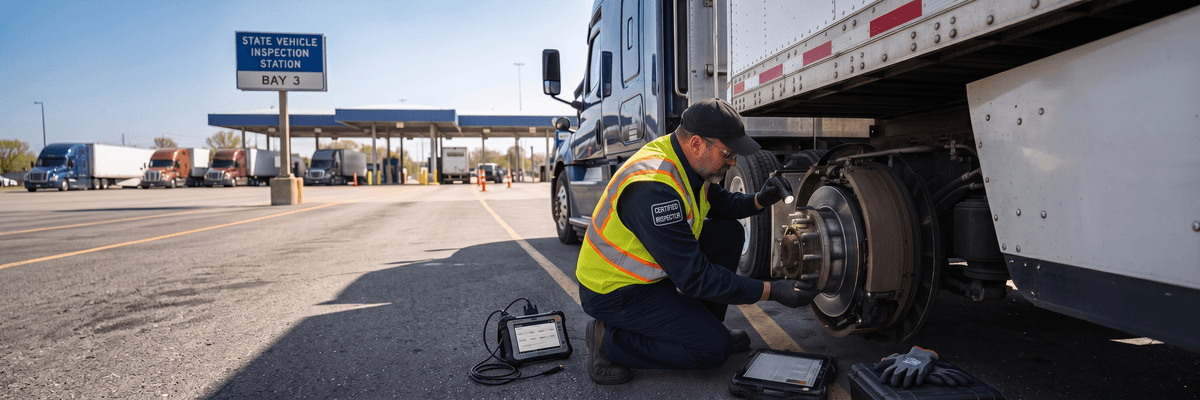
The Bottom Line Up Front: CVSA Brake Safety Week 2026 runs August 23–29, 2026. For the second consecutive year, inspectors will focus on the structural and thermal condition of brake drums and air disc brake rotors. During the 2025 campaign, 15.1% of inspected vehicles were placed out of service, with the "20% defective brakes" criterion alone driving more than half of those orders. Surviving the week is not an August event — it is the product of rigorous, digitally documented daily pre-trip inspections performed all year long.
Key Takeaways: CVSA Brake Safety Week 2026
- Mark the dates: Brake Safety Week runs August 23–29, 2026, as the concentrated escalation of the year-round Operation Airbrake program across the U.S., Canada, and Mexico.
- Drums and rotors are the target: Inspectors are trained to sideline vehicles for heat checking, flexural cracks, scoring, exposed cooling vents, and material in danger of breaking away.
- Two defects can park an 18-wheeler: The 20% defective brakes criterion means just two bad brakes on a standard 10-wheel-end combination triggers an immediate out-of-service order.
- Preparation is a daily habit: A digital DVIR that forces photo-verified brake checks and instant defect routing is the difference between catching a cracked drum in the yard and losing a truck at the scale house.
Brake Safety Week 2026: Dates and Mandate
Among the many components that keep a commercial motor vehicle safe, the pneumatic and mechanical braking system remains the single most critical point of failure. Recognizing this, the Commercial Vehicle Safety Alliance (CVSA) — in coordination with the Federal Motor Carrier Safety Administration (FMCSA) and its Canadian and Mexican counterparts — runs an annual enforcement and education initiative known as Brake Safety Week. Scheduled for August 23–29, 2026, this seven-day blitz is a concentrated escalation of the year-round Operation Airbrake program.
During this window, certified inspectors across North America execute thousands of specialized brake inspections, removing non-compliant assets from the highway network while capturing data on mechanical failure trends. For the 2026 cycle, the CVSA has issued a specific strategic mandate: inspectors will place primary emphasis on the structural and thermal condition of brake drums and air disc brake (ADB) rotors, as detailed in the official 2026 Brake Safety Week focus area. This targeted focus reflects a growing imperative to combat thermal fatigue, metallurgical degradation, and the catastrophic risk of dislodged cast-iron debris on high-speed roads.
CVSA guidelines also strongly recommend that carriers proactively verify pad and lining thickness, eliminate grease contamination, inspect pneumatic hoses for bulges and chafing, meticulously measure pushrod stroke, and confirm Anti-lock Braking System (ABS) functionality — a checklist laid out in the CVSA's brake systems and inspections FAQ. In other words, the announced "focus area" is the tip of a much larger inspection iceberg — and an officer always retains the authority to expand a stop into a full inspection if other violations are apparent.
2025 Enforcement Data: What History Tells Us
During the 2025 Brake Safety Week (August 24–30, 2025), enforcement personnel across 52 jurisdictions conducted 15,175 brake-focused inspections. While 84.9% of vehicles met standards, 15.1% — totaling 2,296 commercial vehicles — were placed out of service for critical brake deficiencies, according to the CVSA's 2025 Brake Safety Week results.
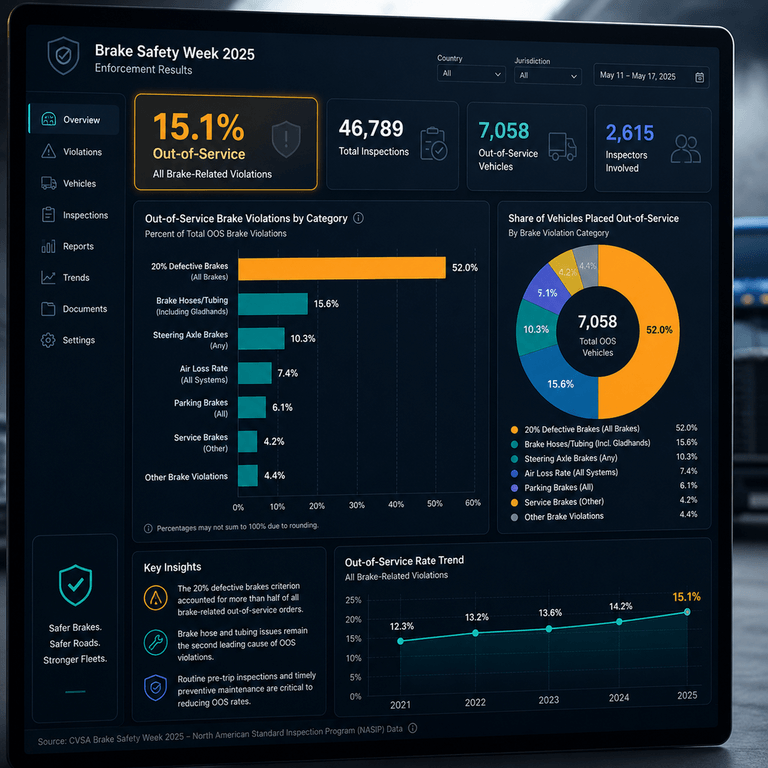
| Violation Category | Total Violations Recorded | Percentage of Brake OOS |
|---|---|---|
| 20% Defective Brakes Criterion | 1,199 | 52.2% |
| Other Brake Violations | 375 | 16.3% |
| Brake Hoses / Tubing Integrity | 306 | 13.3% |
| Steering Axle Brake Violations | 199 | 8.6% |
| Air Loss Rate Failures | 100 | 4.3% |
The dominance of the "20% Defective Brakes" criterion — which accounted for more than half of all out-of-service orders — indicates a systemic failure in routine pre-trip inspections and preventive maintenance scheduling. Just as telling is the comparison with the unannounced Brake Safety Day held on April 22, 2025: inspectors evaluated 4,569 vehicles and placed only 8.7% out of service, per the CVSA's Brake Safety Day results. The gap between the 15.1% announced-week rate and the 8.7% unannounced-day rate reveals a paradox — the heightened scrutiny of the announced week's Level IV special inspections uncovers deep-seated, chronic maintenance deferrals that standard roadside checks routinely overlook.
Directly relevant to the 2026 focus, the 2025 data also tracked 113 distinct drum and rotor violations, which sidelined 39 heavy-duty vehicles. That empirical trend is precisely why the CVSA has scrutinized these components for a second consecutive year.
The 2026 Focus: Brake Drums & Rotors
At the most fundamental level, a commercial brake system is an energy-conversion mechanism: it transforms the kinetic energy of a moving 80,000-pound combination into thermal energy through friction. The components tasked with absorbing, storing, and dissipating that massive thermal load are the brake drums (in traditional S-cam systems) and the rotors (in air disc brake systems). Their structural failure is a catastrophic safety hazard, which is exactly why they are the 2026 priority.
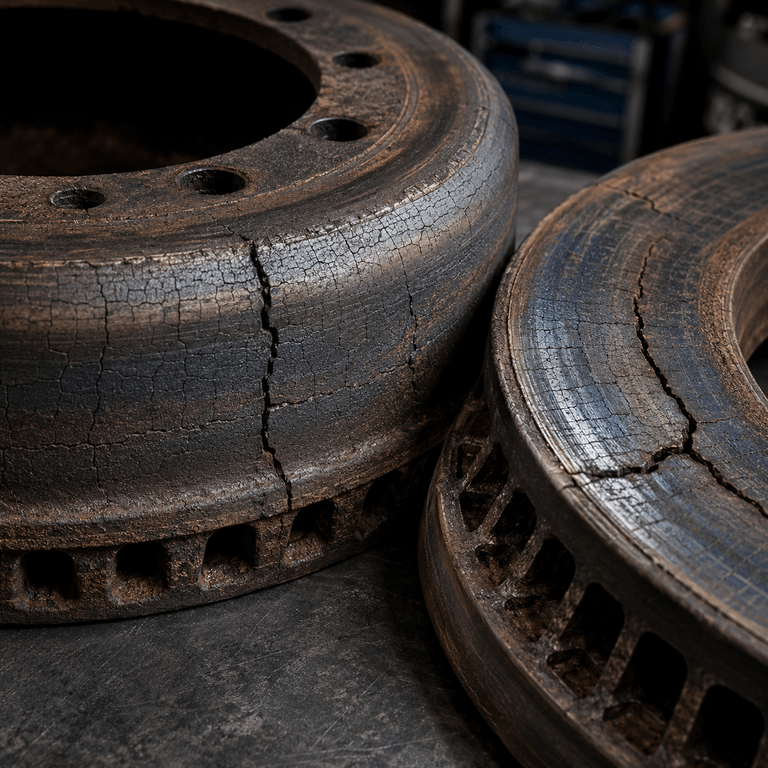
Commercial drums and rotors are cast from grey or vermicular cast iron for its thermal conductivity and heat capacity. But during sustained braking — long mountain descents or high-speed emergency stops — the friction interface can reach 500°C to 600°C (roughly 932°F to 1112°F). This severe thermal cycling drives rapid expansion and contraction, generating internal stresses that exceed the yield strength of the cast iron and produce thermal fatigue. Inspectors are trained to identify its physical signatures:
- Heat checking. Short, fine hairline cracks on the friction surface. Minor checking is normal, but severe checks that intersect or progress deeply create dangerous stress concentrators.
- Flexural cracks. Deep structural fractures that often extend entirely through the drum or rotor. Any drum with an external crack that opens on brake application is an automatic out-of-service order.
- Scoring, gouging, and excessive wear. Deep grooves reduce friction contact area and stopping power. Inspectors explicitly check whether a rotor has worn so thin that its internal cooling vents are exposed.
- Martensite (hard spots). Localized extreme heat can form ultra-hard, brittle deposits that cause uneven pad wear, vibration, and accelerate crack formation.
The emphasis extends beyond lost braking efficiency. As a drum or rotor fatigues and fractures, the immense rotational forces of the wheel end can break heavy chunks of cast iron away entirely. At highway speed, a dislodged fragment becomes a high-energy projectile that strikes trailing vehicles and penetrates windshields. That is why checking for missing material or portions in danger of falling away is a non-negotiable step in the CVSA pre-trip protocol.
Friction Material: Rust Jacking & Contamination
Drums and rotors interface directly with friction materials — brake shoes and pads — and the CVSA advises carriers to confirm sufficient lining thickness, even wear patterns, and the complete absence of oil or grease.
One of the most destructive and least-understood failure mechanisms is rust jacking, especially prevalent in snow-belt fleets that encounter aggressive liquid de-icers like magnesium and calcium chloride. Brake pads bond a friction compound to a steel backing plate with phenolic adhesive, and the friction material is inherently porous. When corrosive slush penetrates those pores and reaches the steel plate, an electrochemical oxidation process begins. As the steel converts to iron oxide, it expands to occupy up to four times the original volume, generating thousands of pounds of pressure that physically tears the friction material away from the backing plate.
The terminal stage is complete delamination: the friction material separates and falls out, forcing bare steel against the rotor, destroying it within miles and eliminating that wheel end's stopping power. Advanced fleets increasingly specify galvanized backing plates with mechanical attachment hooks to physically anchor the friction material rather than relying on adhesive alone.
Inspectors also strictly monitor for contamination. Any oil, grease, or brake fluid permeating the friction material triggers an immediate out-of-service order. The most common culprit is a leaking wheel seal throwing hub oil onto the shoes. Because the porous material acts like a sponge, contaminated shoes cannot be cleaned or salvaged — they must be replaced.
Air Hoses, Air Loss & ABS Functionality
The integrity of drums, rotors, and pads is irrelevant if the pneumatic energy required to actuate them is compromised. The 2026 pre-check recommendations mandate rigorous inspection of brake hoses and tubes for leaks, chafing, bulges, and physical damage.

Under the Out-of-Service Criteria, a vehicle is sidelined if a brake hose exhibits damage extending through the outer reinforcement ply — including severe chafing against a frame rail that exposes the inner braided wire — or if a hose visibly bulges when pressure is applied. Inspectors also evaluate the pneumatic system with a static air loss test: with the system at full pressure, engine off, and firm continuous pressure on the service brake pedal, the system must not lose more than 3 psi per minute for a single vehicle or 4 psi per minute for a combination. Excessive loss points to leaks at gladhands, relay valves, or brake chambers.
Finally, modern vehicles rely on ABS to prevent wheel lockup and jackknifing. During inspection, the driver cycles the ignition; the yellow ABS malfunction lamp must illuminate briefly to prove the bulb works, then cleanly extinguish to confirm the electronic control unit passed its self-diagnostic sweep. A lamp that stays lit signals a severed wheel-speed sensor, a faulty modulator valve, or a corrupted ECU — all of which compromise dynamic stability.
Decoding the Out-of-Service Criteria
The cornerstone of brake enforcement is the "20% defective brakes" rule: a vehicle or combination is placed out of service when the number of defective brakes equals or exceeds 20% of the total service brakes. On a standard five-axle tractor-trailer with 10 wheel ends, that threshold is just two defective brakes.
For a 14-brake configuration, 20% equals 2.8, and the CVSA rounds fractions up — so three defective brakes triggers the order. A brake is classified as "defective" if it has missing components, friction material contamination, lining below minimum thickness (1/4 inch for drums, 1/16 inch for discs), or if pushrod stroke exceeds the maximum adjustment limit.
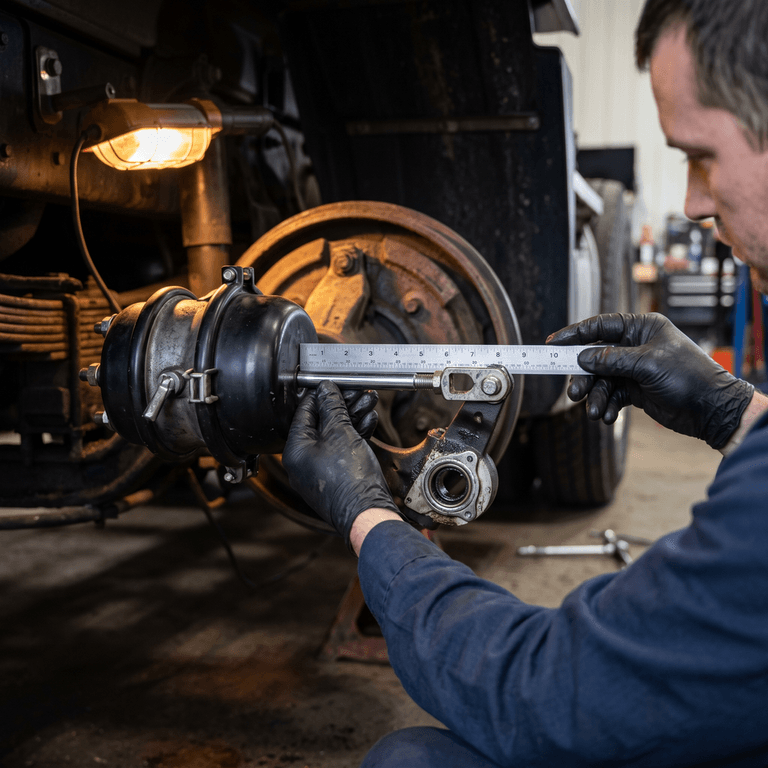
Pushrod stroke limits are defined by the physical size and type of the pneumatic brake chamber under 49 CFR 393.47:
| Brake Chamber Type | Outside Diameter | Maximum Allowable Stroke |
|---|---|---|
| Type 12 (Steer / Medium Duty) | 5-11/16 in (145 mm) | 1-3/4 in (44.5 mm) |
| Type 16 | 6-3/8 in (162 mm) | 2 in (50.8 mm) |
| Type 20 (Standard Stroke) | 6-25/32 in (172 mm) | 2 in (50.8 mm) |
| Type 24 (Standard Stroke) | 7-7/32 in (184 mm) | 2 in (50.8 mm) |
| Type 30 (Standard Heavy Duty) | 8-3/32 in (206 mm) | 2-1/2 in (63.5 mm) |
Crucially, the Out-of-Service Criteria apply a "half-defect" rule: a stroke greater than the maximum limit but less than 1/4 inch beyond it counts as 0.5 of a defective brake. So if a standard 18-wheeler has two brakes each 1/8 inch over the limit, they combine to one full defective brake — and a single additional oil-contaminated brake reaches the two-defect threshold and parks the vehicle.
A dangerous misconception is that automatic slack adjusters (ASAs) eliminate the need to measure stroke. ASAs maintain shoe-to-drum clearance as linings wear, but they can mask severe underlying failures such as a destroyed camshaft bushing or a cracked brake spider. Once an ASA exhausts its adjustment range, the brake goes out of adjustment unannounced. Fleets that rely on the automated function without requiring mechanics to manually measure stroke with a pry bar are gambling with their compliance.
CVSA Inspection Levels I–VIII
Brake Safety Week operates within the broader framework of eight CVSA inspection levels. Understanding them clarifies what drivers should expect at the scale house:
- Level I (North American Standard): The most comprehensive 37-step inspection, requiring the officer to physically examine brakes, suspension, steering, tires, and coupling devices while auditing driver credentials and hours of service.
- Level II (Walk-Around): All driver credential checks plus a vehicle inspection limited to items visible without going underneath.
- Level III (Driver/Credential): An administrative audit of CDL, ELD data, medical cards, and seatbelt use — no mechanical inspection.
- Level IV (Special Inspections): A targeted, one-time examination of a specific component. Brake Safety Week heavily uses Level IV inspections to capture drum, rotor, and adjustment data.
- Level V (Vehicle-Only): A full mechanical inspection conducted without the driver present, typically at a terminal.
- Level VI: Hyper-stringent inspections for vehicles transporting highly radioactive materials.
- Level VII (Jurisdictional Mandated): State-specific audits such as school buses or limousines.
- Level VIII (Electronic): A wireless, in-motion inspection conducted without direct driver interaction.
Drivers should anticipate a surge in Level IV special brake inspections during the week, though any officer can expand a stop into a full Level I inspection if blatant violations — bald tires, unsecured cargo — are immediately apparent.
Performance-Based Brake Testers & the 43.5% Rule
Visual inspections are excellent at finding missing parts and measuring stroke, but they cannot quantify actual stopping force. To close that gap, sophisticated jurisdictions deploy Performance-Based Brake Testers (PBBTs) — roller dynamometers that directly measure braking force at each wheel end.
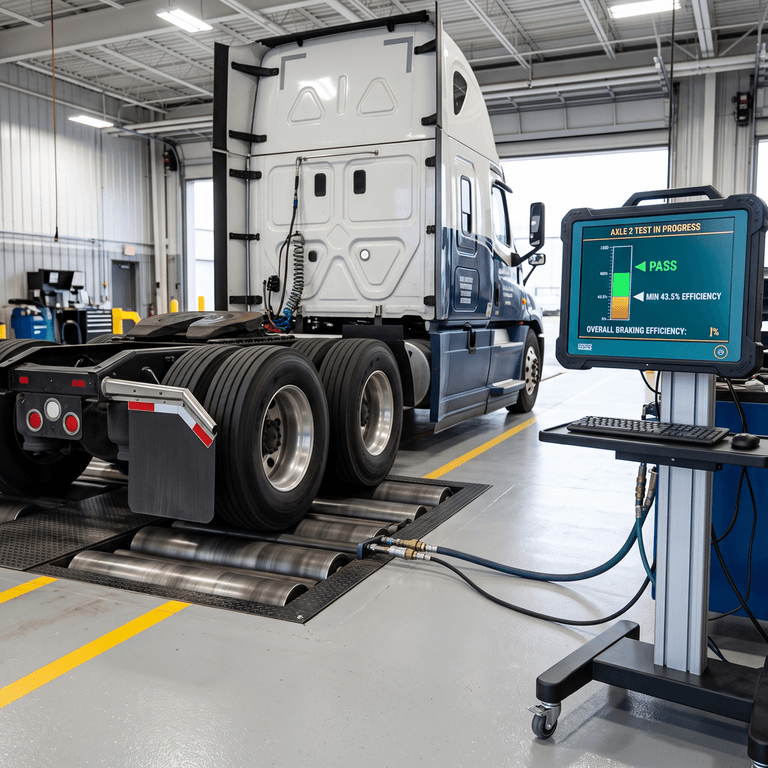
Under 49 CFR 393.52 and Section 1.1 of the Out-of-Service Criteria, commercial vehicles over 10,000 lbs GVWR must achieve a minimum overall braking efficiency of 43.5%. A fully loaded 80,000-lb tractor-trailer must therefore generate at least 34,800 lbs of total braking force. Fall short, and the vehicle is deemed incapable of safe deceleration and placed out of service.
The PBBT exposes a real paradox: a truck can pass a visual Level I inspection with zero violations yet fail a PBBT and be ordered off the road. That is because visual checks cannot detect "hidden" defects such as glazed friction materials that look thick but have crystallized, pneumatic timing imbalance from a slow relay valve, or mismatched friction compounds from cheap aftermarket shoes that fail to generate rated torque. By stripping away subjectivity, PBBTs deliver a mathematically verified assessment of a vehicle's true dynamic safety profile — and reinforce why substandard, non-RSD-compliant linings under FMVSS 121 Reduced Stopping Distance requirements are a liability.
The Financial & Legal Cost of Non-Compliance
Brake enforcement is driven by grim realities: brake-related failures were a critical pre-crash factor in roughly 29% of large-truck collisions in the FMCSA's Large Truck Crash Causation Study. When 80,000 pounds loses the ability to decelerate, the energy transfer into passenger vehicles is catastrophic.
When a vehicle is placed out of service, the mechanical repair cost is dwarfed by the secondary fallout: emergency roadside labor rates, heavy-wrecker towing, missed delivery windows, shipper chargebacks, and total revenue forfeiture while the asset sits idle. Fleet analytics consistently show that a planned, proactive brake repair inside a company terminal costs a fraction of the identical repair performed reactively at a DOT scale house.
Every roadside violation also feeds the FMCSA's Safety Measurement System, inflating a carrier's Vehicle Maintenance BASIC percentile. An elevated score invites constant interception, filters the carrier out of freight brokers' load boards, and justifies punishing insurance premium hikes. Direct penalties are severe as well — operating a CMV under an active out-of-service order can carry a maximum statutory fine near $39,615, while falsifying a maintenance record carries its own penalty. Worst of all is civil exposure: a documented pattern of deferred brake maintenance invites the doctrine of negligence per se and the nuclear verdicts that have bankrupted mid-sized carriers. A well-documented brake program is a carrier's most impenetrable legal shield.
Preparing With a Digital Pre-Trip Program
The frontline defense against roadside violations rests on the driver. Under 49 CFR Part 396, drivers must perform pre-trip (396.13) and post-trip (396.11) inspections, and 49 CFR 392.7 lists service brakes as the very first component to verify before dispatch. A legitimate brake pre-trip is not a passive glance — it requires testing the compressor build rate, running the static air loss test, confirming the low-air alarm triggers before 60 psi, and verifying the tractor protection valve.
Paper DVIRs make this fragile. A driver might write up a cracked rotor on a Friday, but the slip may not reach the maintenance desk until Monday. An electronic DVIR (eDVIR) solves the problem by design: it forces the driver through a standardized, unskippable digital brake checklist, and when a driver flags excessive drum scoring or a chafed hose, they can attach a timestamped, high-definition photograph and dictate notes on the spot.
That data transmits instantly to the fleet's maintenance portal. Before the asset even returns to the terminal, the maintenance director can diagnose severity, order the specific FMVSS 121 RSD-compliant parts, schedule bay time, and assign the work order. This digital synergy transforms the DVIR from a tedious obligation into a high-velocity triage tool that ensures an unsafe vehicle never leaves the yard — and in an audit, generates 90 days of pristine, digitally signed compliance records instantly. For more on closing the loop, see our guides to the three-signature DVIR cycle and the FMCSA AEB mandate.
Walk Into Brake Safety Week Audit-Ready
PTI4YOU forces photo-verified brake, hose, and pushrod checks on every pre-trip, then routes defects to maintenance instantly — so cracked drums and rotors are caught in your yard, not at the scale house.
Start your 15-day free trial today. No credit card required.
Start Your 15-Day Free Trial – No Credit Card RequiredZero setup fees. Zero hardware. 25-minute driver onboarding.
Brake Safety Week Readiness Checklist
Use this 10-point checklist to prepare your fleet well before August 23:
- Inspect drums and rotors for cracks. Look for heat checking, flexural cracks, deep scoring, and any material in danger of breaking away.
- Verify lining and pad thickness. Confirm at least 1/4 inch for drum linings and 1/16 inch for disc pads, with even wear.
- Eliminate contamination. Repair leaking wheel seals and replace any oil- or grease-soaked shoes rather than attempting to clean them.
- Measure pushrod stroke manually. Do not trust automatic slack adjusters alone — verify every chamber is within its adjustment limit.
- Inspect air hoses and tubing. Check for chafing through the outer ply, bulges under pressure, and leaks at gladhands and fittings.
- Run a static air loss test. Confirm loss stays within 3 psi/min (single) or 4 psi/min (combination) and the low-air alarm triggers before 60 psi.
- Confirm ABS functionality. Cycle the ignition and verify the malfunction lamp illuminates then extinguishes on both tractor and trailer.
- Specify RSD-compliant parts. Ensure replacement linings and rotors meet FMVSS 121 Reduced Stopping Distance requirements.
- Digitize your daily DVIR. Require photo-verified brake checks with timestamps and GPS so defects are documented and routed instantly.
- Audit your records. Confirm you can retrieve 90 days of signed inspection and repair history on demand for any vehicle.
Frequently Asked Questions
When is CVSA Brake Safety Week 2026?
CVSA Brake Safety Week 2026 is scheduled for August 23–29, 2026. During this seven-day enforcement window, certified inspectors across the United States, Canada, and Mexico conduct thousands of specialized brake-focused inspections and remove non-compliant vehicles under the North American Standard Out-of-Service Criteria.
What is the focus area for Brake Safety Week 2026?
For 2026, the CVSA has directed inspectors to place primary emphasis on the structural and thermal condition of brake drums and air disc brake rotors. Inspectors look for heat checking, flexural cracks, scoring and gouging, exposed cooling vents, and missing material in danger of breaking away at highway speed.
What is the 20% defective brakes criterion?
Under the Out-of-Service Criteria, a vehicle or combination is placed out of service if the number of defective brakes equals or exceeds 20% of the total service brakes. On a standard five-axle tractor-trailer with 10 wheel ends, just two defective brakes triggers an immediate out-of-service order. This criterion accounted for over 52% of all brake-related out-of-service orders during the 2025 campaign.
What braking efficiency is required to pass a Performance-Based Brake Tester?
Under 49 CFR 393.52 and Section 1.1 of the Out-of-Service Criteria, commercial vehicles over 10,000 lbs GVWR must achieve a minimum overall braking efficiency of 43.5%. A fully loaded 80,000-lb tractor-trailer must generate at least 34,800 lbs of total braking force. A vehicle that fails this threshold on a PBBT is placed out of service, even if it passed a visual inspection.
What was the fleet violation rate during the 2025 Brake Safety Week?
During the 2025 Brake Safety Week (August 24–30, 2025), inspectors across 52 jurisdictions conducted 15,175 brake-focused inspections. While 84.9% of vehicles met standards, 15.1% (2,296 commercial vehicles) were placed out of service. The unannounced Brake Safety Day earlier in 2025 produced a lower 8.7% out-of-service rate, showing that the announced week's deeper Level IV inspections uncover chronic deferred maintenance.
Do automatic slack adjusters eliminate the need to check brake stroke?
No. Automatic slack adjusters maintain shoe-to-drum clearance as linings wear, but they can mask underlying failures such as destroyed camshaft bushings or cracked brake spiders. Once an ASA exhausts its adjustment range, the brake goes out of adjustment with no warning to the driver. Mechanics must still manually measure pushrod stroke with a pry bar during preventive maintenance.
How does an electronic DVIR help fleets pass Brake Safety Week?
An electronic DVIR forces drivers through a standardized, unskippable brake checklist and captures timestamped, geotagged photo evidence of drums, rotors, hoses, and pushrod stroke. Defects transmit instantly to the maintenance team so RSD-compliant parts can be ordered and work orders assigned before the vehicle leaves the yard — turning the DVIR into a triage tool that keeps unsafe vehicles off the road.
Conclusion: Surviving Brake Safety Week Starts in the Yard, Not at the Scale
CVSA Brake Safety Week 2026 is an uncompromising, mathematically precise audit of the industry's commitment to highway safety. The second-year focus on brake drums and air disc rotors is a direct warning to fleets that tolerate thermal fatigue, rust jacking, and structural cracking. With more than 15% of North American commercial vehicles harboring out-of-service brake conditions, the unyielding tolerances of the 20% rule, pushrod stroke limits, and the 43.5% braking efficiency standard leave zero margin for deferred maintenance.
Carriers that treat brake maintenance as an inconvenient expense inevitably absorb the compounded costs of out-of-service orders, insurance hikes, crippled SMS scores, and catastrophic legal exposure. Those that elevate brake integrity to a core operational imperative secure higher asset utilization, protect their drivers, and defend their profitability. The path forward is systemic and year-round — and it begins at the driver level with rigorous, digitally verified daily inspections. Perform your daily digital pre-trip inspection with PTI4YOU and be ready for any inspection.
Turn Every Pre-Trip Into Brake Safety Week Preparation
PTI4YOU centralizes photo-verified inspections, maintenance records, and defect resolution so your fleet stays audit-ready long before August 23.
Start your 15-day free trial today. No credit card required.
Start Your 15-Day Free Trial – No Credit Card RequiredZero setup fees. Zero hardware. 25-minute driver onboarding.