Introduction: The 2026 SMS Overhaul
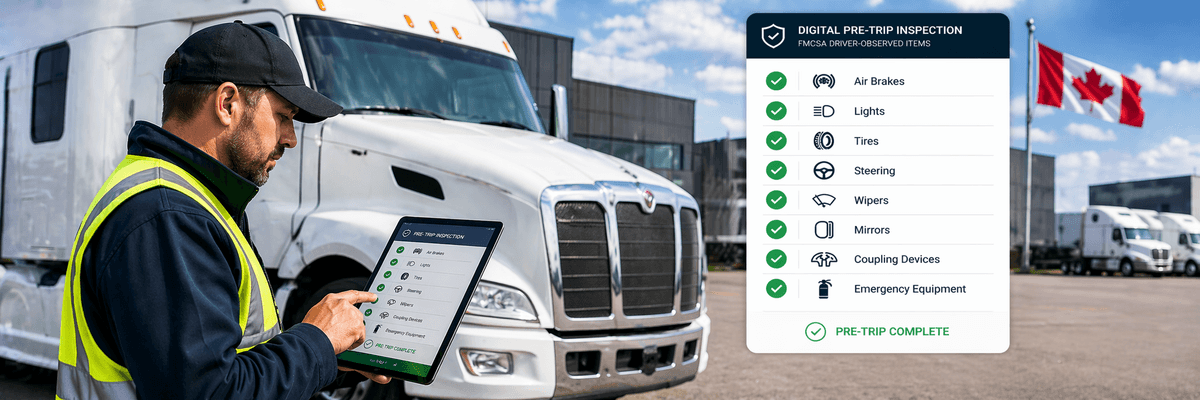
The Federal Motor Carrier Safety Administration (FMCSA) has fundamentally rewritten the rules of roadside inspections in 2026. For decades, fleet managers, safety directors, and compliance officers viewed the "Vehicle Maintenance" BASIC as a broad, catch-all category. It was a statistical bucket that blended deep mechanical failures—like misaligned axles or internal brake chamber leaks—with simple, easily preventable defects like a burnt-out marker light.
That era of generalized data is officially over. The FMCSA’s massive overhaul of the Safety Measurement System (SMS) has introduced a highly targeted, highly punitive new metric: the Vehicle Maintenance: Driver Observed compliance category.
This regulatory shift is not a simple rebranding of DOT terminology. It is a calculated enforcement strategy designed to hold commercial drivers directly accountable for pre-trip negligence. By segmenting data this way, federal and state DOT auditors can instantly identify which fleets suffer from systemic mechanical breakdown, and which fleets suffer from a chronic culture of "pencil whipping" their inspection reports.
For motor carriers operating in the USA and cross-border fleets operating out of Canada, understanding the mechanics of this new violation category is critical. This comprehensive guide will dissect the 2026 SMS changes, examine the most common driver-observed traps, and explain why adopting an electronic DVIR is the only sustainable way to protect your operating authority.
Key Takeaways for Fleet Managers
- New Category Split: Vehicle Maintenance is now divided into two distinct buckets: one for complex mechanical issues, and one for defects a driver should have caught visually.
- Direct Link to Pencil Whipping: High scores in the Driver Observed category are an immediate red flag to auditors that your drivers are falsifying pre-trip inspection logs.
- Condensed Scoring Window: The new SMS methodology only calculates violations from the past 12 months, making recent roadside failures twice as impactful on your percentiles.
- Cross-Border Vulnerability: Canadian fleets operating in the US are fully subject to these new metrics based on their USDOT numbers, requiring tight alignment between NSC Standard 13 and FMCSA regulations.
What is "Vehicle Maintenance: Driver Observed"?
To grasp the threat this new category poses to your fleet safety rating, you must understand its core intent. The Vehicle Maintenance: Driver Observed category is a specific collection of DOT violations that could reasonably be observed by a commercial driver or detected as part of a routine Walk-Around (Level 2) roadside inspection.
In the eyes of the FMCSA, driving a commercial motor vehicle with a defective steering column is a maintenance department failure. However, driving an 80,000-pound combination vehicle with a completely bald steer tire, a missing fire extinguisher, or an audibly hissing air hose is a driver failure. The logic is unassailable: if a DOT inspector can see the defect just by walking around the truck at a weigh station, the driver should have seen it before leaving the terminal yard.
When a roadside inspector logs one of these specific violation codes, the data bypasses the general maintenance pool and feeds directly into this new, specialized percentile. If a carrier's percentile in this specific category exceeds the FMCSA intervention threshold, it triggers immediate enforcement actions, ranging from automated warning letters to comprehensive on-site compliance reviews.
The Difference Between Mechanic vs. Driver Observed Defects
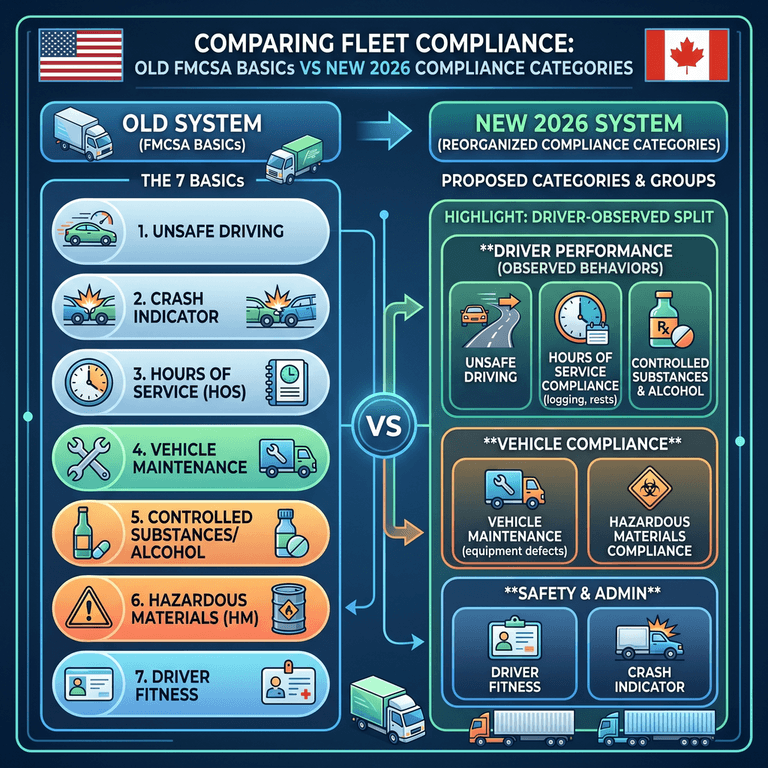
The primary 2026 SMS rule changes consolidated over 950 individual violation codes into approximately 116 organized groups. Understanding the dividing line between what is deemed "Mechanic" versus "Driver Observed" is crucial for training your staff.
The Standard Vehicle Maintenance Category
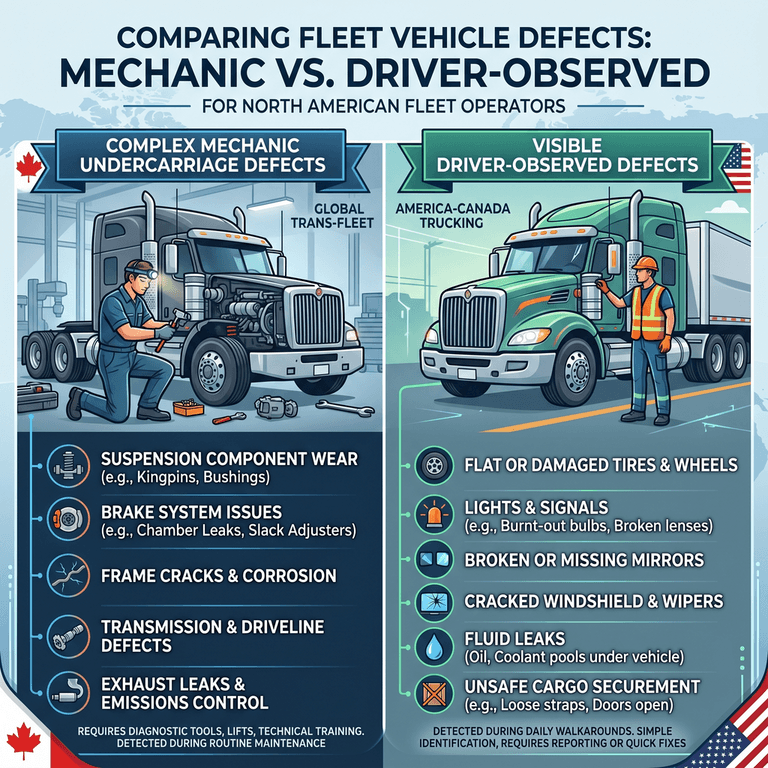
The standard category now strictly tracks complex mechanical failures. These are defects that generally require a trained mechanic, specialized tools, or a Level 1 Full inspection (where the inspector physically crawls underneath the undercarriage) to identify. Examples include:
- Brakes: Brakes out of adjustment, contaminated brake linings, or internal air chamber leaks.
- Suspension: Cracked leaf springs, broken U-bolts, or heavily worn suspension bushings.
- Frame and Fuel: Structural cracking in the chassis frame rails or subtle fuel tank leaks near the mounting brackets.
- Exhaust: Micro-leaks in the exhaust system that could potentially allow dangerous carbon monoxide fumes to seep into the sleeper berth.
The Driver Observed Category
Conversely, the new category targets the "low-hanging fruit" of DOT compliance. These are blatant, highly visible defects. The FMCSA operates on the premise that a driver does not need a mechanic's certification to notice these issues; they simply need to use their eyes and ears. If your fleet accrues violations here, you cannot blame your maintenance shop—you must blame your pre-trip inspection workflow.
How the New Category Impacts Your CSA Percentile
The structural changes to the FMCSA scoring methodology in 2026 do more than just rename categories; they fundamentally alter the mathematical weight of every violation your drivers receive.
The 12-Month Scoring Window
Under the legacy system, a motor carrier's SMS score was calculated based on 24 months of historical roadside inspection data. The 2026 methodology has aggressively condensed this window to just 12 months. This means that a single violation—such as a driver caught with an inoperable headlight—now carries double the statistical weight because the total pool of data diluting the violation is cut in half. Fleets can no longer rely on a long history of "clean" inspections from two years ago to hide recent negligence.
Intervention Thresholds Remain Unforgiving
Despite the condensed time window and the restructuring of violation weights (now operating on a simplified 1 or 2 severity scale rather than the old 1–10 scale), the intervention thresholds for maintenance remain dangerously tight. The FMCSA has established the following thresholds for the new Vehicle Maintenance: Driver Observed safety category:
- 80% for General Property Carriers
- 65% for Passenger Carriers
- 75% for Hazardous Materials (HM) Carriers
If your percentile crosses these lines, you are mathematically flagged as a high-risk carrier, virtually guaranteeing an increase in DOT roadside pull-overs and initiating the process for off-site or on-site safety audits.
The "Pencil Whipping" Connection: Why Drivers Miss Defects
Why do commercial drivers miss defects that are supposedly obvious? The answer lies in human behavior, compensation structures, and outdated compliance tools. The epidemic of "pencil whipping" is the exact target of this new FMCSA category.
In the commercial trucking industry, drivers are predominantly compensated by the mile, not by the hour. Time spent parked in a terminal yard conducting a thorough, 15-minute FMCSA-mandated pre-trip inspection is time spent not earning money. When a fleet relies on paper Driver Vehicle Inspection Reports (DVIRs), the temptation to cheat the system is overwhelming.
A driver can easily sit in the cab of their truck, grab a clipboard, rapidly check all the "satisfactory" boxes on a paper form, sign it, and pull out of the gate in under two minutes. The paper form provides zero empirical proof that the driver physically walked around the trailer, checked the tire pressure, or tested the brake lights. The FMCSA's new category is a direct, data-driven assault on this exact behavior. When the DOT catches the burnt-out light 50 miles down the road, the resulting Driver-Observed violation is the government's way of saying: "We know your driver didn't actually do their pre-trip."
The Top 10 Most Common Driver-Observed Violations
To defend your SMS percentiles, you must know exactly what the inspectors are hunting for. Based on roadside data, these are the top ten violations that will immediately spike your new Driver Observed score:
- Inoperable Required Lamps (Lighting Devices): This is the absolute easiest defect for an inspector to spot. Headlights, tail lights, turn signals, and clearance/marker lights must all be fully functional. A single bulb out on a trailer is an instant ticket to the scale house.
- Tire Tread Depth and Inflation: While a mechanic might check exact PSI, a driver is expected to notice visibly under-inflated (flat) tires, massive tread wear (especially on steer tires), or exposed fabric/cords.
- Audible Air Leaks: When performing a walk-around with the vehicle pressurized, severe air leaks from glad hands or brake lines create a distinct hissing sound that a driver cannot reasonably ignore.
- Missing or Discharged Fire Extinguishers: FMCSA 396.11 mandates emergency equipment checks. Inspectors routinely check the cab to ensure the extinguisher is present, secured, and the gauge reads "in the green."
- Missing Warning Triangles: Commercial vehicles must carry three bi-directional emergency reflective triangles. Drivers often use them during a breakdown and forget to retrieve them, leaving the truck non-compliant for the next trip.
- Windshield Condition and Wipers: Severe cracks in the driver's sweeping vision area, or missing/torn windshield wiper blades, are easily observable safety hazards.
- Visible Fluid Leaks: While complex internal leaks are mechanic issues, massive puddles of oil, transmission fluid, or coolant under the truck in the staging yard should be caught before the key is ever turned.
- Improper Cargo Securement: On flatbeds, frayed straps, damaged transport chains, or unlatched binders are visible from a distance and represent gross negligence.
- Defective Mirrors: Missing, cracked, or improperly secured side-view or hood-mounted mirrors.
- Wheel Hub and Lug Nut Issues: Drivers are expected to look for "rust trails" extending from lug nuts, which is a universally recognized visual indicator of a loose wheel.
Implications for Cross-Border Fleets (USA and Canada Audiences)
For fleets moving freight across the 49th parallel, the regulatory landscape is doubly treacherous. The intersection of the USA and Canada audiences means carriers must navigate two distinct, yet highly interconnected, enforcement systems.
Canadian commercial vehicle drivers operate under the National Safety Code (NSC), specifically Standard 13, which governs daily trip inspections. While the Canadian provincial ministries (like the Ontario MTO or British Columbia CVSE) maintain their own carrier profiles, Canadian carriers operating in the United States are fully subject to FMCSA jurisdiction the moment they cross the border.
When a Canadian truck is pulled over at a weigh station in Michigan or Ohio, the US inspector queries the carrier's USDOT number. If that inspector writes up a violation for a bald tire or a missing fire extinguisher, that data is instantly fed into the FMCSA's new Vehicle Maintenance: Driver Observed category. A spike in this category will not only result in targeted US audits for the Canadian carrier, but severe violations are routinely shared back with Canadian provincial authorities, potentially threatening the carrier's CVOR (Commercial Vehicle Operator's Registration) rating in their home province.
Cross-border fleets must utilize unified fleet management software that handles both NSC Standard 13 scheduling and FMCSA eDVIR regulations seamlessly. A fragmented compliance approach will inevitably result in out-of-service violations on one side of the border or the other.
The Financial Cost of Ignoring the New SMS Categories
Treating the new Driver Observed category as merely an administrative headache is a fatal business error. The financial repercussions of a degraded safety rating in the modern logistics economy are swift and severe.
Freight Access and Broker Blacklisting
Major shippers and 3PL freight brokerages no longer rely on manual vetting. They utilize automated API software that constantly scrubs the FMCSA database. If your Driver Observed percentile crosses the 80% threshold and your overall status shifts to 'Conditional' or flags you for intervention, automated systems will instantly block you from booking premium freight loads. You will be relegated to the spot market, fighting for low-paying scraps.
Commercial Auto Liability Insurance
Insurance underwriters rely heavily on SMS percentiles to determine risk exposure. A high score in the Driver Observed category tells an actuary a very specific story: "This fleet's management cannot control their drivers, and their drivers do not care about the safety of their equipment." This narrative leads to massive premium hikes upon renewal, or worse, policy cancellation.
Nuclear Verdicts in Litigation
If a driver dispatches with a defective steer tire that they failed to report, experiences a blowout, and causes a catastrophic collision, plaintiff attorneys will leverage the Driver Observed violation data. They will argue in civil court that the carrier fostered a culture of pencil whipping and negligent entrustment. This is the exact mechanism that leads to "nuclear verdicts"—judgments exceeding $10 million that bankrupt motor carriers overnight.
Case Study: Surviving the Driver-Observed Trap
Consider the scenario of Apex Cross-Border Logistics, a mid-sized carrier operating 150 power units moving auto parts between Ontario and the US Midwest. In early 2026, the fleet safety director noticed their SMS percentiles climbing dangerously. Upon detailed review, they realized they weren't failing complex, Level 1 mechanic inspections; their drivers were getting written up continuously for burnt-out marker lights, missing fire extinguishers, and low tire tread at roadside scales.
Their "Vehicle Maintenance: Driver Observed" category hit 82% (over the 80% threshold). Shortly after, Apex received a formal FMCSA warning letter, threatening an off-site safety audit. The root cause was undeniable: their drivers were pencil-whipping paper DVIRs, submitting "no defects found" while sitting comfortably in the driver's seat, completely skipping the physical walk-around.
Recognizing the existential threat to their cross-border freight contracts, Apex initiated a total digital overhaul. They threw out the clipboards and deployed PTI4YOU’s electronic DVIR software across their entire fleet. The safety director configured the app to force mandatory, timestamped photo uploads of the dashboard (verifying air pressure), the steer tires, and the trailer lights before the driver could legally generate a trip manifest.
The Results by Q3 2026: Because drivers were technologically forced to actually look at the equipment, defects were caught in the terminal yard where mechanics could fix them quickly and cheaply. Within 90 days, roadside driver-observed violations dropped by 75%. Apex pulled their percentile down to a safe 38%, successfully avoiding the DOT audit and preserving their tier-one freight contracts.
How Electronic DVIRs Prevent Roadside Out-of-Service Events
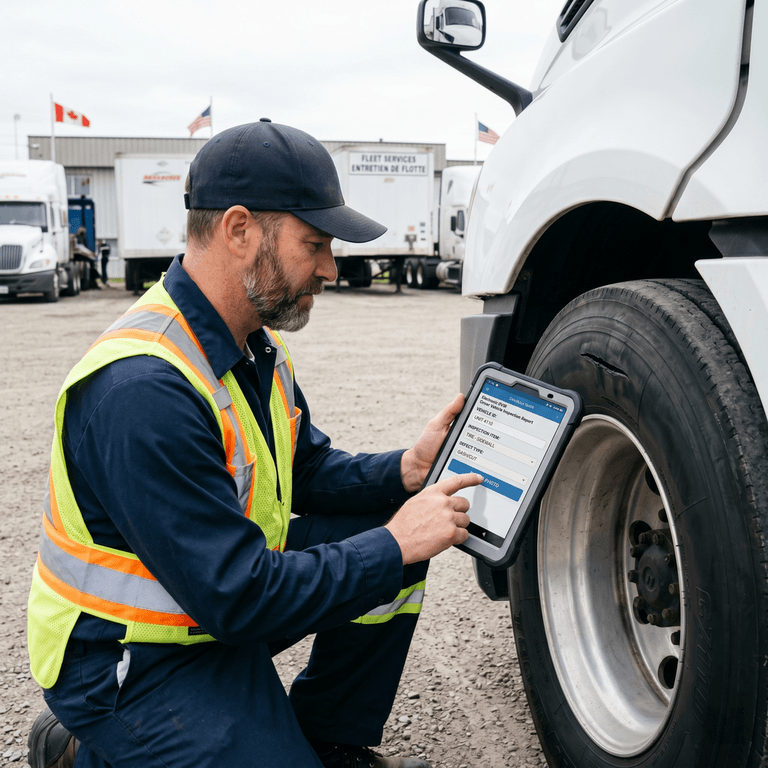
The only sustainable defense against the FMCSA's Driver Observed violation category is to stop defects from leaving your yard. You cannot rely on the honor system. You must rely on verifiable digital workflows. An advanced electronic DVIR (eDVIR) platform fundamentally changes driver behavior and protects your fleet safety rating through three core mechanisms:
1. Eradicating Pencil Whipping via Forced Workflows
A modern eDVIR platform, such as PTI4YOU, mathematically eliminates the ability to fake an inspection. The software utilizes GPS geo-fencing to ensure the driver's mobile device is physically located next to the assigned asset. More importantly, safety managers can configure the software to mandate high-resolution photo uploads of critical components—such as glad hands, tire tread, and light clusters—before the inspection can be submitted. If the driver cannot submit the form without taking a picture of the tire, they are forced to look at the tire. The pencil whipping loophole is permanently closed.
2. Closing the Communication Gap with Maintenance
Under the old paper system, a driver might legitimately note a defect, but the paper form gets lost in the cab or the maintenance shop ignores it. By the time the truck hits the scale house, the defect is still there, and the DOT inspector writes the violation. eDVIRs digitize this entire communication chain. The moment a driver logs a defect on their smartphone, the maintenance shop receives an instant digital alert. The repair can be scheduled and executed before the truck is dispatched into federal jurisdiction.
3. The Three-Signature Cycle Audit Trail
FMCSA regulations strictly require a three-signature cycle when a defect is reported: the driver who found it, the mechanic who fixed it (or deemed it safe), and the next driver who verifies the repair. Paper forms almost always fail this audit requirement. An eDVIR system locks this workflow down digitally. The mechanic signs off on their tablet, and the system physically blocks the next driver from generating a new trip manifest until they digitally acknowledge the mechanic's repair. When a DOT auditor reviews your digital records, they see a flawless, timestamped chain of custody.
Actionable 5-Step Guide to Compliance
Transitioning your fleet to survive the new Driver Observed metric requires decisive action. Use this five-step checklist to protect your operations.
-
Step 1: Audit Your Current SMS Profile
Immediately log into the FMCSA CSA portal and review your new percentile under the "Vehicle Maintenance: Driver Observed" category. Identify if you are currently trending toward the 80% intervention threshold.
-
Step 2: Identify Repeat Offenders
Analyze your roadside inspection data from the past 12 months. Look for patterns. Are specific drivers repeatedly getting cited for lights or tires? Target these individuals for immediate retraining on walk-around procedures.
-
Step 3: Eliminate Paper DVIRs
To protect your Safety Fitness Assessment score, you must eliminate paper inspections. Adopt a DOT-compliant electronic DVIR platform like PTI4YOU. Transitioning your fleet takes less than a week but provides immediate ROI in violation reduction.
-
Step 4: Mandate Photo Evidence
Configure your new eDVIR software to force mandatory defect photos. Require drivers to upload pictures of the dashboard gauges, all steer tires, and the rear trailer light assembly on every pre-trip.
-
Step 5: Enforce the "No Defect, No Dispatch" Rule
Create a strict company policy that dispatchers cannot release a load to a driver unless a fully completed, photo-verified digital pre-trip inspection is logged in the system. Shift the culture from reactive compliance to proactive safety.
Frequently Asked Questions (FAQ)
What is the new Vehicle Maintenance: Driver Observed category?
Introduced in the 2026 FMCSA SMS overhaul, this is a specific compliance category that tracks DOT violations for vehicle defects that a commercial driver should have reasonably identified during a standard pre-trip or post-trip walk-around inspection. Examples include bald tires, inoperable lights, and missing emergency equipment.
How is Driver Observed different from regular Vehicle Maintenance?
The standard 'Vehicle Maintenance' category now strictly tracks complex mechanical failures that typically require a trained mechanic or a Level 1 under-carriage inspection to identify, such as brakes out of adjustment, suspension cracks, or internal frame damage. 'Driver Observed' focuses purely on blatant, visible defects indicating the driver skipped their pre-trip inspection.
What is the FMCSA intervention threshold for the Driver Observed category?
The FMCSA maintains the intervention threshold at 80% for general property carriers, 65% for passenger carriers, and 75% for Hazardous Materials (HM) carriers. Exceeding these percentiles can trigger warning letters or targeted safety audits.
Does the Driver Observed category apply to Canadian fleets?
Yes. Any Canadian motor carrier operating in the United States is subject to FMCSA roadside inspections based on their USDOT number. Violations caught at US scale houses will populate the Canadian carrier's SMS profile, directly impacting their cross-border freight operations and insurance premiums.
How can electronic DVIRs prevent these specific violations?
Electronic DVIRs (eDVIRs) combat the 'pencil whipping' epidemic by forcing drivers to physically walk around the truck. Modern software utilizes GPS geo-fencing and mandates timestamped photo uploads of critical components (like tires and lights), ensuring the driver actually looks at the equipment before dispatching.
Conclusion: Upgrade Your Safety Culture Today
The 2026 rollout of the "Vehicle Maintenance: Driver Observed" category is the FMCSA’s most aggressive move yet to hold commercial drivers accountable for daily safety checks. Motor carriers that continue to rely on the honor system and paper logbooks are operating under extreme, unnecessary risk. The math of the new 12-month scoring window guarantees that pencil whipping will eventually result in a crippling DOT audit or a loss of premium freight contracts.
Do not wait for an unexpected DOT intervention to modernize your operations. Embrace technology to protect your drivers, your safety ratings, and your bottom line.
Automate Your Fleet Compliance Today
Stop pencil whipping and protect your CSA percentiles with PTI4YOU. Our DOT-compliant electronic DVIR platform is designed specifically to help fleets in the USA and Canada maintain perfect digital records, automate mechanic sign-offs, and slash roadside maintenance violations.
Start your 15-day free trial today and bulletproof your maintenance records. No credit card required.
Start Your 15-Day Free Trial – No Credit Card RequiredZero setup fees. Zero hardware. 25-minute driver onboarding.