
Key Takeaways for Fleet Safety Managers
- AEB preparation is bigger than procurement: Fleets must update inspections, technician workflows, driver training, and documentation—not just buy trucks with new sensors.
- Rulemaking language matters: The federal heavy-vehicle AEB process is tied to FMCSA and NHTSA rulemaking. Treat 2026–2027 as a readiness window and verify final applicability by GVWR, build date, and vehicle type.
- Paper inspections are not enough: AEB introduces radar, camera, wiring, calibration, fault-code, and dashboard-warning checks that require searchable digital compliance records.
- Digital DVIR creates defensible evidence: Timestamped inspections, photos, mechanic sign-offs, and next-driver reviews help protect fleets during audits, roadside investigations, and post-crash claims.
1. Introduction: Why AEB Is Changing Fleet Compliance
The next wave of North American trucking safety is not limited to driver training, brake adjustment, or stronger roadside enforcement. It is increasingly tied to commercial truck safety technology: forward-facing radar, camera-based object detection, electronic stability control, forward collision warning, and automatic emergency braking. For fleet operators in the United States and Canada, this shift changes the meaning of a compliant vehicle inspection. A driver and maintenance team must now prove that the truck is mechanically sound and that its safety-critical electronic systems are visible, inspected, repaired, and documented.
The FMCSA AEB mandate conversation comes from joint federal work by the Federal Motor Carrier Safety Administration (FMCSA) and the National Highway Traffic Safety Administration (NHTSA) to address heavy-vehicle crash risk with automatic emergency braking and related advanced driver assistance systems. The exact compliance obligations depend on final rule language, vehicle class, gross vehicle weight rating (GVWR), and production date. But the operational message for fleets is already clear: waiting until a final deadline appears on a purchasing calendar is a risky strategy. AEB preparation touches procurement, driver procedures, shop training, DVIR forms, maintenance records, safety policies, and audit readiness.
Small and mid-size carriers are especially exposed because they often operate a mixed fleet of older tractors, newer units with factory collision mitigation, leased vehicles, and cross-border assets that may be subject to different customer and jurisdictional expectations. If one terminal documents AEB warnings on paper, another relies on driver text messages, and a third stores calibration records in a mechanic's local folder, the company cannot produce a clean safety story during a DOT audit or post-incident investigation. That is why electronic DVIR software and structured digital maintenance tracking are becoming essential parts of fleet safety modernization.
This guide explains what automatic emergency braking does, what fleets should understand about the FMCSA and NHTSA rulemaking path, how AEB changes daily inspection workflows, and why cloud-based digital DVIR records help fleets reduce liability while preparing for 2026–2027 safety technology requirements.
2. What Is Automatic Emergency Braking?
Automatic emergency braking is a crash avoidance system designed to detect a potential collision in front of a vehicle and apply braking automatically when the driver does not respond quickly enough. In commercial trucks, AEB typically works with forward collision warning and other advanced driver assistance systems (ADAS). The warning phase alerts the driver with visual, audible, or haptic signals. If the system calculates that a collision is imminent and driver action is insufficient, the system can command braking to reduce speed, lessen impact severity, or avoid the crash entirely.
AEB is not a single sensor. It is a coordinated safety architecture that may include radar mounted near the front bumper, a camera mounted behind the windshield, electronic braking controls, electronic stability control, wheel-speed data, and software logic that estimates closing speed, object distance, lane position, and braking performance. For heavy vehicles, the engineering challenge is more complex than in passenger cars because vehicle weight, air-brake response, trailer dynamics, cargo load, grades, weather, and tire condition all influence stopping distance.
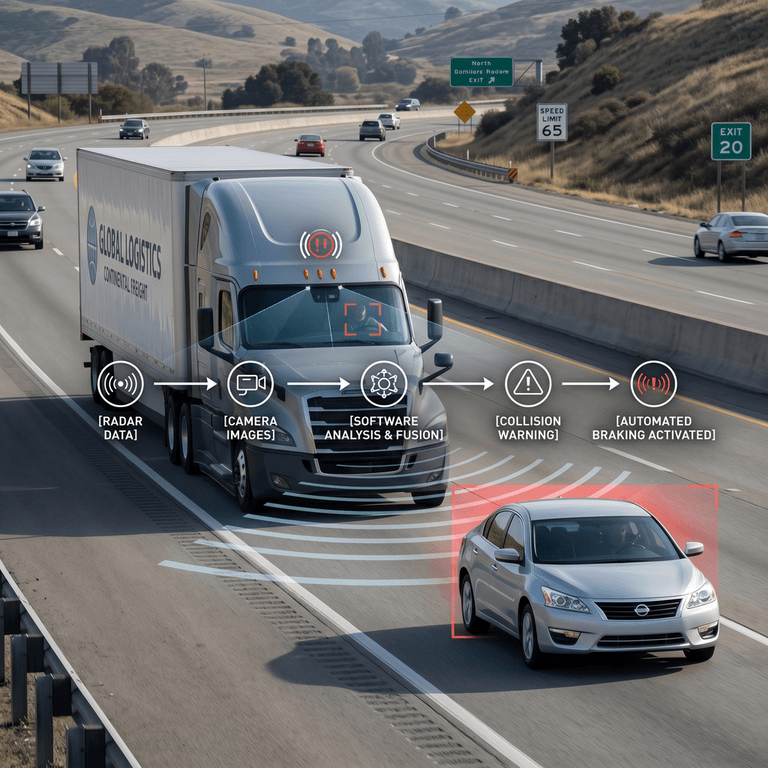
Automatic emergency braking depends on a coordinated sensor, software, warning, and braking workflow—not just one physical component.
How the AEB decision loop works
In a typical highway scenario, forward radar measures distance and closing speed while the camera helps identify vehicles, lane context, and visual cues. The system compares the truck's speed, road conditions, and object movement against programmed thresholds. If risk increases, the driver receives a forward collision warning. If the driver still does not brake, steer, or otherwise respond, the system may apply partial or full emergency braking through the vehicle's braking controls.
That logic can help with trucking accident prevention, but it also introduces new maintenance responsibilities. A dirty radar cover, damaged bumper bracket, replaced windshield, misaligned camera, intermittent fault code, or uncalibrated sensor can weaken the system. AEB therefore becomes part of the vehicle's safety condition. Fleets need inspection steps that drivers can understand, defect categories that dispatchers can act on, and repair records that prove the issue was resolved correctly.
3. Overview of the FMCSA & NHTSA AEB Mandate
The federal heavy-vehicle AEB effort involves two agencies with different but connected roles. NHTSA generally sets vehicle equipment performance standards for manufacturers, while FMCSA regulates motor carrier operation, inspection, maintenance, and safety compliance. For fleets, this means an AEB rule can begin as a manufacturing requirement for new vehicles but still create operational obligations once those vehicles enter service.
As fleets plan for the AEB mandate 2026 discussion, the safest approach is to separate three concepts: what manufacturers must install on new trucks, what carriers must maintain on trucks they operate, and what documentation carriers must produce if a safety-critical system fails. Even before a final deadline applies to every asset, carriers operating trucks with installed collision mitigation systems should treat those systems as safety equipment that must be inspected, maintained, and documented.
| Planning Area | What Fleet Managers Should Watch | Operational Action |
|---|---|---|
| Rule applicability | Final FMCSA/NHTSA language by GVWR, vehicle class, manufacture date, and equipment type. | Map every vehicle and planned purchase against final federal thresholds before ordering or leasing assets. |
| Inspection scope | Radar, cameras, brackets, wiring, dash warnings, and system status indicators. | Add AEB/ADAS items to digital pre-trip, post-trip, and maintenance inspection workflows. |
| Repair validation | Diagnostic trouble codes, calibration requirements, windshield/camera replacement, and bumper/radar repairs. | Require mechanic certification and next-driver review before dispatching after an AEB-related defect. |
| Audit readiness | Searchable proof that defects were reported, repaired, signed, and retained. | Centralize records in electronic DVIR and cloud maintenance systems. |
Cross-border carriers should also monitor Canadian alignment. Even when Canadian rules are not identical word-for-word, customers, insurers, roadside enforcement trends, and vehicle manufacturers often move in the same safety direction. Fleets operating between the U.S. and Canada should standardize around the stricter internal process: if a truck has AEB, inspect it consistently and store the record where compliance managers can retrieve it immediately.
4. Why Regulators Are Mandating AEB
Automatic emergency braking is attractive to regulators because heavy-truck crashes can be severe even when they are relatively infrequent compared with passenger-vehicle incidents. Large trucks have longer stopping distances, higher kinetic energy, more complex brake systems, and greater consequences when a driver is distracted, fatigued, surprised by traffic, or operating in poor visibility. AEB is intended to create a preventive safety layer that reacts faster than a human driver in certain imminent-crash scenarios.
Regulators also focus on repeatable safety performance. A driver may be highly trained, but fatigue, congestion, bad weather, and route pressure can still degrade reaction time. AEB and forward collision warning systems create an additional defense against rear-end crashes and speed-related impact severity. That does not remove the driver's responsibility. It does, however, make the fleet responsible for ensuring the technology is not ignored, disabled, obstructed, or left in fault status.
For fleet owners, the business case is not limited to avoiding citations. One serious crash can trigger towing, cargo loss, vehicle downtime, insurance review, litigation, customer churn, driver injury, and safety-rating pressure. Strong fleet safety compliance programs increasingly combine driver coaching, preventive maintenance, telematics, digital inspections, and documented repair loops. AEB fits into that larger risk-reduction system.
What fleets should avoid saying
Fleets should avoid treating AEB as a magic shield. It is not a replacement for safe following distance, brake maintenance, tire condition, driver attention, or pre-trip inspections. It also cannot be treated as invisible technology that the shop handles only after a crash. The correct operational position is: AEB is a safety-critical system that supports drivers, requires maintenance discipline, and must be documented like other regulated vehicle systems.
5. Operational Challenges Fleets Will Face
AEB adoption creates real operational friction, particularly for small fleets, owner-operators, and carriers with older equipment. The first challenge is cost. New equipment with ADAS may be more expensive, and late-model repairs may involve specialized diagnostics, sensor replacement, calibration targets, software procedures, or OEM service documentation. A front-end collision that once required bumper work may now require radar inspection and calibration evidence.
The second challenge is technician readiness. Traditional diesel maintenance skills remain essential, but ADAS troubleshooting adds a new layer: electrical connections, sensor alignment, camera obstruction, control-module fault codes, and software updates. If a technician clears a warning without documenting diagnosis and calibration, the fleet may have a weak defense if that truck is later involved in a collision.
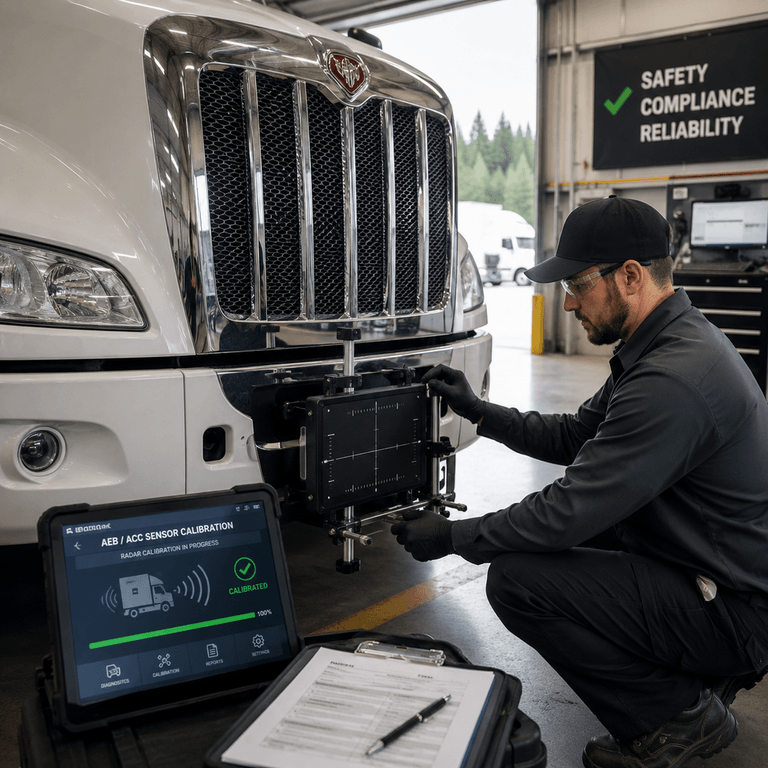
AEB maintenance requires documented calibration, diagnostics, and technician accountability after sensor, bumper, or windshield work.
False braking, driver trust, and training
Another challenge is driver acceptance. Early or poorly calibrated collision mitigation systems can generate false alerts or unexpected braking events in certain conditions. Drivers need training that explains what the system can and cannot do, when to report warnings, how to respond to repeated alerts, and why disabling or ignoring safety technology is unacceptable. A driver who distrusts AEB may fail to report warnings. A driver who overtrusts AEB may follow too closely. Both outcomes increase risk.
Mixed-fleet compatibility
Mixed fleets will need different inspection logic by asset. One truck may have no collision mitigation equipment. Another may have forward collision warning only. A newer tractor may have integrated AEB, ESC, lane alerts, and camera diagnostics. A static paper checklist cannot handle those differences well. Digital inspection workflows can adapt by unit number, vehicle profile, or equipment group, showing the driver only the relevant safety technology checks for that asset. For a deeper view of dynamic forms across different asset types, see our guide to digital DVIR for mixed fleets.
6. How AEB Changes Maintenance & Inspection Workflows
AEB changes inspections because drivers must now look for physical and electronic conditions. A normal walk-around already includes brakes, tires, lights, steering, coupling devices, mirrors, and other visible items. AEB adds safety technology checks: radar cover damage, blocked sensors, loose brackets, cracked windshield areas near camera locations, dashboard ADAS warnings, abnormal collision alerts, and recent repairs that may require calibration.
Paper forms become weak in this environment for three reasons. First, paper checklists are often too generic to reflect the exact ADAS configuration of each truck. Second, paper cannot easily capture photo evidence of a blocked radar or cracked camera area. Third, paper does not create immediate visibility for dispatch and maintenance when a driver reports an AEB warning. The result is delayed repair routing and incomplete audit evidence.
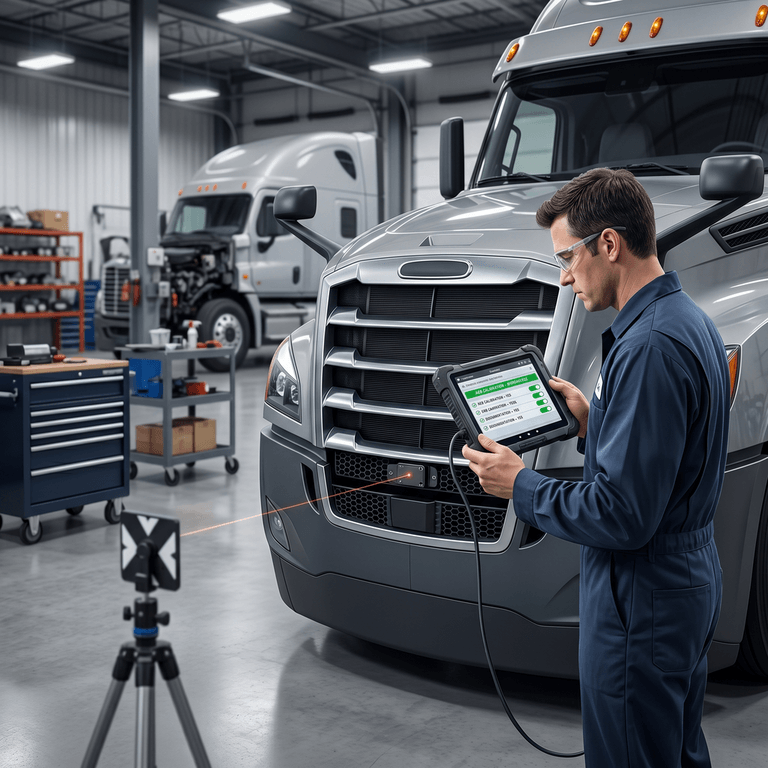
Digital DVIR forms can make AEB checks asset-specific and require photo evidence when safety technology defects are reported.
Strong AEB inspection workflows should include clear driver prompts. Examples include: “Is the forward radar cover clean and undamaged?” “Is the windshield camera area free of cracks, stickers, or obstruction?” “Are any forward collision warning, AEB, ESC, or ADAS fault indicators active?” “Did the truck experience unexpected braking or repeated collision alerts during the previous trip?” These questions convert advanced safety technology into practical driver behavior.
When a defect is reported, the workflow must not stop at “notify maintenance.” A compliant process should route the issue, document repair, capture mechanic certification, and require the next driver to review the repair before operation. That closed-loop discipline is already central to DVIR compliance. See our explanation of the FMCSA 396.11 three-signature cycle for how electronic systems prevent repair-loop gaps.
7. Role of Digital DVIR Platforms in AEB Compliance
Digital DVIR platforms help fleets turn AEB compliance from a vague policy into a repeatable operating system. Instead of relying on a driver to remember whether a truck has AEB, the app can identify the asset and present the correct checklist. Instead of a dispatcher hearing about a dashboard warning hours later, the defect can appear instantly in a maintenance queue with photos, timestamps, and driver comments. Instead of a filing cabinet holding incomplete paper, the fleet can produce searchable records for a specific truck, date range, driver, defect, or repair.
This matters because AEB failures can create both compliance and litigation exposure. If a collision occurs and the truck had an active AEB fault that was never documented or repaired, the fleet may struggle to prove reasonable maintenance. If the system was inspected, a defect was reported, a certified technician repaired it, and the next driver acknowledged the repair, the fleet has a much stronger evidence trail. Digital records do not eliminate liability by themselves, but they create a disciplined, reviewable process.
- Maintenance tracking: AEB-related defects can be assigned to the correct shop role with clear severity and repair status.
- Photo documentation: Drivers can attach images of blocked radar covers, cracked camera zones, damaged bumpers, or warning lights.
- Audit-ready retention: Records remain searchable for compliance review instead of being buried in paper folders.
- Technician accountability: Repair certification can be tied to the mechanic, date, and asset.
- Driver review: The next driver can confirm the repair before the truck returns to service.
For fleets still weighing the operational cost of paper, review our paper vs. electronic DVIR cost calculator. AEB increases the cost of slow, inconsistent, paper-based defect routing because safety technology issues are time-sensitive and often require specialist follow-up.
8. Why pti4you.com Is Better for Modern Fleet Compliance
Modern safety technology does not need a complicated enterprise software rollout to be documented correctly. PTI4YOU is built for fleets that need lightweight, compliance-focused digital inspections without forcing drivers into complex hardware or long onboarding cycles. Drivers can complete structured inspections from their existing mobile devices, while managers gain visibility into defects, repair status, and compliance records from a centralized dashboard.
For AEB readiness, that matters because the workflow must be simple enough for daily use. A driver should be able to report a blocked radar cover or AEB warning in seconds. A safety manager should see whether the truck is still pending repair. A mechanic should have the defect context and photo evidence needed to act. A compliance manager should be able to export records when an auditor asks what happened on a specific date.
Modernize AEB Inspection Records Before Enforcement Pressure Arrives
As FMCSA safety technology requirements evolve, pti4you.com helps fleets modernize inspections, document maintenance activities, and maintain audit-ready compliance records from one centralized digital platform.
- ✅ Asset-specific digital DVIR forms for AEB, ADAS, brake, tire, and lighting checks.
- ✅ Photo-supported defect reporting for blocked sensors, warning lights, and visible damage.
- ✅ Mechanic sign-off and next-driver review to close the repair loop.
- ✅ Cloud audit storage for fast DOT, customer, insurance, and internal safety reviews.
Zero hardware required. Fast driver onboarding. Built for US and Canada fleet compliance.
9. Expert Checklist: How Fleets Should Prepare for the AEB Mandate
Use this checklist to turn AEB readiness into practical operating steps rather than a last-minute compliance scramble:
- Audit current vehicle safety technology: Inventory every truck by VIN, GVWR, year, make, model, installed forward collision warning, AEB, ESC, radar, camera, and telematics capability.
- Identify trucks requiring AEB upgrades or replacement planning: Compare your procurement cycle with final FMCSA and NHTSA applicability dates. Ask OEMs and leasing partners for written safety technology specifications.
- Digitize maintenance workflows: Move inspection reports, repair notes, calibration records, and driver reviews into a searchable system before AEB records become urgent.
- Train technicians on sensor calibration: Build procedures for radar alignment, camera replacement, windshield work, bumper repairs, software diagnostics, and post-repair validation.
- Update DVIR procedures: Add AEB and ADAS prompts to inspection forms, including sensor condition, dash warnings, and driver-reported false alerts.
- Implement cloud-based inspection tracking: Store records where safety managers can retrieve them by asset, date, defect, driver, or mechanic.
- Standardize defect reporting: Create clear categories for AEB disabled, radar blocked, camera obstructed, ADAS fault active, calibration needed, and unexpected braking event.
- Prepare for compliance audits: Run internal mock audits that trace AEB defects from driver report to mechanic sign-off and next-driver review.
- Monitor FMCSA rule updates: Track official FMCSA and NHTSA communications instead of relying on vendor rumors or incomplete social media summaries.
- Modernize fleet safety documentation: Update driver manuals, onboarding materials, shop SOPs, and safety meeting content to explain AEB responsibilities.
10. Future of Fleet Safety Technology
AEB is one step in a broader shift toward connected fleet safety ecosystems. Telematics can already capture hard braking, speeding, location, engine data, and some diagnostic signals. Camera systems can support coaching and incident review. Digital inspection tools capture human observation. Maintenance software tracks repair history. Over time, the strongest fleets will connect these systems into one safety record that shows not only what happened, but what the company did to prevent it from happening again.
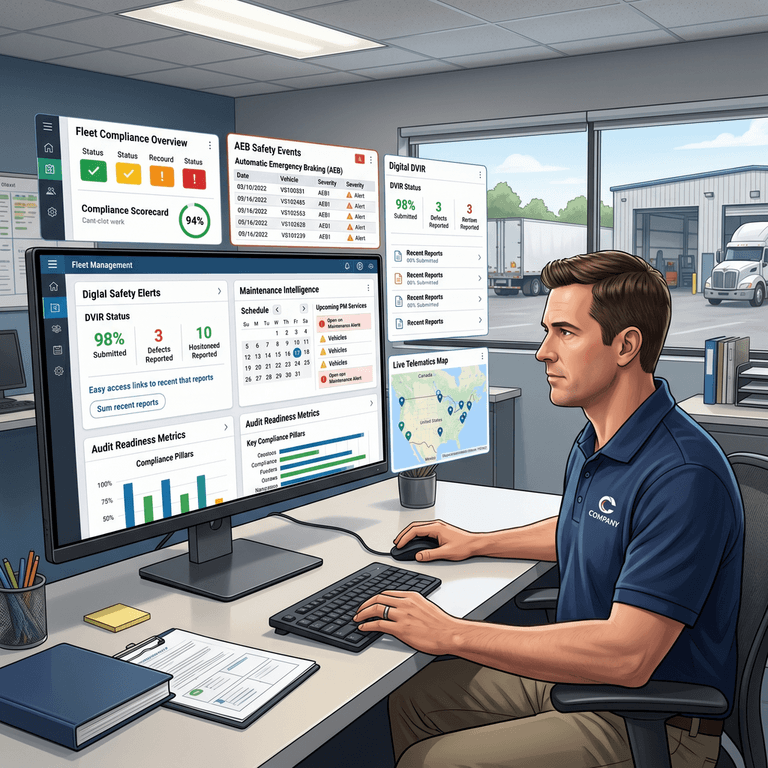
The future of fleet safety is a connected compliance ecosystem that joins inspection data, maintenance records, telematics, and safety technology alerts.
AI-assisted safety systems will likely become more refined, reducing nuisance alerts and improving predictive collision avoidance. Vehicle-to-everything communication may eventually allow trucks to receive hazard data from infrastructure or nearby vehicles before a driver can see the risk. Insurance programs may reward fleets that can prove consistent inspection discipline, preventive maintenance, and safety technology uptime. But none of those future benefits work well without accurate digital records.
The practical path is to start with daily inspection quality. If drivers report defects clearly, mechanics close repairs correctly, and managers can review trends, the fleet is ready to absorb more advanced technology. If inspection records are scattered, incomplete, or paper-based, every new safety system becomes another documentation gap.
11. Frequently Asked Questions
What is the FMCSA AEB mandate?
The FMCSA AEB mandate refers to the joint FMCSA and NHTSA heavy-vehicle automatic emergency braking rulemaking. It is intended to expand the use of automatic emergency braking and forward collision warning on covered new commercial vehicles while reinforcing the need for carriers to maintain safety technology that is installed on trucks they operate.
When will automatic emergency braking become mandatory?
The exact mandatory dates depend on final federal rule language and phased compliance schedules. Fleets should treat 2026–2027 as the preparation period for procurement planning, technician training, AEB inspection checklists, digital repair records, and driver education.
Which trucks require AEB systems?
The heavy-vehicle AEB rulemaking focuses on newly manufactured commercial vehicles above specified GVWR thresholds, with applicability determined by final federal standards. Fleet managers should verify requirements by vehicle type, GVWR, model year, build date, and final rule text before making purchasing decisions.
Can older trucks be retrofitted with AEB?
Some trucks may support OEM or aftermarket collision mitigation technology, but retrofitting must be evaluated carefully for compatibility, warranty impact, calibration needs, technician capability, and documentation requirements. Current federal discussion is primarily focused on new vehicles rather than a universal retrofit requirement for every older truck.
How does AEB affect fleet maintenance?
AEB adds sensor condition, camera visibility, wiring, software diagnostics, and calibration to the maintenance program. A bumper repair, windshield replacement, or front-end impact may require additional ADAS inspection and documented calibration before the truck returns to service.
What inspections are required for AEB systems?
Drivers should check radar covers, camera areas, visible brackets, dashboard warning indicators, and abnormal system behavior. Mechanics should document fault codes, repairs, calibrations, and post-repair verification. The exact checklist should match the vehicle's installed equipment and OEM procedures.
Why are digital DVIR systems important for AEB compliance?
Digital DVIR systems create a searchable audit trail for AEB inspections, defects, photos, repair certifications, and next-driver reviews. That documentation helps prove maintenance diligence during DOT audits, customer reviews, insurance questions, and post-incident investigations.
12. Conclusion: Prepare Before Enforcement Pressure Arrives
Automatic emergency braking is not just another truck option. It is part of a larger safety transformation that ties vehicle technology, driver behavior, maintenance discipline, and compliance records together. Fleets that prepare early will have cleaner procurement decisions, better driver training, faster defect routing, stronger technician accountability, and more defensible safety records.
The best time to modernize inspection workflows is before a roadside question, insurance review, or crash investigation forces the issue. By moving AEB-related inspections and repairs into a digital DVIR process now, fleets can reduce paper gaps, improve maintenance visibility, and build the audit-ready operating culture that modern safety technology requires.