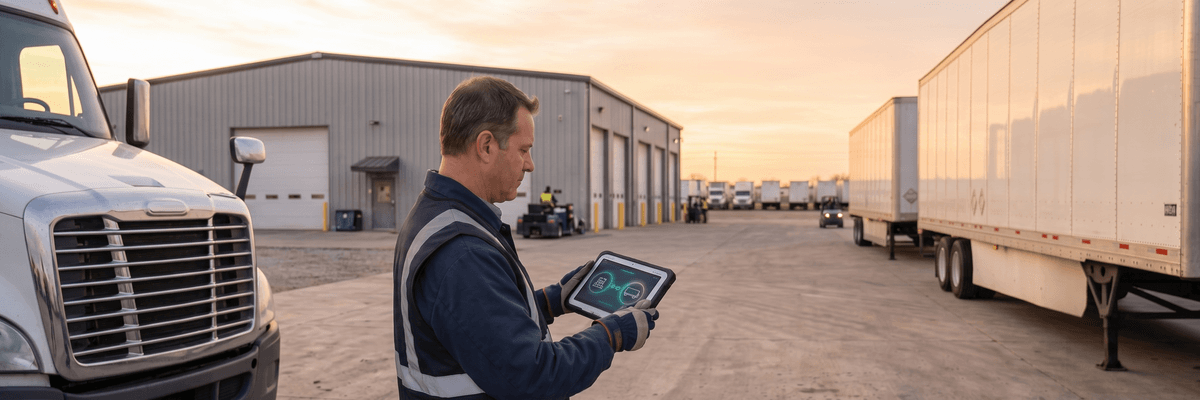
The Bottom Line Up Front: A tractor and a trailer are inspected together but regulated as two separate legal units — each needs its own DVIR. In drop-and-hook operations, where drivers swap trailers constantly, paper-based systems routinely lose the trailer's inspection history the moment it is dropped in the yard. PTI4YOU closes that gap by letting a driver digitally link their power unit report directly to the specific trailer they hook to, carrying forward every unresolved defect so the next driver sees exactly what came before.
Key Takeaways: DVIRs for Truck and Trailer Combinations
- Two units, two records: The power unit and the trailer are separate legal entities under FMCSA rules, even though they are inspected as one coupled combination.
- The paper tube problem: A trailer's DVIR history is only as good as the physical form riding inside it — and that form rarely survives a fast drop-and-hook swap.
- Digital linking closes the gap: PTI4YOU ties a trailer's inspection report to its unique unit number in the cloud, not to a piece of paper that can be lost.
- Triage status travels with the trailer: The next driver sees whether a defect is okay, needs future attention, or needs immediate attention before they ever pull out of the yard.
Why Combination Vehicle DVIRs Are Different
Ask any dispatcher running a drop-and-hook operation what keeps them up at night, and "the trailer paperwork" is near the top of the list. A driver pulls into a yard, backs up to whatever trailer is next in line, hooks up, and rolls — often with zero visibility into what the previous driver found wrong with that specific piece of equipment. If the last DVIR is missing from the document tube, damaged, or simply never made it back to the terminal, the new driver is flying blind on a legal document they are personally responsible for.
This is not a minor administrative wrinkle. It is a structural mismatch between how combination vehicles are regulated and how modern freight actually moves. Regulations were written assuming a driver largely stays with the same tractor-trailer pairing; drop-and-hook logistics assume the opposite. The result is a compliance gap that paper DVIRs were never designed to close — and it is exactly the gap that digital, unit-linked inspection software is built to eliminate.
One Combination, Two Legal Records
Here is the regulatory reality that trips up a lot of small fleets: even though a driver walks around and inspects a tractor and trailer as a single coupled combination, the Federal Motor Carrier Safety Administration treats the power unit and the trailer as separate legal units, each requiring its own inspection record.
Under 49 CFR 396.11, the driver must prepare a report at the completion of each day's work on every vehicle operated, and that requirement applies to the trailer just as much as it applies to the tractor. Under 49 CFR 396.13, before operating the combination, the driver must review the last driver's report for the vehicle — and if the trailer is a different vehicle from yesterday's tractor, that means reviewing the trailer's own separate history, not just the tractor's.
In a fleet where the same driver runs the same tractor-trailer set every day, this distinction barely matters in practice. In a drop-and-hook operation where trailers rotate constantly through a yard, it becomes the single biggest documentation risk in the entire compliance program.
Coupling Devices: The Inspection Point Everyone Forgets
Beyond the two-record requirement, combination vehicles carry an inspection obligation that a straight truck simply does not have: the coupling itself. Under 49 CFR 393.70 and 49 CFR 393.71, the fifth wheel, kingpin, locking jaws, safety chains or cables, and glad hand air connections that join the tractor to the trailer must be properly secured, undamaged, and free of excessive play.
A rushed drop-and-hook swap is exactly the environment where a coupling defect is most likely to be missed. The driver is often working alone, in a hurry to get back on schedule, in a yard with poor lighting, connecting to a trailer they have never touched before. If the kingpin lock is not fully engaged or a glad hand seal is cracked, that defect belongs to whoever drives away with it — regardless of who actually caused it.
The Paper Tube Problem
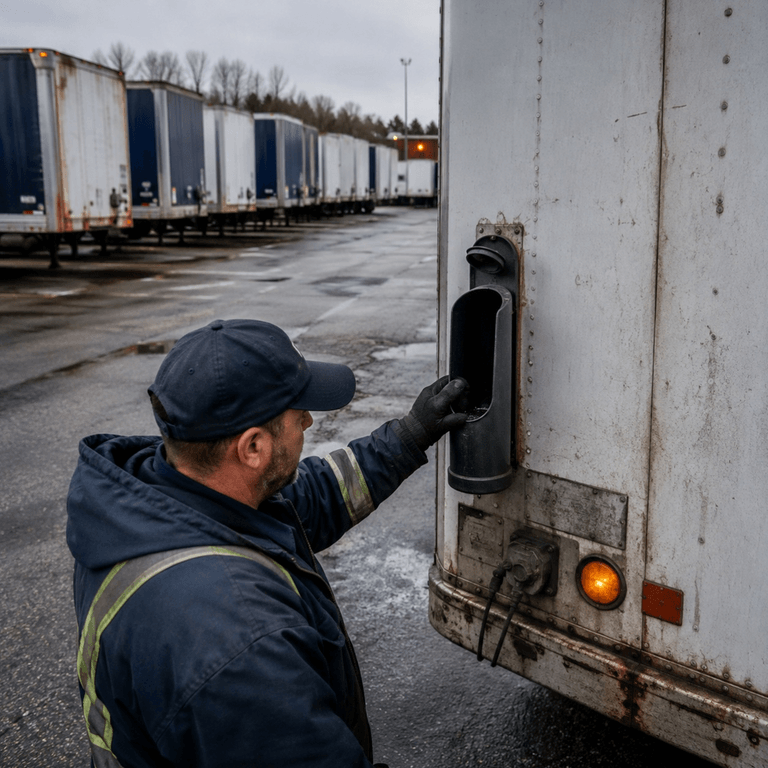
Every carrier that has run trailers on a paper system knows the tube system's failure modes by heart. The previous driver's report is stuffed in a plastic document tube bolted to the trailer's nose. In theory, the next driver pulls it out, reads the last reported defects, signs off, and drives away with a complete legal record. In practice:
- The tube is empty. The last driver forgot to leave the report, or a yard employee removed it during a shuffle.
- The paper is destroyed. Rain, sun, and diesel exhaust turn a week-old thermal-printed DVIR into an unreadable smear.
- The report belongs to the wrong trailer. Someone put the paperwork back in the wrong tube after a yard reshuffle.
- There is no report at all. The trailer was moved by a yard jockey who never generated a DVIR in the first place.
Every one of these failure modes has the same consequence: the incoming driver has no reliable way to know what was wrong with the trailer the last time it was inspected. They are legally required to review that history under 396.13, but the physical system makes that requirement nearly impossible to satisfy consistently. This is the exact administrative chaos that our guide on the FMCSA 396.11 three-signature cycle shows how to solve for a single vehicle — and it gets dramatically harder the moment a fleet adds variable trailer pools into the mix.
What "Drop-and-Hook" Actually Means for Compliance
Drop-and-hook is a dispatch model, not a compliance shortcut. A driver drops a loaded or empty trailer at a yard, terminal, or customer dock, then immediately hooks to a different trailer that is already staged and ready to go. The entire point is to eliminate the dwell time of waiting for a single trailer to be loaded or unloaded — drivers keep moving, and trailers act as interchangeable, asset-tracked units.
That efficiency model is exactly why the regulatory requirement for a per-unit inspection record becomes so hard to satisfy manually. The driver is not committing to one trailer for a multi-day route; they may hook to a different trailer every single day, sometimes multiple times per shift. Any compliance system built around "the driver keeps the paperwork with them" breaks down immediately, because the paperwork needs to travel with the trailer, not the driver.
Truck vs Trailer DVIR: Side-by-Side Requirements
It helps to see exactly where the requirements overlap and where they diverge. This is the version of the comparison we walk dispatchers and safety directors through most often.
| Attribute | Power Unit (Tractor) | Trailer |
|---|---|---|
| Legal record status | Separate DVIR required | Separate DVIR required |
| Typical driver relationship | Assigned to one driver, often daily | Rotates between drivers constantly |
| Where history is stored (paper) | Cab / glovebox | Document tube on the trailer |
| Unique inspection points | Engine, cab controls, steering, brakes | Coupling devices, landing gear, cargo doors, lights |
| Shared inspection points | Brakes, tires, lighting, coupling connection (both units) | |
| Governing regulation | 49 CFR 396.11 / 396.13 | 49 CFR 396.11 / 396.13 / 393.70–71 |
Notice the row that causes the most real-world trouble: "where history is stored." The power unit's paperwork problem is minor because the same driver usually keeps the same tractor. The trailer's paperwork problem is severe, because the physical location of the record and the physical location of the asset are constantly out of sync.
How Digital Linking Solves the Handoff Problem
The fix is conceptually simple: stop storing the trailer's inspection history on a piece of paper riding inside the trailer, and instead store it against the trailer's unique unit number in a central system that any authorized driver can query the instant they select that unit. That is the architectural principle behind linked digital DVIRs.
Instead of a driver filling out one form for "the truck" and hoping a second form exists somewhere for "the trailer," a digital workflow walks them through a guided process: select the power unit, then select the specific trailer being hooked from a list of available units. The moment that pairing happens, the system pulls up the trailer's own inspection history — not the driver's history, not the tractor's history, but the trailer's, tied to its permanent unit identity.
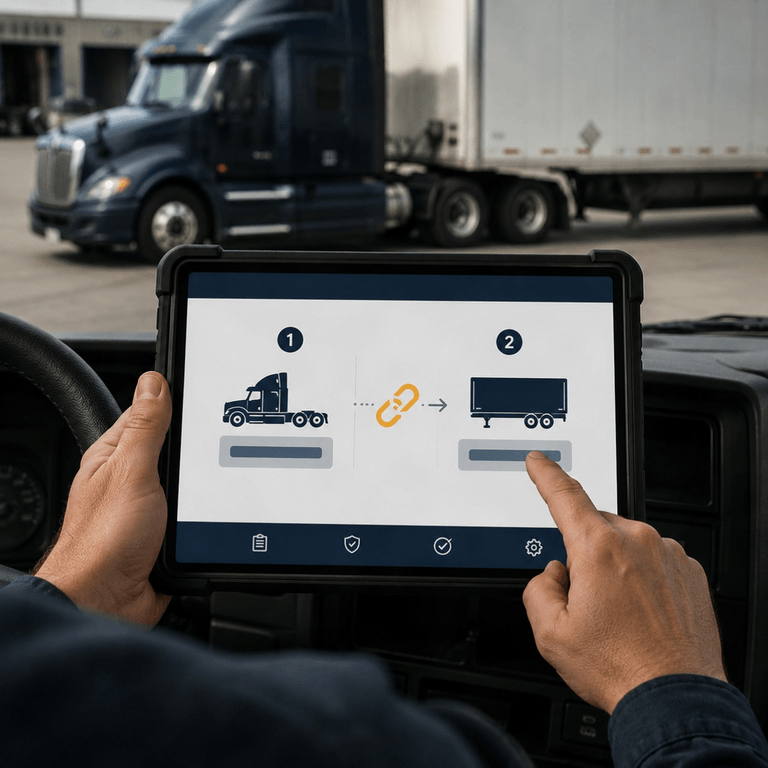
This eliminates the two failure modes that plague paper systems simultaneously: the driver can never accidentally skip the trailer inspection because it is part of the same guided session, and the trailer's history can never physically go missing because it was never stored on paper in the first place.
Triage Status: Okay, Needs Attention, Immediate Attention
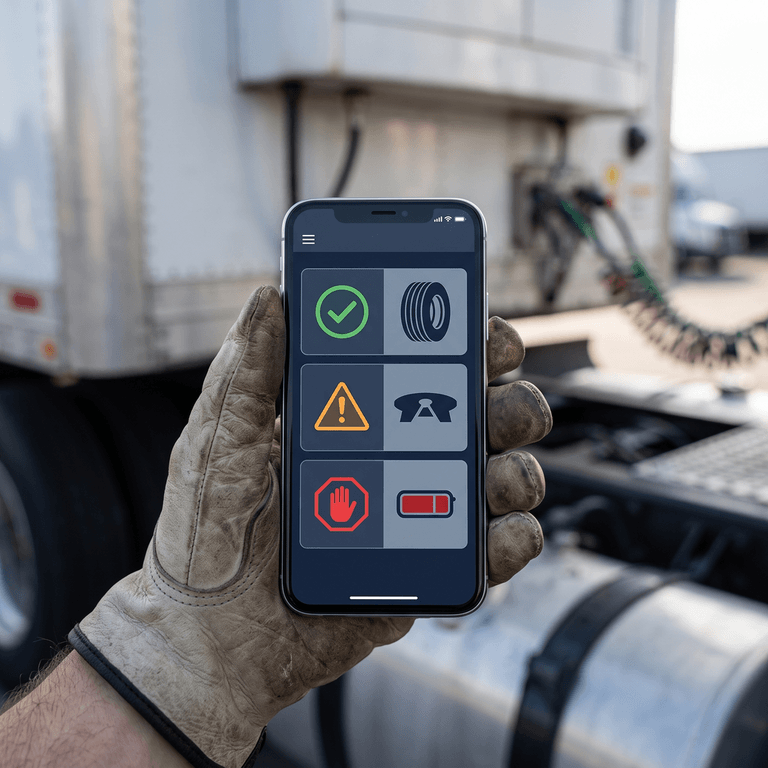
A linked record is only useful if it communicates severity clearly, at a glance, to a driver who has thirty seconds before they need to pull out of the yard. That is why a well-designed trailer inspection workflow does not just log defects — it triages them into a small number of unambiguous status levels:
- Okay. The item was inspected and no defect was found. Nothing further is required.
- Needs future attention. A minor issue was noted — wear, a small cosmetic defect, something to monitor — that does not compromise safe operation right now but should be scheduled for service.
- Immediate attention. A safety-critical defect was found that must be resolved before the vehicle is dispatched.
When this status travels with the trailer's linked record, the next driver sees it the instant they hook up — not buried in a paragraph of handwritten notes, but as a clear, unmistakable flag. A trailer flagged "immediate attention" for a cracked glad hand seal should never leave the yard until that flag is cleared by a qualified repair, and a digital system makes that visible to every driver who might otherwise hook to it. This is the same triage discipline we cover in depth in our guide to preventive maintenance inspections and mechanic action indicators, applied specifically to the handoff moment between drivers.
See Trailer Linking in Action
PTI4YOU lets your drivers pair a power unit to any available trailer in seconds — instantly surfacing that trailer's triage status so nobody hooks up to a hidden defect again.
Start your 15-day free trial today. No credit card required.
Start Your 15-Day Free Trial – No Credit Card RequiredZero setup fees. Zero hardware. 25-minute driver onboarding.
How PTI4YOU Links Power Units and Trailers
PTI4YOU was built with drop-and-hook fleets in mind from the ground up, not retrofitted for them after the fact. A few specific architectural choices make this possible.
A guided linking workflow, not two separate forms
When a driver starts an inspection, they choose their power unit and are then prompted to select the trailer they are hooking to from the fleet's list of available units. That single action creates a direct link between the power unit's inspection report and the trailer's own inspection report — two legally distinct records generated from one fast, guided session instead of two independent paper forms that have to be manually reconciled later.
Trailer history tied to the unit, not the driver
Every trailer's defect history lives against its permanent unit identity in the cloud, not inside a document tube. It does not matter how many different drivers have hooked to that trailer over the past month, or how many different yards it has passed through — the moment any authorized driver selects it, its full inspection history and current triage status are immediately visible.
Role-based defect resolution across the whole combination
A defect reported against a trailer flows through the same structured, role-based approval path as a defect on a power unit — from the driver who reports it, to the mechanic or inspector who resolves it, to the reviewer who signs off. Because that resolution is tied to the trailer's own record, it is visible to every future driver who hooks to that unit, not just the one who happened to report it originally.
Customizable checklists per equipment type
Not every trailer needs the same checklist. A dry van, a reefer, and a flatbed each have different components that matter — refrigeration units, tarps and straps, cargo door seals. PTI4YOU's configurable inspection item groups let a fleet build the right checklist for each trailer type, so the linked report actually reflects what needs to be checked on that specific piece of equipment. This is the same flexibility we detail in our guide to customizing digital inspections for mixed fleets.
The ROI of Linked Trailer Records
For a small or mid-size fleet running a rotating trailer pool, the payoff of linked digital DVIRs shows up in several concrete places:
- Fewer roadside surprises. A driver who can see a trailer's real condition before pulling out is far less likely to get stopped for a defect they inherited and never noticed. Our out-of-service downtime cost calculator shows exactly how expensive a single roadside failure becomes once towing, missed loads, and CSA impact are added up.
- No more "which trailer had that DVIR" scavenger hunts. When a defect needs to be traced back, the record is attached to the unit permanently — no searching through a stack of paper forms from three different trucks.
- Faster yard turns. Drivers spend seconds selecting a trailer and reviewing its status digitally instead of hunting for a document tube that may or may not be there.
- Audit-ready combination records. During an off-site DOT compliance review, a fleet can produce a complete, linked history for any tractor-trailer pairing on demand — exactly the kind of record we describe surviving audits with in our guide to how to survive a DOT safety audit.
None of this requires new hardware or a change in how drop-and-hook dispatching works operationally. It only requires replacing the weakest link in the current process — the physical paper record — with a digital one tied to the asset instead of the driver.
Setting Up Drop-and-Hook Compliance in Your Fleet
Rolling this out across a rotating trailer pool is more straightforward than most fleet owners expect. Here is a practical path:
- Inventory every trailer with a permanent unit number. Every trailer in the pool needs a unique, consistent identifier that the system can key its history to.
- Build trailer-specific checklists. Set up inspection item groups for each trailer type — dry van, reefer, flatbed — so the linked report matches the equipment.
- Train drivers on the linking step. Make sure every driver understands that selecting the specific trailer they are hooking to is not optional paperwork — it is what surfaces the unit's real history.
- Set a hard rule on immediate-attention flags. Any trailer flagged for immediate attention should be visibly locked from dispatch until a mechanic clears it in the system.
- Retire the document tubes. Once drivers are comfortable with the digital workflow, stop relying on paper entirely for trailer history — it only reintroduces the failure modes you just fixed.
Fleets that make this change typically see the biggest improvement not in any single metric, but in driver confidence: nobody wants to hook to a trailer wondering what they might be inheriting, and a linked digital record removes that uncertainty entirely.
Frequently Asked Questions
Does a driver need to fill out separate DVIRs for a truck and a trailer?
Yes. While regulations require the driver to inspect all components of the coupled combination, the power unit and the trailer are separate legal units under FMCSA rules and each needs its own inspection record. Advanced digital compliance systems let drivers generate legally distinct but digitally linked reports for the power unit and the trailing equipment in a single, fast workflow instead of two disconnected paper forms.
What happens to the trailer DVIR in a rapid drop-and-hook operation?
In a paper system, the trailer's inspection history is often lost the moment it is dropped, because the report stays in a tube that may not travel with the unit. In a digital system, the record of the trailer's condition remains securely linked to its unique unit number in the cloud database, so the next driver who hooks to that trailer has immediate access to its historical defect data, no matter which yard or terminal they are at.
What are the FMCSA coupling device inspection requirements?
Under 49 CFR 393.70 and 393.71, coupling devices and towing methods on a combination vehicle must be properly secured, free of looseness or damage, and inspected as part of the driver's pre-trip and en-route checks under 49 CFR 396.13. This includes the fifth wheel, kingpin, locking jaws, safety chains or cables, and glad hand connections joining the power unit and trailer.
Can inherited trailer defects get a driver in trouble?
Yes, if the driver has no way of knowing about them. A driver who hooks to a trailer with an unresolved defect and drives away can be held responsible for operating an unsafe vehicle, even though they did not cause the problem. This is exactly the risk that linked digital trailer records are designed to eliminate, by surfacing every unresolved defect the moment the trailer is selected in the app.
How does linking DVIRs prevent duplicate paperwork?
When a power unit inspection is digitally linked to the specific trailer being hooked, the driver completes one guided session that produces two compliant, separately stored records instead of two independent forms that have to be manually matched up later. This eliminates duplicate data entry, mismatched unit numbers, and the administrative work of reconciling paper DVIRs from different trucks and trailers at the end of the day.
Is a paper tube system still legal for trailer DVIRs?
Paper DVIRs remain technically permitted, but they are a significant operational liability in drop-and-hook operations because the physical form frequently does not travel with the trailer, gets lost, or becomes illegible. Since the FMCSA's 2026 Final Rule explicitly authorizes electronic DVIRs, fleets running variable trailer pools have a strong compliance and efficiency incentive to move to a digital, unit-linked system.
Conclusion: Stop Letting Paperwork Get Lost in the Yard
Drop-and-hook logistics were built for speed — keep the driver moving, treat trailers as interchangeable assets, eliminate dwell time. But that same speed exposes the biggest weakness in a paper-based DVIR system: the physical record can never keep up with a trailer that changes hands every day. The result is drivers hooking to equipment with no reliable knowledge of what came before, and fleets carrying legal exposure for defects nobody actually reviewed.
The fix is not more paperwork discipline. It is removing paper from the equation entirely and tying every trailer's inspection history to its permanent unit identity instead of a document tube that may or may not survive the next yard shuffle. That is exactly the architecture PTI4YOU was built around — a guided linking workflow that turns "which trailer had that DVIR" into a question your drivers never have to ask again.
Close the Drop-and-Hook Compliance Gap
Link every power unit inspection to the exact trailer it hooks to, and give every driver instant visibility into that trailer's real condition — before they ever leave the yard.
Start your 15-day free trial today. No credit card required.
Start Your 15-Day Free Trial – No Credit Card RequiredZero setup fees. Zero hardware. 25-minute driver onboarding.