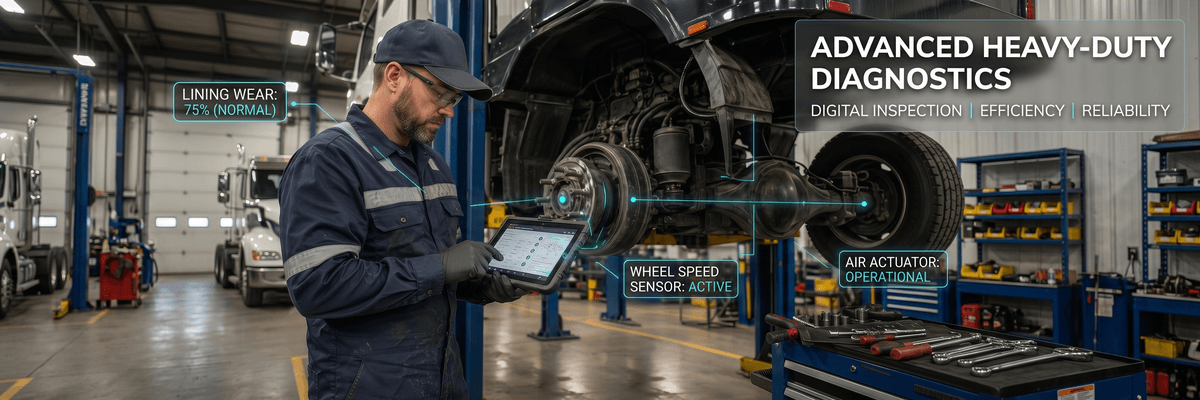
The Bottom Line Up Front: A DVIR is a fast, visual, daily check a driver performs before or after a trip under 49 CFR 396.11. A Preventive Maintenance Inspection (PMI) is a deeper, periodic evaluation performed by a qualified mechanic to satisfy 49 CFR 396.17. They are not interchangeable — and a driver-only inspection app leaves a compliance gap that shows up in every DOT audit. PTI4YOU covers both in one platform with a dedicated PMI module built for mechanics, not just drivers.
Key Takeaways: PMI vs DVIR
- Different jobs, different rules: The daily DVIR (§396.11) proves a driver checked the vehicle; the PMI (§396.17) proves a qualified inspector serviced it. Doing one does not satisfy the other.
- Mechanics need a mechanic's tool: A pass/fail driver checklist cannot document a brake adjustment, a grease point, or a rebuilt component. PMI reports use action indicators like Adjust, Oil, Grease, Replace/Rebuild, and Test.
- The hidden audit gap: Small fleets that only digitize the driver DVIR still keep periodic inspections on paper — the exact records auditors ask for first.
- One platform, both workflows: PTI4YOU pairs quick BYOD driver DVIRs with a separate PMI module and role-based defect approval, so you never buy two systems to stay compliant.
DVIR vs PMI: The Difference in One Minute
If you run a small fleet, you already know the Driver Vehicle Inspection Report (DVIR) inside and out. Your drivers walk around the truck, check the lights, kick the tires, note anything wrong, and sign off. That routine keeps you legal on a day-to-day basis, and modern apps have made it fast and painless.
But there is a second inspection that lives on a completely different clock, is governed by a completely different regulation, and is performed by a completely different person — and it is the one that quietly sinks fleets during a compliance review. It is the Preventive Maintenance Inspection (PMI), the periodic, mechanic-driven evaluation that keeps your equipment roadworthy between roadside stops and satisfies the annual inspection mandate.
The confusion is understandable. Both are "inspections," both generate paperwork, and both are about safety. But treating them as the same thing — or assuming that a driver-facing DVIR app covers your periodic obligations — is one of the most common and most expensive mistakes small carriers make. This guide breaks down exactly how DVIR and PMI differ, why your mechanics need software built for them (not just your drivers), and how to run both from a single system without paying for two.
Two Regulations, Two Worlds: §396.11 vs §396.17
The cleanest way to understand the DVIR/PMI split is to look at the two federal rules that create them. They sit next to each other in the Federal Motor Carrier Safety Regulations, but they ask for very different things.
49 CFR 396.11 — the daily DVIR. This rule requires the driver to prepare a report covering the condition of the vehicle at the end of each driving day (and to review the prior report before the next trip). It is operational and immediate: is this truck safe to drive right now? The driver is looking for obvious, safety-critical defects — service brakes, parking brake, steering, lights, tires, horn, wipers, mirrors, coupling devices, and emergency equipment. You can read the exact text on the official eCFR 49 CFR 396.11 page.
49 CFR 396.17 — the periodic (annual) inspection. This rule requires every commercial motor vehicle to pass a periodic inspection at least once every 12 months, performed to the minimum standards in Appendix A to Part 396. This is not a walk-around; it is a structured mechanical evaluation of brakes, coupling devices, exhaust, fuel systems, lighting, steering, suspension, frame, tires, wheels, and more, documented on a formal inspection report. The governing text lives at eCFR 49 CFR 396.17, and the qualifications for who may perform it are defined in §396.19.
Here is the sentence that matters most for your compliance file: completing daily DVIRs does not satisfy §396.17. A year of perfect driver reports does not replace a single periodic inspection. And in the real world, the PMI is where fleets do their preventive work — catching a worn brake lining or a leaking seal on a scheduled interval, long before it becomes an out-of-service order at a scale house.

What a Daily DVIR Actually Covers
The DVIR is intentionally lightweight. It is designed to be completed in a few minutes by a driver — not a technician — using their eyes, ears, and hands. A good electronic DVIR turns that walk-around into a structured checklist with photo evidence and instant routing of defects, which is why fleets have moved off paper in droves. If you want the full breakdown of that transition, our guide to the best DVIR apps for small and medium fleets covers it in depth.
What the DVIR is not designed to do is document repair work. When a driver flags "brakes feel soft," that is the end of the driver's job and the beginning of the mechanic's. The DVIR captures the symptom. It does not, and cannot, capture the service — the adjustment, the component replacement, the torque spec, the road test. Trying to force that depth of detail into a driver checklist is where a lot of "all-in-one" apps quietly fall apart.
Under the three-signature model that closes the loop on a reported defect, the driver reports it, a mechanic certifies the repair, and the next driver confirms the vehicle is safe before dispatch. We explain that closed loop in detail in our breakdown of the FMCSA 396.11 three-signature cycle. The PMI is what feeds that middle signature with real mechanical substance.
What a Preventive Maintenance Inspection Covers
A Preventive Maintenance Inspection (PMI) is a scheduled, systematic evaluation performed by a qualified mechanic — not a driver — on a time- or mileage-based interval such as every 90 days, plus the federally mandated annual inspection under 49 CFR 396.17. Unlike a DVIR's visual walk-around, a PMI is a component-level mechanical check that produces a documented service record of what was inspected and what action was taken.
A PMI is a scheduled, systematic inspection performed by a qualified mechanic on a time- or mileage-based interval — commonly every 90 days, or tied to engine hours and odometer thresholds. Its purpose is preventive: find and fix wear before it becomes a failure. A thorough PMI walks the entire vehicle system by system:
- Foundation brakes: lining and pad thickness, drum and rotor condition, pushrod stroke and slack adjuster travel, air system leak-down, chamber and hose integrity.
- Steering and suspension: steering play, kingpins, tie rods, springs, bushings, shock absorbers, and air-ride components.
- Tires and wheels: tread depth, sidewall condition, inflation, rim cracks, and fastener torque.
- Powertrain and fluids: engine oil, coolant, filters, belts, leaks, and driveline lubrication.
- Electrical and lighting: all lamps, reflectors, wiring, and connections.
- Frame, coupling, and exhaust: cross-members, fifth wheel, kingpin lock, and exhaust routing.
The output is not a simple "pass." It is a service record: what was inspected, what condition it was in, and what action the mechanic took. That is a fundamentally different document than a DVIR — and it needs a fundamentally different tool to create it.
DVIR vs PMI: Side-by-Side Comparison
If you only remember one section of this article, make it this table. It is the fastest way to explain the split to a driver, a mechanic, or a nervous owner-operator.
| Attribute | Daily DVIR | Preventive Maintenance Inspection (PMI) |
|---|---|---|
| Governing rule | 49 CFR 396.11 | 49 CFR 396.17 (annual minimum) |
| Who performs it | Driver | Qualified mechanic / inspector |
| Frequency | Every driving day | Scheduled interval (e.g., 90 days) + annual |
| Depth | Visual walk-around | Component-level mechanical evaluation |
| Output | Pass / defect flag | Service record with action indicators |
| Primary purpose | Is it safe to drive today? | Prevent failure before the next interval |
Notice that the two rows that trip fleets up most are "who performs it" and "output." A driver app produces a driver's document. A PMI needs a mechanic's document. When your software only speaks the first language, your periodic inspections end up in a paper binder in the shop — disconnected, un-searchable, and invisible during an audit.
The "Cheap App" Trap for Small Fleets
Here is how the trap springs. A small fleet adopts an inexpensive driver-inspection app to get off paper. It works great for the DVIR. Everyone is happy. Then the annual inspection comes due, the mechanic pulls out a clipboard, fills in a paper 396.17 form, and files it in a drawer. The fleet now runs two disconnected systems: a slick digital DVIR and an analog PMI process that nobody can find in a hurry.
That gap becomes a real liability during an off-site DOT safety audit, where investigators request maintenance and periodic inspection records through a digital portal on a tight deadline. If your DVIRs export in one click but your PMIs live on paper in a shop 200 miles away, you have a problem that no amount of clean driver data can fix.
The deeper issue is that many "all-in-one" platforms use per-asset pricing that punishes fleets with trailers and support equipment, then still deliver only a driver-grade inspection. We dug into that pricing dynamic in our analysis of the per-asset pricing trap. The takeaway: paying more does not automatically get you a real mechanic's inspection workflow. You have to look for the PMI module specifically.
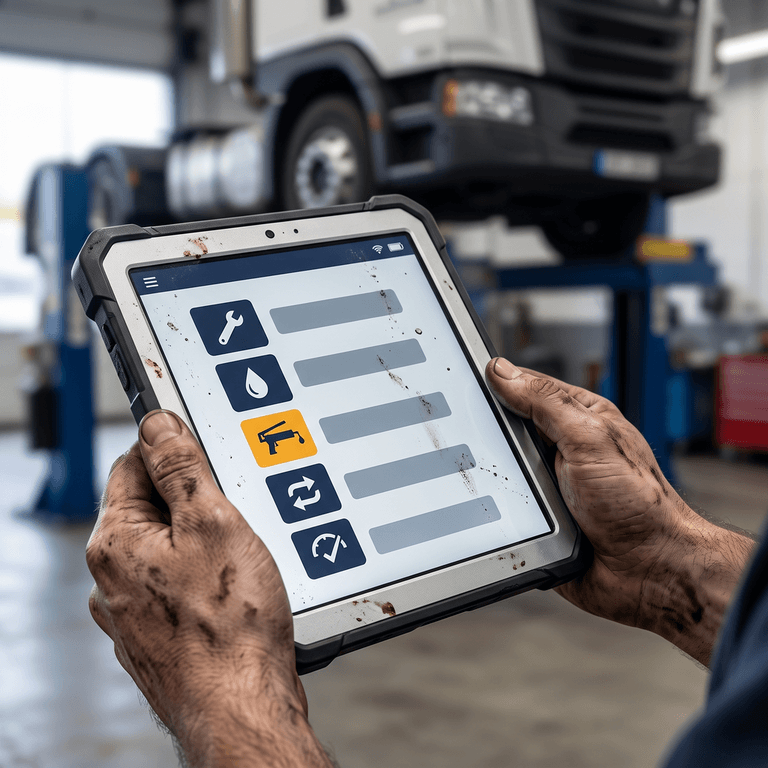
Mechanic Indicators: Adjust, Oil, Grease, Replace, Test
Professional PMI software tracks maintenance work using standardized mechanic action indicators — typically Adjust, Oil, Grease, Replace/Rebuild, and Test — instead of the simple pass/fail defect flags used on a driver's daily DVIR. These indicators document exactly what service was performed on each component, turning an inspection into a searchable maintenance history.
The clearest signal that a platform actually understands preventive maintenance is its vocabulary. A driver DVIR speaks in "OK" and "defect." A professional PMI speaks in action indicators — the standardized shorthand mechanics have used on paper service sheets for decades:
- Adjust — the component was brought back into spec (e.g., brake adjustment, belt tension).
- Oil — oil-level service or top-off was performed.
- Grease — lubrication points were serviced.
- Replace / Rebuild — the part was swapped out or reconditioned.
- Test — the system was function-tested after service (e.g., an air-brake or lighting test).
These indicators turn an inspection into a maintenance history. Six months later, when a wheel seal fails, you can pull the record and see exactly when it was last greased, who serviced it, and what condition it was in. That is the kind of documentation that defends a fleet in a lawsuit and protects a small operator's insurance profile — and it is impossible to produce from a pass/fail driver checklist.
This forward-looking, data-rich approach is exactly where fleet maintenance is heading. Our look at EPA 2027 predictive maintenance ROI shows how structured service data becomes the foundation for predicting failures before they happen — but you cannot predict from data you never captured.
See the PMI Module in Action
PTI4YOU gives your mechanics a dedicated preventive maintenance inspection workflow — with Adjust, Oil, Grease, Replace/Rebuild, and Test indicators — while your drivers keep doing quick BYOD DVIRs. One platform, both jobs, zero paper binders.
Start your 15-day free trial today. No credit card required.
Start Your 15-Day Free Trial – No Credit Card RequiredZero setup fees. Zero hardware. 25-minute team onboarding.
How PTI4YOU Handles Both Workflows
PTI4YOU was built on a simple architectural decision: drivers and mechanics do different jobs, so they get different tools inside the same platform. Instead of forcing a technician to document a rebuild through a driver's pass/fail screen, the platform keeps the two workflows architecturally separate while storing their output together.
A dedicated PMI module for mechanics
The preventive maintenance module gives mechanics an interface designed for service logging, complete with the professional action indicators covered above. Each PMI is tied directly to the mechanic who performed it, creating clear accountability and a defensible service history for every asset. The finished inspection generates a separate, audit-ready PDF that is stored in the same cloud archive as your daily DVIR tickets — so a periodic inspection is never more than one click away during a review.
Role-based defect approval
Defects flow through a structured, role-based approval path — from the driver who reports it, to the inspector or mechanic who resolves it, to the reviewer who signs off. That chain of custody is what turns a pile of inspection forms into a genuine compliance system, and it is what auditors are really looking for: proof that a reported problem was actually fixed and verified, not just noted and forgotten.

Customizable checklists for mixed equipment
Not every asset should be inspected with a truck checklist. PTI4YOU lets you build inspection item groups tailored to each vehicle or equipment type, so a reefer trailer, a dump truck, and a service van each get the right checklist — and each PMI reflects the components that actually matter for that asset. This flexibility is a lifesaver for the mixed fleets we cover in our guide to customizing digital inspections for semi-trucks and construction equipment.
Fair, unit-based pricing
Finally, PTI4YOU uses transparent limits on the number of units rather than punitive per-asset add-ons for every trailer and generator. That pricing model — combined with a bring-your-own-device approach that needs no proprietary hardware — keeps the total cost of running both DVIR and PMI within reach of the small fleets that need the protection most.
The ROI of Getting PMI Right
For a small fleet, preventive maintenance is not a cost center — it is the cheapest insurance you can buy. Consider the math:
- Downtime avoided. A brake or seal issue caught on a scheduled 90-day PMI is a planned bay visit. The same issue caught at a roadside inspection is an out-of-service order, an emergency road call, a missed load, and a hit to your safety score. We put real numbers on that gap in our out-of-service downtime cost calculator.
- Audit protection. When periodic inspections live in the same searchable archive as your DVIRs, an off-site audit becomes a one-click export instead of a fire drill. Missing or incomplete maintenance records are among the most common audit findings.
- Longer asset life. Documented lubrication and adjustment intervals extend the service life of expensive components — and give you leverage on resale and warranty claims.
- Lower liability. After a crash, plaintiff attorneys subpoena maintenance records first. A complete, timestamped PMI history is one of the strongest defenses a carrier can have.
None of that value is theoretical. It is the direct result of capturing structured service data on every asset, on a schedule — which is exactly what a dedicated PMI module is built to do.
How to Set Up PMI Scheduling in a Weekend
Standing up a proper preventive maintenance program is far less work than most owners expect. Here is a practical, five-step path:
- List your assets and set intervals. Decide on a time- or mileage-based PMI cadence for each vehicle class — 90 days is a common baseline, with the annual 396.17 inspection layered on top.
- Build the right checklists. Create inspection item groups per equipment type so each PMI reflects the components that matter for that asset.
- Assign your qualified inspector. Confirm your mechanic meets the §396.19 qualification standard for the annual inspection, and tie PMIs to their profile for accountability.
- Turn on reminders. Let the system schedule the next PMI automatically so nothing slips — the number-one cause of a missed periodic inspection is simply forgetting.
- Export a sample audit packet. Before you ever face a real review, pull a combined DVIR + PMI export for one truck. If it looks clean and complete, your whole fleet is protected.
Do that once, and you have converted your biggest hidden compliance risk into a routine that runs itself.
Frequently Asked Questions
Does completing a daily DVIR satisfy the FMCSA's periodic inspection requirement?
No. A daily DVIR is a pre- or post-trip operational check mandated under 49 CFR 396.11, while a Preventive Maintenance Inspection satisfies the deeper periodic and annual requirements under 49 CFR 396.17. The periodic inspection must be performed by a qualified inspector and evaluates components a driver walk-around does not. A year of perfect DVIRs does not replace one periodic inspection.
What specific indicators should a digital PMI report track?
Professional PMI workflows categorize maintenance actions using standard mechanic indicators such as Adjust, Oil, Grease, Replace/Rebuild, and Test. These move beyond the pass/fail defect flagging on a driver DVIR and create a real service history documenting exactly what work was performed on each component.
How often is a periodic inspection required under 49 CFR 396.17?
Every commercial motor vehicle must receive a periodic (annual) inspection at least once every 12 months. Many fleets schedule preventive maintenance inspections more frequently — on mileage or time-based intervals such as every 90 days — to catch wear before it becomes an out-of-service violation or a roadside breakdown.
Can one software platform handle both DVIR and PMI for a small fleet?
Yes. PTI4YOU includes a dedicated PMI module that is architecturally separate from the daily driver DVIR, so drivers complete quick pre-trip checks while mechanics log deep service work with professional indicators. Both report types are stored together in one cloud archive, giving small fleets a single audit-ready system instead of two disconnected tools.
Who is allowed to perform a preventive maintenance inspection?
Under FMCSA rules the annual periodic inspection must be performed by a qualified inspector who meets the training or experience requirements of 49 CFR 396.19. Routine preventive maintenance inspections are typically performed by qualified fleet mechanics. A driver completing a daily DVIR does not meet this standard, which is why driver-only apps cannot close the periodic inspection gap.
Do small fleets really need PMI software, or is a paper binder enough?
A paper binder technically satisfies the record requirement, but it fails during off-site DOT audits, is easy to lose, and makes it impossible to spot recurring defects across a fleet. Digital PMI software timestamps every service action, retains reports for the required period, and lets you export clean records in one click — protection small operators cannot afford to skip.
Conclusion: Stop Inspecting Like a Driver When You Need to Inspect Like a Mechanic
The DVIR and the PMI are two halves of a complete compliance program, and most small fleets have only digitized the first half. The daily driver check keeps you legal today; the periodic mechanic inspection keeps you roadworthy, audit-proof, and out of court tomorrow. Treating them as one thing — or trusting a driver-only app to cover both — is the gap that turns a routine audit into an expensive one.
You do not need two systems and you do not need enterprise pricing to close that gap. You need one platform that respects the difference between a driver's job and a mechanic's job, captures real service data with professional indicators, and stores every record in one searchable, exportable archive. That is exactly what PTI4YOU was built to do — for the small and mid-size fleets that carry the most risk and have the least room for error.
Cover Both Inspections With One Platform
Give drivers fast BYOD DVIRs and give mechanics a real preventive maintenance inspection module — with role-based approval and one audit-ready archive for everything.
Start your 15-day free trial today. No credit card required.
Start Your 15-Day Free Trial – No Credit Card RequiredZero setup fees. Zero hardware. 25-minute team onboarding.