
The Bottom Line Up Front: A single roadside Out-of-Service (OOS) violation typically costs a North American motor carrier $10,000 or more in true, all-in financial damage — and the FMCSA citation printed on the inspection report is usually the smallest number in that total. Lost load revenue, emergency towing, and after-hours repair labor almost always outweigh the direct fine, which is exactly why so many fleet owners underestimate the real cost of a bad pre-trip inspection until it happens to them.
Key Takeaways: The True Cost of an OOS Violation
- The all-in cost typically runs $8,000–$14,000+ per incident: Once lost load revenue, emergency towing, emergency repair labor, and regulatory fines are stacked together, the "it's just a fine" mental model is off by an order of magnitude.
- Brakes, tires, and lighting cause most OOS orders: These three categories combined for roughly three-quarters of all vehicle out-of-service violations during CVSA's 2025 International Roadcheck, and every one of them is visible during a proper pre-trip inspection.
- The fine is the smallest line item: Lost load revenue and emergency repair labor together usually outweigh the direct regulatory penalty by three to five times.
- Detection before dispatch is the only real prevention: Paperwork documents a failure after it happens; only a defect caught in the yard, before the truck rolls, avoids the cost bucket entirely.
- US and Canadian carriers share the same exposure: CVSA's harmonized out-of-service criteria apply on both sides of the border, so the cost math below applies equally to NSC-regulated Canadian fleets.
The $10,000 Question: What Does an Out-of-Service Order Really Cost?
Ask a fleet CFO or owner-operator what a roadside violation costs, and most will quote a number from the citation itself — a few hundred to a few thousand dollars, depending on the item. That number is real, but it is also the least important figure in the transaction. The FMCSA fine is a line item; it is not the bill.
The actual bill arrives in four separate invoices that never sit on the same desk at the same time: the freight broker charging a late-delivery penalty, the towing company that clears the shoulder, the mobile mechanic who bills after-hours labor rates, and finally — often weeks later — the civil penalty notice. Because these costs are scattered across different departments and different timeframes, almost no one adds them up. This guide adds them up.
For US and Canadian commercial carriers alike, an Out-of-Service (OOS) order under the CVSA Out-of-Service Criteria Guidebook (North American Standard Out-of-Service Criteria) means a vehicle or driver is prohibited from operating until a specific, safety-critical condition is corrected. The criteria are harmonized across North America, which is why the cost logic below is universal: it applies the same way to a dry van carrier running Ohio-to-Indiana lanes and to an NSC-regulated Canadian fleet running Ontario-to-Quebec.
Calculate Your Fleet's Downtime Bleed Risk
Before the breakdown of where the money goes, run your own fleet's numbers. Enter your fleet size, average revenue per load, and operating region to see an estimated annual downtime risk exposure — the number most fleets never calculate until a truck is already sitting on the shoulder.
Your Estimated Annual Downtime Bleed Exposure
| Lost Load Revenue (per incident) Missed load, detention, and lost backhaul opportunity | $0 |
| Emergency Towing/Removal (per incident) Heavy-duty flatbed tow off the shoulder or scale house | $0 |
| Emergency Roadside Repair Labor (per incident) After-hours mobile mechanic dispatch, parts and labor | $0 |
| Regulatory Fines & Penalties (per incident) Base civil penalty tied to the safety-critical violation | $0 |
| Estimated Annual Downtime Risk Exposure | $0 |
This is the exposure sitting in your operation right now. An electronic DVIR system that flags defects before dispatch is the only mechanism that removes this risk bucket entirely — not just documents it afterward.
Start Your 15-Day Free Trial (No Hardware Required)Estimates use industry-informed modeling assumptions for OOS incident frequency and per-incident cost, adjustable to your own fleet's actual load values and region. Individual results will vary.
The Most Common Roadside Traps: Why Brakes, Tires & Lighting Trigger Most OOS Orders
Worn brakes, tires, and lighting or reflective-device defects are the most common roadside violations FMCSA and CVSA inspectors cite because they are fast to check, easy to see, and statistically responsible for the overwhelming majority of vehicle out-of-service orders. During CVSA's 2025 International Roadcheck, brake-related defects alone accounted for 41.1% of all vehicle OOS violations, tires added another 21.4%, and lighting defects contributed 12.8% — together, roughly three-quarters of every vehicle placed out of service (CVSA 2025 International Roadcheck Results).
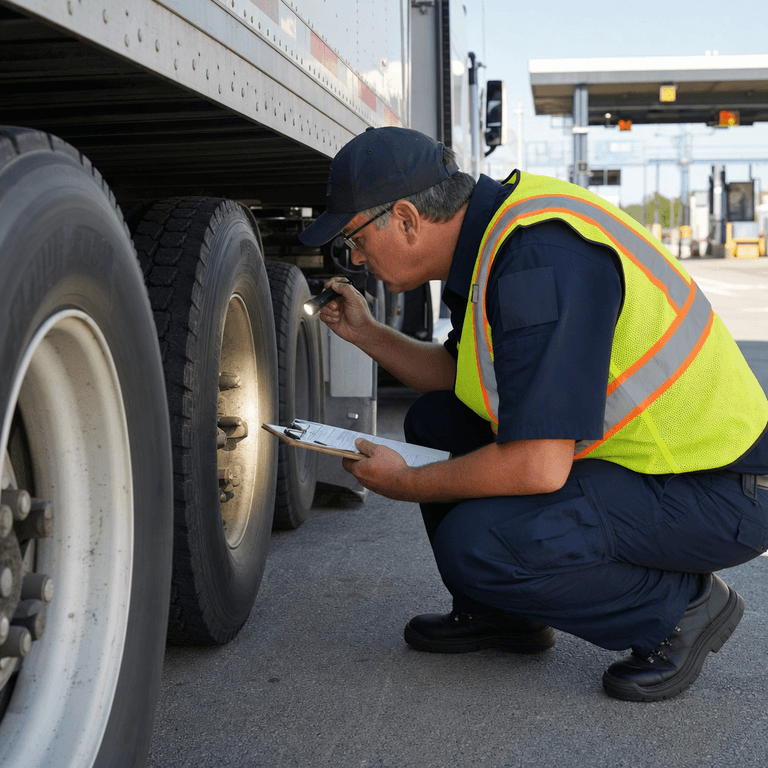
These three categories dominate the out-of-service criteria checklist for a structural reason: a Level 1 or Level 2 inspection is built to move quickly, and inspectors are trained to check the items that produce the highest yield in the shortest time. A brake pushrod stroke gauge takes seconds per wheel end. A tire tread depth check takes seconds per tire. A walk-around for inoperative lights takes less than a minute. None of this requires disassembling the vehicle — it requires the inspector to look at exactly what a driver's pre-trip inspection is legally required to look at.
The single most consequential rule inside this checklist is the 20% defective brake standard: if 20% or more of a vehicle's (or combination vehicle's) service brakes exhibit a critical defect, the entire combination is placed out of service immediately. On a standard five-axle, ten-brake tractor-trailer, that threshold is crossed the moment just two wheel ends fail — a cracked chamber, an out-of-adjustment slack adjuster, or an audible air leak is often all it takes.
A simplified snapshot of the criteria most likely to ground a truck looks like this:
| Category | Example OOS-Triggering Defect | Typical Inspection Check Time |
|---|---|---|
| Brakes | Cracked brake chamber, audible air leak, 20% or more defective brakes on the combination | Seconds per wheel end (stroke gauge / visual) |
| Tires | Tread depth below 4/32" (steer) or 2/32" (drive/trailer), exposed cord, sidewall bulge | Seconds per tire (tread depth gauge / visual) |
| Lighting & Reflective Devices | Inoperative brake lights, turn signals, or clearance lamps; missing conspicuity tape | Under a minute (full walk-around) |
| Cargo Securement | Loose, shifted, or inadequately secured cargo; failed tie-down count | 1–2 minutes (visual + tie-down count) |
Every item on that checklist is something a competent driver can see, hear, or feel during a legitimate pre-trip inspection — which is precisely why the majority of OOS orders trace back not to catastrophic mechanical failure, but to a walkaround that was rushed, skipped, or "pencil-whipped" the morning the truck left the yard.
The Anatomy of a Downtime Bleed: What Is the True Cost of a Truck Roadside Breakdown?
The true cost of a truck roadside breakdown triggered by an Out-of-Service order is the total financial damage from a single event, calculated as the sum of four cost buckets: lost load revenue, emergency towing and removal, emergency roadside repair labor, and regulatory fines and penalties. For a routine single-axle brake failure, this total typically starts around $8,000 and climbs from there.
The formula is simple to state and brutal to experience:
The Downtime Bleed Formula
Downtime Bleed = Lost Load Revenue + Emergency Towing/Removal + Emergency Roadside Repair Labor + Regulatory Fines & Penalties
- Lost Load Revenue — the missed or delayed load's contract value, plus driver detention beyond free time and any lost backhaul opportunity created by the delay.
- Emergency Towing/Removal — the cost to clear a disabled Class 8 tractor-trailer from a highway shoulder or scale house, typically well above a passenger-vehicle tow rate.
- Emergency Roadside Repair Labor — a mobile mechanic dispatched at after-hours or emergency rates, which run materially higher than in-shop labor rates, plus parts sourced under time pressure.
- Regulatory Fines & Penalties — the direct FMCSA/CVSA civil penalty tied to the specific safety-critical violation that triggered the OOS order.
To make this concrete, consider a realistic, common scenario: a dry van truckload carrier has one tractor placed out of service for a cracked brake chamber, discovered during a Level 1 inspection at a fixed scale house roughly 200 miles from the carrier's home terminal.
| Line Item | Estimated Cost |
|---|---|
| Lost Load Revenue (missed linehaul revenue, detention, lost backhaul) | $3,600 |
| Emergency Towing/Removal (heavy-duty flatbed tow, 200 miles from terminal) | $750 |
| Emergency Roadside Repair Labor (after-hours mobile mechanic, parts + labor) | $1,850 |
| Regulatory Fines & Penalties (base civil penalty for the equipment violation) | $1,800 |
| TOTAL DOWNTIME BLEED | $8,000 |
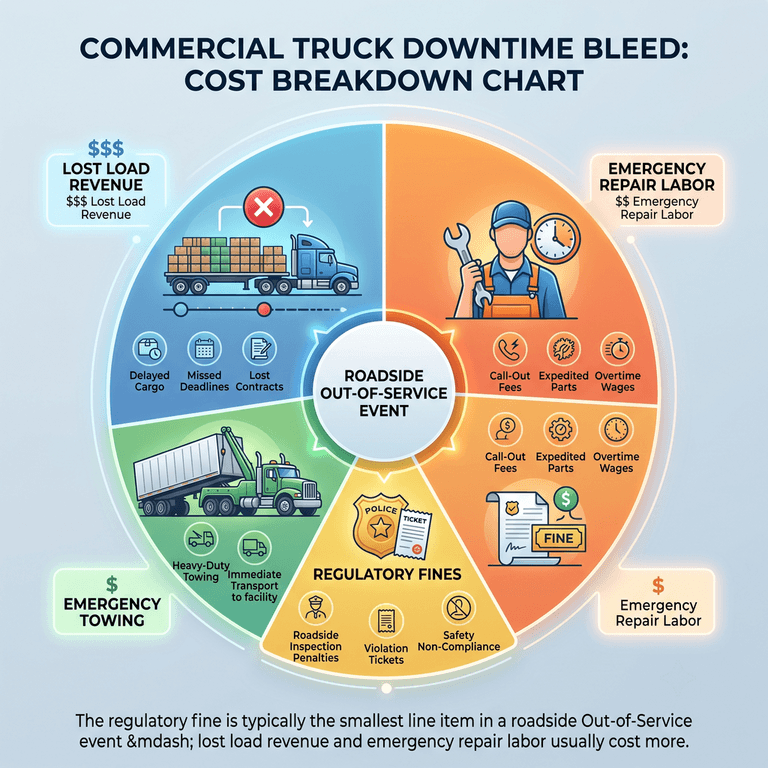
Notice the shape of that total: the FMCSA-style civil penalty is the smallest of the four buckets, not the largest. Lost load revenue and repair labor combined are more than double the fine itself. And $8,000 is the conservative end of the range for this scenario — it assumes daytime hours, a mobile mechanic within reasonable driving distance, and a part that doesn't need to be backordered.
Push the same brake failure into a holiday weekend, a rural interstate corridor with only one certified mobile technician within 100 miles, or a part that has to ship overnight, and the total climbs past $12,000–$14,000 without much difficulty. That range is why the $10,000+ average cited at the top of this guide is a realistic average across the full spread of OOS scenarios, not a worst-case scare number. According to ATRI's Operational Costs of Trucking benchmarking, the average per-mile operating cost for trucking sits above $2.25, with detention time and lost drive-hours consistently identified as some of the most corrosive, hardest-to-recover costs in the industry — which is exactly the category a roadside OOS event detonates in a single afternoon.
If you want to see how these same "invisible cost" dynamics play out in day-to-day paperwork instead of a single roadside incident, see the full paper-vs-digital cost comparison for a breakdown of the ongoing administrative bleed that paper DVIRs create even without a breakdown involved.
How Fleets Reduce Roadside Maintenance Costs Before They Start
Fleets reduce roadside maintenance costs by catching brake, tire, and lighting defects during a mandatory, verifiable pre-trip inspection instead of discovering them at a scale house. The lever that matters most is tracking fleet maintenance metrics like downtime-per-unit and repeat-defect rate closely enough to fix the process, not just the truck.
A short, practical checklist that consistently moves the needle:
- Make the brake stroke check non-negotiable. Weekly pushrod travel verification catches the single most common OOS trigger before it becomes a 20%-defective-brake shutdown.
- Put a tread depth gauge in every cab. A $15 tool prevents a $750+ tow and a missed load caused by a tire that should never have left the yard.
- Treat lighting checks as a two-minute daily habit. Lighting defects are the single most preventable OOS category on the entire checklist — and the fastest for an inspector to spot.
- Track fleet maintenance metrics on a dashboard, not a whiteboard. Downtime-per-unit, mean-time-to-repair, and repeat-defect-by-vehicle turn roadside risk from a mystery into a manageable, trackable number.
- Route every reported defect to a mechanic before the truck leaves the gate. A defect logged but not resolved before dispatch provides zero downtime protection — it only creates a paper trail for later.
Every item on that list points to the same underlying requirement: the inspection has to be verifiable, timestamped, and tied to a mandatory stop-dispatch action when a defect is found. That is a workflow problem, not a maintenance-budget problem — and it is the exact gap that the best DVIR software for fleet downtime prevention is built to close.
Your Technology Insurance Policy: Stopping the Bleed Before the Truck Leaves the Yard
Digitizing pre-trip and post-trip inspections is the only mechanism that prevents a downtime bleed entirely, rather than simply documenting it after the fact, because it forces a mandatory, GPS- and photo-verified defect check and blocks dispatch until the defect is resolved. A paper DVIR or a "pencil-whipped" digital shortcut can record that a truck was inspected; it cannot stop that truck from leaving the yard with a cracked brake chamber.

This is the core distinction between "compliance software" and true downtime-cost prevention. A system that only stores completed DVIRs in the cloud is a better filing cabinet — genuinely useful for a DOT audit, but powerless to stop a truck from being dispatched with a defect that was checked off without actually being inspected. Preventing a Downtime Bleed requires the software to sit in front of dispatch, not behind it: a mandatory GPS-verified walkaround, mandatory photo capture of specific safety-critical components, and an automated hold that blocks the vehicle from being assigned to a load until a flagged defect is resolved and signed off.
This is the model pti4you.com is built around. As a hardware-agnostic electronic DVIR system, it runs on the smartphones and tablets drivers already carry — no proprietary GPS gateways to install, activate, or remove when a truck changes hands. Compared with enterprise telematics platforms like Samsara or Motive, which typically require mandatory hardware and 36–60 month contracts under opaque enterprise pricing, PTI4YOU publishes transparent public pricing with no long-term contract. And compared with maintenance-CMMS-first platforms like Fleetio or Whip Around, which are strong products built primarily around scheduled maintenance workflows, PTI4YOU's core design goal is narrower and more specific: catch the safety-critical defect before the vehicle leaves the yard, because that is the only way to actually prevent an OOS event — not just produce a clean record of one after the fact.
In practice, that means:
- Mandatory GPS-verified walkarounds that confirm the driver was physically at the vehicle, not filling out a form from the cab or the breakroom.
- Photo-verified defect capture on safety-critical components, so a "checked" box is backed by visual evidence, not a driver's assumption.
- Automated defect flagging and dispatch holds that route a reported defect straight to a mechanic and block the load assignment until it is resolved.
- No proprietary hardware requirement, which matters for fleets that lease equipment, run seasonal rentals, or simply don't want a 5-year hardware commitment tied to a single vendor.
- Transparent, published pricing and no long-term contract, so a 10-truck fleet isn't locked into enterprise terms built for a 1,000-truck carrier.
Stop Documenting Defects. Start Preventing Them.
pti4you.com catches safety-critical defects before the vehicle leaves the yard — the only mechanism that actually prevents an OOS event instead of just recording it.
Start your 15-day free trial today. No credit card required.
Start Your 15-Day Free Trial – No Credit Card RequiredZero setup fees. Zero hardware. 25-minute driver onboarding.
Frequently Asked Questions
How long does an Out-of-Service (OOS) order remain active?
An Out-of-Service order is legally binding until the specific safety-critical defect is repaired and certified on-site by a qualified mechanic. The vehicle cannot legally move based on a promise to fix the issue at the next terminal; a certified repair provider must complete the work at or near the inspection site, and the driver must be able to produce documentation proving the repair before continuing the trip.
What is the direct penalty for a driver violating an active OOS order?
Drivers face personal civil penalties up to $4,000, and carriers face fines exceeding $15,000 for operating, or allowing operation of, a vehicle placed out of service. These federal civil penalties are assessed under FMCSA's inflation-adjusted penalty schedule (49 CFR Part 386, Appendix B) on top of the towing, repair, and lost-revenue costs already created by the roadside stop.
What triggers an Out-of-Service order at a roadside inspection?
An Out-of-Service order is triggered when a certified inspector finds a safety-critical defect listed in the CVSA North American Standard Out-of-Service Criteria, most often involving brakes, tires, or lighting and reflective devices. These items are checked first during a Level 1 or Level 2 inspection because they are fast to verify and statistically responsible for the overwhelming majority of vehicle OOS orders.
Does an OOS violation affect my CSA score or insurance premiums?
Yes. Every OOS violation is recorded against the carrier's Safety Measurement System (SMS) scores, most often the Vehicle Maintenance BASIC, and elevated scores increase the likelihood of future roadside stops and DOT interventions. Insurance underwriters routinely pull SMS/CSA data when setting or renewing commercial auto liability premiums, so a pattern of OOS violations frequently results in higher rates or non-renewal.
Is the OOS criteria the same in Canada as the US?
Yes, the core safety-critical defect thresholds are harmonized across North America through the CVSA's North American Standard Out-of-Service Criteria, which enforcement personnel apply in both countries. Canadian carriers also operate under the National Safety Code, particularly NSC Standard 13 for daily trip inspections, and provincial safety fitness rules, but the brake, tire, and lighting thresholds that trigger an OOS order are the same CVSA criteria on both sides of the border.
How much does a typical roadside truck breakdown actually cost?
A single roadside breakdown or Out-of-Service event typically costs $8,000 to $14,000 or more once lost load revenue, emergency towing, emergency repair labor, and regulatory fines are combined. Remote locations, multi-day parts delays, or holiday-weekend timing can push the total well beyond that range, while the direct FMCSA fine is usually the smallest line item in the bleed.
Can a fleet contest or appeal an Out-of-Service order?
No, an Out-of-Service order itself cannot be appealed on the roadside; the underlying defect must be repaired and certified before the vehicle can legally move again. Carriers can later challenge the accuracy of the inspection data through FMCSA's DataQs system, but that process does not lift the immediate OOS restriction or recover the downtime already incurred.
The Fine Is the Tip of the Iceberg
The DOT citation is the part of an OOS event that shows up in writing, so it is the part fleet owners fixate on. But the real damage — the number that actually hurts a small or midsize carrier's margins — is the missed defect that took the truck off the road in the first place. The towing invoice, the after-hours mechanic, and the load that didn't get delivered don't show up on the citation, but they show up on the P&L.
Digitizing your inspections with pti4you.com is what prevents that scenario from happening at all. Instead of a paper form or a rushed digital checklist that only proves a truck was looked at, a mandatory GPS- and photo-verified pre-trip workflow with automated dispatch holds proves the defect was caught — and stopped — before the truck ever reached the scale house.
Calculate Your Downtime Risk. Start With pti4you.com Free Today.
No proprietary hardware. No long-term contract. Transparent public pricing. Just a hardware-agnostic electronic DVIR system built to catch safety-critical defects before dispatch.
Calculate Your Downtime Risk – Start With pti4you.com Free Today15-day free trial. No credit card required. Cancel anytime.