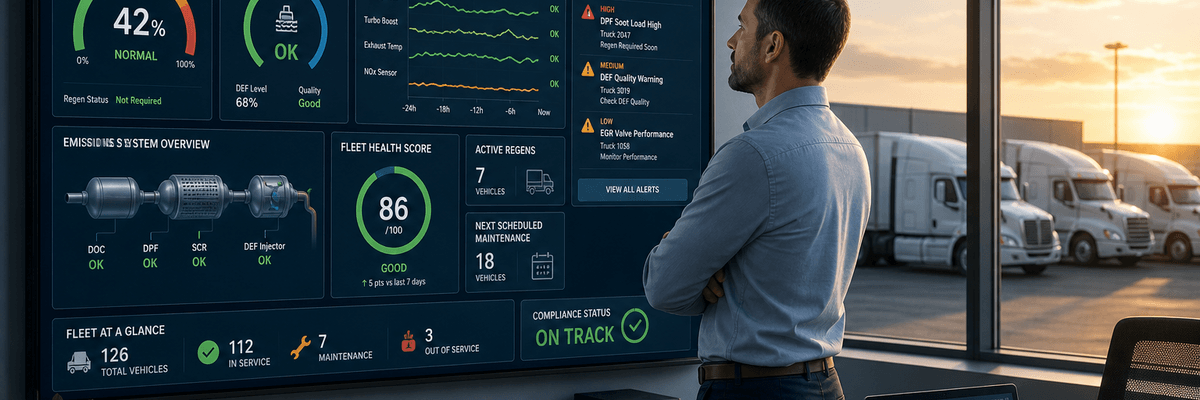
Why EPA 2027 Is a Maintenance Problem Before It Is a Compliance Problem
EPA 2027 is not primarily about tailpipes. It is about the maintenance schedule your fleet runs today. The emissions standards that take effect with model year 2027 heavy-duty engines represent the largest regulatory transition for diesel trucks in a generation, and the fleets that come through it profitably are the ones treating maintenance planning — not truck purchasing — as the first lever to pull.
Here is the situation as it stands in August 2026. The core rule was finalized back in December 2022. Engine manufacturers have spent nearly four years redesigning aftertreatment systems, adding sensors, and re-engineering how their engines respond to emissions faults. Then, on July 9, 2026, EPA proposed a set of amendments that keeps the strict NOx standard in place while softening several of the provisions that would have protected fleet owners — most notably the extended emissions warranty. The public comment period on that proposal closes August 29, 2026.
That combination should get every fleet owner's attention. The trucks arriving in 2027 will carry the most complex emissions hardware ever installed on a commercial vehicle. If the proposed amendments are finalized, the warranty covering that hardware may be no longer than the one on a 2026 truck. Whichever way the final rule lands, the financial exposure sits in the same place: the maintenance bay.
Fleets running 5 to 500 vehicles feel this asymmetry most sharply. A national carrier can absorb a bad quarter of emissions repairs. A 40-truck regional fleet cannot. This article explains what is actually confirmed in the EPA 2027 rules, why reactive maintenance is becoming the most expensive strategy in trucking, and how predictive maintenance — built on digital inspection data you can start collecting this week — pays for itself years before any inspector asks about it.
Key Takeaways
- The EPA 2027 heavy-duty emissions standards, finalized in December 2022, cut allowable NOx emissions by more than 80% and remain in effect for model year 2027 engines — even after the amendments EPA proposed in July 2026.
- EPA's July 2026 proposal would roll back the extended emissions warranty to current 5-year/100,000-mile levels and remove mandatory DEF derates. If finalized, fleets — not manufacturers — carry more of the repair risk on far more complex engines.
- Reactive maintenance already costs more on modern aftertreatment systems: a neglected DPF or DEF dosing fault escalates from a minor service item into a multi-thousand-dollar repair plus lost revenue days.
- Predictive fleet maintenance is a business investment first and a compliance strategy second. Fleets that build it now capture fuel, uptime, and repair savings years before enforcement pressure arrives.
- Every predictive maintenance program starts with structured inspection data. Digital DVIRs — with recurring defect tracking, timestamps, photos, and verified repairs — are the foundation layer.
Understanding EPA 2027: What Is Confirmed, What Is Proposed, and What Is Expectation
EPA 2027 refers to the final rule Control of Air Pollution from New Motor Vehicles: Heavy-Duty Engine and Vehicle Standards, adopted by the U.S. Environmental Protection Agency on December 20, 2022. It sets substantially stricter emissions standards for heavy-duty engines beginning with model year 2027. Because regulatory reporting on this topic is frequently muddled, it is worth separating three categories: what the finalized rule says, what EPA has proposed to change, and what the industry expects but no agency has confirmed.
Confirmed: The Finalized 2027 Standards
According to the EPA final rule and related materials, model year 2027 and later heavy-duty engines must meet NOx limits of 0.035 grams per horsepower-hour under normal operation, 0.050 g/hp-hr under low-load conditions, and 10 grams per hour at idle. That is more than an 80% reduction from the previous standard, and — critically for maintenance planning — the new limits cover low-load and idle operation, the exact conditions where aftertreatment systems run cool and struggle to perform. The rule also tightened particulate matter limits, strengthened onboard diagnostics requirements, and required manufacturers to design engines that resist emissions-control tampering.
The 2022 rule additionally extended the regulatory useful life for heavy heavy-duty engines from 435,000 miles to 650,000 miles and lengthened the emissions warranty from 5 years/100,000 miles to 10 years/450,000 miles. Those two provisions are now the subject of proposed amendments — which brings us to the second category.
Proposed: The July 2026 Amendments
On July 9, 2026, EPA proposed targeted amendments to the 2027 program (Docket ID EPA-HQ-OAR-2026-0728, published in the Federal Register on July 14, 2026). Per the official EPA fact sheet, the proposal would:
- Keep the 0.035 g/hp-hr NOx standard in place. EPA states the revised program retains nearly 90% of the projected NOx reductions.
- Revert emissions warranty periods to model year 2026 levels — meaning 5 years/100,000 miles for heavy heavy-duty engines instead of the extended 10-year/450,000-mile coverage.
- Delay the extended useful-life requirements until model year 2030.
- Eliminate mandatory speed and power derates for DEF system failures, replacing them with visible and audible dashboard warnings.
- Allow nonconformance penalties so manufacturers can sell engines that do not yet fully meet the standard during the transition.
As of this article's publication, these amendments are a proposal, not law. Written comments are due August 29, 2026, per EPA's public comment notice, and a final rule will follow the agency's review. Separately, EPA rescinded the federal Phase 3 greenhouse-gas standards for heavy-duty vehicles in early 2026 — an action now working through litigation — which leaves the low-NOx program as the operative federal emissions requirement for 2027 trucks.
Expected: How OEMs and the Industry Are Responding
Engine manufacturers began certifying and announcing 2027-compliant platforms well before the amendment proposal, and the hardware direction is consistent across OEMs: more capable selective catalytic reduction (SCR) systems, revised exhaust gas recirculation (EGR) strategies, additional NOx and temperature sensors, and in several designs, close-coupled catalysts that treat exhaust during cold starts and low-load operation. Industry groups such as the American Trucking Associations' Technology & Maintenance Council have published recommended practices for maintaining these systems. Dealers and fleet analysts widely expect 2027 trucks to cost more and to demand more disciplined maintenance — but specific price premiums remain estimates, not regulatory facts, and this article treats them accordingly.
The Operational Bottom Line for Fleets
Read the July 2026 proposal from a fleet owner's chair and one insight stands out. The complexity is staying; the safety nets may be leaving. The engines still must meet a NOx limit 80% stricter across more operating conditions, which means the sensors, dosing systems, and catalysts remain. But if the warranty reverts to 100,000 miles, the fleet — not the OEM — pays for aftertreatment failures across most of the vehicle's working life. And if DEF faults trigger dashboard alerts instead of automatic derates, nothing physically forces a driver or fleet to act before a small fault becomes catastrophic damage. Under either version of the final rule, disciplined, data-driven maintenance is the hedge. That is why preparation cannot wait for 2027.
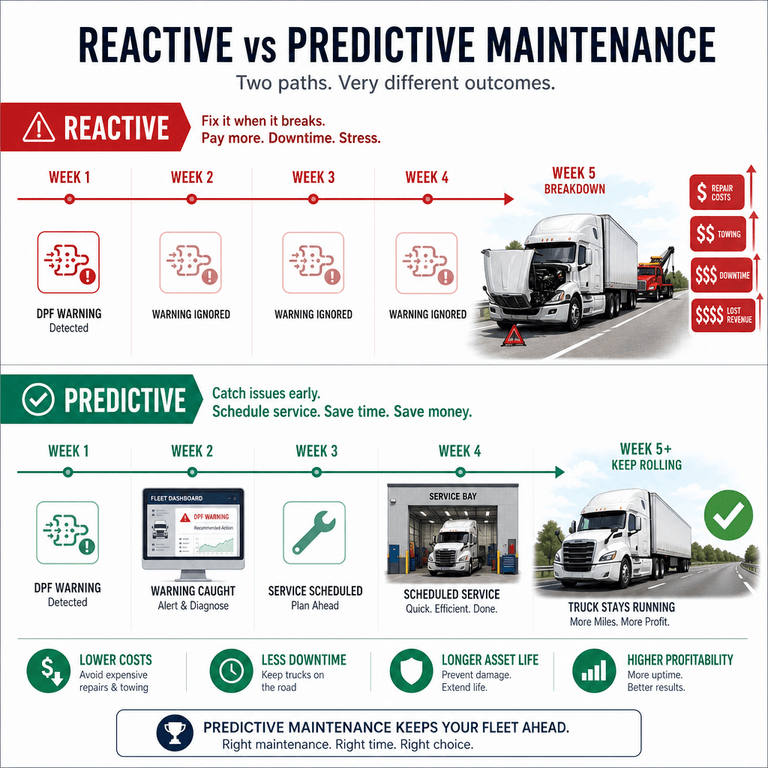
Why Reactive Maintenance Is Becoming Too Expensive to Keep
Reactive maintenance — running equipment until something breaks — was always a gamble. On a mechanically simple 1990s diesel, it was at least a gamble with bounded losses. On a modern emissions-equipped truck, the failure modes cascade, and each stage of the cascade multiplies the bill.
Consider the diesel particulate filter. A DPF that regenerates normally is a routine service item: cleaned or exchanged on a planned interval, at a planned cost, in a planned bay. A DPF that is quietly plugging — because regeneration cycles are failing, because a driver keeps interrupting them, or because an upstream injector problem is loading the filter with soot — announces itself with warning lamps, then power loss, then a truck that will not complete its route. By that point the fleet is often looking at forced regeneration or filter replacement, a tow, a missed delivery window, and sometimes collateral damage: excessive backpressure is hard on turbochargers, and turbocharger failures on emissions-era engines are among the most expensive single repairs in the shop.
The DEF and SCR system tells the same story. Crystallized DEF lines, failing NOx sensors, and dosing faults start as cheap fixes. Ignored, they escalate into contaminated catalysts and five-figure aftertreatment repairs. Under today's rules, a DEF fault eventually derates the engine — disruptive, but at least self-enforcing. Under the July 2026 proposal, that derate becomes a dashboard warning a busy driver can ignore for weeks. The regulation would stop protecting careless fleets from themselves. Your maintenance process has to take over that job.
The indirect costs pile on top of the repair invoice:
- Unplanned downtime. A roadside breakdown removes a revenue-producing asset for days, not hours — towing, diagnosis queue, parts availability, and re-dispatching all stack up. Our out-of-service downtime cost calculator walks through the math for your own fleet.
- Fuel efficiency loss. A soot-loaded DPF, a lazy EGR valve, or dragging brakes quietly tax every gallon for months before they fail outright. Reactive fleets pay this tax without ever seeing an invoice for it.
- Lost driver productivity. Drivers stranded with a broken truck do not stop costing money; hours-of-service clocks keep running, and recovery logistics consume dispatcher time.
- Customer service damage. Missed appointments compound. For regional carriers competing on reliability, a breakdown pattern shows up in shipper scorecards long before it shows up in financial statements.
- Compliance exposure. Vehicles that break down are usually vehicles with defect histories, and defect histories surface during roadside inspections and audits. FMCSA's Safety Measurement System tracks vehicle maintenance violations against your DOT number, and 49 CFR Part 396 requires systematic inspection, repair, and maintenance regardless of how new your trucks are.
Add the 2027 hardware generation — more sensors, more calibration-sensitive components, tighter tolerances — and reactive maintenance stops being a strategy at all. It becomes a standing order to buy the most expensive version of every repair.
What Is Predictive Fleet Maintenance?
Predictive fleet maintenance is the practice of using vehicle data — inspection results, engine diagnostics, sensor readings, and maintenance history — to forecast component failures and schedule repairs before breakdowns occur. Where preventive maintenance services components on a fixed calendar or mileage interval, predictive maintenance uses each vehicle's actual condition and defect patterns to decide what needs attention and when.
The distinction matters financially in both directions. Preventive-only programs replace healthy parts too early (wasted spend) and still miss failures that develop between intervals (wasted uptime). Predictive maintenance narrows both errors by grounding decisions in evidence. In practice, a working predictive program for a commercial fleet draws on four data layers:
- Digital inspection data. Structured driver vehicle inspection reports capture what drivers see and feel every day — the earliest and cheapest sensor network a fleet owns.
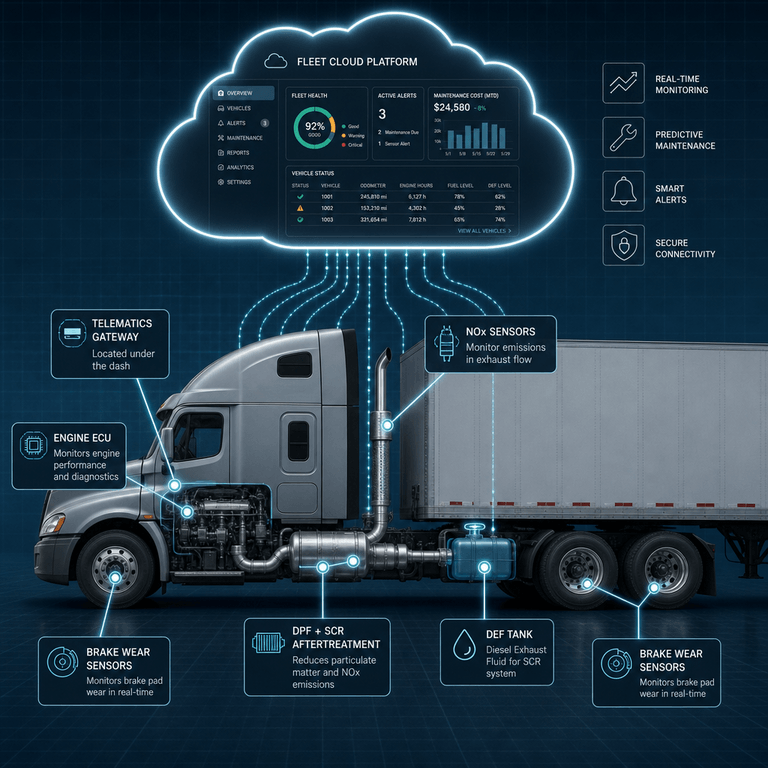
- Connected vehicle and engine diagnostics. Telematics devices read fault codes, DPF soot load, DEF quality and level, coolant temperature trends, and brake wear indicators directly from the vehicle's electronic systems.
- Maintenance history. Complete repair records reveal which components fail repeatedly on which units — the raw material for recurring defect analysis.
- Analytics and AI-assisted review. Rules, thresholds, and increasingly machine-learning models sift these inputs into ranked maintenance alerts, a topic we explore in depth in our guide to AI and analytics in fleet management.
What Predictive Maintenance Looks Like in a Real Fleet
Abstract definitions are less useful than examples, so here are four scenarios drawn from everyday trucking operations:
- DPF regeneration trending. Truck 214's regeneration frequency has crept from every 600 miles to every 280 miles over six weeks. Nothing is broken yet. A predictive program flags the trend, the shop finds a failing injector loading the filter with soot, and a $700 repair replaces what would have become a plugged DPF, a stressed turbocharger, and a tow.
- Recurring brake defects. Drivers have written up soft brake feel on the same trailer three times in five weeks; each time, the pads measured within limits and the unit went back out. Condition-based analysis of the recurring defect points to a slow air leak in a relay valve — found in the bay for the cost of an hour's labor instead of during a CVSA roadside inspection as an out-of-service violation.
- DEF system early warning. A DEF quality sensor starts intermittently flagging on cold mornings. Reactive fleets wait for the fault to harden. A predictive fleet schedules the sensor replacement with the next planned service, protecting the SCR catalyst and avoiding an unplanned road call.
- Coolant temperature drift. Engine data shows one tractor running ten degrees hotter than its identical siblings on the same routes. The pattern — invisible to any single driver — points to a degrading water pump months before failure.
Notice what these examples have in common: none of them requires exotic technology. They require structured data, collected consistently, and someone — or something — watching for patterns. That is why the foundation of predictive maintenance is not an algorithm. It is the daily inspection.
Why Digital DVIR Is the Foundation of Predictive Maintenance
Digital DVIR is the foundation of predictive maintenance because it converts the most frequent inspection event in trucking — the driver's daily walk-around — into structured, analyzable data. Telematics tells you what the engine's sensors can measure. Drivers catch everything else: the tire wearing unevenly, the air leak you can hear but no sensor reports, the marker lamp that keeps failing, the mudflap bracket cracking a little more each week.
On paper, those observations die in a filing cabinet. A paper DVIR is a legal record and nothing more; nobody can query 90 days of paper forms for "all brake-related write-ups on trailers 40 through 55." Digitized, the same observations become a longitudinal dataset. Here is what each element of a properly implemented digital DVIR contributes to maintenance forecasting:
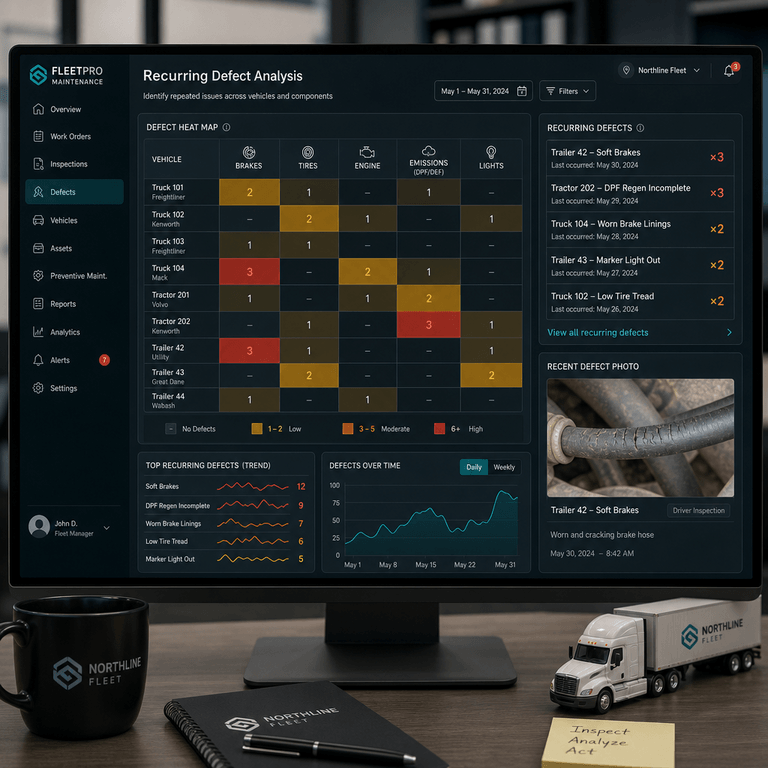
- Recurring defect tracking. When the same component on the same unit is written up repeatedly, that is a failure signature. Recurring defects are the single most accessible predictive signal available to small and mid-sized fleets — no hardware installation required.
- Inspection history. A complete, searchable timeline per vehicle turns anecdote ("that truck's always had electrical gremlins") into evidence (11 electrical write-ups in 6 months, 8 on the same circuit).
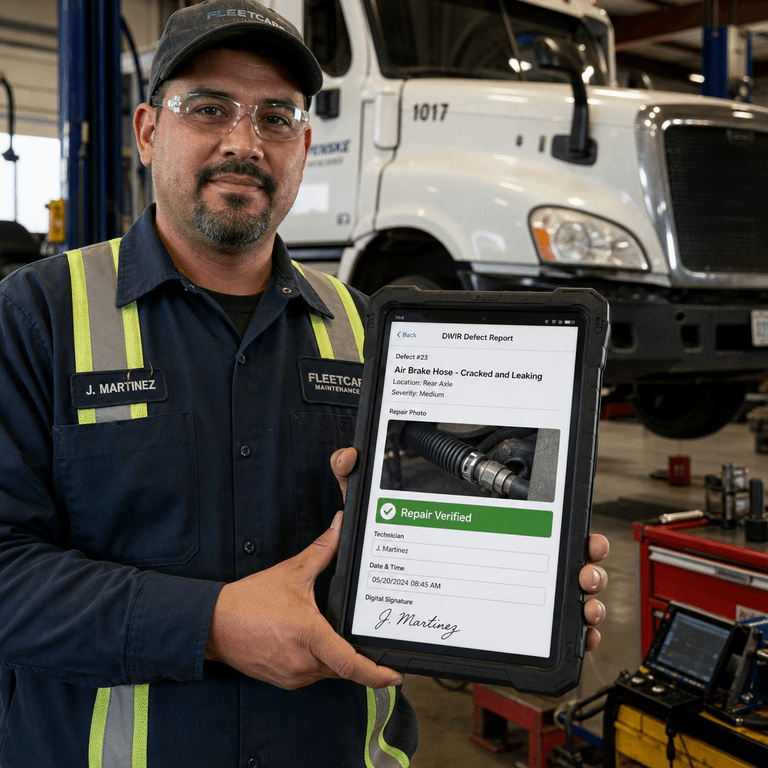
- Repair verification. Under 49 CFR 396.11, motor carriers must certify that reported defects have been repaired or that repair was unnecessary before the vehicle is dispatched again. Digital workflows enforce this loop — defect reported, repair certified, next driver acknowledges — closing the gap where paper systems quietly fail. We cover the mechanics in our guide to the FMCSA 396.11 driver signature rule.
- Timestamps and GPS verification. Time and location stamps prove an inspection actually happened where and when it should have — the antidote to pencil-whipped forms, and the difference between defensible records and liability during litigation or a DOT safety audit.
- Photo evidence. A photo of a cracked brake hose is worth more than a checkbox to the technician triaging the defect queue — and it documents the defect's severity progression if it recurs.
- Technician accountability. Digital repair sign-offs attach a name, a timestamp, and often photos to every completed repair, which makes repair quality auditable and surfaces comeback patterns.
The payoff compounds. After 90 days of digital inspections, a fleet can answer questions no paper system can touch: Which five vehicles generate the most defects per mile? Which defect categories are trending up? Which repairs keep coming back? Those answers are the inputs to maintenance forecasting — and they double as exactly the evidence FMCSA reviewers request during increasingly common off-site audits conducted through digital portals.
For emissions readiness specifically, the daily inspection is where fleets should already be standardizing checks on DEF level and visible leaks, exhaust smoke, warning lamps, and regeneration interruptions. Standardizing DPF, SCR, and DEF dosing system checks on daily electronic DVIRs catches blockages and faults before they trigger severe damage — a practice that becomes non-negotiable as the July 2026 proposal shifts fault response from automatic derates to dashboard alerts that only a disciplined process will act on.
Get the EPA 2027 Compliance Playbook
Want the condensed version of this article as a working document? pti4you.com's mixed fleet emissions and sensor maintenance playbook covers the daily inspection items, recurring defect workflows, and documentation practices that prepare a fleet for 2027-generation engines.
Request Your CopyDelivered by email. No credit card required.
Predictive Maintenance ROI: Reactive vs. Predictive, Line by Line
The business case for predictive maintenance does not rest on any single saving. It rests on the same fault costing dramatically different amounts depending on when you find it — multiplied across every cost category a fleet manages. The comparison below reflects the operational mechanics discussed throughout this article; your fleet's exact numbers depend on size, duty cycle, and current maintenance discipline, which is why we recommend running your own figures rather than trusting anyone's averages.
| Cost or Operational Factor | Reactive Maintenance | Predictive Maintenance |
|---|---|---|
| Repair costs | Failures found at the most expensive stage; cascade damage common (plugged DPF stressing the turbocharger, contaminated SCR catalyst) | Faults corrected as minor repairs at planned cost; cascade damage largely designed out |
| Downtime | Unplanned, multi-day, at the worst possible location; towing and diagnosis queues extend it | Planned, scheduled into route gaps; measured in hours in your own bay or preferred shop |
| Fuel economy | Silent losses from soot-loaded filters, dragging brakes, and underinflated tires persist for months | Efficiency-degrading conditions flagged by trend data and inspection write-ups, corrected early |
| Emergency repairs | Frequent; premium road-call labor rates, expedited parts, and tow bills | Rare; emergencies limited to genuinely unpredictable failures |
| Maintenance scheduling | Chaotic; shop capacity consumed by whatever broke last night | Forecasted weeks ahead from condition data; parts ordered in advance, bays booked deliberately |
| Inspection readiness | Roadside inspections are a gamble; defect backlogs surface as violations and out-of-service orders | Defects caught and closed daily; vehicles roll into CVSA inspections with clean, documented histories |
| Fleet availability | Unpredictable; spare ratio inflated to absorb surprise failures | Higher and stable; fewer spare vehicles needed to protect service commitments |
| Environmental performance | Degraded aftertreatment runs dirty long before it fails; emissions faults linger unaddressed | Emissions components maintained at design performance; compliance is a byproduct of the process |
| Administrative workload | Paper chase after every failure; records assembled manually under audit pressure | Documentation generated automatically as work happens; audit responses take hours, not weeks |
| Technician efficiency | Diagnosis starts from zero at the worst moment; comebacks are invisible until they recur | Technicians start with defect history, photos, and fault context; comeback patterns are tracked and fixed |
Two rows deserve emphasis for the EPA 2027 context. First, environmental performance: a predictive fleet is compliant as a side effect of running well, which means the 2027 transition adds inspection items to an existing process rather than requiring a new one. Second, administrative workload: as FMCSA leans further into data-driven oversight — including the maintenance-related scoring changes discussed in our analysis of the Vehicle Maintenance: Driver Observed category — fleets with structured maintenance records hold a durable advantage over fleets reconstructing history from paper.
Fleet Maintenance Software Compared: Fleetio, Motive, Samsara, Whip Around, Geotab
Predictive maintenance is a process, but software determines whether the process is sustainable. The platforms below dominate the commercial fleet maintenance conversation in 2026. Each takes a different path to the same goal, and the right choice depends heavily on fleet size, whether you run an in-house shop, and how much hardware you are willing to install and manage. Pricing is noted only where vendors publish it; Motive, Samsara, and Geotab quote pricing through sales channels rather than publicly.
| Platform | Core Strength | Predictive Capability | Hardware Requirement | Pricing Transparency | Best Fit |
|---|---|---|---|---|---|
| Fleetio | Maintenance management system of record | Threshold and interval automation; diagnostics via telematics integrations | None (integrates with telematics providers) | Public tiered per-vehicle pricing on its website | Fleets with in-house shops and parts inventory |
| Motive | All-in-one telematics, ELD, and safety | Fault code monitoring and maintenance alerts from its vehicle gateway | Proprietary vehicle gateway; optional AI dashcams | Quote-based | Fleets already committed to the Motive ecosystem |
| Samsara | Enterprise connected-operations platform | Deep engine diagnostics, fault alerting, and maintenance analytics | Proprietary vehicle gateways and sensors | Quote-based | Larger fleets with dedicated ops and IT resources |
| Whip Around | Inspection-first DVIR and defect workflows | Defect-driven; predictive value depends on inspection data quality | None (driver mobile devices) | Public per-asset pricing on its website | Compliance-focused small and mid-sized fleets |
| Geotab | Open telematics and vehicle data platform | Extensive engine data, fault rules, and analytics add-ins | GO telematics device | Sold through resellers; quote-based | Data-driven fleets wanting maximum diagnostic depth |
Fleetio
Fleetio is the closest thing this market has to a dedicated computerized maintenance management system for fleets. Preventive maintenance scheduling by date, mileage, or engine hours is mature; work orders, parts inventory, and vendor management are genuine strengths; and failed inspection items convert automatically into issues and work orders. Its reporting on cost per mile and total cost of ownership is among the best in class, and it integrates with major telematics providers — including Geotab, Samsara, and Motive — to pull odometer readings and fault codes. Its limitation is the mirror of its strength: Fleetio is not a telematics company, so live vehicle diagnostics depend on integrations, and its "predictive" layer is primarily well-executed threshold automation rather than modeling. Best use case: fleets with in-house maintenance operations that want a deep system of record.
Motive
Motive pairs a proprietary vehicle gateway with an all-in-one operations platform spanning ELD compliance, AI dash cams, fuel management, and maintenance. Its maintenance module reads fault codes directly from the vehicle, generates alerts, and ties into driver DVIRs completed in the same app drivers already use for hours of service — a real workflow advantage. Reporting is strong across safety and compliance. The trade-offs are structural: hardware installation across the fleet, quote-based pricing typically attached to multi-year terms, and a breadth of features that smaller fleets often pay for without using. Best use case: fleets that want telematics, compliance, and maintenance from a single vendor and accept the contract structure that comes with it.
Samsara
Samsara is the enterprise benchmark for connected fleet operations. Its vehicle gateways stream rich engine diagnostics, its maintenance tooling turns fault codes and usage data into scheduled work, and its dashboards and open API support sophisticated analytics — the raw material for genuinely predictive programs at scale. DVIR workflows are built into the driver app. The considerations for the 5–500 vehicle segment are cost and complexity: proprietary hardware, quote-based multi-year agreements, and a platform whose full value assumes administrative bandwidth that small operations rarely have. Best use case: larger fleets consolidating safety, telematics, and maintenance onto one enterprise platform. For a deeper look at how these vendors compare for smaller operations, see our Whip Around vs. Motive vs. Samsara small fleet comparison.
Whip Around
Whip Around approaches maintenance from the inspection side. Drivers complete customizable digital DVIRs on their phones; failed items flow into defect and work order queues; and its maintenance module handles service scheduling and reminders. It publishes per-asset pricing publicly and requires no hardware, which keeps adoption friction low for small fleets. Its limitation is diagnostic depth: without native telematics, its predictive value rises and falls with the quality and honesty of inspection inputs, and fleets wanting engine-data-driven forecasting will need to pair it with a telematics source. Best use case: small and mid-sized fleets whose first priority is inspection compliance and defect workflow discipline.
Geotab
Geotab is fundamentally a vehicle data platform. Its GO device captures arguably the industry's deepest stream of engine and diagnostic data, its rules engine turns that stream into alerts, and its marketplace of add-ins extends the platform into maintenance, DVIR, and analytics territory — including predictive tooling built on its large connected-vehicle dataset. It is sold through a reseller network, so pricing and support experience vary by partner. The limitation for smaller fleets is assembly: maintenance workflows and inspections arrive via add-ins rather than one integrated product, and getting full value requires someone who enjoys configuring a data platform. Best use case: fleets that want maximum diagnostic visibility and are comfortable building their stack.
What the Comparison Misses
Every platform above assumes the hard part — consistent, trustworthy inspection data — already exists. It usually does not. Fleets that jump straight to telematics-driven maintenance while their daily inspections remain pencil-whipped paper forms build analytics on sand: the engine data arrives clean, but the human-observed defects that predict brake, tire, coupling, and body failures never enter the system. That gap is where pti4you.com fits.
Why pti4you.com Is the Foundation Layer for Predictive Fleet Maintenance
pti4you.com is a hardware-agnostic digital inspection and compliance platform built for exactly the fleets this article addresses: 5 to 500 vehicles, operating in the United States and Canada, without enterprise IT departments or 36-month contract appetites. It does not try to be your telematics provider. It does the foundational job — turning inspections into structured maintenance intelligence — and does it without proprietary gateways, installation projects, or opaque pricing.
For a fleet building toward predictive maintenance ahead of EPA 2027, that translates into specific capabilities:
- Digital DVIR on any device. Drivers complete DOT-compliant pre-trip and post-trip inspections on the phones they already carry, with timestamps, GPS verification, and photo evidence attached to every defect — the data quality that makes recurring defect analysis possible.
- Customizable inspection templates. Add emissions-focused items — DEF level and leaks, exhaust warning lamps, regeneration interruptions, visible smoke — to daily checklists today, so your data history is already months deep when 2027-generation trucks arrive. Templates flex across mixed fleets running diesel and electric vehicles alike.
- Recurring defect tracking. The platform surfaces repeat write-ups by vehicle and component, converting driver observations into the failure signatures that predictive scheduling depends on.
- Repair documentation and verification. Defects flow to mechanics, repairs are certified with technician sign-off, and the 396.11 signature loop closes digitally — no defect silently dispatched, no repair unverified.
- Maintenance history and visibility. Every inspection, defect, and repair lives in one searchable timeline per vehicle, giving maintenance managers the trend visibility that spreadsheets and filing cabinets structurally cannot provide.
- Cloud record storage and audit readiness. Records are retained, organized, and exportable on demand — the difference between a stressful week and a routine afternoon when a DOT auditor or an off-site FMCSA review requests your maintenance files.
- Compliance reporting. Inspection completion rates, defect resolution times, and vehicle histories compile into reports fit for safety managers, executives, and auditors.
Every predictive maintenance strategy begins with accurate inspection data. pti4you.com transforms digital DVIRs into actionable maintenance intelligence, helping fleets reduce downtime while preparing for tomorrow's environmental regulations.
The sequencing matters. A fleet that digitizes inspections this quarter will have a year of structured defect and repair history before the first model year 2027 trucks reach its yard — which means its maintenance planning for the new emissions hardware starts from evidence, not guesswork. The new environmental reality demands new maintenance precision. Leave the paper clipboards in the past, and let the data you already generate every morning start paying for itself.
EPA 2027 Fleet Readiness Checklist
Preparation for EPA 2027 does not begin with a truck order. It begins with ten process steps, most of which pay for themselves regardless of what the final amendment rule says:
- Digitize inspections. Replace paper DVIRs with digital inspections that capture timestamps, GPS, and photos — the foundation every later step builds on.
- Track maintenance history. Consolidate every service, repair, and part into one searchable record per vehicle.
- Record recurring defects. Flag repeat write-ups by component and unit; treat every recurrence as a forecast, not a coincidence.
- Verify completed repairs. Enforce the defect-repair-certification loop required by 49 CFR 396.11, with technician sign-off on every closed defect.
- Schedule preventive maintenance. Run interval-based service on time as the baseline; predictive refinement layers on top of a working preventive maintenance program, not instead of one.
- Monitor emissions-related components. Add DPF, DEF, SCR, and EGR checks to daily inspection templates and watch regeneration and dosing trends.
- Centralize documentation. Move maintenance records, inspection reports, and repair evidence into cloud storage that survives personnel changes and satisfies auditors.
- Analyze maintenance trends. Review defect rates, downtime causes, and cost per vehicle quarterly; let the data pick your next process improvement.
- Prepare compliance reports. Test how fast you can produce a complete maintenance file for any vehicle — that speed is your audit readiness.
- Continuously improve maintenance planning. Feed what breakdowns and comebacks teach you back into inspection templates and service intervals every quarter.

Frequently Asked Questions About EPA 2027 and Predictive Maintenance
What is EPA 2027?
EPA 2027 refers to the EPA final rule "Control of Air Pollution from New Motor Vehicles: Heavy-Duty Engine and Vehicle Standards," adopted in December 2022. It requires heavy-duty engines beginning with model year 2027 to meet NOx limits more than 80% stricter than previous standards — 0.035 g/hp-hr in normal operation — across a wider range of operating conditions, including low-load and idle. In July 2026, EPA proposed amendments that keep the NOx standard but would scale back extended warranty and useful-life provisions.
Will EPA 2027 affect existing trucks?
No. The EPA 2027 standards apply to newly manufactured engines beginning with model year 2027, not to trucks already in service. Existing vehicles remain subject to the standards in effect when they were built, plus ongoing federal maintenance requirements under 49 CFR Part 396. The practical effect on existing fleets is indirect: purchase timing decisions, mixed-fleet maintenance complexity as new engines arrive, and rising expectations for maintenance documentation.
What is predictive fleet maintenance?
Predictive fleet maintenance uses vehicle data — digital inspection results, engine diagnostics, sensor readings, and maintenance history — to forecast component failures and schedule repairs before breakdowns happen. Unlike preventive maintenance, which services components on fixed intervals, predictive maintenance bases decisions on each vehicle's actual condition and defect patterns, reducing both premature part replacement and unexpected failures.
How does predictive maintenance reduce operating costs?
Predictive maintenance reduces operating costs by catching faults at their cheapest stage. It converts emergency road calls into planned shop visits, prevents cascade damage such as a plugged DPF destroying a turbocharger, recovers fuel economy lost to degraded components, reduces the spare vehicles needed to cover surprise downtime, and cuts the administrative cost of reconstructing records for audits. The same fault can differ in total cost by an order of magnitude depending on when it is found.
Does digital DVIR improve maintenance planning?
Yes. Digital DVIRs turn daily driver inspections into structured, searchable data: recurring defects by vehicle and component, complete inspection histories, verified repairs, timestamps, GPS confirmation, and photo evidence. That dataset reveals failure patterns weeks or months before breakdowns, feeds maintenance forecasting, and simultaneously produces the audit-ready documentation FMCSA reviewers request — none of which is practical with paper forms.
Which fleet software supports predictive maintenance?
Fleetio, Motive, Samsara, Whip Around, and Geotab all support elements of predictive maintenance, with different emphases: Fleetio leads in maintenance management workflows, Samsara and Geotab in engine diagnostics depth, Motive in all-in-one telematics integration, and Whip Around in inspection-driven defect workflows. pti4you.com provides the foundation layer — hardware-free digital DVIRs, recurring defect tracking, repair verification, and centralized maintenance records — that predictive programs are built on, particularly for fleets of 5 to 500 vehicles.
How can fleets prepare before EPA 2027?
Fleets should prepare by building maintenance data discipline now: digitize daily inspections, add emissions-system checks (DPF, DEF, SCR) to inspection templates, track recurring defects, verify every repair, centralize maintenance records in the cloud, and review trend reports quarterly. Fleets that start in 2026 will have a full year of structured vehicle history before model year 2027 trucks arrive — turning the transition into a data-informed process instead of a gamble.
The Regulations Are Coming. The ROI Is Already Here.
Strip away the docket numbers and the story of EPA 2027 is simple. Emissions hardware is getting more complex and staying that way. Warranty protection may get shorter, not longer. Automatic derates that once forced fleets to address DEF faults may become polite dashboard suggestions. In every version of that future, the fleets that win are the ones whose maintenance decisions run on data — and the fleets that lose are the ones still running on clipboards, spreadsheets, and mechanical intuition.
The good news is that nothing about predictive maintenance requires waiting for 2027, a new truck order, or a hardware installation project. It requires structured inspection data, a closed repair loop, and the discipline to act on trends. Those capabilities cut repair costs, downtime, and audit stress from the first quarter you use them. The regulatory readiness comes along for free.
Future-proof your mixed fleet. Start scheduling compliant, data-driven maintenance today — book a pti4you.com demo and see how digital inspections become predictive maintenance intelligence, or start your 15-day free trial and have your first structured inspection data flowing this week.
Turn Daily Inspections into Predictive Maintenance Intelligence
See how pti4you.com converts digital DVIRs into recurring defect insights, verified repairs, and audit-ready maintenance records — before EPA 2027 raises the stakes.
Start your 15-day free trial today. No credit card required.
Book a Demo of PTI4YOUZero setup fees. Zero hardware. 25-minute driver onboarding.
Official Sources and Further Reading
- EPA — Final Rule: Control of Air Pollution from New Motor Vehicles: Heavy-Duty Engine and Vehicle Standards (December 2022)
- EPA — Fact Sheet: Proposed Amendments and Nonconformance Penalties for MY 2027 and Later Heavy-Duty Highway Engines (July 2026, EPA-420-F-26-012)
- EPA — Public Hearing and Comments: MY 2027 Heavy-Duty Engine Amendments (Docket EPA-HQ-OAR-2026-0728)
- eCFR — 49 CFR Part 396: Inspection, Repair, and Maintenance
- FMCSA — Compliance, Safety, Accountability (CSA) Safety Measurement System
- Commercial Vehicle Safety Alliance (CVSA)
This article summarizes regulatory information available as of August 15, 2026, for general guidance. EPA's July 2026 proposed amendments were not final at publication; fleets should verify current requirements against official EPA and FMCSA sources before making compliance decisions.