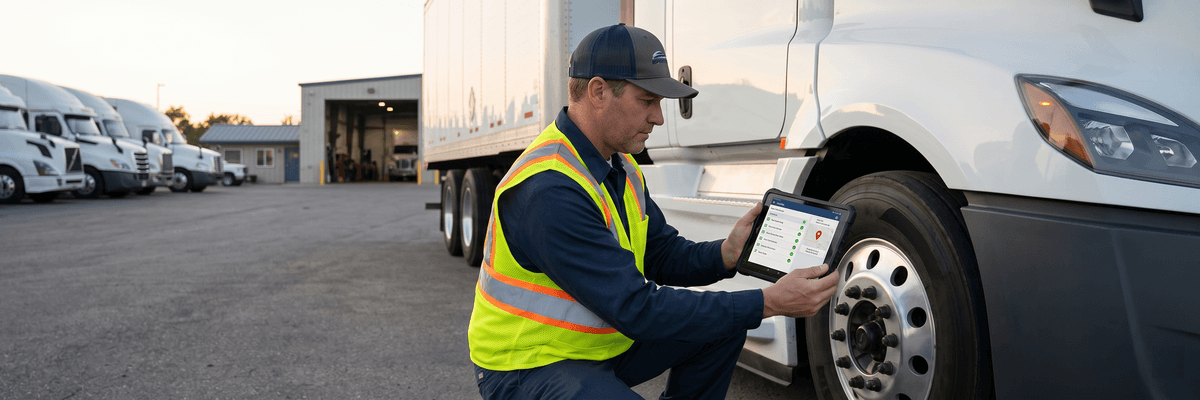
Key Takeaways for Fleet Operators
- Definition: Pencil whipping means signing a DVIR without performing the physical walkaround. It is federally classified as record falsification under 49 CFR 390.35.
- Root causes are systemic: Pay-per-mile compensation, maintenance backlogs, weather, and repetitive task fatigue drive drivers to skip inspections — not malice.
- Paper cannot verify itself: Carbon-copy inspection pads have zero accountability. No GPS, no timestamps, no photos, no audit trail.
- Digital DVIR creates proof: GPS geofencing, mandatory photo uploads, minimum duration enforcement, and digital signatures make it physically impossible to fake an inspection.
- 2026 enforcement is real: The FMCSA Final Rule (FMCSA-2025-0115, effective March 2026) codifies electronic DVIRs with cryptographic digital signatures. The 2026 CSA scoring methodology now double-weights "Driver Observed" defects.
- Cost of inaction: Pencil whipping leads to roadside breakdowns, Out-of-Service orders, DOT fines, catastrophic CSA damage, and nuclear verdicts exceeding $10M.
1. Introduction: The Inspection Accountability Crisis
Pencil whipping means completing or signing a required inspection document — such as a Driver Vehicle Inspection Report (DVIR) — without actually performing the physical safety checks the form demands. In trucking, it is the act of a driver rapidly checking every box on a pre-trip or post-trip form and signing it while the truck sits uninspected. This practice violates 49 CFR 390.35, masks mechanical defects that cause roadside breakdowns and crashes, and exposes motor carriers to DOT fines, CSA downgrades, and multi-million-dollar litigation.
Every commercial motor vehicle operating in the United States and Canada requires a documented safety inspection before it leaves the yard. The federal regulations are clear: 49 CFR § 396.13 mandates a pre-trip review, and 49 CFR § 396.11 requires a post-trip report documenting any defects. The intent is straightforward: catch broken brakes, bald tires, inoperative lights, and faulty coupling devices before they endanger the driver, the public, and the carrier's operating authority.
Yet across the industry, fleet safety managers know that a significant percentage of DVIRs are completed without the driver ever leaving the cab. The result is a compliance system built on trust — and trust, without verification, is not compliance. It is liability.
This guide examines why pencil whipping persists, what it actually costs carriers in operational dollars and legal exposure, why paper-based systems are inherently vulnerable, and how digital inspection technology creates the verification layer that paper cannot provide. We also compare leading DVIR software platforms and explain why accountability-focused solutions like pti4you.com are purpose-built for small and mid-sized fleets that need compliance without enterprise complexity.
2. What Is Pencil Whipping? Definition and Origin
In the commercial trucking industry, pencil whipping means a driver signs their Driver Vehicle Inspection Report (DVIR) — whether pre-trip or post-trip — without physically inspecting brakes, tires, coupling devices, lights, or other critical components. The term comes from the speed at which the pen moves through the checkboxes, as if the driver is "whipping" the pencil across the page.
The phrase originated in military and aviation maintenance contexts, where technicians were required to sign off on detailed equipment checklists. When time pressure or complacency led someone to sign without inspecting, the rapid pen motion through the form became known as "pencil whipping." The behavior migrated into commercial transportation as the DOT expanded mandatory inspection documentation requirements for motor carriers.
A typical Class 8 tractor-trailer has over 50 inspection points that require physical verification during a thorough walkaround: tire tread depth measured with a gauge, air brake static and applied pressure tests, visual inspection of brake drums and slack adjusters, fifth-wheel locking jaw engagement confirmed with a flashlight, lighting and reflector operability, fluid levels, windshield condition, coupling device integrity, and emergency equipment presence. A qualified driver performing this inspection properly needs 15 to 20 minutes. A pencil-whipped inspection takes 15 seconds.
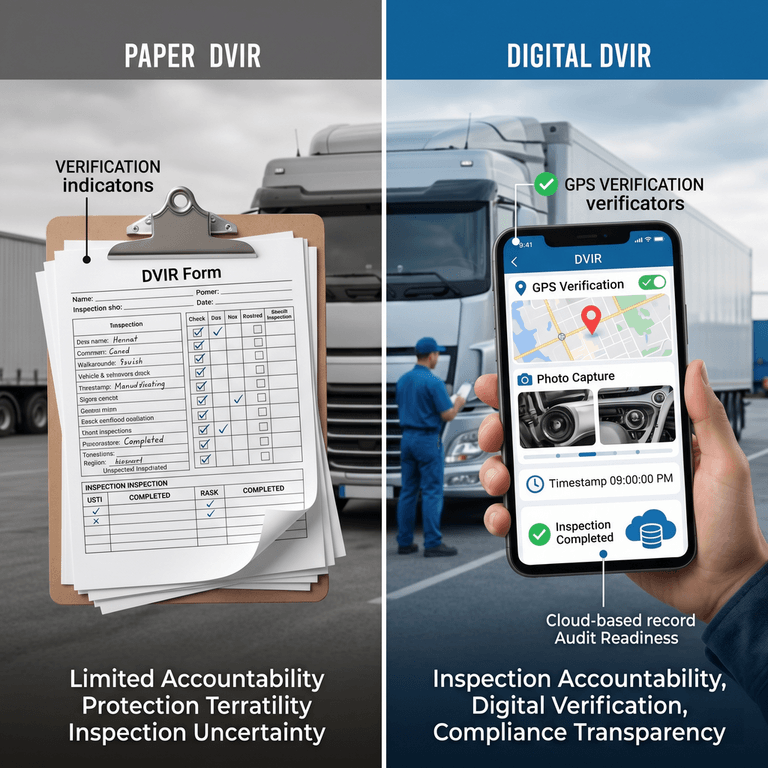
A paper DVIR with blind checkmarks offers zero verification, while a digital inspection app enforces GPS location, photo evidence, and time tracking.
The distinction between pencil whipping and a genuine inspection failure matters legally. Pencil whipping is not an accidental oversight — it is intentional falsification of a federally mandated safety record. Under 49 CFR § 390.35, no motor carrier, its agents, or employees shall make or cause to be made a fraudulent or intentionally false entry on any application, certificate, report, or record required by FMCSA regulations. A pencil-whipped DVIR meets that definition precisely.
3. Why Drivers Skip Safety Inspections
Understanding the root causes of pencil whipping is essential for designing solutions that actually work. Drivers rarely falsify inspections out of malice. They do it because the operational environment creates powerful incentives to cut corners:
Time pressure and pay structure
The majority of over-the-road (OTR) commercial drivers are compensated per mile, not per hour. Every minute spent in the yard conducting a thorough walkaround is a minute not generating revenue. When a driver faces a tight delivery window, a backed-up dispatch queue, and a ticking Hours of Service (HOS) clock, the 20-minute inspection feels like an unpaid tax on their income. The economic incentive to skip the inspection and start driving is real and persistent.
Maintenance downtime fear
In many fleet operations, reporting even a minor defect — a flickering clearance light, a slow air leak, a worn wiper blade — means the truck enters a repair queue. Depending on the shop's backlog, that driver may sit idle in the terminal for hours or even days waiting for a $15 part. Drivers quickly learn that reporting defects costs them loads. The rational (if dangerous) response is to ignore minor issues and hope they survive until the next scheduled maintenance window.
Environmental friction
A thorough walkaround requires crawling under the trailer with a flashlight to check the fifth wheel, kneeling on asphalt to inspect brake components, and walking the full length of a 53-foot trailer. In January in Minnesota at 5:00 AM with wind chill at -20°F, or in August in Phoenix at 110°F, the physical discomfort of that task is extreme. When the alternative is sitting in an air-conditioned cab and drawing a line through checkboxes, the temptation is obvious.
Repetitive task fatigue and complacency
A driver operating the same dedicated route in a well-maintained, late-model truck who completes 200 consecutive inspections with zero defects develops a psychological certainty that defects do not exist. The inspection becomes muscle memory — a rote administrative task stripped of its safety purpose. This complacency is the most dangerous catalyst because it affects even conscientious drivers.
Fleet culture and accountability gaps
If a fleet's safety management does not actively review DVIRs, does not follow up on anomalies, and does not reward thorough inspections, drivers receive a clear implicit message: nobody is watching. Paper-based systems reinforce this dynamic because management has no real-time visibility into inspection quality. The DVIRs go into a filing cabinet and are never reviewed until an auditor or an attorney requests them.
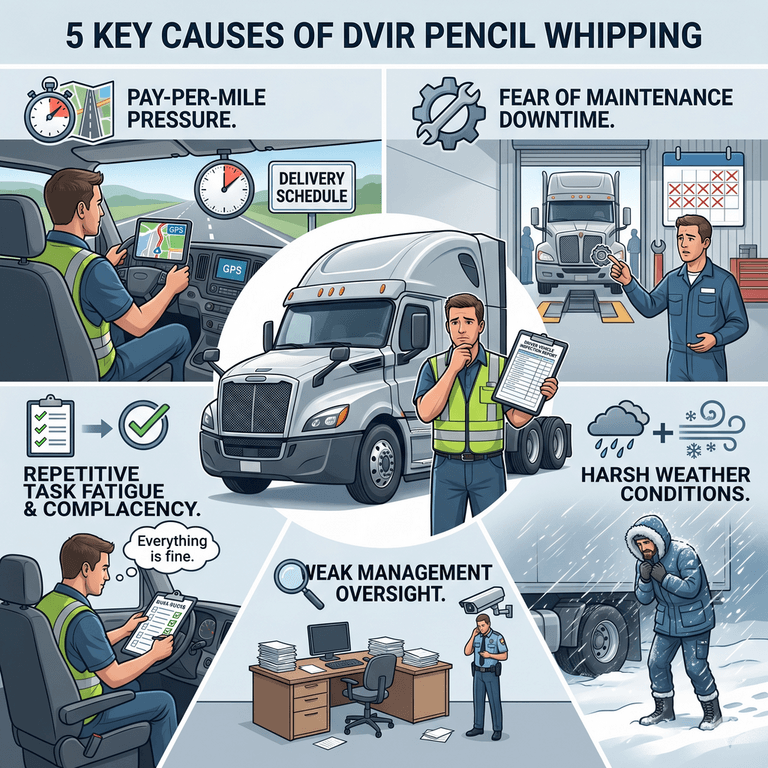
Five systemic factors drive drivers to pencil whip inspections: pay-per-mile pressure, maintenance downtime fear, harsh weather, repetitive task fatigue, and weak management oversight.
4. The Hidden Costs of Pencil Whipping
Fleet owners who tolerate pencil whipping often underestimate the operational damage until a catastrophic event forces a reckoning. The hidden costs extend far beyond regulatory fines:
Roadside breakdowns and emergency repairs
A frayed alternator belt caught during a 15-minute pre-trip costs $40 and 30 minutes in the shop. That same belt snapping on Interstate 80 in Wyoming triggers a $600 mobile mechanic call, a $300 tow, 8 hours of driver downtime, a missed delivery, a freight claim, and a customer relationship that may never recover. Pencil whipping converts cheap preventive maintenance into expensive reactive emergencies.
Out-of-Service orders and CSA damage
When a roadside inspector finds a bald steer tire, inoperative brake lights, or an audible air leak on a truck that was supposedly inspected that morning, the vehicle receives an Out-of-Service (OOS) order. Under the 2026 CSA methodology, these "Driver Observed" defects carry double severity weight because they represent failures a driver should have caught during a proper walkaround. Each OOS event damages the fleet's safety score, increases the probability of targeted interventions, and raises insurance premiums.
DOT violations and civil penalties
Falsifying a DVIR violates 49 CFR 390.35. Civil penalties for record falsification can run thousands of dollars per occurrence. More critically, a single falsification finding gives the auditor probable cause to expand the audit scope, pulling months of records and uncovering additional violations that compound the financial damage.
Insurance premium increases
Commercial auto insurers in 2026 increasingly require telematics and electronic inspection systems as conditions of preferred coverage. Insurers understand that paper DVIRs cannot be trusted. Fleets operating on paper with poor CSA scores face premium surcharges, coverage exclusions, or outright non-renewal. The insurance market is pricing pencil whipping risk into every policy.
Nuclear verdicts and litigation exposure
If a truck involved in a serious crash has pencil-whipped DVIRs, plaintiff attorneys will use those documents as the centerpiece of a negligence case. The "Reptile Theory" litigation strategy argues that the carrier knowingly endangered the public by tolerating fraudulent safety records. Juries respond to this argument with punitive damages that regularly exceed $10 million. A single nuclear verdict can bankrupt a small fleet. Timestamped, GPS-verified digital inspection records are the strongest defense against this outcome.
Customer and contract loss
Major shippers increasingly require carriers to demonstrate active safety technology and digital compliance programs as a condition of doing business. A fleet that cannot produce verifiable inspection records loses access to premium freight lanes, high-value contracts, and long-term partnerships with quality-focused shippers.
5. How Pencil Whipping Creates Compliance Risks
The FMCSA's enforcement framework treats DVIRs as legally binding safety documents. When those documents are falsified, the compliance consequences cascade through multiple regulatory systems:
FMCSA recordkeeping requirements
Under 49 CFR § 396.11, motor carriers must retain all original DVIRs, mechanic repair certifications, and reviewing-driver signatures for a minimum of 90 days. During a compliance review or safety audit, DOT investigators pull these 90-day files and examine them forensically. They look for "straight-lined" checkboxes, identical handwriting across different dates, pristine paper that should show yard grime, and timestamps that conflict with ELD data.
How investigators identify suspicious records
DOT auditors are trained forensic examiners. Their detection methods include:
- ELD cross-referencing: If the DVIR timestamp shows 7:00 AM but the ELD records the truck shifting into drive at 7:02 AM, a 50-point inspection in two minutes is physically impossible.
- Toll and fuel receipt comparison: If a post-trip DVIR is timestamped at the terminal at 5:00 PM but a fuel receipt shows the driver 40 miles away at 5:05 PM, the record is fraudulent.
- Pattern analysis: A month of DVIRs written with the same pen, same ink pressure, and identical signature styling suggests batch-filling — writing an entire month of inspections in one sitting.
- Zero-defect anomalies: If a fleet's DVIRs show zero defects across all trucks for 90 consecutive days, while their CSA profile shows tire and lighting violations at roadside, the inspection records are not credible.
2026 CSA scoring impact
The 2026 CSA restructuring created a new "Driver Observed" subcategory within the Vehicle Maintenance BASIC. This category isolates defects a driver should have caught during a proper walkaround — bald tires, inoperative exterior lighting, audible air leaks, broken reflectors. These violations now carry double severity weight and trigger immediate OOS orders. The strategic intent is to directly penalize pencil whipping by punishing the gap between what the driver certified and what the roadside inspector found. For a complete breakdown, see our guide on the FMCSA Driver Observed maintenance category.
Legal liability after accidents
When a crash occurs, every DVIR for that truck becomes discovery material. If plaintiff attorneys find pencil-whipped records — or worse, missing records where the carrier claims "lost paperwork" — they argue spoliation of evidence. This legal doctrine allows juries to infer that the destroyed or missing evidence would have been unfavorable to the carrier. Combined with Reptile Theory framing, this creates a litigation environment where settlements and verdicts routinely destroy small carriers financially.

DOT auditors cross-reference DVIR timestamps against ELD data, fuel receipts, and toll records to identify falsified inspection reports.
6. Why Paper DVIR Systems Enable Pencil Whipping
Paper inspection forms are fundamentally trust-based documents with zero verification capability. A carbon-copy pad cannot tell you where the driver was standing when they signed it, how long the inspection took, whether they actually looked at the truck, or whether the photos they claim to have in their head match reality. Paper actively enables pencil whipping through several structural weaknesses:
- No location verification: A paper form signed in the cab is indistinguishable from one signed next to the truck. There is no GPS data to confirm the driver was physically present at the vehicle.
- No time tracking: Paper records the time the driver writes down, not the actual duration of the inspection. A driver can write "7:00 AM – 7:20 AM" while actually signing the form at 7:01 AM.
- No photo evidence: Paper cannot capture visual proof that the driver examined specific components. It relies entirely on the checkmark.
- "Straight-lining" vulnerability: Drivers can draw a single vertical pen stroke down the entire checkbox column in one motion, certifying 50 items in one second.
- Batch-filling: Drivers can pre-fill an entire week or month of inspection forms on a single day, using the same pen and handwriting, then submit them as if completed daily.
- Lost and damaged records: Paper gets stained with diesel, blows out of trucks, gets crumpled into glove boxes, and disappears from filing cabinets. Missing records during an audit are treated as compliance violations.
- No real-time visibility: Management cannot see inspection data until the paper physically arrives at the office — which may be days or weeks later. By then, dangerous conditions have already been on the road.
The FMCSA recognized these limitations with the Final Rule (Docket No. FMCSA-2025-0115), effective March 23, 2026, which explicitly codifies electronic DVIRs with cryptographic digital signatures under E-SIGN and GPEA. While paper remains legally permissible, the regulatory direction is unambiguous: electronic records are the standard for demonstrating compliance credibility. For a full cost breakdown, see our paper vs. electronic DVIR hidden cost calculator.
7. How Digital DVIR Technology Stops Pencil Whipping
Digital inspection software does not just digitize the form — it enforces the physical reality of the walkaround. Technology creates a verification layer that paper structurally cannot provide.
Modern electronic DVIR software eliminates pencil whipping by combining multiple verification mechanisms into a single inspection workflow:
-
GPS Geofencing and Location Verification
When a driver initiates an inspection on their smartphone, the app reads the device's GPS coordinates and compares them against the vehicle's known location or terminal geofence. If the driver is sitting in the breakroom 300 yards from the truck, the app blocks the inspection from starting. The driver must be physically next to the vehicle to proceed. This single feature eliminates the most common form of pencil whipping: signing the form from the cab or the office.
-
Minimum Duration Enforcement
The system timestamps the exact second the inspection starts and ends. Fleet managers configure a minimum time threshold — typically 12 to 15 minutes for a standard tractor-trailer walkaround. If a driver attempts to submit a 50-item inspection in 45 seconds, the app rejects the submission, flags the attempt, and sends an immediate alert to the safety manager. Time-on-task enforcement makes speed-running physically impossible.
-
Mandatory Live Photo Captures
The app can be configured to require live, in-app photographs of critical safety items: steer tire tread depth, brake components, fifth-wheel connection, lighting operability, and fluid levels. Critically, robust platforms disable camera-roll uploads — the driver cannot submit a photo taken three weeks ago. They must take a fresh photo in real-time, within the app, proving they physically looked at that component. This is the ultimate counter to pencil whipping.
-
Randomized Inspection Checklists
To combat muscle-memory tapping — where a driver memorizes the screen layout and taps the same spots without reading — advanced platforms randomize the order of inspection items daily. Today, tires are first; tomorrow, lights lead. This cognitive disruption forces the driver to engage with each prompt individually rather than blindly tapping through a familiar sequence.
-
Authenticated Digital Signatures
Paper signatures are easily forged, often illegible, and difficult to verify in court. Electronic systems require secure login authentication — PIN, biometric fingerprint, or face recognition — before the final signature can be applied. Under the 2026 FMCSA Final Rule, these cryptographic digital signatures carry the same legal weight as wet ink signatures, while providing far stronger audit-trail integrity.
-
Real-Time Defect Routing and Alerts
When a driver reports a genuine defect, the system instantly creates a digital work order, routes it to the maintenance team with photos and descriptions, and initiates the FMCSA 396.11 three-signature cycle (driver → mechanic → next driver) entirely within the cloud. No paper gets lost in the cab. No defect goes unreported because the driver couldn't find a mechanic.
-
Anomaly Detection and Manager Dashboards
Fleet safety managers receive real-time visibility into every inspection across the fleet. Dashboards flag anomalies: rushed inspections, zero-defect streaks that exceed statistical probability, GPS mismatches, and photo uploads that appear suspiciously similar across multiple days. This management visibility transforms the safety director from a paper-filing clerk into an active compliance enforcer.
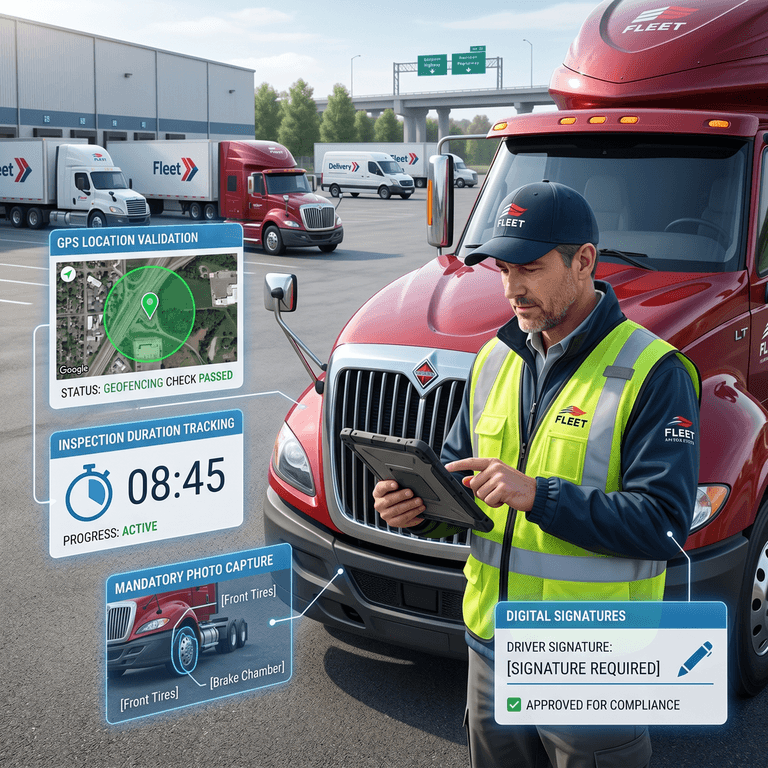
Digital DVIR verification combines GPS geofencing, minimum duration enforcement, mandatory photo captures, and authenticated digital signatures into one tamper-proof workflow.
8. DVIR Software Comparison: Whip Around vs. Motive vs. Samsara
Several platforms offer digital DVIR capabilities. Understanding their strengths and limitations helps fleet managers make informed decisions based on fleet size, budget, and accountability priorities. For a deeper head-to-head analysis, see our full Whip Around vs. Motive vs. Samsara comparison.
Whip Around
Whip Around is a standalone inspection and maintenance platform designed for fleet operators who need digital forms without committing to a full telematics ecosystem. It offers customizable inspection templates, photo capture, defect management workflows, and reporting dashboards.
- Strengths: Highly flexible form builder, strong photo documentation, maintenance tracking, and a focused inspection-first design philosophy.
- Limitations: Does not include native ELD or telematics hardware. Fleets needing GPS location verification must rely on smartphone GPS rather than vehicle-mounted hardware. Pricing can escalate for larger fleets needing advanced analytics.
- Best for: Mid-sized fleets that already have a separate ELD/telematics provider and need a purpose-built inspection tool.
Motive (formerly KeepTruckin)
Motive provides an integrated platform combining ELD compliance, GPS tracking, dashcams, and DVIR functionality. The inspection module is part of a broader fleet management suite.
- Strengths: Deep telematics integration, AI-powered dashcam analysis, driver safety scoring, and a mature ELD compliance workflow.
- Limitations: The DVIR module is often secondary to the ELD and camera features. Inspection customization may be limited compared to inspection-first platforms. Hardware costs (cameras, ELD devices) add to the total investment. Small fleets may find the platform oversized for their needs.
- Best for: Larger fleets that want a unified telematics-plus-inspection platform and can absorb the hardware and subscription costs.
Samsara
Samsara offers a comprehensive IoT platform for fleet management, including ELD, GPS, dashcams, temperature monitoring, and digital DVIR forms. It targets enterprise and large fleet operations.
- Strengths: Enterprise-grade data platform, deep API integrations, strong hardware ecosystem, and advanced analytics across safety, fuel, maintenance, and compliance.
- Limitations: Enterprise pricing makes it cost-prohibitive for many small and mid-sized fleets. The inspection workflow is one module within a large platform, which can feel complex for operators who primarily need accountability-focused DVIRs. Onboarding and configuration timelines can be lengthy.
- Best for: Enterprise fleets with 200+ vehicles that need a unified IoT data platform across multiple operational functions.
9. Why pti4you.com Is Better for Inspection Accountability
While enterprise platforms serve large fleets well, small and mid-sized carriers (5 to 150 trucks) face a different reality. They need inspection accountability without enterprise complexity, hardware procurement, or six-figure annual contracts. pti4you.com is designed specifically for this operator profile:
- GPS inspection verification: Every inspection is tied to the driver's physical location. The system validates proximity to the vehicle before allowing the walkaround to begin.
- Mandatory photo evidence: Configure required photo uploads for any checklist item — tire tread, brake components, coupling devices, fluid levels, lighting. Live photos only; no camera-roll uploads.
- Inspection duration tracking: Set minimum completion thresholds. Rushed inspections are automatically flagged and reported to the safety manager in real time.
- Cloud-based audit trails: All inspection records, defect reports, mechanic certifications, and driver reviews are stored in a searchable cloud database. The 90-day federal retention requirement is handled automatically. Records are exportable for DOT audits, insurance reviews, and legal defense.
- Digital three-signature cycle: The FMCSA 396.11 signature cycle (driver → mechanic → next driver) runs entirely within the platform. No paper handoffs, no lost forms, no broken repair loops.
- Compliance reporting dashboard: Real-time fleet-wide visibility into inspection completion rates, defect trends, driver performance, and compliance gaps.
- Fast driver onboarding: Drivers download the app to their existing smartphone and complete training in approximately 25 minutes. No specialized hardware required.
Stop paying drivers to check boxes without checking trucks. pti4you.com gives fleet managers GPS timestamps, photo verification, and inspection duration tracking that prove inspections actually happened.
10. Fleet Manager Checklist: Preventing Pencil Whipping
Use this checklist to systematically eliminate pencil whipping from your fleet operations:
- Eliminate paper DVIR forms: Remove all carbon-copy inspection pads from every truck. When paper is not available, drivers cannot default to the old behavior.
- Require GPS-verified inspections: Deploy eDVIR software that validates the driver is physically located next to the vehicle using smartphone GPS before the inspection can begin.
- Implement photo documentation: Configure the app to require live, in-app photos of critical items. Block camera-roll uploads to prevent recycled images.
- Audit inspection completion times: Set minimum duration thresholds (12–15 minutes) and flag any inspection submitted under the limit for immediate review.
- Review defect reporting trends: Analyze data for drivers who report zero defects over extended periods. Cross-reference against common DVIR violations and roadside findings.
- Conduct random verification checks: Have safety managers periodically walk the yard during pre-trip hours to verify drivers are performing physical walkarounds.
- Train drivers on compliance expectations: Frame digital inspections as CDL protection. Timestamped photos prove the driver did their job if a roadside failure occurs later. See our guide on why drivers must do pre-trip inspections.
- Monitor inspection consistency: Use analytics to detect robotic patterns such as identical completion times across multiple days.
- Maintain digital audit trails: Store all records in a cloud system that retains data for the 90-day federal minimum and beyond. Review the DOT safety audit preparation guide for audit readiness.
- Use automated DVIR software: Select a platform that combines GPS, photos, duration tracking, digital signatures, and real-time defect routing into one accountability workflow.
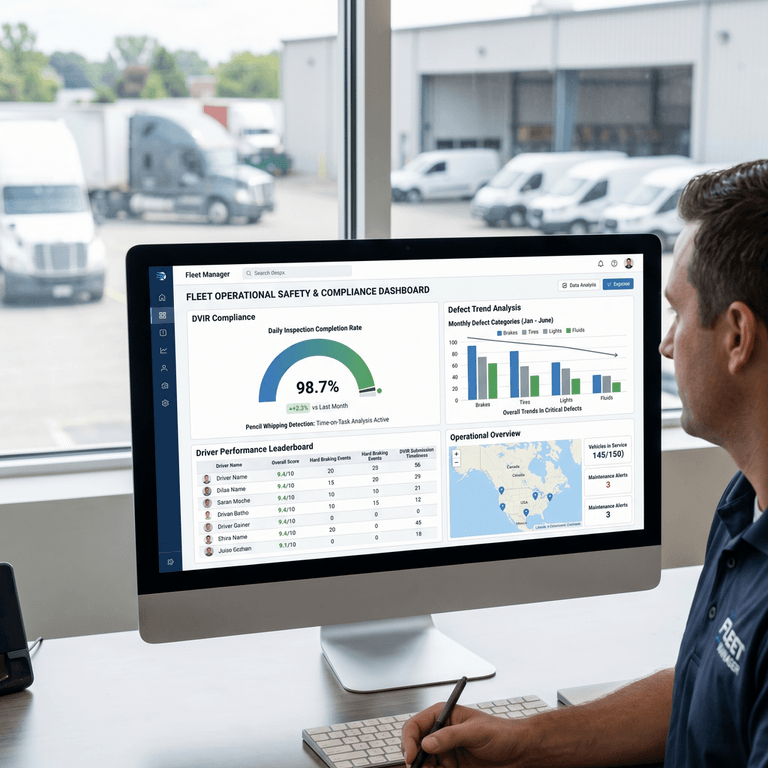
A compliance dashboard gives safety managers real-time visibility into inspection completion rates, defect trends, and driver-level accountability metrics.
11. Frequently Asked Questions
What is pencil whipping?
Pencil whipping means completing or signing a required inspection document without actually performing the physical safety checks. In trucking, it refers to a driver rapidly marking all boxes on a pre-trip or post-trip DVIR and signing it without walking around the vehicle. It violates FMCSA regulation 49 CFR 390.35.
What does pencil whipping mean in trucking?
In the commercial trucking industry, pencil whipping means a driver signs their Driver Vehicle Inspection Report (DVIR) — whether pre-trip or post-trip — without physically inspecting brakes, tires, coupling devices, lights, or other critical components. The term comes from the speed at which the pen moves through the checkboxes.
Why do drivers skip vehicle inspections?
Drivers skip inspections due to mileage-based pay structures that make yard time feel unpaid, fear of maintenance downtime that costs them loads, adverse weather conditions, repetitive task fatigue from days of zero-defect results, and fleet cultures that tolerate shortcuts rather than rewarding thorough compliance.
Is pencil whipping illegal?
Yes. Pencil whipping a DVIR constitutes falsification of a federally mandated safety record under 49 CFR 390.35. Penalties include civil fines, Out-of-Service orders, severe CSA score damage, and personal liability for the driver and motor carrier.
Can DOT auditors detect pencil whipping?
Yes. DOT auditors cross-reference DVIR timestamps against ELD movement data, toll records, fuel receipts, and GPS telematics. If a driver signed a 15-minute inspection but their ELD shows the truck moving two minutes later, the DVIR is flagged as falsified. Auditors also look for 'straight-lined' checkboxes and batch-filled forms.
How do electronic DVIR systems prevent false inspections?
Electronic DVIR systems prevent false inspections by requiring GPS-verified location near the vehicle, enforcing minimum inspection duration thresholds, demanding live in-app photo captures of critical components, using randomized checklists to prevent muscle-memory tapping, and creating timestamped audit trails that prove compliance.
What features should fleets look for in DVIR software?
Fleets should look for GPS geofencing, minimum duration enforcement, mandatory live photo uploads, digital signature authentication, automated defect routing to maintenance, randomized inspection checklists, cloud-based 90-day record retention, real-time manager alerts for anomalies, and compliance reporting dashboards. For a detailed evaluation framework, see our guide on choosing reliable pre-trip inspection software.
12. Conclusion: From Blind Checkmarks to Verified Inspections
Pencil whipping is not a harmless shortcut. It is a systemic vulnerability that converts every inspection into a liability, every truck into a risk, and every paper form into potential evidence of corporate negligence. In a 2026 enforcement environment defined by double-weighted CSA penalties, electronic audit trails, and multi-million-dollar nuclear verdicts, tolerating pencil whipping is a financial and legal gamble that no fleet can afford.
The technology to stop it exists today. GPS verification proves the driver was at the truck. Duration tracking proves they spent real time inspecting. Mandatory photos prove they looked at the components. Digital signatures prove they certified the result. Cloud storage proves the record exists when the auditor asks for it.
The question for fleet operators is no longer whether to digitize inspections. It is how quickly they can replace blind checkmarks on paper with verified, accountable, audit-ready inspection records that protect drivers, trucks, and the business.
Stop Paying for Blind Checkmarks on Paper
PTI4YOU gives fleet managers GPS timestamps, photo verification, and inspection duration tracking that prove inspections actually happened. Eliminate pencil whipping and build audit-ready compliance records from day one.
Start Your 15-Day Free Trial – No Credit Card RequiredZero setup fees. Zero hardware. 25-minute driver onboarding.