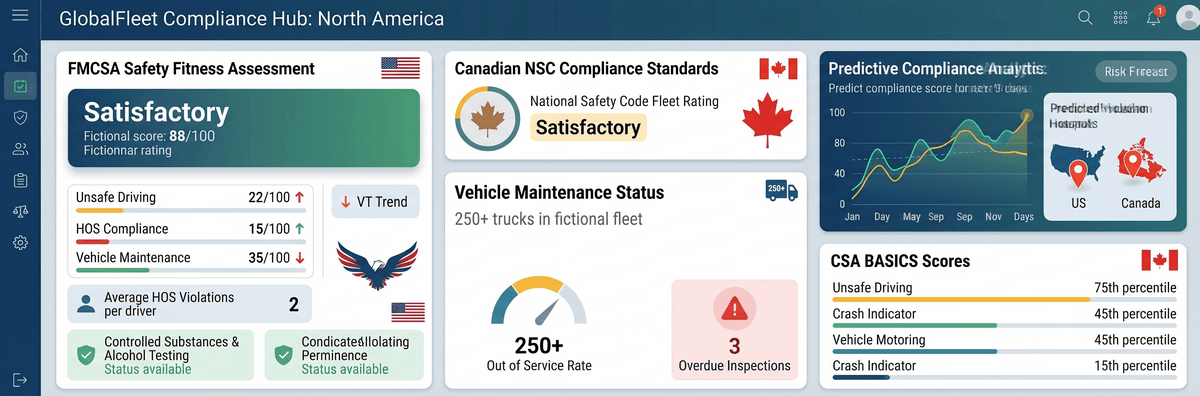
Introduction: The 2026 Regulatory Paradigm Shift
The commercial transportation sector in 2026 is undergoing one of the most profound regulatory transformations in the last decade. For motor carriers operating across the United States and Canada, surviving DOT compliance audits is no longer about maintaining filing cabinets full of paper. It is entirely about digital data integrity. The Federal Motor Carrier Safety Administration (FMCSA) is aggressively pushing forward two monumental initiatives: the overhaul of the FMCSA Safety Fitness Assessment (Safety Fitness Determination) methodologies and the final, mandatory implementation of the NRII integration 2026 requirements for medical certifications.
For decades, fleet managers have operated under a relatively static compliance umbrella. If a fleet wasn't physically audited, its safety rating remained untouched. If a driver handed you a paper medical certificate, you filed it away and dispatched the truck. In 2026, those analog loopholes have been permanently closed. The FMCSA’s new data-driven ecosystem means that your daily roadside inspection performance—and the digital footprint of your driver qualification files—are continuously monitored, analyzed, and scored in real-time.
Whether you operate an interstate long-haul fleet originating in Texas or a cross-border logistics company based in Ontario, understanding how these two regulatory pillars intersect is non-negotiable. This comprehensive guide breaks down exactly how the new Safety Fitness Assessment works, what the recent NRII extensions mean for your hiring process, and why adopting an electronic DVIR system is your ultimate defense against an unexpected "Unfit" rating.
Key Takeaways for Fleet Managers
- Safety Fitness Assessment Shift: The FMCSA is moving away from purely on-site Compliance Reviews to leveraging continuous roadside inspection data to determine your official safety rating.
- NRII Deadline Extension: Due to State IT delays, the NRII (Medical Examiner's Certification Integration) has been granted a temporary exemption allowing the use of paper medical cards until October 11, 2026.
- USA and Canada Audiences: Cross-border fleets must understand how electronic CDLIS updates intersect with Canadian provincial medical reciprocity to avoid Out-Of-Service violations.
- Electronic Automation is Mandatory: Defending your Vehicle Maintenance BASIC requires stopping "pencil whipping" through advanced eDVIR software like PTI4YOU.
Understanding the New FMCSA Safety Fitness Assessment (SFD)
To truly grasp the magnitude of the 2026 changes, one must understand how the fleet safety rating system historically functioned. Under the old methodology, established largely in the 1990s, a motor carrier received a safety rating (Satisfactory, Conditional, or Unsatisfactory) only after undergoing an extensive, on-site Compliance Review (CR). Because the FMCSA and state enforcement agencies have limited manpower, a vast majority of registered motor carriers operated for years—sometimes decades—as "Unrated."
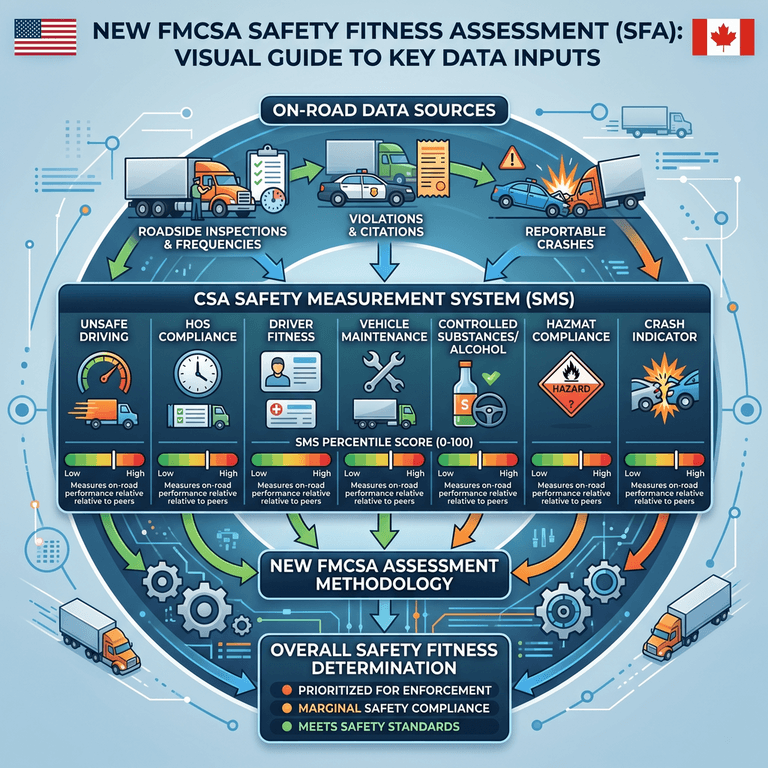
The new FMCSA Safety Fitness Assessment methodology, often referred to as Safety Fitness Determination (SFD), completely dismantles this outdated approach. Instead of relying solely on physical investigators digging through paper logbooks, the FMCSA now utilizes its massive repository of big data. The new methodology integrates performance data from the Compliance, Safety, Accountability (CSA) Safety Measurement System (SMS).
Data-Driven Determinations
In 2026, your fleet is effectively being audited every single day. Every time a truck rolls through a weigh station or undergoes a Level I, II, or III inspection, that data is immediately fed into your BASICs (Behavior Analysis and Safety Improvement Categories). If a carrier demonstrates a pattern of critical violations—particularly in the Unsafe Driving, Crash Indicator, HOS Compliance, or Vehicle Maintenance BASICs—the FMCSA's algorithms can trigger a proposed "Unfit" determination without an investigator ever visiting your corporate office.
This shift emphasizes absolute failure rates over relative peer percentiles. Previously, fleets might complain that they were unfairly rated against unlike peers. The 2026 refinement focuses on absolute thresholds of safety violations. If your drivers repeatedly fail to secure cargo, falsify logs, or operate vehicles with defective brakes, the system will flag the carrier regardless of how other fleets in your category are performing.
For fleet executives, the message is clear: DOT compliance is no longer a periodic event you prepare for; it is a continuous operational standard you must maintain daily. If your internal data collection—such as maintenance records and DVIRs—is not faster and more accurate than the data the DOT is collecting at the roadside, you are fundamentally operating at a severe disadvantage.
Demystifying NRII: The Medical Examiner’s Certification Integration
While the SFD methodology addresses vehicle and operational safety, the physical qualification of the human behind the wheel is managed by a different, equally stringent system: the Medical Examiner's Certification Integration, officially known as National Registry II, or simply NRII. (Note: While frequently searched in industry circles as the "National Registry of Inspector Information", the correct regulatory nomenclature is the National Registry of Certified Medical Examiners integration).
The Legacy Paper Problem
Historically, when a commercial driver required a DOT physical, they visited a certified medical examiner. Upon passing, the examiner handed the driver a physical paper document—the Medical Examiner’s Certificate (Form MCSA-5876). The driver then physically handed a copy to their motor carrier to file in the Driver Qualification (DQ) file, and subsequently took another copy to their State Driver's Licensing Agency (SDLA) to maintain their CDL status.
This analog process was fraught with systemic vulnerabilities. Paper certificates were routinely forged or altered. Drivers forgot to submit forms to the SDLA, resulting in accidental CDL downgrades. Furthermore, motor carriers bore the heavy administrative burden of manually verifying the medical examiner's National Registry number to ensure the exam was legitimate.
The NRII Digital Workflow
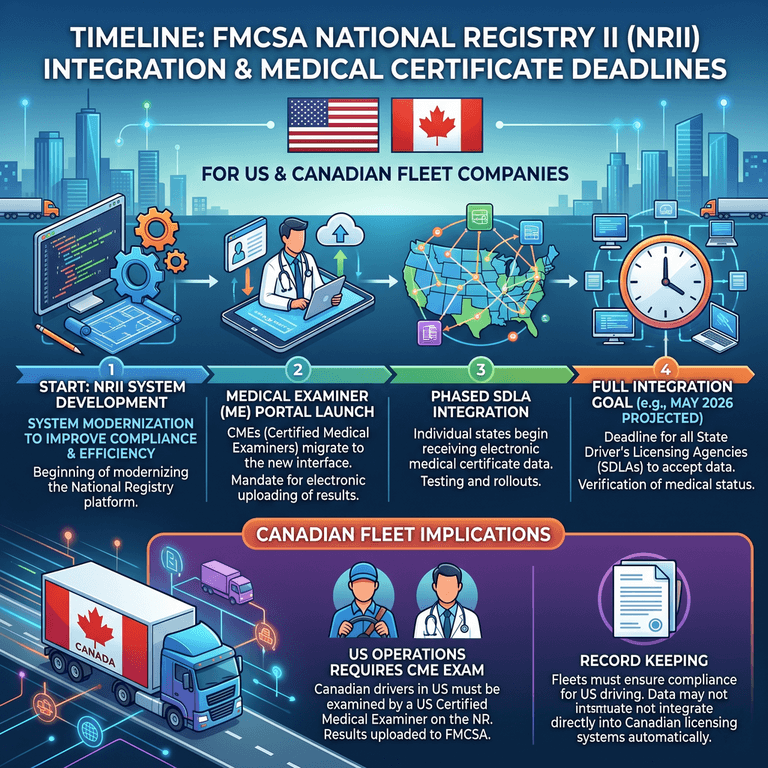
The NRII integration 2026 fundamentally changes this workflow by eliminating the driver as the courier of their own medical data. Under the final rule, certified medical examiners must electronically transmit the physical qualification results (whether medically qualified, unqualified, or voided) directly to the FMCSA’s National Registry by midnight of the next calendar day.
Once the FMCSA receives this data, they electronically push it to the appropriate SDLA. The SDLA then posts the medical status directly onto the Commercial Driver’s License Information System (CDLIS) driver motor vehicle record (MVR). Consequently, motor carriers are no longer required—or permitted—to use the paper Form MCSA-5876 as official proof of medical certification. Instead, motor carriers must pull the CDLIS MVR to verify medical status.
Navigating State Non-Compliance and Carrier Responsibilities
While the theoretical framework of NRII is brilliant, the practical execution has encountered significant roadblocks. The original compliance date for States to implement the necessary IT infrastructure to receive this electronic data was June 23, 2025. However, as the deadline approached, a substantial number of states proved to be non-compliant due to software limitations and budgetary constraints.
To prevent massive industry disruption and unjust CDL downgrades, the FMCSA issued a critical temporary exemption. Effective from April 11, 2026, through October 11, 2026, the FMCSA has granted a waiver allowing interstate CDL holders, CLP holders, and motor carriers to continue relying on a paper copy of the medical examiner's certificate as proof of medical certification for up to 60 days after the date it is issued.
What Fleets Must Do Before October 2026
During this six-month grace period, fleet managers operate in a challenging hybrid environment. You must verify which state your driver is licensed in against the FMCSA's official list of non-compliant states. If a driver is licensed in a state that has not implemented NRII, they must physically take their paper MCSA-5876 to the SDLA, and the carrier must retain a paper copy in the DQ file.
However, the FMCSA has made it abundantly clear: Do not expect further nationwide extensions after October 11, 2026. Fleets must use this time to transition their HR and safety departments to automated MVR monitoring APIs. Relying on paper tracking beyond this date will inevitably lead to dispatching medically disqualified drivers, resulting in severe compliance review changes and immediate out-of-service orders at weigh stations.
Cross-Border Complexities: USA and Canada Audiences
For fleets operating transnationally, the regulatory landscape is uniquely complex. The intersection of the USA and Canada audiences requires an intricate understanding of both FMCSA mandates and the Canadian National Safety Code (NSC).
Canadian commercial vehicle drivers operate under provincial medical certification standards, which are highly integrated with their provincial driver's licenses. Because of longstanding medical reciprocity agreements between Transport Canada and the FMCSA, a Canadian driver holding a valid commercial license (e.g., an Ontario Class A) is generally deemed medically qualified to operate in the United States without needing to register in the US National Registry or carry a separate FMCSA MCSA-5876 form.
However, how does the new NRII integration 2026 affect cross-border fleets? While Canadian medical examiners do not transmit data to the US National Registry, US roadside inspectors utilize interconnected database queries (such as Nlets) to verify the validity of the Canadian license in real-time. If a Canadian driver's provincial medical expires, their license is downgraded in Canada, and a US inspector will immediately flag them as operating without a valid CDL equivalent.
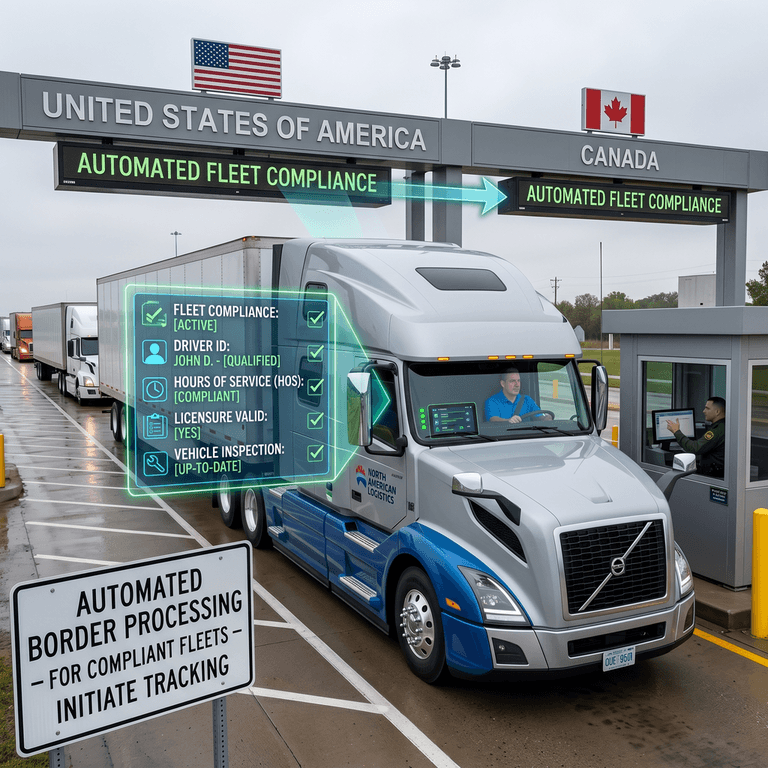
Furthermore, Canadian motor carriers operating in the US are fully subject to the new FMCSA Safety Fitness Assessment based on their USDOT numbers. If a Canadian truck receives maintenance violations in Ohio or hours-of-service violations in Michigan, that data feeds directly into their FMCSA SMS percentiles. Cross-border fleets must utilize unified fleet management software that handles both NSC Standard 13 (Canadian daily trip inspections) and FMCSA eDVIR regulations seamlessly to protect their safety ratings on both sides of the border.
The Financial and Operational ROI of SFD & NRII Readiness
Navigating these regulations is not just an administrative exercise; it is a profound financial imperative. Motor carriers that fail to adapt to the 2026 digital reality will experience severe financial hemorrhaging through three distinct channels: freight access, insurance premiums, and litigation exposure.
Freight Access and Broker Relationships
In the modern logistics economy, major shippers and freight brokerages utilize automated APIs to scrub carrier safety ratings before tendering a load. Under the new data-centric Safety Fitness Assessment, dropping into an "Unfit" or equivalent high-risk category means immediate blacklisting from lucrative corporate freight networks. The financial impact of a sidelined fleet vastly outweighs the cost of compliance software.
Insurance Premium Escalation
Commercial auto liability insurers strictly monitor CSA SMS percentiles. If your Vehicle Maintenance BASIC spikes due to poor roadside inspections, underwriters classify your fleet as a high-frequency risk. Insurers know that fleets with poor maintenance disciplines generally suffer higher crash severity. Maintaining a pristine SFD profile is the most effective strategy for negotiating flat or reduced insurance renewals in a hardening market.
Litigation and Nuclear Verdicts
The failure to properly manage NRII integration carries apocalyptic legal risks. If a safety director misses an electronic medical downgrade on a CDLIS MVR and dispatches a medically disqualified driver who subsequently causes a catastrophic collision, plaintiff attorneys will target the carrier for negligent entrustment. The phrase "Nuclear Verdict" (judgments exceeding $10 million) is intrinsically linked to carriers failing to digitize and audit their Driver Qualification files. Automated MVR monitoring is no longer a luxury; it is your corporate shield.
The Critical Role of Electronic DVIRs in Improving Safety Fitness
Because the new FMCSA Safety Fitness Assessment relies so heavily on roadside inspection data, a carrier's primary defense strategy must happen in the terminal yard before the truck ever hits the highway. The single most effective tool for protecting your safety rating is a robust, strictly enforced electronic DVIR (Driver Vehicle Inspection Report) program.
Eradicating "Pencil Whipping"
The vast majority of Vehicle Maintenance violations—such as bald tires, chafing air hoses, and inoperable lighting—are entirely preventable. However, fleets relying on paper DVIRs fall victim to "pencil whipping," the dangerous practice where drivers blindly check off inspection boxes without actually walking around the vehicle. Paper forms provide zero proof of physical compliance.
A modern eDVIR platform, such as PTI4YOU, mathematically eliminates pencil whipping. The software utilizes GPS geo-fencing to ensure the driver is physically located at the asset. It mandates timestamped, high-resolution photo uploads of critical components (steer tires, glad hands, brake pushrods) before the inspection can be submitted. If a driver cannot fake the inspection, defects are caught in the yard where they can be repaired affordably, rather than at a DOT scale house where they generate an OOS violation and degrade your Safety Fitness Assessment.
Closing the Mechanic Signature Loop (FMCSA 396.11)
Another major trap for fleets is the failure to properly document repairs. FMCSA Rule 396.11 requires a strict three-signature cycle when a defect is noted. With paper forms, the mechanic's sign-off is often lost in the cab or destroyed. Electronic DVIR systems digitize this workflow completely. When a driver logs a defect, the system instantly alerts the maintenance shop. The mechanic digitally signs off on the repair, and the next driver to operate the asset is electronically forced to acknowledge the repair before generating a new trip manifest. This closed-loop audit trail is exactly what FMCSA investigators look for in a modern fleet.

Case Study: A 100-Truck Fleet Transitions to 2026 Standards
Consider the fictional, yet highly representative case of Apex Cross-Border Freight, a mid-sized carrier operating 100 power units moving auto parts between Michigan and Ontario. In early 2025, Apex struggled with paper-based compliance. Their Vehicle Maintenance BASIC percentile was hovering dangerously close to the FMCSA intervention threshold at 78%. Simultaneously, their HR department was drowning in the confusion of the early NRII rollout, manually tracking which states were compliant and repeatedly calling drivers to hunt down paper medical cards.
Recognizing the impending danger of the 2026 Safety Fitness Assessment shift, Apex initiated a total digital overhaul. First, they partnered with a third-party consortium that provided API-integrated continuous MVR monitoring. This automated the NRII compliance tracking, instantly alerting the safety director if the CDLIS record showed a medical downgrade, completely bypassing the reliance on paper MCSA-5876 forms.
Secondly, Apex deployed PTI4YOU’s electronic DVIR software across their entire fleet. Drivers were trained that "all clear" inspections without required photos would be flagged by management. Mechanics were equipped with tablets to instantly close defect loops digitally.
The Results by Q2 2026: Apex saw a 42% reduction in roadside out-of-service violations over eight months. Because defects were caught and repaired proactively, their Vehicle Maintenance BASIC percentile plummeted from 78% to 41%. When the new data-centric FMCSA SFD methodology analyzed their profile, they securely maintained the highest safety fitness tier, preserving their dedicated freight contracts and successfully negotiating a 4% reduction in their commercial auto liability insurance renewal.
5-Step Implementation Checklist for 2026 Compliance
Transitioning a fleet to meet the demands of the NRII mandate and the data-driven Safety Fitness Assessment requires decisive action. Use this five-step checklist to protect your operations.
-
Step 1: Audit Driver Qualification (DQ) Files
Immediately review all active CDL and CLP driver files. Identify which drivers have medical certifications expiring before the October 11, 2026, exemption deadline. Categorize drivers based on whether their licensing SDLA is fully NRII-compliant or operating under the temporary paper waiver.
-
Step 2: Implement Automated MVR Monitoring
Transition away from manually requesting annual Motor Vehicle Records. Integrate an API-based MVR monitoring tool that automatically queries CDLIS to verify electronic medical certification updates directly from the National Registry, removing human error from the equation.
-
Step 3: Deploy Electronic DVIR Software
To protect your SFD rating from maintenance violations, you must eliminate paper inspections. Adopt a DOT-compliant electronic DVIR platform like PTI4YOU. Ensure the system forces mandatory defect photos and enforces closed-loop mechanic signatures.
-
Step 4: Train Drivers on New Documentation Rules
Conduct mandatory safety meetings. Inform drivers that while they may still receive a paper Form MCSA-5876 during the exemption period, the ultimate proof of their qualification will strictly reside on their electronic MVR. Emphasize that losing CDLIS status means immediate suspension from dispatch.
-
Step 5: Monitor SMS Percentiles Proactively
Assign a compliance officer to monitor the fleet's CSA SMS BASIC percentiles weekly. Since the new Safety Fitness Assessment relies heavily on this continuous data feed, early intervention on negative trends is the only way to prevent a sudden 'Unfit' safety rating.
Frequently Asked Questions (FAQ)
What is the FMCSA Safety Fitness Assessment change in 2026?
In 2026, the FMCSA Safety Fitness Assessment transitions from relying heavily on resource-intensive, on-site Compliance Reviews to a data-centric model. The new methodology utilizes continuous roadside inspection data and SMS/BASIC performance metrics to issue Safety Fitness Determinations (SFD), meaning fleets can be rated 'Unfit' based purely on historical roadside data without a physical investigator stepping foot in their terminal.
What does NRII stand for, and why is it important?
NRII stands for National Registry II, officially known as the Medical Examiner's Certification Integration. Sometimes colloquially searched as the National Registry of Inspector Information, this rule mandates that Certified Medical Examiners electronically transmit driver physical results to the FMCSA by midnight of the next calendar day. The FMCSA then pushes this to the State Driver's Licensing Agencies (SDLAs) to automatically update the driver's CDLIS motor vehicle record, eliminating paper medical cards (Form MCSA-5876) as official proof.
How does the NRII April 2026 temporary exemption work?
Because several State Driver's Licensing Agencies (SDLAs) experienced IT delays in connecting to the FMCSA's National Registry, the FMCSA issued a temporary exemption effective from April 11, 2026, to October 11, 2026. During this six-month window, motor carriers, CDL, and CLP holders may continue to rely on paper copies of the medical examiner's certificate as proof of medical certification for up to 60 days after issuance. However, fleets must use this time to finalize their digital verification workflows.
Do Canadian drivers need to comply with US NRII rules?
Canadian commercial drivers operating in the US generally operate under medical reciprocity agreements between Transport Canada and the FMCSA. While the internal NRII transmission process applies strictly to US SDLAs, Canadian carriers operating in the US must ensure their drivers' provincial medical certifications are active and properly reflected in provincial databases, which are queried by US roadside inspectors via cross-border data exchanges.
How can an electronic DVIR help improve a Safety Fitness Assessment?
Because the new Safety Fitness Assessment relies heavily on roadside inspection data, the Vehicle Maintenance BASIC is a critical factor. An electronic DVIR (eDVIR) system forces true compliance by requiring mandatory photos and GPS timestamps, completely stopping the practice of 'pencil whipping.' By catching defects in the yard rather than at the weigh station, fleets drastically reduce out-of-service violations, thereby protecting their overarching SFD score.
Conclusion: Future-Proof Your Fleet with PTI4YOU
The 2026 regulatory environment is unforgiving to carriers that cling to the past. The FMCSA’s integration of the National Registry II and the rollout of data-driven Safety Fitness Assessments signify a permanent end to the era of paper compliance. If your data is not structured, digital, and verifiable in real-time, your fleet is operating under extreme, unnecessary risk.
Do not wait for an unexpected DOT intervention or a devastating CDL downgrade to modernize your operations. Embrace technology to protect your drivers, your safety ratings, and your bottom line.
Automate Your Fleet Compliance Today
Stop pencil whipping and protect your Safety Fitness Assessment score with PTI4YOU. Our DOT-compliant electronic DVIR platform is designed specifically to help fleets in the USA and Canada maintain perfect digital records, automate mechanic sign-offs, and slash maintenance violations.
Start your 15-day free trial today and bulletproof your maintenance records. No credit card required.
Start Your 15-Day Free Trial – No Credit Card RequiredZero setup fees. Zero hardware. 25-minute driver onboarding.