
Key Takeaways
- FedEx Ground linehaul contractors do not need proprietary hardware to create defensible IVMR records for IFTA audit preparation in 2026.
- Manual mileage spreadsheets fail at scale because they create reconciliation delays, weak audit trails, and higher back-office labor cost.
- BYOD mileage automation gives small fleets a practical way to combine GPS trip data, odometer validation, and driver confirmation in one searchable system.
- IFTA audit readiness is about evidence, not estimates: trip dates, routes, unit numbers, jurisdiction miles, and record retention must align.
- PTI4YOU is positioned as a hardware-agnostic compliance option for fleets that want electronic DVIR + mileage tracking without long contracts or gateway lock-in.
How FedEx Contractors Can Automate IVMR and IFTA Without Hardware Lock-In
If you are a FedEx Ground linehaul contractor, the fastest way to improve IFTA audit preparation is to stop managing your Individual Vehicle Mileage Report (IVMR) in disconnected spreadsheets, paper trip notes, and dispatch memory. A BYOD workflow that combines GPS trip capture, odometer validation, mobile driver inputs, and cloud retention gives small fleets a lower-cost path to accurate mileage records without proprietary telematics hardware.
That answer matters because most small fleets are not losing sleep over “technology adoption.” They are losing sleep over margin. Every extra hour spent rebuilding state line crossings, fixing mileage discrepancies, or chasing missing trip detail is labor that does not generate revenue. Every weak IVMR sheet is a future audit problem waiting to surface during tax filing, contractor review, or internal reconciliation.
The strategy context behind this article is clear: this is not top-of-funnel educational content. It is a bottom-of-funnel, revenue-first page designed for buyers already searching terms like IVMR sheet, IFTA mileage tracking software, FedEx TSP software, TruckSpy alternatives, and FedEx Linehaul contractor compliance. Those searchers are not asking if compliance matters. They are asking which system gives them cleaner records, lower cost, faster setup, and fewer audit surprises.
For USA and Canada fleets, especially contractors operating 1 to 50 trucks, the commercial decision usually comes down to this: do you buy another hardware-centric tool, or do you move to a more practical compliance workflow that fits the economics of a small business? This guide answers that directly.

A fleet compliance dashboard displaying vehicle-by-vehicle mileage records, exception alerts, and audit-readiness status for a small linehaul fleet.
What Is an Individual Vehicle Mileage Report in FedEx Linehaul Operations?
An Individual Vehicle Mileage Report (IVMR) is the unit-level mileage record that shows how far a specific power unit traveled during a given reporting period. In FedEx linehaul environments, the IVMR sheet is not just an operations worksheet. It is part of the evidence chain that supports route accountability, cost control, tax reporting, and audit defensibility.
For small fleets, the mistake is often assuming that “we know where the truck went” is the same as “we can prove how many jurisdiction miles it ran.” Those are not the same thing. An auditor, accountant, or contractor compliance reviewer will not accept a rough spreadsheet summary if the underlying trip detail is fragmented or inconsistent.
What a defensible IVMR sheet should show
A useful IVMR sheet should answer the questions that matter during review:
- Which vehicle moved?
- When did it move?
- Where did it start and finish?
- What route or jurisdiction path did it travel?
- What were the beginning and ending odometer readings?
- How many total miles did it run?
- How many of those miles belonged to each state or province?
- Can the record be reconciled against driver confirmation and fuel records?
That is why FedEx Linehaul contractor compliance is fundamentally a documentation discipline. If the truck moved but the record is incomplete, the business still carries the risk. For FedEx contractors, the pressure is higher because customer expectations, route commitments, tax filings, and internal profitability all converge at the vehicle-record level.
Why this matters commercially
Searchers looking for fedex contractor compliance software or IFTA mileage tracking software are rarely looking for generic visibility dashboards. They are looking for a cleaner system of record. In other words, they need software that lowers the cost of being right every quarter.
What IFTA Auditors Need to See in 2026 Across the USA and Canada
IFTA audit preparation is not just about the quarterly return. It is about the source documents behind the return. In 2026, both U.S. and Canadian operators still need comprehensive distance and fuel documentation that supports how jurisdiction miles were calculated for every qualified vehicle.
At a practical level, the record package should include trip-level support, jurisdiction allocation, and fuel documentation that can be pulled without back-office reconstruction. Fleets should generally retain IFTA source records for four years from the return due date or filing date, subject to jurisdiction rules. That expectation aligns with official IFTA reference materials and long-standing audit practice.
Core mileage fields auditors expect
- Trip date or trip period
- Origin and destination
- Route traveled
- Beginning and ending odometer or hubometer readings
- Total trip miles or kilometers
- Miles or kilometers in each jurisdiction
- Qualified vehicle unit number
Where small fleets fail
The common failure pattern is not a total lack of data. It is fragmented data. A driver message holds one trip detail, a spreadsheet contains an estimate, dispatch remembers the route, and a fuel receipt sits in an email attachment. That structure may be enough to file a return. It is not enough to defend the return efficiently.
Cross-border operations make the problem worse. Once a truck runs into Canada, the audit expectation around accurate state and provincial allocation becomes even tighter. If jurisdiction miles are assigned after the fact rather than captured in a disciplined workflow, error risk increases quickly.
For fleets that already use an automated DVIR compliance system, there is an additional opportunity: mileage evidence becomes more defensible when inspection activity, timestamps, driver participation, and trip support are tied together rather than scattered across systems.
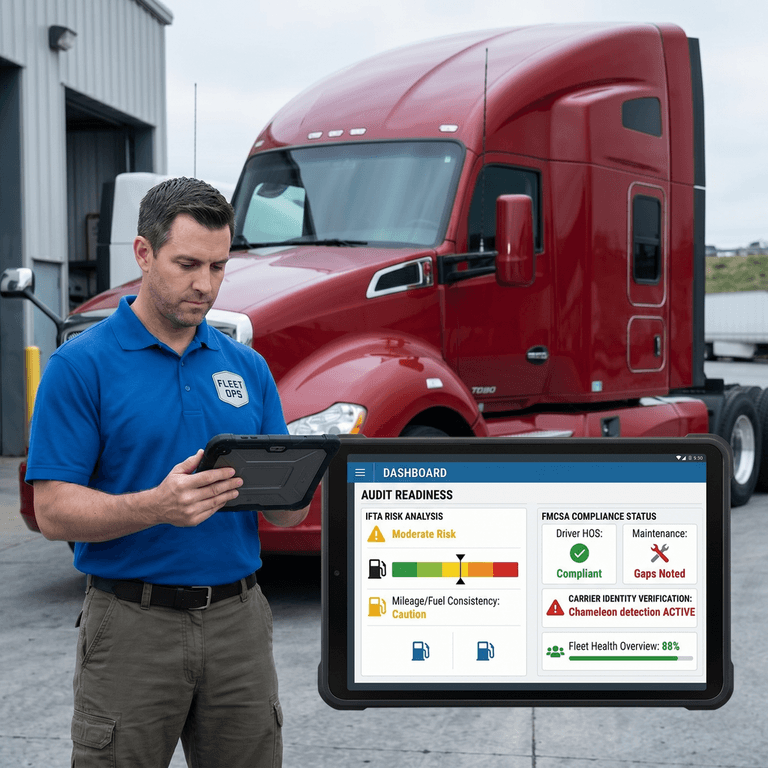
A fleet manager reviewing audit-risk indicators, documentation gaps, and record retention status for a U.S. and Canada trucking operation.
For official guidance, consult the official IFTA Manual and the eCFR text for 49 CFR 396.11 when aligning vehicle inspection and record workflows.
Why Manual IVMR Sheets Fail Small Fleets
Manual workflows feel inexpensive because the cost is buried in labor. A spreadsheet template, an ifta tracking spreadsheet, or a paper mileage notebook may look lean on day one. The problem is what happens at quarter-end, during disputes, or when an auditor asks how a number was built.
Manual mileage systems create four predictable failures
1. Small input mistakes become filing mistakes. One wrong odometer digit, one missed border crossing, or one inaccurate allocation assumption can ripple across a vehicle’s quarterly totals.
2. The IVMR sheet becomes a summary instead of a source record. When dispatch or accounting rebuilds mileage after the trip is over, the record loses evidentiary strength. It may be usable for internal estimates, but it is weaker in an audit context.
3. Admin labor scales faster than fleet size. A fleet with 12 trucks does not create only 12 times the work of a single-truck operation. It creates exception work, follow-up work, correction work, and quarterly compression work.
4. Visibility comes too late. Most small fleets only discover record gaps during filing preparation. By then, the driver may not remember the route split, the dispatch trail may be incomplete, and the back office is forced into educated reconstruction.
This is why buyers searching truckspy ivmr pricing, TruckSpy alternatives, or fleet compliance software USA Canada are often less concerned with feature lists than with operational friction. They want fewer records to chase and fewer hours lost repairing the same administrative problem every quarter.
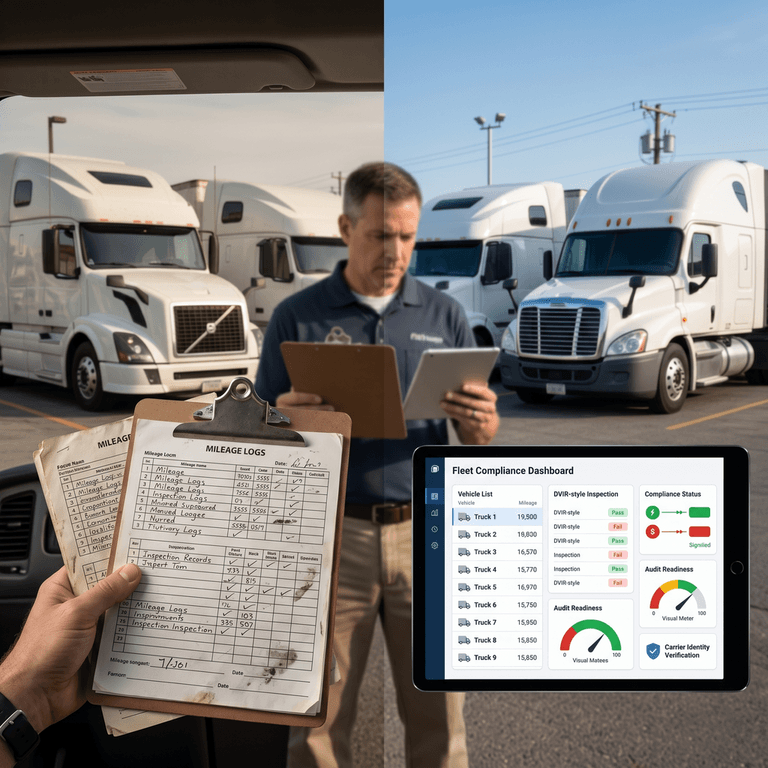
Split-screen comparison between paper-based inspection and mileage forms versus a digital compliance workflow on mobile and desktop.
Why Hardware-Heavy Mileage Tools Hurt Margin for Small FedEx TSPs
Small fleets usually do not reject enterprise telematics because the technology is bad. They reject it because the economics are wrong for the use case. If your immediate need is accurate IVMR records, better IFTA audit preparation, and tighter electronic DVIR + mileage tracking, a hardware-first stack can create more cost than value.
The hardware cost trap
When a vendor requires proprietary gateways, dedicated installs, replacement units, and contract commitments, you are no longer just buying compliance software. You are buying an infrastructure decision. That may make sense for a large enterprise safety program. For a 5-, 12-, or 25-truck linehaul fleet, it can delay ROI and lock you into a platform before you know whether the workflow truly fits your operation.
That is the practical weakness PTI4YOU can exploit against more hardware-centric competitors: the product story is not “more telematics.” The story is “faster compliance value with less operational friction.”
Illustrative hardware savings comparison
The table below uses simple illustrative budgeting logic for a small fleet evaluating mileage and compliance tools. It is not a market-wide pricing guarantee. It is a decision model for finance-minded operators.
| Cost Category | Hardware-Centric Setup | BYOD Cloud Workflow |
|---|---|---|
| Upfront Deployment | Higher: install time, devices, replacements | Lower: app-based rollout on existing driver devices |
| Implementation Speed | Slower: scheduling, hardware logistics, training | Faster: account setup, mobile onboarding, workflow configuration |
| Contract Rigidity | Often higher | Typically more flexible |
| Best Fit | Enterprise fleets needing deep telematics layers | Small fleets prioritizing compliance, speed, and cost control |
Run Your Free Cost Study
If you are comparing hardware-heavy mileage tools against a BYOD workflow, PTI4YOU can help you estimate per-truck savings in admin time, deployment cost, and audit preparation effort.
Run Your Free Cost StudySee whether your current IVMR workflow is costing more than you think.
How BYOD IVMR Automation Works for Small Fleets
BYOD means your drivers use devices they already carry, while the system creates a structured digital mileage workflow behind the scenes. For a small fleet owner, that changes the implementation story from “we need to equip every truck” to “we need to standardize every record.”
The practical workflow
- Driver or operations team confirms trip activity in a mobile workflow
- GPS-based trip data supports movement and route context
- Odometer values are captured or validated
- Vehicle-level trip records are centralized in one dashboard
- Exceptions are flagged before quarter-end instead of after filing prep begins
- Records can be exported for finance, compliance, or audit response
That is the bigger strategic advantage of PTI4YOU as FedEx TSP software: it does not require the fleet to become a telematics integrator just to improve record quality. It gives small teams a cleaner operational cycle built around evidence, speed, and lower overhead.
Where PTI4YOU fits
PTI4YOU is especially relevant for fleets that already feel the pain of separate systems. If inspections live in one place, mileage is tracked in another, and quarter-end summaries happen in Excel, every compliance review becomes slower and more fragile. A connected workflow provides stronger record continuity and a better path toward pre-trip inspection and DVIR software integration.

A mobile-first workflow showing driver verification, GPS-backed trip records, and digital compliance events feeding a centralized fleet dashboard.
TruckSpy Alternatives and Platform Comparison
For buyers evaluating TruckSpy alternatives, Motive, Samsara, Fleetio, or PTI4YOU, the right comparison is not who has the most features on a sales deck. The real question is which platform solves the compliance problem with the lowest operational drag for a 1–50 truck fleet.
| Platform | Hardware Requirement | Pricing Transparency | Best Fit for SMB Fleets | IVMR Automation Capability | IFTA Audit Readiness |
|---|---|---|---|---|---|
| TruckSpy | Often telematics-linked | Moderate | Good for fleets that already accept telematics-centric workflows | Useful, but workflow fit depends on how records are configured | Can be strong when setup discipline is high |
| Samsara | Yes, proprietary hardware common | Typically quote-based | Better for larger or more complex operations | Strong raw data visibility | Strong, but usually higher total cost |
| Motive | Yes, hardware-centric ecosystem | Moderate to limited | Strong for bundled ELD/camera buyers | Good inside an all-in-one telematics model | Good, especially for fleets already standardized on Motive |
| Fleetio | No mandatory proprietary hardware for core workflows | Moderate | Useful for maintenance-heavy operations | Less specialized for contractor-style mileage evidence | Helpful for management records, less purpose-built for IFTA source capture |
| PTI4YOU | No proprietary hardware required | Transparent SaaS positioning | Strong for 1–50 truck fleets in USA and Canada | Built around mobile + GPS + odometer-based record workflows | Strong fit for searchable retention and audit prep |
The commercial angle is straightforward: if your fleet needs enterprise telematics, buy enterprise telematics. If your fleet needs cleaner compliance records, faster rollout, and lower deployment friction, PTI4YOU has a sharper story.
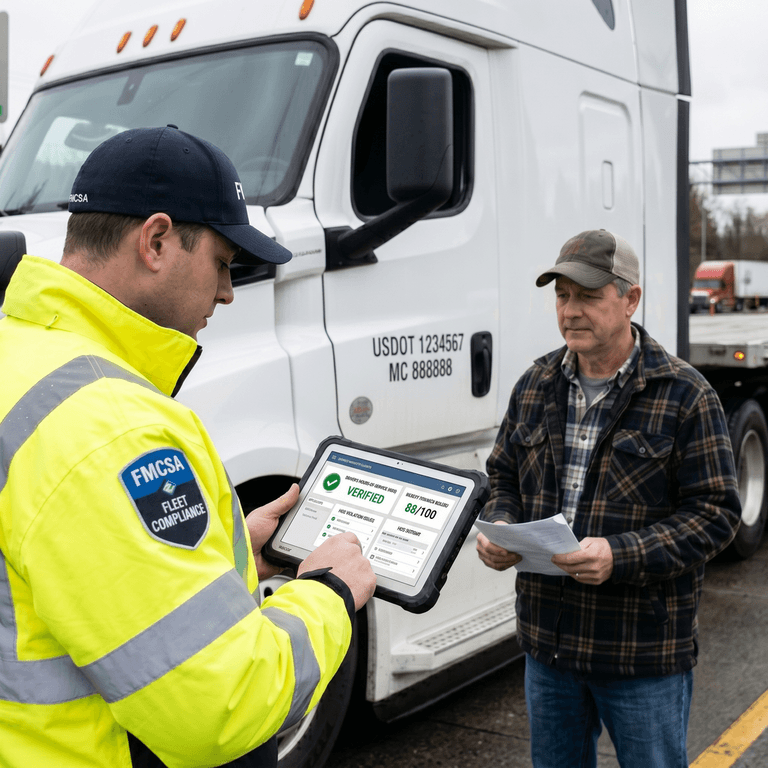
An IVMR and IFTA compliance workflow connecting vehicle-level mileage capture, jurisdiction allocation, and quarterly audit-ready reporting.
7-Step IFTA Audit Preparation Plan for FedEx Linehaul Contractors
-
1. Standardize the IVMR workflow by unit
Each qualified vehicle should follow the same process for route support, odometer checkpoints, driver confirmation, and jurisdiction allocation. If one truck uses paper and another uses dispatch notes, your audit process is already fragmented.
-
2. Capture trip evidence while the trip is still fresh
Post-trip reconstruction is where accuracy degrades. BYOD workflows help lock in origin, destination, route context, and mileage support closer to the actual operation.
-
3. Reconcile GPS miles and odometer values continuously
Do not wait until quarter-end. Review exceptions every week so discrepancies can be fixed while drivers, dispatchers, and route history are still accessible.
-
4. Validate state and provincial allocation
This is one of the biggest audit pain points for USA and Canada operations. When a truck crosses multiple jurisdictions, allocation should be built from evidence, not memory.
-
5. Match fuel records to operating geography
Fuel receipts should make sense against trip activity. If a truck’s route pattern and fuel geography conflict, you want to catch that internally before an auditor does.
-
6. Build the quarterly summary before filing pressure peaks
Quarter-end should be a review workflow, not a forensic rebuild. Strong fleets summarize as they go, then use quarter-end to validate rather than invent missing history.
-
7. Run an audit drill
Choose one truck and one completed quarter. See how quickly your team can produce source trip records, jurisdiction summaries, and fuel support. If it takes hours, the workflow still needs work.
For fleets that also want a broader audit-readiness framework, review Preparing for a DOT Safety Audit and Canadian NSC Standard 13 Compliance to strengthen the rest of your U.S./Canada compliance stack.
ROI, Payback, and Cost Control: Why Digital IVMR Wins
The easiest way to explain return on investment is this:
Monthly savings per truck = labor reduced + reconciliation time avoided + audit risk reduced + record retrieval time reduced − software cost
Where the savings come from
- Less spreadsheet cleanup: less manual re-entry, fewer formula errors, fewer last-minute rebuilds.
- Faster quarter-end processing: operations and finance work from cleaner records.
- Lower deployment cost: BYOD avoids some of the expense tied to proprietary hardware installs.
- Better audit response speed: searchable records reduce scramble time and support confidence.
A small fleet owner does not need a complex enterprise model to evaluate this. If one truck creates even one hour of monthly mileage correction work, that time has a real cost. If five trucks create recurring exception cleanup, that cost multiplies quietly. By the time quarter-end arrives, the “cheap” spreadsheet workflow often turns out to be the expensive option.
That is why this is not just a compliance discussion. It is an efficiency discussion. It is also why PTI4YOU should be positioned as a practical answer for fleets searching fleet compliance software USA Canada rather than yet another bloated telematics suite.
Common Mistakes That Trigger IFTA Audit Pain
Most audit problems are repetitive, not dramatic. They happen because the process tolerates weak records until the quarter closes.
- Missing trip detail: if the route or trip context is missing, jurisdiction totals become harder to defend.
- Weak source documentation: if the IVMR sheet is only a summary, it may not be enough on its own.
- Incorrect state or province allocation: manual estimates create recurring filing risk.
- Odometer mismatch: if GPS, odometer, and summary records do not reconcile, the file becomes vulnerable.
- Poor retention discipline: if four years of support cannot be produced quickly, the system is not truly audit-ready.
- Disconnected compliance tools: when mileage, inspections, and back-office review live in separate silos, evidence quality drops.
Official References and Internal Resources
If you want to validate the compliance framework behind this article, start with the official sources below:
- Official IFTA Manual
- International Fuel Tax Association (IFTA)
- 49 CFR 396.11 in the Electronic Code of Federal Regulations
For internal follow-up reading on your own site, the most relevant companion pages are:
- Pre-Trip Inspection & DVIR Software Guide
- Paper Logs vs. Electronic DVIR Apps: Hidden Cost Calculator
- Whip Around vs Motive vs Samsara: Small Fleet Comparison
- Canadian NSC Standard 13 Compliance Guide
Frequently Asked Questions (FAQ)
What is an IVMR sheet?
An IVMR sheet is an Individual Vehicle Mileage Report that records unit-level trip activity, mileage, odometer readings, and jurisdiction allocation for a specific truck. For a FedEx linehaul contractor, it should support both operational review and IFTA documentation.
How long must IFTA records be kept?
IFTA source records generally should be retained for four years from the return due date or filing date, depending on the governing jurisdiction. Trip support, mileage summaries, and fuel records should be kept together.
Do I need hardwired GPS hardware for IFTA compliance?
No. What matters is having accurate, defensible, well-retained records. A BYOD workflow that combines GPS-based trip support, odometer validation, and mobile driver participation can support compliance without proprietary in-cab hardware.
Is Excel enough for IFTA audits?
Usually not by itself. Excel is useful for summary analysis, but it is weaker as a primary system of record because auditors generally expect source-level trip support and a reliable retention process behind the totals.
What should an IVMR sheet include for a FedEx linehaul contractor?
A defensible IVMR sheet should include unit number, trip dates, origin and destination, route traveled, odometer start and end, total trip miles, jurisdiction miles, and supporting driver or system verification.
What should a FedEx contractor look for in IVMR software?
Look for vehicle-level trip records, jurisdiction support, odometer reconciliation, exportable reports, strong retention, and a workflow that your back office can actually maintain without installing expensive hardware.
What is the biggest risk with manual IVMR tracking?
The biggest risk is not just clerical error. It is the inability to defend mileage totals during an IFTA audit because records are fragmented across paper notes, spreadsheets, dispatch messages, and missing source documentation.
Start Your IVMR Upgrade Before the Next Filing Cycle
FedEx contractors are judged on execution, and mileage documentation is part of execution. If your current process still depends on spreadsheet reconstruction, scattered notes, or quarter-end guesswork, you are carrying unnecessary audit and labor risk.
PTI4YOU gives USA and Canada fleets a more practical alternative: a BYOD, hardware-agnostic workflow built to centralize records, support cleaner IVMR reporting, and reduce the cost of staying compliant.
Automate Your FedEx IVMR Reports Today
Stop rebuilding mileage history by hand. Use PTI4YOU to strengthen IFTA audit preparation, reduce admin time, and create searchable vehicle-level records without proprietary hardware.
Start your free trial or book a demo today. No hardware lock-in. Faster setup. Better records.
Start Your Free Trial or Book a DemoSoft CTA: ask for a workflow review. Hard CTA: launch your BYOD rollout and replace manual IVMR sheets this quarter.