
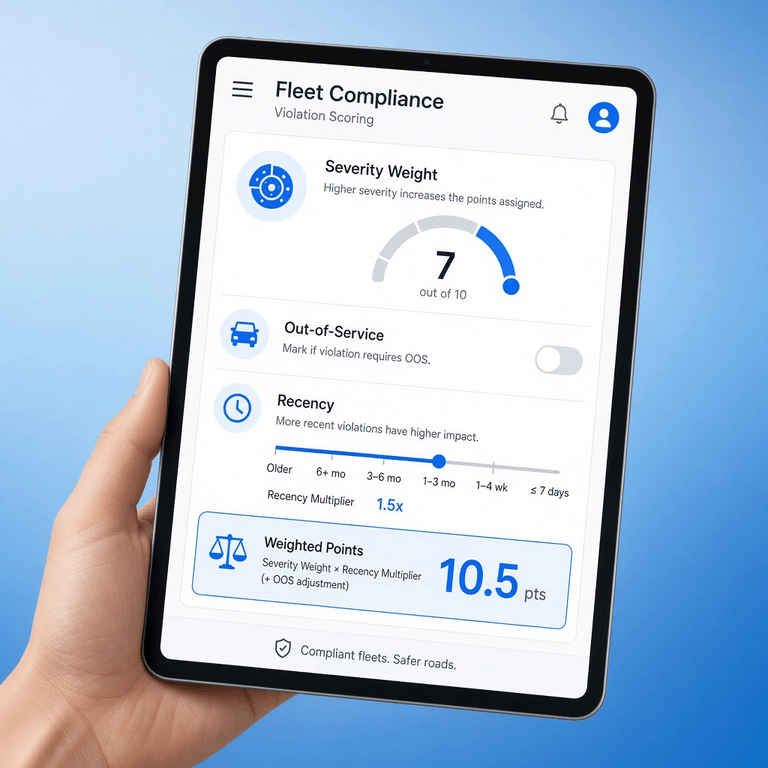
The Bottom Line Up Front: Your CSA score is not an abstract compliance metric — it is a filter that freight brokers, shippers, and insurers apply before they will do business with you. The Vehicle Maintenance BASIC score is calculated using a specific formula: each violation gets a severity weight from 1 to 10, an extra 2 points if it triggered an out-of-service order, and a time multiplier of 3x, 2x, or 1x depending on how recently it happened. You cannot edit that math after the fact. The only way to actually lower your Vehicle Maintenance BASIC percentile is to prevent the violation from ever reaching a roadside inspector — which is exactly what a strictly enforced digital DVIR workflow is built to do.
Key Takeaways: Lowering Your CSA Vehicle Maintenance BASIC Score
- Your CSA score is a sales tool, not just a safety record: brokers and shippers screen public SMS data before award, and a high Vehicle Maintenance percentile can quietly disqualify you before a rate negotiation ever starts.
- The score is pure math: severity weight (1–10) + 2 points if out-of-service, multiplied by a time weight of 3x, 2x, or 1x based on recency, summed across a rolling 24-month window.
- Repairing a defect does not erase the violation: once a roadside inspector writes it up, it stays on your SMS profile for up to 24 months regardless of how fast you fixed it.
- Prevention is the only lever that works: a defect caught and resolved during a mandatory pre-trip digital DVIR, before the truck ever reaches a scale house, never becomes a scoreable violation at all.
Why Your CSA Score Is a Revenue Problem, Not Just a Compliance Problem
A high CSA score costs you freight before it costs you a fine. Most freight brokers, 3PLs, and shipper compliance teams run every prospective carrier's DOT number through the FMCSA's public Safety Measurement System (SMS), or a third-party monitoring platform built on that same data, as a standard part of onboarding. An elevated percentile in the Vehicle Maintenance BASIC is one of the most common automatic disqualifiers in that screening — often flagged before a dispatcher ever sees your rate confirmation, and independent of whether you have ever failed a formal compliance review.
This is the part of CSA scoring that gets lost in most compliance training: the Safety Measurement System was designed as a prioritization tool for FMCSA enforcement, but it has been adopted, almost universally, as a due-diligence tool by the private freight market. Insurance underwriters price policies against BASIC percentiles. Large shippers bake maximum acceptable SMS thresholds directly into their carrier qualification standards. Load boards and freight-matching platforms increasingly surface SMS status alongside your MC number. None of that requires FMCSA to open an investigation — the market does the filtering on its own, automatically, every time your number gets checked.
For a small or mid-size carrier, this creates a brutal asymmetry. A large fleet with hundreds of power units can absorb a handful of bad inspections without moving its percentile much, because the SMS ranks carriers against peers with similar inspection volume and the score is normalized per inspection. A 15-truck carrier with the same handful of violations sees its percentile spike hard, because there is a much smaller sample size diluting the impact. That means the fleets who can least afford to lose a premium contract are exactly the fleets most exposed to a fast, damaging swing in their Vehicle Maintenance BASIC.
The financial chain runs in a predictable sequence: a driver misses a defect during a rushed pre-trip → a roadside inspector cites it → the violation is weighted and posted to the carrier's SMS profile within days → the Vehicle Maintenance percentile climbs → a broker's automated carrier vetting tool flags the account → the load offer never arrives, or arrives at a lower rate reflecting perceived risk. None of that sequence requires an audit, a citation in court, or even a phone call. It happens silently, inside procurement software you will never see, and the first sign a carrier usually gets is a quieter phone from brokers who used to call regularly.
Inside the SMS: What a CSA Score Actually Measures
The Safety Measurement System organizes roadside inspection and crash data into seven Behavior Analysis and Safety Improvement Categories, commonly called BASICs, and ranks each carrier against peer carriers of similar size and inspection volume within each category, producing a percentile from 0 to 100 where a lower percentile is better.
The seven current BASICs are Unsafe Driving, Hours-of-Service Compliance, Driver Fitness, Controlled Substances/Alcohol, Vehicle Maintenance, Hazardous Materials Compliance, and the Crash Indicator. Each BASIC has its own intervention threshold — the percentile at which FMCSA begins prioritizing a carrier for a warning letter, a targeted roadside enforcement effort, or a full compliance review. For general freight carriers, the Vehicle Maintenance BASIC's current intervention threshold sits at the 80th percentile, meaning a carrier scoring worse than 80% of its peer group becomes a visible enforcement priority, on top of whatever damage the score has already done in the freight market.
The Vehicle Maintenance BASIC specifically captures violations tied to the mechanical condition and required equipment of commercial motor vehicles: brakes, tires, steering and suspension components, lighting, coupling devices, cargo securement, and defective or missing required equipment. It is calculated from every violation cited during every roadside inspection your fleet's vehicles undergo, whether or not the inspection resulted in an out-of-service order. This is the single BASIC most directly influenced by the quality of a fleet's own pre-trip and post-trip inspection discipline, because unlike Unsafe Driving or Hours-of-Service, which are driven by behavior at the moment of the stop, Vehicle Maintenance violations are frequently defects that existed — and were arguably discoverable — well before the vehicle ever reached the scale house.
A Note on the Coming SMS Overhaul
FMCSA has approved, but has not yet launched, an updated SMS methodology that would rename BASICs to "compliance categories," simplify severity weights to a 1-or-2 scale, and split Vehicle Maintenance into two categories — one for defects a mechanic or Level 1 inspector would find, and a new "Vehicle Maintenance: Driver Observed" category built specifically around defects a driver's pre-trip and post-trip inspection should catch. As of this article's publication, FMCSA has not announced an official go-live date, and the 1-to-10 severity weight methodology described throughout this article remains the live, governing system. Carriers can preview how their current scores would look under the pending methodology using FMCSA's Prioritization Preview tool. The practical takeaway does not change under either system: documented, photo-verified pre-trip inspections are about to matter even more, not less, to your score.
The Math Behind Your Vehicle Maintenance BASIC Score
Every violation's contribution to your Vehicle Maintenance BASIC score is calculated as: (base severity weight, 1 to 10, plus 2 additional points if the violation triggered an out-of-service order) multiplied by a time weight of 3, 2, or 1 depending on how recently the violation occurred. Those weighted points are summed across every inspection in the rolling 24-month window, then normalized against your inspection volume and compared to peer carriers to produce your percentile.
Each piece of that formula deserves its own explanation, because it is the specific mechanics — not a vague sense of "bad inspections" — that determine whether a carrier's score climbs slowly or spikes overnight.
Severity weight: not all defects are scored equally
According to FMCSA's SMS Methodology documentation, every specific violation code is assigned a severity weight from 1 to 10 within its BASIC, reflecting how strongly that violation type correlates with crash occurrence and crash severity based on FMCSA's statistical modeling. Critically, severity weights are BASIC-specific and cannot be compared across BASICs — a weight of 6 in Vehicle Maintenance represents a different underlying crash-risk relationship than a weight of 6 in Unsafe Driving. Within the Vehicle Maintenance BASIC, a burned-out marker lamp and a defective brake system sit at opposite ends of that 1-to-10 scale, and the gap between them is exactly what makes some inspection failures far more damaging than others.
The out-of-service bump: a defect that grounds your truck also grounds your score
Within the Vehicle Maintenance, Hours-of-Service, Driver Fitness, and Hazardous Materials BASICs, any violation that results in an out-of-service order receives an additional 2 points added directly to its base severity weight, before the time multiplier is applied. A brake defect with a base severity weight of 4 that is also severe enough to place the vehicle out of service is scored as a 6 for that inspection — a 50% increase in weighted points purely because of the OOS designation, independent of anything else about the inspection.
Time weight: the 24-month clock that never stops running
Once a severity weight (plus any OOS bump) is established, it is multiplied by a time weight based on how long ago the violation was recorded: 3x for violations from the most recent 6 months, 2x for violations 7 to 12 months old, and 1x for violations 13 to 24 months old. Violations older than 24 months are dropped from the calculation entirely. This means a fleet's most recent quarter of inspection performance carries disproportionate weight in its current score — a cluster of bad inspections in the last 6 months can dominate a Vehicle Maintenance BASIC percentile even if the previous 18 months were clean.
Put the full formula together with a real example: a driver misses a defective turn signal lamp (severity weight 6, non-OOS) during a roadside inspection two months ago. That single violation currently contributes 6 × 3 = 18 weighted points to the carrier's Vehicle Maintenance BASIC. In another six months, once it crosses the 6-month mark, that same violation's contribution drops to 6 × 2 = 12 points, then to 6 points once it passes 12 months, and finally to zero once it passes 24 months. The violation record itself never changes — only its weighted contribution to the live score does, purely as a function of time. FMCSA also caps the sum of severity weights from any single inspection at 30 points per BASIC, which prevents one catastrophically bad inspection from mathematically overwhelming a carrier's entire profile on its own.
Are high SMS scores costing you loads? Prevent violations before they happen with PTI4YOU — digital DVIRs that ground a defective truck before it ever reaches a scale house.
Why Recent Violations Hurt More: The 24-Month Lookback Explained
Roadside inspection violations remain on a carrier's SMS profile for 24 months, with violations occurring in the most recent 6 months carrying the heaviest time-weight multiplier of 3x — which means the single worst thing that can happen to a Vehicle Maintenance BASIC score is a run of bad inspections concentrated in a short window, rather than the same number of violations spread evenly across two years.
This has a direct strategic implication that most safety directors underestimate: a fleet that goes through a rough patch — a new terminal opening with inexperienced drivers, a maintenance backlog during a busy season, a batch of aging trailers nearing replacement — can watch its Vehicle Maintenance percentile spike hard within a single quarter, purely from the concentration of the 3x multiplier. That spike will not meaningfully improve just because the fleet fixes the underlying problem the following month. The violations already on record continue accumulating weighted points at the 3x rate until they individually age past the 6-month mark, then the 2x mark, then finally drop off at 24 months.
In practice, this means a carrier cannot "fix" a bad Vehicle Maintenance score quickly through better maintenance alone. Improved maintenance and inspection discipline stops new violations from being added, but it does nothing to accelerate the decay of violations already on the books. The only two forces that reduce an existing score are time (as violations age past 6, 12, and 24 months) and the absence of new violations diluting the average as the inspection count grows. That is precisely why prevention has to start today, not after the current quarter's damage is already done — every month without a new Vehicle Maintenance violation is a month the existing 3x-weighted violations are drifting toward the 2x tier, and every new violation resets that clock at the worst possible multiplier.
Top Vehicle Maintenance Violations and Their Severity Weights
The table below shows real, published severity weight examples for common Vehicle Maintenance BASIC violation codes, drawn from FMCSA's public SMS carrier profile data. Use it to see exactly why a "minor" defect and a "serious" defect are treated so differently by the math — and to prioritize your own pre-trip checklist around the items that carry the most scoring risk.
| Violation | Base Severity Weight | Typically OOS? | Effective Weight if OOS |
|---|---|---|---|
| Clearance/marker/ID lamp inoperative or missing | 2 | Rarely | 4 |
| License plate lamp missing | 2 | Rarely | 4 |
| Oil or grease leak (lubrication) | 3 | Rarely | 5 |
| Brake out of adjustment | 4 | Sometimes | 6 |
| Air brake audible leak / ABS malfunction lamp defective | 4 | Sometimes | 6 |
| Drum or disc brake friction surface / lining defect | 4 | Sometimes | 6 |
| Fails air brake loss-rate test | 4 | Often | 6 |
| Headlamp(s) or backup lamp inoperative | 6 | Rarely | 8 |
| Cargo not secured against shifting/spilling | 7 | Often | 9 |
| Defective service brakes ≥20% of total service brakes | 7–8 | Always | 9–10 |
| Steer tire front, in contact with part of the vehicle | 8 | Always | 10 |
Severity weights are drawn from real violation codes published in FMCSA's SMS carrier profile system and methodology documentation; exact weights are periodically revised by FMCSA and should be confirmed against the current SMS Methodology Appendix A for a specific violation code.
Notice the pattern: lighting defects sit at the low end of the scale (severity weight 2) precisely because FMCSA's crash-risk modeling shows a weaker statistical relationship between a burned-out marker lamp and a resulting crash. Brake, tire, and cargo securement violations sit much higher (6 to 8, before any OOS bump) because they correlate far more strongly with loss-of-control and cargo-related crash events. This is exactly the "worn brakes versus a non-functioning clearance light" comparison that trips up drivers doing a rushed, unstructured walk-around — both look like a single line item on a paper form, but one is worth roughly three to four times as many weighted points as the other, and considerably more once an OOS order is added.
Stop Scoring Points You Don't Have To
PTI4YOU's digital DVIR workflow forces drivers through a structured, photo-documented inspection that flags brake, tire, and lighting defects before dispatch — the exact violation categories that carry the highest severity weights in your Vehicle Maintenance BASIC.
Start your 15-day free trial today. No credit card required.
Start Your 15-Day Free Trial – No Credit Card RequiredZero setup fees. Zero hardware. 25-minute driver onboarding.
Why Reactive Maintenance Can't Protect Your Score
Reactive maintenance — fixing defects only after a roadside inspector or a driver's complaint identifies them — cannot protect a Vehicle Maintenance BASIC score, because by the time a defect is reactively addressed, the roadside violation that exposed it has almost always already been written up and posted to the carrier's SMS profile.
This is the mental model that trips up a lot of otherwise well-run maintenance departments: they treat CSA scoring as a lagging indicator of how well-maintained their fleet is, when it is actually a lagging indicator of how well their drivers' pre-trip and post-trip inspections caught defects before a roadside inspector did. A shop that turns around every reported defect within 24 hours is running a genuinely tight maintenance operation — but if the defect was first discovered by a state trooper at a scale house rather than by the driver in the yard, the violation is already scored, the severity weight is already assigned, and the repair speed afterward has zero effect on the SMS calculation.
The only way to actually move the needle on a Vehicle Maintenance BASIC score is to shift the point of discovery earlier — from the roadside inspection back to the driver's own structured pre-trip walk-around, before the vehicle ever leaves the yard. A defect caught and resolved at that stage generates no roadside citation, no severity weight, no time-weight multiplier, and no OOS bump, because it never becomes part of the SMS dataset in the first place. This is the single most important distinction in this entire topic: repair speed protects your maintenance budget and your uptime; discovery speed protects your CSA score.
How Digital DVIRs Physically Prevent These Violations From Ever Happening
A strictly enforced digital DVIR prevents Vehicle Maintenance violations by making three things structurally impossible to skip: mandatory photo evidence of the components being inspected, forced classification of every defect into a clear severity tier, and a hard dispatch block on any vehicle carrying an unresolved critical defect — three controls that a paper checklist, by its nature, cannot enforce.
Mandatory photo evidence closes the "I checked it" loophole
A paper DVIR asks a driver to check a box next to "brakes" and sign. There is no way to verify, after the fact, whether that box reflects a genuine 30-second inspection or a rushed signature at the end of a long shift — a pattern our guide to stopping pencil-whipped inspections covers in depth. A digital DVIR that requires a timestamped photo of specific components — a tire's tread and sidewall, a brake chamber, a marker lamp, a coupling device — converts a subjective checkbox into an objective, reviewable record. Drivers who know a photo is required for a given inspection point are measurably less likely to skip a genuine visual check of that component, simply because the shortcut of a blind checkmark is no longer available to them.
Three-tier defect classification forces a decision, not a shrug
When a driver does find something wrong, a well-designed digital inspection workflow does not let them log a vague note and move on. It forces a specific triage decision into one of three categories: okay (inspected, no defect found), needs future attention (a minor issue noted for scheduled service, not a safety-critical condition), or immediate attention (a safety-critical defect that must be resolved before the vehicle is dispatched). This triage structure is the same discipline we detail in our guide to preventive maintenance inspections and mechanic action indicators, and it matters enormously for CSA protection specifically: an item flagged "immediate attention" is precisely the category of defect — brakes, steering, tires, coupling devices — that carries the highest severity weights and the highest OOS risk if it reaches a roadside inspector instead of a shop.

A hard dispatch block turns policy into physics
The final and most important control is architectural, not procedural: a vehicle carrying an open "immediate attention" defect should be structurally prevented from being dispatched, not merely flagged for a dispatcher to notice if they happen to look. When that block is enforced by the software itself — not by a sticky note or a verbal reminder — a defective truck simply cannot leave the yard with a known critical defect, which means it cannot generate the roadside violation that would have scored against the Vehicle Maintenance BASIC in the first place. This is the exact mechanism separating a fleet that talks about safety culture from one that mathematically cannot dispatch its way into a bad CSA score.
How PTI4YOU Turns Inspection Data Into Score Protection
PTI4YOU was built around the specific insight that CSA score protection is a data architecture problem, not a training problem. A few design choices make the prevention mechanism described above enforceable in daily operations rather than aspirational.
A three-role workflow: driver, inspector, reviewer
Every reported defect moves through a structured, three-role approval path — from the driver who first identifies and photographs it, to the inspector or mechanic who performs and documents the repair, to the reviewer who verifies and signs off before the record is closed. This mirrors the same driver-mechanic-driver signature discipline we cover in our guide to the FMCSA 396.11 three-signature cycle, extended with an explicit reviewer role so that no single person's judgment call is the only thing standing between a critical defect and a dispatch decision.
Side-of-vehicle defect mapping for combination units
For fleets running trailers alongside power units, defects can be logged and photographed against the specific side and location of the unit — driver's side, curb side, front, rear — rather than a generic free-text note. That level of specificity matters when a mechanic needs to locate a defect quickly during a busy shift, and it produces a far more defensible record if a repair is later questioned during a DataQ challenge or an audit.
Every predictive CSA strategy starts with accurate inspection data. PTI4YOU turns strictly enforced digital DVIRs into a hard barrier between a defective vehicle and a scale house — converting compliance from a cost center into a direct freight-revenue protection strategy.
Recurring defect visibility across the fleet
Because every inspection record is centralized and searchable, a safety director can see recurring defect patterns across specific units, routes, or drivers — a trailer that keeps generating the same lighting defect, or a driver whose inspections consistently miss the same category of issue. That visibility turns CSA protection from a reactive, inspection-by-inspection exercise into a proactive maintenance-planning input, closing the loop between what the Vehicle Maintenance BASIC is measuring and what the fleet's own maintenance program is actually doing about it.
The lock_date Feature: Why Immutable Records Matter for Audits and Safety Fitness
A digital inspection record that can still be edited after the fact is not meaningfully better than a paper form for audit purposes; the lock_date feature freezes a completed DVIR against any further modification once it has been reviewed and closed, creating a tamper-evident record that can be produced during a compliance review or a Safety Fitness Determination with full confidence in its integrity.
This matters for two related but distinct reasons. First, during an FMCSA compliance review or off-site audit — the exact scenario detailed in our guide to surviving a DOT safety audit — an auditor is not just checking whether a DVIR exists, but whether it can be trusted as an accurate record of what happened when. A record with a locked timestamp and no possibility of retroactive editing answers that question definitively; a record that could theoretically have been altered after the fact invites exactly the kind of scrutiny that turns a routine audit into a prolonged one.
Second, immutable records support a carrier's broader case during a Safety Fitness Determination review, where FMCSA and, increasingly, insurers and brokers are evaluating not just your violation count but the credibility of your safety management systems overall — the same theme we cover in our companion piece on Safety Fitness Assessment and NRII integration. A fleet that can instantly produce twenty-four months of locked, photo-documented, three-role-verified inspection records is making a fundamentally stronger case for its own safety management maturity than a fleet producing a stack of signed paper forms with no independent way to verify when, or by whom, they were actually completed.

A 90-Day Plan to Start Lowering Your Vehicle Maintenance BASIC
Because existing violations cannot be erased, only allowed to age out, the most effective 90-day plan focuses entirely on stopping new violations from being added while your existing weighted points naturally decay toward the next time-weight tier.
- Pull your current Vehicle Maintenance BASIC detail report. Log in to your SMS profile and identify exactly which violation codes, and which specific units or drivers, are driving your current percentile.
- Rank your problem violations by severity weight, not by count. A single severity-8 violation matters more to your score than three separate severity-2 violations; prioritize your pre-trip checklist emphasis accordingly.
- Mandate photo evidence on your highest-severity inspection points. Require timestamped photos specifically for brakes, tires, steering components, and coupling devices — the items carrying the highest severity weights in the table above.
- Enforce a hard dispatch block on immediate-attention defects. Make it a system rule, not a policy memo, that a vehicle with an open critical defect cannot be assigned a load.
- Review recurring defects weekly, not quarterly. A unit or driver generating the same defect repeatedly is a leading indicator of a future roadside violation, and catching the pattern early prevents it from ever reaching a scale house.
- Lock every completed inspection record. Build your audit-readiness posture continuously, so a Safety Fitness Determination review or DOT audit never catches your documentation off guard.
- Track your weighted-points trend monthly, not your raw violation count. Because of the 3x/2x/1x time-weight decay, your score can be improving even while your total violation count stays flat, simply because older violations are aging into lower multiplier tiers.
None of these steps require new hardware or a change to how dispatch operates day to day. They require replacing the weakest link in most fleets' current process — an unverifiable paper checkbox — with a structured digital workflow that makes skipping a genuine inspection materially harder than doing it correctly.
Frequently Asked Questions
How long do vehicle maintenance violations negatively impact a motor carrier's CSA score?
Roadside inspection violations remain on a carrier's SMS profile for 24 months, with violations occurring in the most recent 6 months carrying the heaviest time-weight multiplier of 3x. Violations recorded 7 to 12 months ago carry a 2x multiplier, and those recorded 13 to 24 months ago carry a 1x multiplier before dropping off the record entirely.
Can implementing an electronic DVIR directly lower a CSA score?
Yes, by proactive prevention rather than by editing history. Digital DVIRs ensure defective vehicles are grounded before dispatch, effectively eliminating the roadside violations that mathematically inflate the Vehicle Maintenance BASIC score. A violation that never happens can never be assigned a severity weight, a time weight, or an out-of-service penalty.
What is a severity weight in the FMCSA Safety Measurement System?
A severity weight is a score from 1 to 10 that FMCSA assigns to each specific roadside violation code, reflecting how strongly that violation is statistically associated with crash risk within its BASIC. Severity weights are BASIC-specific, meaning a weight of 5 in the Vehicle Maintenance BASIC is not equivalent to a weight of 5 in the Unsafe Driving BASIC.
How much does an out-of-service violation add to a CSA score?
In the Vehicle Maintenance, Hours-of-Service, Driver Fitness, and Hazardous Materials BASICs, a violation that results in an out-of-service order receives an additional 2 points added directly to its base severity weight before the time-weight multiplier is applied. A violation with a base severity weight of 6 that also triggers an OOS order is scored as an 8 for that inspection.
Does fixing a defect after a roadside violation remove it from my CSA score?
No. Repairing the defect does not remove the violation from the carrier's SMS profile. The violation and its weighted points remain on record for the full 24-month window regardless of how quickly the vehicle was repaired; only time, not repair, reduces its impact on the score.
What percentile triggers an FMCSA intervention in the Vehicle Maintenance BASIC?
Under the current SMS methodology, general freight carriers are prioritized for intervention in the Vehicle Maintenance BASIC once they reach or exceed the 80th percentile relative to peer carriers with similar inspection volume, though the exact threshold varies by carrier segment and is subject to change as FMCSA updates its methodology.
Do freight brokers actually check CSA scores before awarding loads?
Yes. Most freight brokers, 3PLs, and shipper compliance departments use the FMCSA's public SMS data, or a third-party monitoring service built on it, as part of routine carrier vetting. A carrier with an elevated Vehicle Maintenance BASIC percentile is a common automatic disqualifier in broker onboarding checklists, independent of whether that carrier has ever failed a formal safety audit.
Is the FMCSA changing how CSA scores are calculated?
FMCSA has approved a future overhaul of the Safety Measurement System that would simplify severity weights to a 1-or-2 scale, rename BASICs to compliance categories, and split Vehicle Maintenance into two categories, but as of this article's publication FMCSA has not announced an official launch date, and the current 1-to-10 severity weight methodology described in this article remains the live, governing system.
Conclusion: The Score Is Math, and Prevention Is the Only Variable You Control
A Vehicle Maintenance BASIC score is not a subjective judgment about your fleet — it is the direct output of a formula applied to every violation your vehicles accumulate at the roadside, weighted by severity, boosted by out-of-service status, and multiplied by how recently it happened. You cannot negotiate with that math after a violation is written up, and you cannot repair your way out of it once an inspector has already recorded the defect. The score only moves in two ways: violations age out over 24 months, or new violations stop being added.
That leaves prevention as the only lever a fleet actually controls. A digital DVIR workflow that mandates photo evidence, forces a clear defect triage decision, enforces a hard dispatch block on critical defects, and locks every completed record against tampering shifts the point of discovery back to the yard, where a defect costs you a repair instead of a severity-weighted, time-multiplied, permanently recorded hit to the score that brokers and insurers are already watching.
Protect Your Vehicle Maintenance BASIC Before the Next Roadside Inspection
Give every driver a structured, photo-verified pre-trip workflow that catches defects before they become scoreable violations — and give every completed inspection a locked, audit-ready record the moment it's closed.
Start your 15-day free trial today. No credit card required.
Start Your 15-Day Free Trial – No Credit Card RequiredZero setup fees. Zero hardware. 25-minute driver onboarding.
Official Sources and Further Reading
- FMCSA — Safety Measurement System (SMS) Methodology
- FMCSA — CSA Prioritization Preview (pending SMS methodology changes)
- Federal Register — Enhanced Carrier Safety Measurement System (SMS), November 20, 2024
- eCFR — 49 CFR 396.11: Driver Vehicle Inspection Reports
This article reflects the SMS methodology in effect as of September 19, 2026, including published severity weight examples and the current time-weighting formula. FMCSA has approved but not yet launched an updated methodology; carriers should confirm current thresholds and weights against FMCSA's official SMS resources before making compliance decisions.