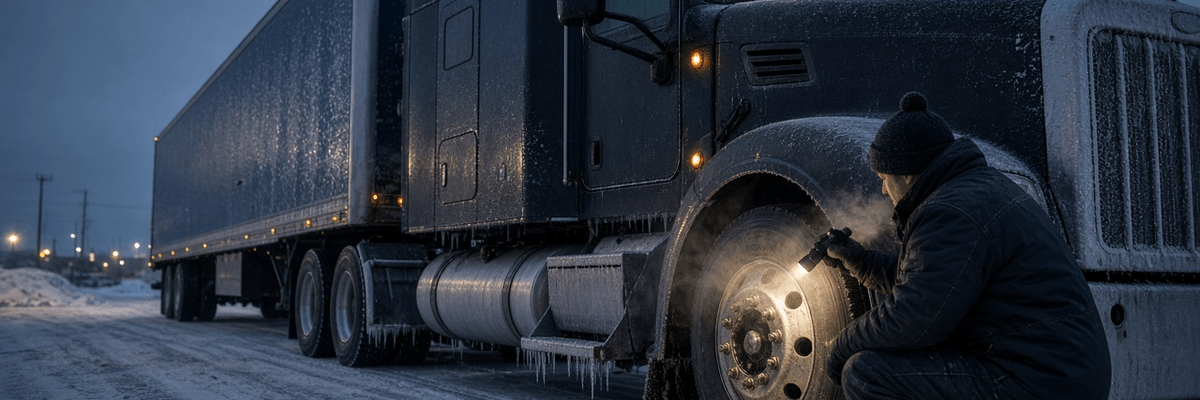
The Bottom Line Up Front: A winter pre-trip inspection has to check things a summer inspection never touches: air tank moisture ejectors and air dryer heaters (to prevent frozen brake lines), block heater function, Diesel Exhaust Fluid for gelling below 12°F, tire chain integrity, coolant freeze protection, and winter-grade washer fluid. Skipping these items does not just risk a citation — it risks a brake that will not release on an icy grade or a truck that will not start at a fuel stop in sub-zero weather. The fastest way to close this gap is a dedicated "Winter Ops" inspection item group that a fleet manager can build and push to every relevant driver's app in about fifteen minutes, with no coding and no waiting on IT. Folding these checks into your heavy-duty truck winterization checklist now, rather than after the first cold snap, is what separates a routine season from an expensive one.
Key Takeaways: Winter Pre-Trip Inspections
- Frozen air brakes are a life-safety issue, not a paperwork issue: condensation in the air system can freeze valves and lines shut, causing brakes that drag, lock, or fail to release entirely.
- DEF freezes at 12°F (-11°C) and expands roughly 7% by volume, so tanks need headroom and heater lines need to be verified functional before the cold sets in.
- Generic paper forms and rigid apps don't flex for the season: if a checklist item isn't there, drivers don't check it, and legacy platforms often require a developer ticket to add one.
- A configurable digital DVIR closes the gap in minutes: a fleet manager can build a "Winter Ops" item group and assign it only to the vehicle types that need it, updating every driver's app instantly.
Why a Winter Pre-Trip Is a Different Inspection, Not the Same One in a Coat
A pre-trip inspection performed in July and one performed in January should not be the same checklist executed in different weather — they need to check fundamentally different failure points, because cold temperatures create defect categories that simply do not exist the rest of the year.
Most fleet inspection programs are built around a single, static list of items derived from 49 CFR 396.11 and 396.13: brakes, tires, lights, steering, coupling devices, and the handful of systems federal regulation requires every driver to check before and after every trip. That baseline list is necessary, but it was never designed with a Minnesota parking lot at minus 15°F in mind. It says nothing about air tank moisture, block heaters, DEF, or tire chains, because those are seasonal and regional concerns, not universal ones. A dispatcher in Phoenix and a dispatcher in Winnipeg are running the same federal DVIR requirement, but only one of them needs a driver to confirm the air dryer heater is warm to the touch before pulling out of the yard.
The operational stakes of skipping that seasonal layer are not abstract. A vehicle that leaves the yard with moisture sitting in its wet tank can develop a frozen brake valve two hours into a route, at highway speed, on an exit ramp with black ice already reducing available traction. A driver whose block heater cord snapped overnight discovers it not in a warm shop but at a truck stop off I-94 at 4 a.m., unable to restart after a fuel stop, burning hours of detention time waiting for a road service call. None of these are hypothetical; they are the seasonal service calls that spike every year across northern fleets between late October and March, and nearly all of them are catchable in a five-minute pre-trip — provided the checklist actually asks the driver to look.
That is the argument for treating winter pre-trip inspections as their own discipline rather than an afterthought bolted onto the existing DVIR. The rest of this guide walks through exactly what a cold-weather inspection needs to cover, zone by zone, and then addresses the operational problem underneath it: most DVIR software was never built to let a fleet manager add these items without a support ticket or a multi-week wait for a vendor's product roadmap.
Anatomy of a Winter Pre-Trip Inspection
A complete cold-weather pre-trip inspection adds four zones of scrutiny on top of the standard federal DVIR: the air and brake system, the engine and starting system, fluids and fuel, and the chassis and traction components — each with specific, physically verifiable checks that a driver can complete in under five minutes.
| Zone | Specific Winter Checks | Why It Matters |
|---|---|---|
| Air & Brake System | Manually drain wet tank moisture ejector, confirm air dryer heater is warm to the touch, inspect for cracked gladhand seals, listen for abnormal air leaks | Condensation left in the system freezes valves and lines shut, causing brakes that drag or fail to release entirely |
| Engine & Starting System | Verify block heater cord and plug are undamaged, confirm heater cycled overnight (coolant should feel warm), check battery terminals for corrosion | Cold cranking amps drop sharply below freezing; a failed block heater or corroded terminal is the single most common no-start cause in winter |
| Fluids & Fuel | Check DEF level and look for frozen tank indicators, verify coolant freeze-protection rating, confirm winter-blend diesel or fuel additive, top off winter-grade washer fluid | DEF freezes at 12°F, fuel wax crystallization can clog filters, and summer washer fluid freezes solid in the reservoir and lines |
| Chassis & Traction | Inspect tire chain condition, count links, verify tensioners, confirm correct chain size is carried for the route, check tire tread depth and pressure | Cold air drops tire pressure roughly 1-2 PSI per 10°F, and a missing or damaged chain set is a compliance failure on chain-law routes |
| Visibility & Electrical | Confirm all marker, brake, and headlamps are clear of ice and functioning, test defroster and wiper output, inspect mirrors for ice buildup | Shorter daylight hours and reduced storm visibility make functioning lights and clear glass a direct crash-prevention factor |
Each of these five zones deserves its own detailed walkthrough, because the failure mechanics behind them are different enough that a driver who understands why they matter is far less likely to skip the check on a bitterly cold morning when every instinct says to get moving.
Air Brake Systems: The Silent Winter Killer
Air brake systems fail in winter because compressed air always carries moisture, and once that moisture reaches valves or lines and the temperature drops far enough, it freezes solid — blocking airflow and producing brakes that drag, lock, or fail to apply or release at all.
The mechanics are straightforward once you understand the plumbing. A truck's air compressor draws in ambient air to pressurize the brake system, and that air, no matter how dry the day feels, always contains some humidity. As the compressor pushes hot, pressurized air into the tanks, it cools, and the water vapor it was carrying condenses into liquid. In warm weather that condensation just sits in the tank until it is drained. In cold weather, if it migrates into a valve or line before it is removed, it can freeze — and once ice blocks a passage, the air behind it cannot move the way the system was designed to. Depending on where the blockage forms, the result ranges from a sluggish brake application to a brake that will not release, which on a downgrade is exactly the failure mode you cannot afford.
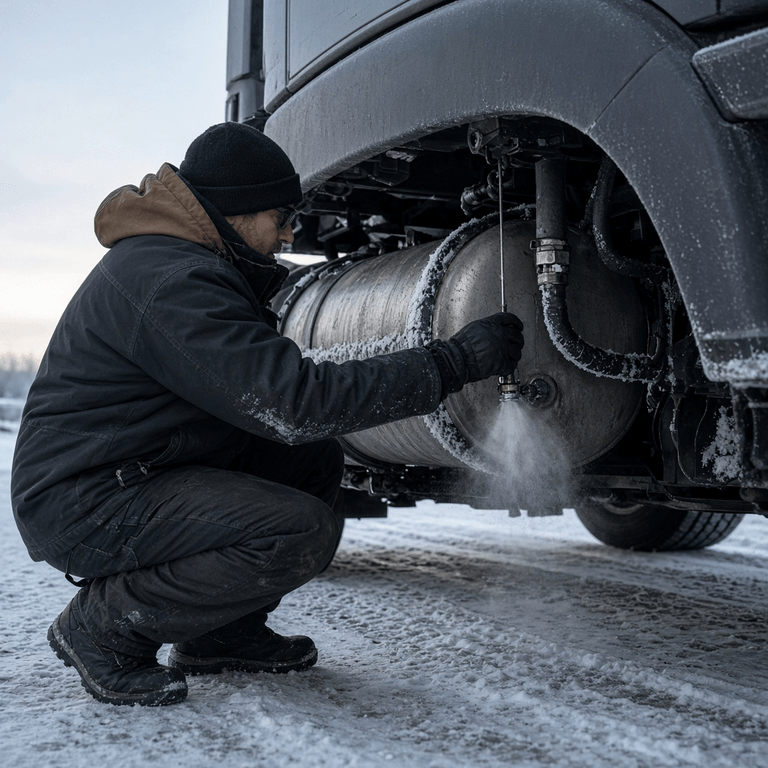
Two components exist specifically to prevent this, and both belong on a winter pre-trip. The wet tank — the first reservoir the compressor fills — has a moisture ejector, either a manual drain valve or an automatic one, and it needs to be actuated at the start of winter operations regardless of which type is installed, since automatic valves themselves are prone to failure and need periodic verification. The air dryer, positioned between the compressor and the tanks, strips moisture out of the air before it reaches the reservoirs, relying on a desiccant cartridge that should be replaced annually ahead of the cold season, plus a heater element that keeps its internal purge valve from icing over. A driver checking a winter DVIR should be able to place a hand near the base of the air dryer with the engine running and feel warmth; if it is cold to the touch while the truck is operating, the heater has likely failed and needs immediate attention.
This is also where a routine winter breakdown becomes a documented federal violation. A brake that fails to build adequate pressure or does not release properly is a defect under 49 CFR 393.48, and brake-system violations already account for roughly half of all out-of-service orders issued at roadside, a pattern CVSA's Operation Airbrake program was built to address. Our detailed breakdown of CVSA Brake Safety Week's inspection criteria covers exactly which brake defects trigger an out-of-service order, and a frozen valve found roadside is scored no differently than a worn lining — it still costs the fleet everything our out-of-service downtime cost analysis quantifies in lost hours, rebooked freight, and detention pay.
One more point matters enough to state plainly: if a line or valve does freeze anyway, the fix is patience, not chemistry. Industry guidance from brake manufacturers is unambiguous that pouring alcohol or de-icing fluid into an air system as a routine fix damages rubber seals and washes lubricant out of valves, creating new leaks down the line. The correct response to a frozen air line is to move the vehicle into a heated space and let it thaw naturally — not a substitute for keeping moisture out of the system in the first place through disciplined daily draining.
A Realistic Scenario: The Grade That Didn't Care About the Schedule
A tanker driver leaves a Minnesota terminal at 3 a.m. in minus 12°F weather, running behind schedule after a late load. The pre-trip is rushed: brakes look fine, air pressure builds normally in the yard, and the truck rolls. Forty minutes later, descending a long grade with a loaded tank pushing hard from behind, the driver applies the brakes and gets a delayed, uneven response — ice sitting undrained in a line since the previous shift had partially blocked it, and the overnight cold snap finished the job. The driver controls the descent using engine braking and downshifts, but it's close enough to prompt an out-of-service tag at the next inspection point.
The corrective action afterward is not a lecture about caution; it's a checklist gap. The driver had never been specifically asked, in any digital or paper form, to confirm the wet tank had been drained that week. Once the fleet added a dedicated winter item requiring photo confirmation of the drain valve being actuated, the same failure mode did not recur that winter — a fifteen-minute fix against a defect that had come within seconds of a very different outcome.
Are your drivers actually checking the items that matter in January? Build a Winter Ops checklist in PTI4YOU and know every winter-specific item was confirmed and photographed before the truck left the yard.
Engine and Starting System: Block Heaters and Cold Cranking
A block heater keeps engine coolant warm overnight so a diesel engine starts reliably and suffers less internal wear during cold starts, and most manufacturers recommend using one whenever overnight lows fall into the 0°F to 20°F range — but the heater only helps if the cord, plug, and timer are actually functioning, which a pre-trip inspection needs to confirm rather than assume.
The physics here are worth understanding because it changes what a driver should actually be checking. Diesel engines rely on compression heat to ignite fuel, and when the engine block and the oil inside it are extremely cold, that compression generates less heat, cranking speed drops, and the starter and battery are placed under far more strain than at moderate temperatures. A block heater, typically an electric heating element installed in a core plug or coolant passage, keeps the coolant — and the block itself — warm enough that a cold start no longer means grinding the starter hoping the engine catches. Left unplugged or with a damaged cord, the heater does nothing, and the driver finds out only when the key turns and nothing happens.
The pre-trip check is simple but frequently skipped: inspect the extension cord for cracking, exposed wire, or water intrusion at the connection point, confirm the heater was actually plugged in and running overnight (a coolant gauge reading noticeably above ambient before start is a good indicator), and verify the timer, if the truck has one, is set for the expected departure time rather than left on a stale schedule. Transport Canada's winter vehicle preparation guidance flags battery and charging system condition alongside engine warming systems, since a fully charged battery paired with a properly warmed engine is what actually starts a truck at minus 20°F.
Battery condition deserves its own line item precisely because cold weather punishes it disproportionately. A battery's available cranking power drops significantly as temperature falls — a battery that cranks a warm engine without issue can struggle badly at 0°F even if it tested "fine" in summer. Corrosion on terminals adds resistance exactly when the system can least afford it. A winter DVIR item asking the driver to inspect terminals for corrosion and confirm there is no swelling or leakage on the battery case catches a failing battery before it strands a truck, rather than after.
Fluids and Fuel: DEF Gelling, Coolant, and Winter Blend
Three fluid systems need winter-specific attention: Diesel Exhaust Fluid, which begins freezing at 12°F and expands roughly 7% by volume; engine coolant, which needs verified freeze protection rather than an assumed 50/50 mix; and diesel fuel itself, which can gel or cloud with wax crystals in extreme cold if it is not winter-blended.
DEF is the newest of these concerns for many fleets, and drivers who came up on older equipment sometimes underestimate it. DEF is roughly two-thirds deionized water, and that water content means it freezes at 12°F (-11°C), turning to slush and then a solid block if temperatures stay low long enough. This is not itself a crisis: freezing does not degrade DEF's chemical effectiveness, and it performs normally once thawed. Nearly every modern SCR system includes a tank and line heater, drawing on engine coolant, that begins thawing frozen DEF automatically once the engine starts, and the truck can typically be driven immediately without waiting for it to fully liquefy. What a winter pre-trip should catch is the exception: a DEF heater that has failed, evidenced by repeated cold-weather fault codes or fluid that remains solid well into a route. The pre-trip item is simple — confirm the DEF level, leave headroom in the tank for expansion when it freezes, and flag any history of DEF-related fault codes for a technician.
Coolant freeze protection is easy to assume and expensive to get wrong. A 50/50 coolant-to-water mix typically protects to around -34°F, but a mix topped off inconsistently over time, or diluted with plain water during a summer repair, can have a meaningfully higher freeze point than the fleet assumes. A quick refractometer or test-strip check during fall service, logged as a pass/fail item, is the only way to know the actual protection level.
Fuel gelling rounds out the fluid concerns. Standard diesel contains paraffin wax that can crystallize at low temperatures, clouding the fuel and, in severe cases, clogging filters enough to starve the engine. Most fuel suppliers in northern climates automatically blend in a percentage of #1 diesel or anti-gel additives during winter to lower the cloud point, but fleets fueling across multiple regions should treat "did this fuel come from a winter-blended source" as a real pre-trip question, not an assumption.
Chassis and Traction: Tire Chains, Tread, and Chain Laws
Winter chassis checks center on tire chain integrity and correct sizing for mandatory chain-law routes, tread depth and inflation pressure (which drops with falling temperature), and a general inspection for ice or snow accumulation that can affect handling and add uncontrolled weight.
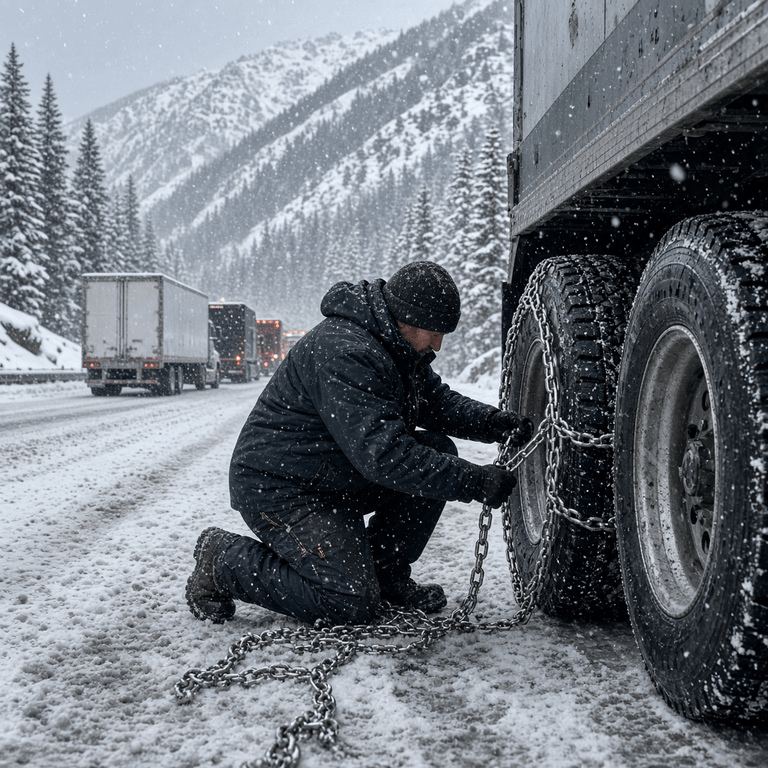
Several mountain corridors across the US and Canada require chains during active winter storms, and requirements are enforced with real teeth: sections of I-80 through the Sierra Nevada, I-70 through the Colorado Rockies, and mountain passes across British Columbia all have chain-law provisions that activate when conditions warrant. A driver caught without the right equipment on an active route faces both a citation and a truck that cannot safely continue. A winter pre-trip needs a specific line item confirming the correct number and size of chains for the vehicle's axle configuration are on board, not just that "chains are carried," since a mismatched or incomplete set found after the chain law activates is functionally the same as having none. Inspecting the chains themselves matters just as much as confirming their presence: broken or stretched links, missing cross members, and worn tensioners all reduce effectiveness exactly when the driver needs them working, on a grade, in active snowfall.
Tire pressure is a quieter but constant winter issue. Air contracts as temperature drops, and a tire correctly inflated on a 70°F afternoon can lose several PSI by the time an overnight cold snap sets in, without a single physical leak. Under-inflated tires reduce traction, generate excess heat at highway speed, and wear unevenly. A cold-weather DVIR should prompt drivers to physically check pressure rather than eyeball tread and sidewall condition alone, particularly after the first hard freeze and any significant temperature swing.
Visibility and Electrical: Lights, Wipers, and Batteries
Winter shortens daylight hours and adds snow, road spray, and salt film that can obscure lenses and glass far faster than in dry conditions, making functioning lights, effective defrost, and clean glass a direct factor in crash avoidance rather than a cosmetic checklist item.
The check here is less about new components and more about verifying existing ones under conditions that make failure more likely. Marker lamps, headlights, and brake lights should be inspected not just for function but for physical obstruction — ice, packed snow, and road grime accumulate on lenses in ways that reduce visible light output even when the bulb works perfectly. Wiper blades degrade faster in freezing precipitation, and a defroster that takes ten minutes to clear a windshield is a problem a driver discovers at the worst moment if it is not tested during the pre-trip rather than assumed functional.
Washer fluid deserves specific mention because it is one of the easiest items to get wrong: summer-grade fluid freezes solid in the reservoir and lines well above the temperatures a northern winter regularly produces, and a frozen reservoir can crack the tank or pump. Winter-grade fluid rated to -40°F, confirmed before the first freeze rather than after a driver reports a dry, frozen reservoir mid-route, closes this gap for the cost of a jug of fluid.
Why Static Checklists and Rigid Apps Fail When Temperatures Drop
A checklist item that doesn't exist can't be checked, and most commercial DVIR platforms — paper forms or apps with hard-coded templates — have no mechanism for a fleet manager to add a seasonal item without a developer change request, leaving winter defects structurally invisible to the inspection process.
This is where the technology problem and the safety problem converge. A driver who is never asked about air tank moisture, block heater condition, or DEF status is not being negligent by skipping those checks — the checklist in front of them simply does not mention them. Paper forms are the most obvious version of this failure: a form printed in bulk in June has no capacity to adapt at all. Many electronic DVIR platforms carry the same limitation in their architecture. If the inspection template is hard-coded into the app, adding a field means submitting a change request to the vendor and hoping the update ships before the season it was meant to address has already passed.
The operational consequence compounds over a season. Every driver working from a checklist that never mentions winter-specific items develops the same blind spot independently, which means a fleet is exposed to a systemic gap across its entire operation, not a single weak link. And because none of those missed checks show up as a violation until something fails — a frozen brake, a dead battery, a missing chain at a checkpoint — the gap is invisible on every compliance dashboard right up until it becomes an expensive incident report.
Fleets running mixed equipment across multiple asset classes face an even sharper version of this problem, since a single universal checklist forces irrelevant items onto vehicles that don't need them while still failing to cover the ones that do. Our companion guide on customizing digital inspections across mixed fleet asset types covers this same limitation for construction equipment and waste management vehicles, and the fix is identical: the platform needs to let non-technical fleet staff build and assign templates dynamically, rather than treating every checklist as fixed code.
Will Your DVIR Even Ask About Winter Items?
If adding a seasonal checklist item to your current app means submitting a support ticket, it's already too late for this winter. PTI4YOU lets any fleet manager build and deploy a custom item group in minutes.
Start your 15-day free trial today. No credit card required.
Start Your 15-Day Free Trial – No Credit Card RequiredZero setup fees. Zero hardware. 25-minute driver onboarding.
Building a Winter Ops Item Group Without Calling IT
PTI4YOU's inspection templates are built around configurable item groups, internally called TypeVehicleItemGroups, which let an ADMIN or MANAGEMENT-level user create a new set of checklist items and assign it to specific vehicle types — tractors or reefer units, for example — without writing code or waiting for a vendor release cycle.
The rollout is deliberately simple: a fleet manager, not a developer, should be able to do it in one sitting.
- Open the inspection template manager. Log in with an ADMIN or MANAGEMENT role and navigate to the item group configuration screen, the same place standard federal DVIR items already live.
- Create a new item group and name it clearly. Label it "Winter Ops" or "Cold Weather Checks," so there's no ambiguity about why a new section appeared in the app.
- Add the specific winter checkpoints. Build out the items covered earlier: air tank moisture ejector drained, air dryer heater warm, block heater cord intact, DEF heater functioning, tire chains present and undamaged, coolant freeze protection verified, winter-grade washer fluid topped off. Mark photo evidence mandatory on items prone to a quick, unverified checkbox.
- Assign the group to the right vehicle types. This step prevents seasonal bloat: rather than forcing every asset through winter items, assign the group only to vehicle types that need it — tractors and reefers, for instance — while yard spotters keep their existing template.
- Publish, and the update goes live immediately. No app store approval, no manual updates. The next time an assigned driver opens the app, the new Winter Ops items are simply there.
The contrast with a rigid platform is the entire value proposition here. A fleet running a locked-down app has to file that request in September and hope it lands on a roadmap before winter arrives regardless. A fleet running a genuinely configurable system can have the same change live before lunch and rolled out fleet-wide by the end of the week — the gap between a checklist that reflects actual operating conditions and one that reflects whatever a vendor's product team prioritized eighteen months ago.

Canadian fleets running cross-border routes should note that winter item groups layer alongside, not instead of, the jurisdiction-specific schedules already required under NSC Standard 13. A tractor crossing into Ontario in December still needs its Schedule 1 trip inspection items intact; Winter Ops simply adds cold-weather checks on top of the mandated baseline.
Your Printable Winter Operations Daily Checklist
For fleets not yet ready to configure a digital item group, the table below is designed to be printed and posted at a dispatch window as a standalone daily reference — the same content a digital Winter Ops group would enforce, formatted for a clipboard or a break-room wall.
| # | Inspection Item | Winter Standard |
|---|---|---|
| 1 | Wet tank moisture ejector | Manually drained (or automatic valve verified) every shift |
| 2 | Air dryer heater | Warm to the touch with engine running |
| 3 | Air system leak check | No audible leaks at gladhands, valves, or chambers |
| 4 | Block heater cord & plug | No cracking, exposed wire, or water intrusion |
| 5 | Overnight engine warming | Coolant temp noticeably above ambient before start |
| 6 | Battery terminals | Free of corrosion, connections tight |
| 7 | DEF level & tank headroom | Adequate level with room for expansion if frozen |
| 8 | DEF fault code history | No unresolved heater-related fault codes |
| 9 | Coolant freeze protection | Verified rated to at least -34°F |
| 10 | Washer fluid grade | Winter-rated to -40°F, reservoir full |
| 11 | Tire chains (route-dependent) | Correct size and count, no broken links, tensioners functional |
| 12 | Tire pressure | Checked and adjusted for current temperature |
| 13 | Lights & lenses | Clear of ice and snow, all functioning |
| 14 | Wipers & defrost | Blades effective, defrost clears windshield promptly |
Print this table, laminate it if it's going up at a fuel island, and treat it as the minimum floor for the season, not the ceiling. Fleets running specialized equipment or extreme northern routes should expand it with items specific to their own operation — precisely the gap a configurable digital item group closes permanently.
Before the First Freeze: A Fleet Manager's Prep Plan
Heavy-duty truck winterization is a short sequence of operational steps that should happen before the first hard freeze, not in reaction to the first stranded truck.
- Replace air dryer desiccant cartridges fleet-wide before the season starts. A cartridge that limped through last winter is not a bet worth making twice; annual replacement is the highest-leverage step against frozen air systems.
- Test every block heater and extension cord, not just the ones that get complaints. A heater that worked fine last March can have a corroded connection by October. Run a plug-in test before relying on it during an actual cold snap.
- Build and deploy the Winter Ops item group before the first storm, not during it. Configuring the checklist after a truck is already stranded roadside is a lesson learned the expensive way.
- Brief drivers specifically on what changed and why. A five-minute pre-shift explanation of why the moisture ejector item matters, backed by a real example like the grade scenario earlier in this guide, gets far more genuine compliance.
- Stock chain inventory against actual route requirements, not fleet averages. Confirm every truck assigned to a chain-law corridor is carrying a complete, correctly sized set — not just "some chains somewhere in the cab."
- Review DEF heater fault code history across the fleet before deep cold arrives. A unit that threw a DEF heater code last February and was cleared without a root-cause fix is likely to fail again.
- Confirm coolant freeze protection fleet-wide, not truck by truck as complaints come in. A batch test during fall service catches units running a weaker mix than assumed, before that gap becomes a cracked block.
None of these steps require new hardware or a significant budget line — just treating winter readiness as a scheduled task with an owner and a deadline, not something handled informally whenever a driver mentions the cold is coming.
Build Your Winter Ops Checklist Before the First Freeze
Give every driver a checklist that actually reflects January conditions — configured by your team in minutes, not requested from a vendor and hoped for by December.
Start your 15-day free trial today. No credit card required.
Start Your 15-Day Free Trial – No Credit Card RequiredZero setup fees. Zero hardware. 25-minute driver onboarding.
Frequently Asked Questions
What specialized vehicle components must be inspected during a winter pre-trip?
In sub-zero temperatures, drivers must rigorously inspect air tank moisture ejectors and the air dryer heater element to prevent frozen brake lines, the block heater and its power cord, tire chain integrity and tensioners, Diesel Exhaust Fluid (DEF) for gelling or freezing, coolant freeze-protection level, winter-grade washer fluid, and battery terminals, since cold cranking amps drop sharply as temperatures fall.
Can I add winter-specific inspection items to a standard digital DVIR app?
Advanced and flexible platforms like PTI4YOU allow fleet managers to dynamically create and update item groups without coding, seamlessly injecting winter prep requirements into the driver's daily digital checklist and assigning them only to the vehicle types that need them, such as tractors or reefers.
At what temperature do air brake lines start to freeze?
Moisture inside an air brake system can begin freezing valves and lines once temperatures drop into the range of roughly minus 4°F to minus 20°F (minus 4°F to minus 29°C), though the exact threshold depends on how much condensation has accumulated in the wet tank and whether the air dryer's heater element is functioning correctly.
What temperature does Diesel Exhaust Fluid (DEF) freeze at, and does it damage the engine?
DEF begins to freeze at 12°F (minus 11°C) and expands roughly 7% by volume as it solidifies. Frozen DEF does not damage the engine or the fluid itself; nearly all modern Selective Catalytic Reduction (SCR) systems include a built-in heater that thaws the tank and supply lines automatically once the engine is running.
Do I need a full walkaround if my truck has a block heater plugged in overnight?
Yes. A block heater only warms the engine coolant to ease starting and reduce cold-start wear; it does not replace a federally required pre-trip inspection under 49 CFR 396.13, and it has no effect on air brake moisture, tire chain condition, DEF status, or any other winter-specific item that only a physical walkaround can verify.
Are tire chains legally required for commercial trucks in winter?
Requirements vary by jurisdiction, but several US states and Canadian provinces mandate carrying or installing chains on designated mountain routes during active winter storms, such as sections of I-80 in the Sierra Nevada, I-70 in Colorado, and mountain passes in British Columbia. Drivers should confirm chain law requirements for their specific route before departure and inspect chain condition during the pre-trip.
How cold does it have to be to require a block heater?
Most diesel engine manufacturers recommend using a block heater whenever overnight temperatures drop below roughly 0°F to 20°F (minus 18°C to minus 7°C), since cold engine oil and coolant at those temperatures significantly increase starter strain and cylinder wear during cold starts.
Does a frozen air brake count as an out-of-service violation?
Yes. A brake that fails to release, drags, or does not build adequate air pressure violates federal brake performance requirements under 49 CFR 393.48 and is one of the most commonly cited out-of-service conditions during CVSA roadside inspections, particularly during cold-weather months when moisture-related freeze-ups spike.
Conclusion: The Checklist Has to Know What Season It Is
Winter does not create a single new category of risk for commercial fleets — it creates several at once, spread across the brake system, the engine, the fluids, the chassis, and the electrical system, and every one of them is preventable with a physical check a driver can perform in a few minutes. The failure mode that actually causes winter breakdowns and roadside violations is rarely a driver who doesn't care; it is a checklist that never asked the question.
That is solvable, and solving it doesn't require new hardware or a new vendor contract if a fleet already runs a configurable digital DVIR platform. It requires deciding, before the first hard freeze, which winter-specific items matter for a given fleet's routes and equipment, building them into a dedicated item group, and assigning it to the vehicle types that need it. PTI4YOU's TypeVehicleItemGroups architecture exists precisely so that decision can be made and deployed in an afternoon, not filed as a feature request and revisited next season.
Don't Let a Static Checklist Miss What Only Winter Reveals
Build a custom Winter Ops item group, assign it to the right vehicle types, and know every driver's app reflects the season — before the first hard freeze, not after the first roadside call.
Start your 15-day free trial today. No credit card required.
Start Your 15-Day Free Trial – No Credit Card RequiredZero setup fees. Zero hardware. 25-minute driver onboarding.
Official Sources and Further Reading
- Transport Canada — Preparing Your Vehicle for Winter
- Transport Canada — Winter Driving Safety Guidance
- CVSA — Operation Airbrake Program Overview
- CVSA — Brake Safety Campaigns
- eCFR — 49 CFR 393.48: Brakes to Be Operative at All Times
- eCFR — 49 CFR 396.13: Driver Inspection Requirements
This article reflects federal regulatory text, Transport Canada guidance, CVSA program information, and diesel component manufacturer technical data available as of October 10, 2026.