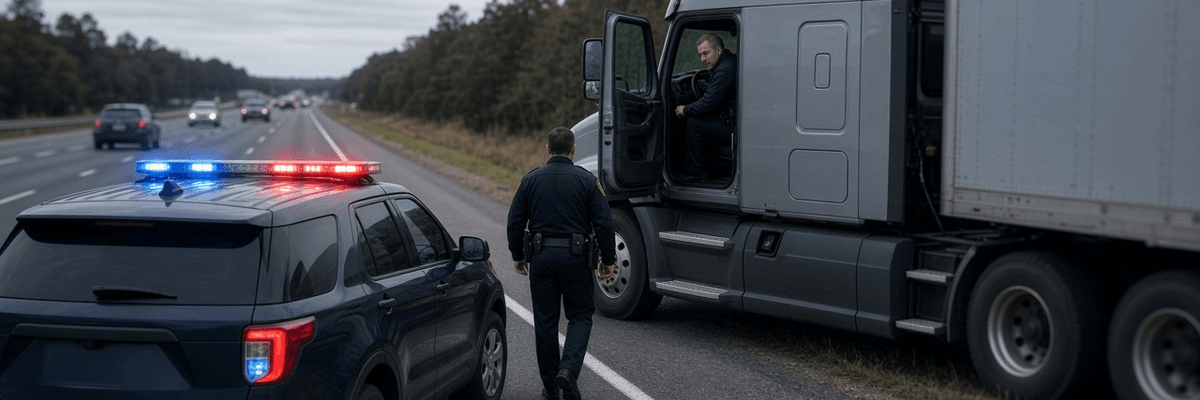
The Bottom Line Up Front: CVSA's Operation Safe Driver Week 2026 ran July 12–18, targeting reckless, careless, and dangerous driving behaviors across the United States, Canada, and Mexico. Official 2026 tallies have not yet been published, but last year's campaign pulled over 8,739 vehicles and issued 2,504 citations and 3,575 warnings, with speeding as the single largest violation category. The real compliance exposure for fleets is rarely the moving violation itself — it's what happens next. A traffic stop for speeding or following too closely routinely escalates into a full Level II or III inspection, and the first thing an officer asks for is the driver's inspection record. A driver who cannot produce a complete, signed DVIR on the spot turns a $200 speeding ticket into a vehicle placed out of service. This article recaps what actually happened during the 2026 campaign and lays out exactly what to fix before CVSA's next enforcement initiative arrives.
Key Takeaways: Operation Safe Driver Week 2026
- Operation Safe Driver Week 2026 ran July 12–18, with law enforcement across North America targeting reckless, careless, and dangerous driving specifically.
- Official 2026 results were not yet published at the time of this recap: based on the 2025 release timeline, expect CVSA to publish the 2026 tallies in the coming weeks.
- The moving violation is rarely the real risk: a stop for speeding or tailgating routinely escalates into a full DVIR and logbook check, which is where an unprepared driver gets an out-of-service order added to the original ticket.
- Preparation is the only lever fleets control: a driver who can produce a complete, locked, photo-verified inspection record instantly from their phone closes the single biggest gap enforcement officers look for.
What Happened During Operation Safe Driver Week 2026
The Commercial Vehicle Safety Alliance held Operation Safe Driver Week 2026 from July 12 through July 18, deploying federal, state, provincial, and local law enforcement across the United States, Canada, and Mexico to identify and cite unsafe driving behaviors among both commercial motor vehicle drivers and passenger vehicle drivers.
Unlike CVSA's other flagship initiatives, Operation Safe Driver Week is not a vehicle inspection blitz — it's a driver behavior blitz. International Roadcheck and Brake Safety Week put officers underneath trucks looking at brake components and mechanical condition. Safe Driver Week puts officers on the shoulder of the road watching how people actually drive, then pulling them over when they see it. According to CVSA's official April 30, 2026 announcement, this year's campaign, like the last several, centered on drivers who are speeding, using a phone, following too closely, driving fatigued, driving impaired, not wearing a seatbelt, changing lanes unsafely, or disregarding traffic control devices — and officers who spot any of those behaviors, in either a truck or a passenger car, are authorized to stop and cite the driver.
CVSA's own justification for the initiative is stark. The alliance's announcement cites 36,640 traffic deaths in the United States in 2025, an average of roughly 2,000 annual motor vehicle fatalities in Canada, and 15,979 road deaths reported in Mexico for 2022 — and notes that driver behavior, not vehicle condition, contributes to the overwhelming majority of crashes. That framing matters for fleets specifically: it means CVSA and its member agencies view Safe Driver Week as a behavior-correction campaign first, with citation and warning issuance serving mainly as the enforcement mechanism that gets a driver's attention.
As of this recap's publication, CVSA had not yet released the official count of citations and warnings issued during the 2026 campaign. That is not unusual: CVSA published its 2025 Operation Safe Driver Week results on October 14, 2025, roughly three months after that year's campaign concluded on July 19. Applying the same rough timeline to a campaign that ended July 18, 2026 puts the expected 2026 results release right around the time this article is being published, or shortly after. Fleets tracking their own citation history against the eventual CVSA release will get the clearest read on how this year's enforcement compared to 2025 — but the operational lessons below don't require waiting for that data to act on.
Inside the 2026 Focus: Reckless, Careless, and Dangerous Driving
CVSA defines reckless driving as operating a vehicle in willful or wanton disregard for the safety of persons or property, and careless or dangerous driving as operating a vehicle without due care and reasonable consideration for other road users — a deliberately broad definition that gives officers wide latitude to stop a driver for almost any observably unsafe behavior during Safe Driver Week.
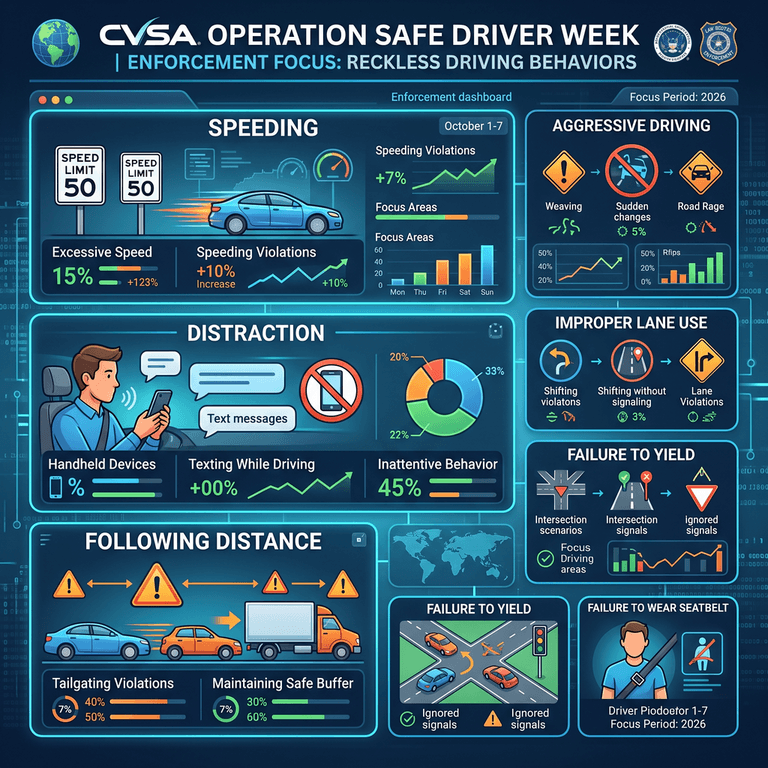
That breadth is the point. Rather than narrowing enforcement to a single behavior, CVSA's stated focus area functions as an umbrella covering the full range of driving behaviors most strongly linked to crash risk. The table below breaks down the specific behaviors named in CVSA's own materials, organized by the type of risk each one represents.
| Behavior Category | Specific Behaviors Targeted | Why It's a Priority |
|---|---|---|
| Speed & following distance | Speeding, following too closely, unsafe lane changes | Speeding alone accounted for 29% of all U.S. traffic fatalities in the most recent full-year federal data |
| Attention & distraction | Distracted driving, handheld device use, texting | Distraction-affected crashes killed thousands of people in the most recent reporting year and remain a top enforcement priority |
| Driver condition | Fatigued or drowsy driving, impaired driving | Directly tied to Hours-of-Service compliance and the FMCSA Drug & Alcohol Clearinghouse program |
| Compliance & restraint | Failure to wear a seatbelt, disregarding traffic control devices | Among the most frequently cited violations in prior Safe Driver Week campaigns for both CMV and passenger drivers |
Notice that none of these behaviors are mechanical defects. A perfectly maintained truck with a clean pre-trip inspection can still generate a citation during Safe Driver Week if the driver is following too closely or glancing at a phone. That's precisely why this initiative catches fleets with excellent maintenance programs off guard — the enforcement trigger has nothing to do with the vehicle's condition, and everything to do with driver behavior in the moment an officer happens to be watching.
What the Numbers Show: 2025 Results as the Baseline for 2026
With 2026 figures not yet published, the most reliable benchmark for understanding the scale of Operation Safe Driver Week comes from CVSA's official 2025 results: 8,739 vehicles pulled over, 2,504 citations issued, and 3,575 warnings issued across the U.S. and Canada, with speeding as the single largest violation category by a wide margin.
| Metric | Commercial Motor Vehicle Drivers | Passenger Vehicle Drivers | Combined Total |
|---|---|---|---|
| Warnings issued | 3,230 | 345 | 3,575 |
| Citations/tickets issued | 1,839 | 665 | 2,504 |
| Speeding warnings | 1,073 | 176 | 1,249 |
| Speeding citations | 491 | 416 | 917 |
Two details in this table matter more than the totals. First, commercial motor vehicle drivers received nearly three times as many warnings and citations combined as passenger vehicle drivers, despite representing a much smaller share of total road traffic — a strong signal that enforcement attention during Safe Driver Week disproportionately falls on CMV drivers relative to their actual share of vehicles on the road. Second, speeding was not a marginal category; it was the dominant violation type for both driver populations, which tracks directly with federal data showing speeding-related crashes account for roughly 29% of all U.S. traffic fatalities in the most recent full-year reporting period, based on NHTSA's Traffic Safety Facts data on speeding. If 2026 tracks anywhere near 2025's pattern once CVSA publishes its results, fleets should assume speed-related citations will again be the largest single category their drivers face.
Will your driver's logs survive an unexpected traffic stop? Generate audit-ready PDFs instantly with PTI4YOU — before the next officer asks.
The Domino Effect: How a Speeding Stop Becomes a Full DVIR Audit
A moving violation stop for speeding, tailgating, or a lane change is, by law and by training, a completely separate matter from the vehicle's mechanical condition and paperwork — but in practice, almost every commercial vehicle traffic stop gives the officer the opening to request the driver's logs, qualification documents, and most recent inspection report, and many stops escalate into a full roadside inspection on the spot.
This is the mechanism that makes Operation Safe Driver Week relevant to fleets who have never had a maintenance problem in their lives. The behavior that triggers the stop is entirely about driving, but once a commercial vehicle is stopped and an officer is standing at the driver's window, that officer is trained to look for secondary indicators of a fleet's overall compliance posture. A driver who is visibly disorganized, can't locate their logbook, or hesitates when asked for a DVIR is giving the officer every reason to escalate a routine citation into a Level II walk-around inspection or a full Level III driver/document review. A driver who produces everything cleanly and immediately gives the officer very little reason to go further.
The financial stakes of that escalation are not trivial. Our companion analysis on the true cost of a roadside out-of-service violation breaks down exactly how much a single OOS order can cost in downtime, driver detention, and rebooking freight — costs that stack directly on top of whatever fine the original moving violation carries. A $200 speeding ticket that triggers a Level II inspection finding a DVIR deficiency, or worse, a mechanical defect that independently meets out-of-service criteria, can easily cost a fleet thousands of dollars once downtime and missed delivery windows are factored in. The moving violation was never the expensive part of the interaction; the escalation was.
A Realistic Scenario: The Tailgating Stop That Wasn't About Tailgating
Picture a flatbed driver on a state highway during Safe Driver Week, running two seconds behind the vehicle ahead in heavy traffic. A trooper working the enforcement detail clocks the following distance and initiates a stop — a textbook Safe Driver Week citation, unrelated to the truck's condition or the carrier's safety program.
At the window, the trooper asks routine follow-up questions: license, registration, logbook, and the day's inspection report. If the driver fumbles through a clipboard looking for a paper form that may or may not have been completed that morning, the trooper now has a second reason to look closer — and CVSA-trained officers are taught to treat a disorganized paperwork response as a signal worth investigating further. What started as a following-distance citation can turn into a full walk-around inspection, and if that inspection finds so much as a worn tread or an inoperative marker lamp, the vehicle can be placed out of service on top of the original ticket.
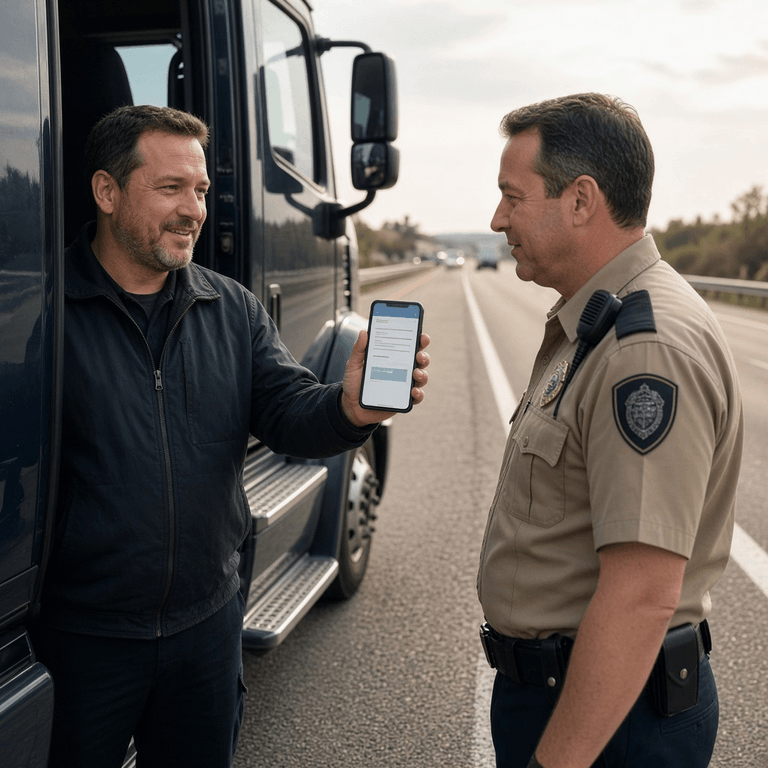
Now picture the same stop with a driver who opens an app, taps twice, and hands over a complete, timestamped, photo-verified DVIR from that morning's pre-trip. The trooper has what they asked for in under ten seconds, with a locked timestamp that predates the stop by hours. There is no ambiguity to investigate and no organizational disorder to flag. The citation for following too closely still gets written — nothing changes that — but the interaction ends there instead of expanding into a Level II inspection that could have taken the truck out of service for the rest of the day.
Fleet Telematics and Driver Behavior: A Different Tool for a Different Problem
Fleet telematics platforms that monitor harsh braking, speeding events, and following distance in real time are a genuinely valuable layer of defense against the behaviors CVSA targets during Safe Driver Week — but they solve a different problem than a digital DVIR does, and fleets should not treat the two as interchangeable.
Telematics and driver-behavior monitoring systems are built to catch the moving violation before it happens, or at least flag it immediately afterward so a safety manager can coach the driver. That is exactly the kind of tool that addresses the root behaviors CVSA is measuring during Safe Driver Week — speeding events, hard braking that indicates following too closely, and, on some platforms, distraction detection through in-cab cameras. If your fleet runs telematics, Safe Driver Week is a good annual prompt to pull a following-distance and speeding-event report and see which drivers are generating the kind of behavior patterns that would draw a citation this week specifically.
PTI4YOU intentionally does not compete in that category. It does not use GPS geofencing, does not score driving behavior, and does not attempt to prevent the moving violation itself. What it does is govern a completely different part of the compliance chain: whether the vehicle's daily inspection record is complete, accurate, photo-verified, and instantly retrievable the moment anyone — an officer, an auditor, an insurance adjuster, or a plaintiff's attorney — asks for it. A fleet running both telematics for driver behavior and a digital DVIR for inspection records has covered both halves of the Safe Driver Week risk: the behavior that draws the initial stop, and the paperwork gap that turns a routine stop into an expensive one. Neither tool substitutes for the other, and fleets that only invest in one are leaving the other half of the exposure unaddressed.
What an Inspector Actually Checks Once You're Already Stopped
Once a commercial motor vehicle is legally stopped for any reason, an inspector who chooses to escalate the interaction into a roadside inspection will typically request the driver's license and medical certificate, the vehicle's registration, the driver's record of duty status or ELD data, and — specific to daily vehicle condition — the most recent driver vehicle inspection report.
The DVIR request is where Safe Driver Week and standard DOT compliance intersect most directly. Under 49 CFR 396.11, a motor carrier must ensure that a driver prepares a written report identifying any defect discovered during or after a trip, and that report has to be available for the inspector to review. A driver who was handed a blank paper form at the start of the shift and never filled it out, or who filled it out but left it in a folder back at the terminal, cannot satisfy that requirement in the moment an officer is standing at the door — and that failure is itself a documentable violation, independent of anything happening with the vehicle's brakes or tires.
This is also where a Safe Driver Week stop can quietly touch a carrier's CSA score in two different places at once. The original moving violation — speeding, following too closely, distracted driving — posts to the carrier's Unsafe Driving BASIC. If the resulting inspection also turns up a DVIR deficiency or a mechanical defect, that separately posts to the Vehicle Maintenance BASIC, which is the exact scoring mechanism we cover in detail in our guide to lowering your CSA score through digital DVIRs. A single five-minute roadside interaction, triggered by nothing more than a driver following too closely, can end up dinging two separate BASIC scores simultaneously — which is a disproportionate compliance cost for what started as a driving-behavior citation.

How an Instantly Available Digital DVIR Changes the Interaction
PTI4YOU cannot prevent a driver from speeding, and it does not use GPS geofencing or telematics to monitor driving behavior — that is a genuinely different problem from what an electronic DVIR platform solves. What it does solve is the secondary risk every Safe Driver Week stop creates: making sure the driver's inspection paperwork is immaculate and instantly available the moment an officer asks for it.
A complete PDF, already on the driver's phone
Every closed inspection report in PTI4YOU generates a formatted PDF that lives directly in the driver's app, accessible in seconds without a phone call to dispatch or a search through a glovebox folder. When an officer asks for the day's DVIR, a driver running a paper system is hoping the right form is in the truck and was actually filled out; a driver running PTI4YOU is opening an app and handing over a complete, professional, already-signed document. That difference in how the interaction visibly unfolds is exactly the kind of secondary signal that determines whether an officer's attention narrows back to the original citation or widens into a full inspection.
A locked record an inspector doesn't need to question
Every completed inspection is locked once reviewed, the same tamper-evident mechanism we detail in our guide to how locked inspection records defend fleets in litigation and insurance renewals. That same locking mechanism matters at the roadside too: a report with a verified, unchangeable timestamp answers the only question an inspector actually cares about — was this genuinely completed before the trip, or filled out after the fact to look compliant. A driver who can show a report locked hours before the stop, not scrambled together in the cab after being pulled over, removes the single biggest reason an officer would escalate the interaction.
Photo evidence that speaks for itself
PTI4YOU's mandatory photo requirements on specific inspection points — the same discipline we cover in our guide to stopping pencil-whipped inspections — give a driver something more persuasive than a checked box during a roadside conversation. A timestamped photo of a tire, a brake component, or a marker lamp taken that same morning corroborates the written finding without the officer needing to take the driver's word for it, which shortens the interaction and reduces the odds an officer decides a deeper look is warranted.
Be Ready Before the Next Officer Asks
PTI4YOU keeps a locked, photo-verified inspection PDF on every driver's phone — ready to produce the instant a Safe Driver Week stop turns into a paperwork check.
Start your 15-day free trial today. No credit card required.
Start Your 15-Day Free Trial – No Credit Card RequiredZero setup fees. Zero hardware. 25-minute driver onboarding.
Preparing Your Fleet Before the Next CVSA Enforcement Blitz
CVSA runs several major enforcement initiatives every year, not just Operation Safe Driver Week — International Roadcheck typically lands in May and Brake Safety Week in late summer, alongside Safe Driver Week in July. Use the checklist below as your standing briefing points before any of them, rather than scrambling in the days before the next announcement.
- Brief drivers on the specific behaviors being targeted. Before any CVSA initiative, hold a five-minute pre-shift briefing that names the exact behaviors drawing extra scrutiny that week — following distance and phone use for Safe Driver Week, brake stroke and slack adjusters for Brake Safety Week, cargo securement and ELD compliance for Roadcheck. A generic "drive safe" reminder doesn't change behavior; naming the specific trigger does.
- Confirm every driver can produce a DVIR in under 30 seconds. Run a spot check the week before any announced initiative: ask a random sample of drivers to pull up their most recent completed inspection report on their phone and time how long it takes. If any driver hesitates, can't find it, or has to call dispatch, that is the exact failure mode a roadside stop will expose.
- Verify driver qualification files are current. A license, medical certificate, or FMCSA Drug & Alcohol Clearinghouse query that has lapsed is an easy secondary violation an officer will find during any escalated stop, and it is entirely preventable with a quarterly file audit that costs a fraction of what a single expired-certificate citation does.
- Review the past 30 days of inspection history for recurring defects. A unit generating the same minor defect repeatedly — a marker lamp, a slow air leak, worn tread on a specific axle — is a leading indicator of the kind of mechanical finding that turns a driving citation into an out-of-service order. Pull that report before the next initiative, not after a defect gets flagged roadside.
- Remind drivers that a calm, organized response shortens every stop. An officer who sees a driver locate paperwork instantly has measurably less operational reason to escalate; a driver who visibly fumbles, argues, or stalls gives the officer every reason to look closer. This is coachable behavior, and it costs nothing to train.
- Lock every inspection the moment it's reviewed. Don't let a completed report sit unclosed in a queue waiting for manager sign-off. A locked, timestamped record with a verified completion time hours or days before a roadside stop is the single strongest piece of evidence a driver can produce, and it is worthless if it's still sitting in an "open" or "pending review" state when the question gets asked.
- Track the CVSA enforcement calendar as a standing operations item. Safe Driver Week, International Roadcheck, and Brake Safety Week repeat annually on a broadly predictable rhythm — May, July, and late summer, respectively. Build driver briefings into your operations calendar ahead of each one, not in reaction to the first citation of the week.
- Debrief after every enforcement-week citation, whether or not it escalated. Even a clean stop that didn't escalate into a full inspection is useful data: ask the driver how the interaction went, what was requested, and how quickly they could produce it. Patterns across multiple drivers point directly at where your DVIR process needs tightening before the next initiative.
None of these steps require new hardware, new telematics, or a change to how dispatch assigns loads. They require making sure that when a driver is pulled over for something as simple as following too closely, the rest of the interaction goes as smoothly as possible — because the moving violation is the one thing your fleet can't fully control, and the paperwork is the one thing it can.

Frequently Asked Questions
When was Operation Safe Driver Week 2026?
The Commercial Vehicle Safety Alliance held Operation Safe Driver Week 2026 from July 12 through July 18, deploying heightened law enforcement patrols across the United States, Canada, and Mexico as part of its annual driver-behavior enforcement and education initiative.
What was the primary enforcement focus of Operation Safe Driver Week 2026?
CVSA's 2026 initiative focused on reckless, careless, and dangerous driving behaviors, broadly encompassing speeding, distracted driving, following too closely, fatigued or drowsy driving, impaired driving, failure to wear a seatbelt, unsafe lane changes, and disregarding traffic control devices.
How many citations were issued during Operation Safe Driver Week 2025?
According to CVSA's official results, law enforcement pulled over 8,739 vehicles during the 2025 campaign and issued 2,504 citations and 3,575 warnings combined to commercial and passenger vehicle drivers, with commercial motor vehicle drivers alone receiving 1,839 citations and 3,230 warnings. Speeding was the single largest violation category.
Has CVSA released official results for Operation Safe Driver Week 2026?
As of this article's publication, CVSA had not yet released official tallies for the 2026 campaign. Based on the 2025 cycle, where results were published roughly three months after the event concluded, fleets should expect the 2026 results to be released in the coming weeks.
Does a traffic stop for speeding or distracted driving trigger a full DOT inspection?
Not automatically, but it commonly does in practice. An officer who stops a commercial motor vehicle for a moving violation is trained to look for secondary red flags, and many will escalate the stop into a Level II or Level III inspection, which includes a review of the driver's logs, qualification documents, and the vehicle's daily inspection report.
What happens if a driver cannot produce a complete DVIR during a roadside inspection?
A missing, incomplete, or unsigned driver vehicle inspection report is itself a citable violation under 49 CFR 396.11 and 396.13, and it can prompt the inspector to more closely scrutinize the vehicle's mechanical condition. If the resulting inspection uncovers a defect that independently meets out-of-service criteria, the vehicle can be placed out of service on top of the original moving violation.
Can a citation from Operation Safe Driver Week affect a carrier's CSA score?
Yes. Moving violations recorded during a roadside stop are posted to the carrier's FMCSA Safety Measurement System profile under the Unsafe Driving BASIC, and any resulting vehicle inspection that finds a mechanical defect adds separately to the Vehicle Maintenance BASIC, meaning a single enforcement-week stop can affect two different BASIC scores at once.
How can fleets prepare before CVSA's next enforcement blitz?
Fleets should brief drivers on the specific behaviors being targeted, confirm every driver can produce a complete and current inspection record instantly from their phone, verify driver qualification files are current, and review recent inspection history for recurring defects before the next scheduled CVSA initiative, whether that is the next Operation Safe Driver Week, International Roadcheck, or Brake Safety Week.
Conclusion: The Citation Is Temporary, the Paperwork Gap Is What Costs You
Operation Safe Driver Week 2026 came and went the same way it does every year: a week of heightened attention to how people drive, a predictable spike in speeding and distraction citations, and, for most fleets, no lasting operational impact at all. The exposure that actually matters isn't the campaign itself — it's what a single roadside stop, on any ordinary day, can turn into when a driver can't immediately produce a clean inspection record.
That is the gap a digital DVIR closes. PTI4YOU doesn't stop a driver from speeding, and it never will — that's a driver-behavior problem, not a paperwork problem. What it does is make sure that when a stop happens, for any reason, on any day of the year, the interaction ends as quickly and cleanly as possible, because the one thing an officer asks for is already sitting, complete and locked, on the driver's phone.
Don't Wait for the Next Enforcement Blitz to Find Out Your Paperwork Isn't Ready
Give every driver a locked, photo-verified inspection record they can produce in seconds — whether it's Safe Driver Week, Roadcheck, or an ordinary Tuesday traffic stop.
Start your 15-day free trial today. No credit card required.
Start Your 15-Day Free Trial – No Credit Card RequiredZero setup fees. Zero hardware. 25-minute driver onboarding.
Official Sources and Further Reading
- CVSA — Operation Safe Driver Week Scheduled for July 12-18, 2026
- CVSA — Official 2025 Operation Safe Driver Week Results
- CVSA — Operation Safe Driver Program Overview
- NHTSA — Traffic Safety Facts: Speeding (2024 Data)
- NHTSA — Distracted Driving in 2024
- eCFR — 49 CFR 396.11: Driver Vehicle Inspection Reports
This article reflects CVSA campaign details and federal traffic safety data available as of October 3, 2026. Official 2026 Operation Safe Driver Week results had not yet been published by CVSA at the time of writing; figures cited for 2025 are from CVSA's official results release and are the most recent verified data available.