
The Bottom Line Up Front: Leasing or renting a commercial vehicle never transfers DOT compliance responsibility to the leasing company. Under 49 CFR 396.11, 396.17, and 49 U.S.C. 14102, the motor carrier that operates the vehicle is legally responsible for daily DVIRs, annual inspections, and maintenance records — regardless of who holds the title. A leasing company can perform physical maintenance or even the annual inspection itself, but it cannot absorb the operating carrier's legal accountability during an FMCSA audit.
Key Takeaways: Leased & Rented Vehicle DOT Compliance
- The operating carrier is always accountable: Under 49 CFR 376.12(c)(1) and 49 U.S.C. 14102(a)(4), the motor carrier leasing the equipment must have exclusive possession, control, and use of the vehicle and assume complete responsibility for its operation "as if the motor vehicles were owned by the motor carrier."
- Daily DVIRs apply to every vehicle you operate: 49 CFR 396.11 does not exempt leased or rented equipment — every vehicle a carrier operates needs a driver-completed inspection report, retained for 3 months.
- Delegation is allowed, accountability is not: 49 CFR 396.17(e) permits a fleet leasing company to perform the annual inspection as the carrier's agent, but 396.21(b)(3) still requires the carrier to obtain and produce that report on demand.
- Records must survive ownership changes: Maintenance records for a non-owned vehicle must identify the party furnishing it (49 CFR 396.3(b)(1)) and stay with the operating carrier's system, not with the lease itself.
Why Leased and Rented Fleets Are the New Normal
Commercial fleets across the United States and Canada have quietly restructured how they acquire equipment. Instead of purchasing every tractor, box truck, or trailer outright, more carriers now blend owned equipment with long-term leases, short-term rentals, and owner-operator leased-on units to flex capacity without tying up capital. A fleet running 40 trucks might own 20, lease 15 from a leasing company, and rent the remaining 5 to cover a seasonal freight surge. This flexibility is good for the balance sheet — but it has created a dangerous compliance blind spot that surfaces at the worst possible moment: during an FMCSA safety audit.
The blind spot starts with a simple, understandable, and completely incorrect assumption: "The leasing company owns the truck, so the leasing company handles the DOT paperwork." Fleet managers who would never dream of skipping a daily inspection on an owned tractor sometimes treat leased and rented units as someone else's regulatory problem. Drivers assume a rental agency's maintenance stickers mean the annual inspection is "someone else's job." Safety directors assume a leasing company's shop invoices constitute their own maintenance records. None of these assumptions hold up under federal law, and none of them hold up when an auditor asks a simple question: "Where is the DVIR for this vehicle from Tuesday?"
This misunderstanding is not a minor technicality. It is one of the most common and most expensive compliance failures fleets experience, precisely because it hides in plain sight until a DOT Compliance Review or roadside inspection forces the issue. A carrier can have a spotless record for every vehicle it owns and still receive a conditional safety rating because three leased trailers had no documented annual inspection on file. The regulation does not distinguish between "my truck" and "their truck." It distinguishes between the vehicle the carrier controls and the vehicle it does not — and every leased or rented unit a carrier dispatches falls firmly into the first category.
This guide breaks down exactly who is responsible for DVIRs, annual inspections, preventive maintenance, and recordkeeping when a commercial vehicle is leased or rented, cites the specific federal regulations that establish that responsibility, and shows how fleets running mixed ownership models — owned, leased, and rented side by side — can build a compliance program that survives an audit no matter whose name is on the title.
Understanding Responsibility Under FMCSA Regulations
The motor carrier operating a commercial vehicle is legally responsible for its DOT compliance, not the vehicle's owner or leasing company. Federal law requires that a written lease grant the operating carrier exclusive possession, control, and use of the equipment, and that the carrier assume complete responsibility for its safe operation for the duration of the lease.
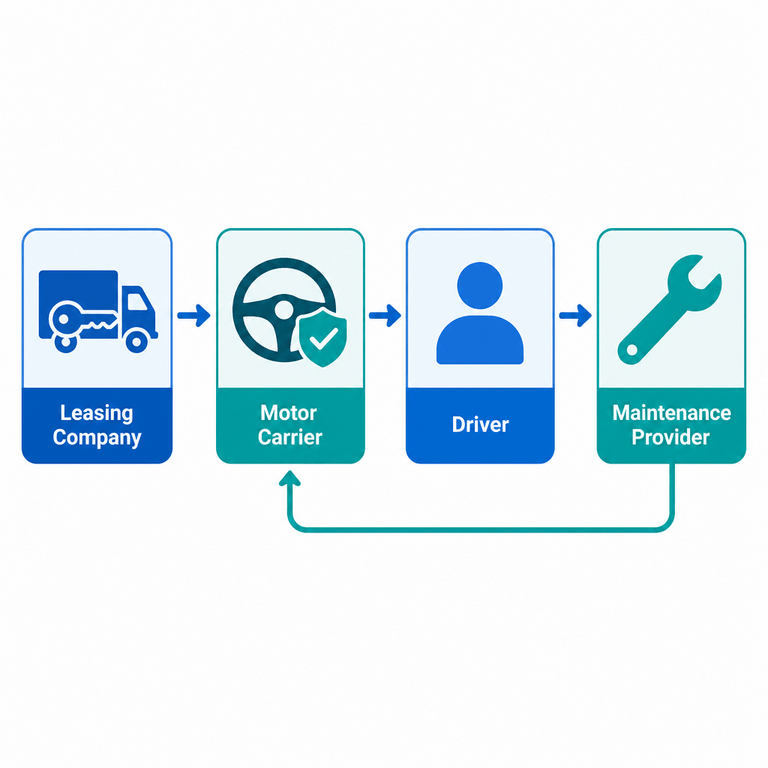
To understand why, it helps to separate four roles that are frequently — and incorrectly — treated as interchangeable:
- The vehicle owner / leasing company. This is the entity that holds title to the truck or trailer and, under a lease, provides the equipment to a motor carrier in exchange for payment. The owner may also perform maintenance or the annual inspection under a service agreement, but ownership alone creates no FMCSA safety compliance obligation.
- The motor carrier (lessee). This is the entity operating under its own USDOT number that dispatches the vehicle, employs or contracts the driver, and is legally answerable to the FMCSA for that vehicle's safety compliance for as long as the lease or rental is in effect.
- The driver. The driver performs the daily pre-trip and post-trip inspection and reports defects, but the carrier — not the driver personally — bears the recordkeeping and repair obligation that follows.
- The maintenance provider. Whether it is the leasing company's own shop, an independent garage, or a network of regional repair facilities, the maintenance provider performs the physical work, but the carrier remains responsible for ensuring the work happens and that documentation of it exists.
The controlling federal statute is 49 U.S.C. § 14102, which authorizes the Secretary of Transportation to require that a motor carrier using vehicles it does not own "have control of and be responsible for operating those motor vehicles in compliance with requirements prescribed by the Secretary on safety of operations and equipment, and with other applicable law as if the motor vehicles were owned by the motor carrier." That statutory authority is carried out through 49 CFR Part 376 (Lease and Interchange of Vehicles), which requires every lease of commercial equipment to be in writing and to contain specific mandatory provisions.
This single clause is the legal foundation for everything that follows in this guide. A lease that does not grant the carrier exclusive possession and control — or that does not make the carrier responsible for the equipment's operation — does not meet the federal leasing requirements. In practical terms, this means every properly executed truck or trailer lease already places DOT compliance obligations squarely on the carrier's shoulders, whether the lease document spells that out in plain English or not.
That responsibility flows directly into 49 CFR Part 396 (Inspection, Repair, and Maintenance), the regulation that governs DVIRs, preventive maintenance, and annual inspections. Part 396 consistently uses the phrase "subject to its control" rather than "owned by it" when describing which vehicles a motor carrier must inspect and maintain. Section 396.3(a) requires every motor carrier to "systematically inspect, repair, and maintain, or cause to be systematically inspected, repaired, and maintained, all motor vehicles... subject to its control" — language that applies with equal force to a vehicle bought outright, leased for three years, or rented for a single weekend haul.
Rental vehicles receive no special exemption, either. A rental agreement is functionally a very short-term lease, and the operating carrier's obligations under Part 396 begin the moment the vehicle is dispatched, not after some minimum rental duration. This is a common point of confusion during peak season, and it is directly relevant to fleets that supplement owned equipment with rental units during freight surges — a practice covered in more detail in our guide to the 2026 FMCSA regulatory changes affecting fleet operations.
Who Is Responsible for Each Compliance Requirement?
The table below breaks the leased/rental compliance question into its component parts. For each requirement, it identifies who is legally responsible, the misunderstanding that trips up most fleets, and the best practice that closes the gap.
| Compliance Requirement | Responsible Party | Common Misunderstanding | Best Practice |
|---|---|---|---|
| Daily DVIRs | Motor carrier operating the vehicle (49 CFR 396.11) | "The leasing company inspects the truck since they own it" | Driver completes a digital DVIR on every leased/rented unit exactly as on owned equipment |
| Annual DOT (Periodic) Inspection | Motor carrier must ensure it happens (49 CFR 396.17(b)); may delegate performance to a leasing company as agent (396.17(e)) | "Leasing companies automatically perform and file the annual inspection" | Confirm in writing who performs each cycle and obtain the certificate the same day it is issued |
| Preventive Maintenance | Motor carrier (49 CFR 396.3(a)) | "The lease covers maintenance, so scheduling isn't our job" | Build a PM schedule for every leased/rented unit inside the carrier's own system |
| Driver Qualification Files | Motor carrier employing/contracting the driver (49 CFR 391.51) | Confused with the leasing company's own driver pool on leased-on owner-operator units | Maintain DQFs centrally regardless of which vehicle a driver is assigned to |
| Maintenance Documentation | Motor carrier, must identify the furnishing party if not owned (49 CFR 396.3(b)(1)) | "The shop or leasing company keeps the paperwork, so we don't need copies" | Require every invoice and work order to be uploaded to the carrier's own compliance system |
| Defect Repairs | Motor carrier or its agent, prior to further operation (49 CFR 396.11(a)(3)) | "It's leased, so repair liability belongs to the lessor" | Track every reported defect to a signed repair certification, regardless of who pays |
| Roadside Inspection Corrections | Motor carrier operating the vehicle at the time of the stop (49 CFR 396.9(d)) | "It's a rental, so the rental company handles the CVSA report" | Route every roadside inspection report to the carrier's safety team immediately |
| Record Retention | Motor carrier operating the vehicle, at the location where it is housed/maintained | "Records leave with the vehicle when the lease ends" | Store compliance history in a cloud system tied to the carrier, not the physical vehicle |
Two rows deserve special attention because they generate the most audit findings in practice. First, the annual inspection row: 396.17(e) genuinely does allow "a commercial garage, fleet leasing company, truck stop, or other similar commercial business" to perform the inspection as the carrier's agent — but the very next section, 396.21(b)(3), states plainly that if the carrier did not perform the vehicle's last annual inspection itself, "the motor carrier... is responsible for obtaining the original or a copy of the last annual inspection report" upon demand. In other words, delegating the work is legal; delegating the paperwork obligation is not.
Second, the maintenance documentation row contains a detail fleets consistently miss: 396.3(b)(1) does not just require a maintenance record for non-owned vehicles — it specifically requires that record to "identify the name of the person furnishing the vehicle." Regulators anticipated leased and rented equipment when they wrote this rule, which is a strong signal that they expect carriers to document the leasing relationship as part of their own compliance file, not to treat it as external paperwork that belongs to someone else.
Common Compliance Mistakes With Leased Vehicles
The most common leased-vehicle compliance mistakes are missing DVIR records, assuming a maintenance provider stores documentation on the carrier's behalf, completed annual inspections with no retrievable certificate, fragmented vendor records, mismanaged short-term rentals, incorrect retention periods, and continued reliance on paper forms.
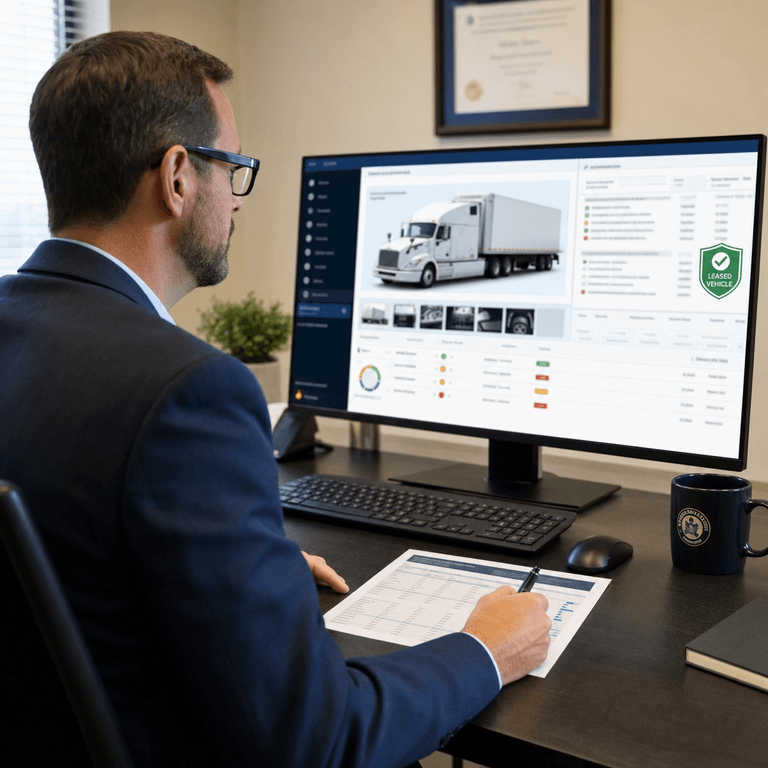
These failure patterns show up so consistently across fleets with mixed ownership models that they are worth examining individually:
- Missing DVIR records for leased units. Drivers sometimes treat a leased truck as "not really ours" and skip or informally handle the daily inspection, leaving a gap the moment an auditor requests three months of records for that unit.
- Assuming the maintenance provider stores documentation. When a leasing company's own shop performs a repair, fleets often assume the invoice lives permanently in that shop's system. If the lease ends, that vendor relationship ends with it — and so does easy access to the record.
- Annual inspections performed but certificates missing. The inspection happened, the sticker is on the windshield, but no copy of the actual report ever reached the carrier's own file, violating the retrieval obligation under 396.21(b)(3).
- Multiple maintenance vendors across a leased fleet. A carrier leasing units from three different companies may end up with three incompatible recordkeeping systems, none of which talk to the carrier's own compliance software.
- Temporary rental vehicles treated as compliance-exempt. A one-week rental brought in to cover a breakdown or seasonal surge still requires daily DVIRs and a valid annual inspection certificate for every day it is dispatched.
- Incorrect document retention assumptions. Some fleets assume retention periods reset or do not apply once a vehicle is returned to the lessor, when in fact the carrier's retention clock is tied to when it controlled the vehicle, not to the lease's expiration date.
- Continued reliance on paper inspection forms. Paper DVIRs and maintenance logs for leased equipment are especially prone to getting lost in the handoff between the carrier, the driver, and the leasing company's own paperwork trail.
Each of these mistakes shares a root cause: treating the leased or rented vehicle's compliance obligations as belonging, at least partially, to someone outside the carrier's own operation. Auditors do not make that distinction, and neither does the regulatory text. A fleet that internalizes "every vehicle I dispatch is my compliance responsibility, no matter whose name is on the title" eliminates the majority of these failure points before they ever reach an auditor's desk.
Why Paper Documentation Breaks Down
Paper documentation breaks down on leased and rented fleets because records are scattered across multiple leasing companies, regional repair shops, driver glove boxes, and email inboxes, with no single system tying everything back to the vehicle and the carrier that operated it.
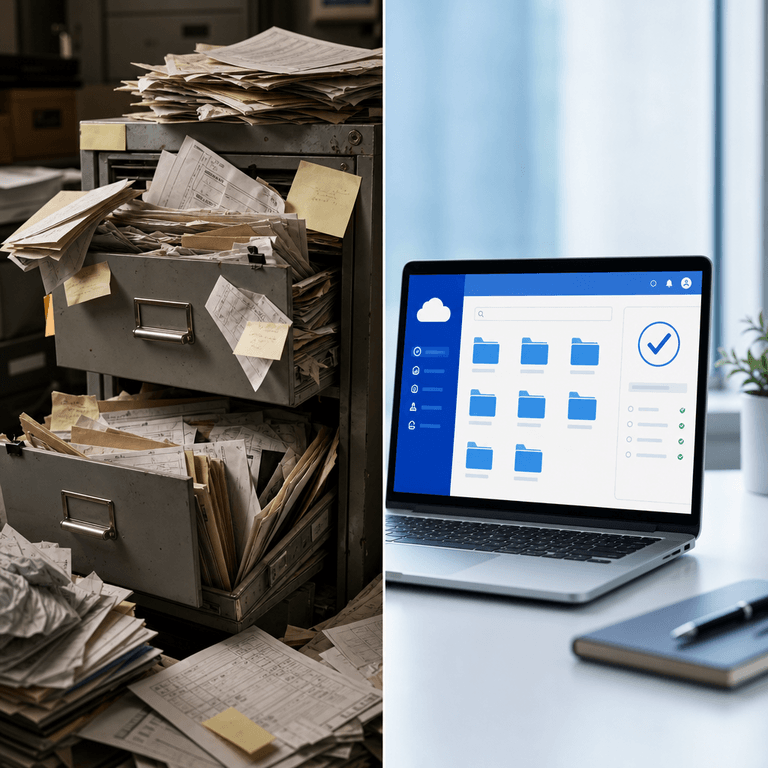
Fleets running owned vehicles on paper already face the well-documented problems of illegible scans, missing signatures, and inconsistent filing — issues we cover in depth in our hidden cost analysis of paper DVIRs versus electronic apps. Leased and rented equipment multiplies every one of those problems:
- Multiple leasing companies mean multiple paper trails. A carrier leasing from three different companies inherits three different invoice formats, three different filing habits, and three different points of contact when a document goes missing.
- Repair invoices live with the vendor, not the carrier. Regional repair shops used by leasing companies rarely proactively send copies of every work order to the operating carrier — someone has to remember to request and file them.
- Email attachments become the unofficial filing system. Annual inspection certificates and lease agreements frequently arrive as email PDFs that are never printed, filed, or cross-referenced against the vehicle's compliance record.
- Missing inspection certificates surface only when needed. The gap between "the inspection was done" and "the paperwork proving it is retrievable" often goes unnoticed until an auditor or roadside officer asks for it.
- Slow document retrieval compounds under time pressure. When an audit document request letter arrives, reconstructing records across several leasing relationships and vendors takes far longer than pulling records for owned equipment alone.
A centralized digital system solves this by design rather than by discipline. Instead of depending on every leasing company, shop, and driver to independently maintain a complete paper trail, a cloud-based compliance platform makes the carrier's own record the single source of truth — regardless of how many outside parties touched the vehicle along the way.
The Digital Compliance Workflow
The most important structural advantage of a digital compliance workflow is that ownership status becomes a data field, not a filing boundary. A leased tractor and an owned tractor move through the exact same lifecycle, and the resulting records live in the exact same searchable system:
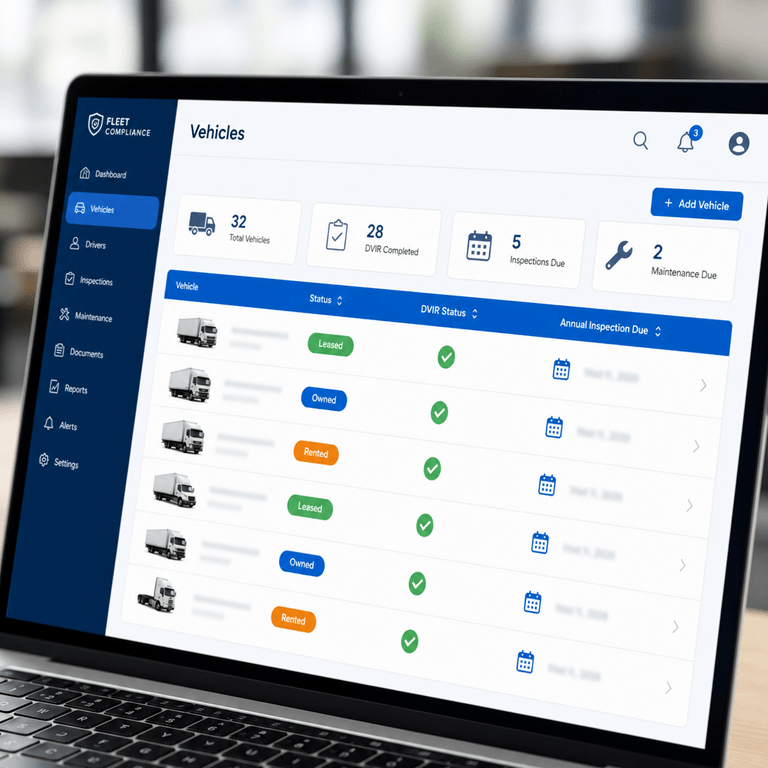
- Driver completes a digital DVIR. The pre-trip or post-trip inspection is performed on a smartphone or tablet for every dispatched vehicle, tagged automatically by unit and ownership type.
- Defect automatically logged. Any reported defect is captured with structured fields and timestamps, instantly visible to the safety manager regardless of which company holds the title.
- Maintenance request created. The system opens a work order automatically, whether the repair will be performed by the carrier's own shop, the leasing company's facility, or an independent vendor.
- Repair completed. The assigned technician certifies the repair, closing the loop required under 396.11(a)(3) regardless of who employs that technician.
- Inspection history updated. Annual inspection due dates, certificates, and prior results are attached to the vehicle's permanent digital profile, not to a specific vendor relationship.
- Cloud storage. Every DVIR, repair record, and inspection certificate is stored centrally, backed up automatically, and tied to the carrier's own account.
- Audit-ready records. When a document request arrives, the required date range and vehicle can be filtered and exported in minutes, whether the vehicle is owned, leased, or already returned to the lessor.
The critical design principle here is that ownership changes should never disrupt compliance records. When a lease term ends and a vehicle goes back to the leasing company, or a rental unit is returned after a seasonal surge, the carrier's compliance history for that unit does not disappear with it — because it was never stored with the vendor in the first place. It lived in the carrier's own system the entire time, exactly where an FMCSA investigator will expect to find it.
Manual Compliance vs. Digital Fleet Platform
The operational gap between manual, paper-based tracking and a purpose-built compliance platform becomes most visible when measured against the specific challenges a mixed ownership fleet creates:
| Capability | Manual / Paper Process | Digital Fleet Platform |
|---|---|---|
| Document Retrieval | Hours to days, spread across multiple vendor filing systems | Seconds to minutes via search and filter, regardless of vendor |
| Vehicle Ownership Changes | Records often stay with the departing vendor or vehicle | Records stay permanently with the carrier's account |
| Leased Fleet Management | Separate tracking method for each leasing relationship | Single system tags every vehicle by ownership type |
| Maintenance Visibility | Depends on each vendor proactively sharing invoices | Centralized visibility across every maintenance provider |
| Audit Readiness | Reactive scramble across multiple paper trails | Continuous; every unit is audit-ready by default |
| Cloud Storage | Rare; typically physical folders at one location | Encrypted, automatically backed-up, accessible anywhere |
| Compliance Alerts | Manually tracked spreadsheets, easy to miss a due date | Automated alerts for DVIR gaps, inspections, and DQF expirations |
| Scalability | Administrative burden multiplies with every added lease | Scales from 5 to 500+ vehicles with no added filing overhead |
| Administrative Workload | Significant hours reconciling vendor paperwork monthly | Administrative time redirected to safety management |
| Operational Efficiency | Slows down as leased/rental mix grows more complex | Remains consistent regardless of ownership mix |
Software Comparison: Motive, Whip Around, Samsara, Fleetio & JJ Keller
Fleets evaluating compliance software for mixed ownership fleets typically shortlist the same five names. Each platform was built to solve a different core problem, and that origin still shapes how well each one handles leased and rented equipment today.
| Platform | Primary Focus | Inspection Management | Maintenance Documentation | Leased Fleet Support | Pricing Transparency |
|---|---|---|---|---|---|
| Motive | ELD & AI dashcams, broad fleet operations | Integrated eDVIR tied to HOS logs | Functional but secondary to telematics data | No dedicated ownership-type tagging; asset-centric model | Opaque; custom enterprise quoting |
| Samsara | Enterprise IoT & telematics | Robust, highly customizable eDVIR workflows | Strong compliance dashboards for owned hardware-equipped units | Requires proprietary gateways per vehicle, complicating short-term rentals | Opaque; custom enterprise quoting |
| Whip Around | Digital inspections & defect workflows | Purpose-built inspection and defect management | Solid work order tracking; no native ELD | BYOD model supports adding/removing rental units easily | Public, per-asset pricing |
| Fleetio | Asset lifecycle & maintenance CMMS | Adequate; secondary to maintenance focus | Deep parts/vendor tracking and repair history | Strong for tracking leased asset details, but not DVIR/DQF-first | Public, tiered SaaS pricing |
| JJ Keller | Regulatory consulting, training & ELD | Broad compliance document library plus DVIR/ELD modules | Comprehensive but consulting-driven, not self-serve | Handled through advisory services rather than software tagging | Varies; largely quote-based for enterprise suites |
| PTI4YOU | Focused DOT compliance & DVIR automation | Digital DVIR built for daily use across every ownership type | Unified maintenance and repair records tied to the carrier's account | Native owned/leased/rented tagging with no hardware lock-in | Fully transparent SaaS pricing |
Motive built its reputation as an industry-leading Electronic Logging Device with an integrated eDVIR module tied to the driver's duty status. It works well for fleets primarily concerned with Hours-of-Service compliance, but its document management treats every vehicle the same asset-centric way, without a purpose-built mechanism for separating owned, leased, and rented units in reporting. Adoption typically requires a multi-year commitment to proprietary hardware, which can be a poor fit for a fleet that regularly rotates in short-term rental units.
Samsara offers highly customizable eDVIR workflows inside a broader enterprise IoT and telematics platform, with genuinely strong compliance dashboards. Its dependency on proprietary hardware gateways becomes a real friction point for rented vehicles, since installing and later removing a gateway from a two-week rental unit is far less practical than for a permanently owned tractor. For a deeper look at how Samsara and Motive compare against lighter-weight alternatives, see our small fleet software comparison.
Whip Around was purpose-built to digitize the inspection and defect-reporting process, with a bring-your-own-device model that makes it straightforward to add a rental unit for a few weeks and remove it when the rental ends, without any hardware installation. It does not include a native ELD, so fleets whose leased or rented units also require Hours-of-Service tracking need to pair it with a separate system.
Fleetio positions itself as a system of record for asset lifecycle and maintenance, with deep parts inventory and vendor coordination features that are genuinely useful for tracking a leased asset's service history in detail. It is not primarily architected around DVIR compliance or Driver Qualification File tracking, so fleets whose main audit exposure is inspection and driver documentation may find it strongest as a maintenance companion rather than a full compliance system of record.
JJ Keller remains one of the most established names in trucking compliance, combining regulatory publications, consulting, and training with ELD and inspection software. Its breadth appeals to fleets that want a single compliance partner for advisory support in addition to software, particularly when navigating complex leasing arrangements, though its enterprise offerings are typically quote-based rather than published.
Every platform on this list solves a real problem well. The distinction that matters for a mixed ownership fleet is whether the software treats "leased" and "rented" as first-class data attached to a vehicle's compliance record, or as an afterthought layered onto an asset-tracking or telematics-first architecture.
Why PTI4YOU Simplifies Compliance for Mixed Fleets
PTI4YOU was built around a single premise: a fleet running 5 to 500 vehicles — owned, leased, and rented in any combination — should never have to reconcile three different filing systems just to answer a simple audit question. As a hardware-agnostic platform, PTI4YOU runs on the smartphones and tablets your drivers and mechanics already carry, which makes onboarding a short-term rental unit as fast as onboarding an owned tractor.
For fleets managing mixed ownership compliance, that translates into concrete capabilities:
- Digital DVIR for every unit: Structured pre- and post-trip inspections with timestamped submissions and mandatory driver-mechanic sign-off, satisfying 49 CFR 396.11 regardless of ownership type.
- Maintenance tracking: Preventive maintenance schedules and defect-to-repair tracking for owned, leased, and rented units inside one unified system.
- Repair documentation: Every work order and invoice is uploaded to the carrier's own account, closing the "the shop keeps the paperwork" gap permanently.
- Inspection history: Annual inspection due dates and certificates are attached to each vehicle's permanent profile, independent of which leasing company performed the work.
- Cloud document storage: Encrypted, automatically backed-up storage that survives lease turnovers and rental returns.
- Compliance dashboards: A real-time view of DVIR completion, open defects, and upcoming inspections, filterable by ownership type.
- Audit-ready reporting: Export a complete, organized record set for any vehicle within minutes of a document request.
- Centralized records regardless of vehicle ownership: One system of record for the entire fleet, whether a vehicle has been owned for a decade or rented for a week.
One Compliance System for Every Vehicle You Operate
Whether your fleet owns, leases, or rents vehicles, pti4you.com centralizes inspections, maintenance records, and compliance documentation so every vehicle remains audit-ready.
Start your 15-day free trial today. No credit card required.
Start Your 15-Day Free Trial – No Credit Card RequiredZero setup fees. Zero hardware. 25-minute driver onboarding.
Leased Vehicle Compliance Checklist
Use this 10-point checklist to evaluate whether your fleet's leased and rented vehicles are as audit-ready as your owned equipment:
- Verify responsibility within every lease agreement. Confirm the lease grants your carrier exclusive possession, control, and use of the equipment as required under 49 CFR 376.12(c)(1).
- Perform digital DVIRs daily. Apply the same pre- and post-trip inspection standard to leased and rented units that you apply to owned equipment.
- Maintain annual inspection certificates. Obtain and file a copy of the report the same day the inspection is performed, even if a leasing company's shop did the work.
- Track preventive maintenance. Build a PM schedule inside your own system for every leased and rented unit, independent of the lessor's own service reminders.
- Store all repair documentation electronically. Require every invoice and work order — regardless of vendor — to be uploaded to your carrier account.
- Keep maintenance history with the vehicle's record, not the vendor. Ensure repair and inspection history stays searchable in your system even after a lease ends.
- Verify document retention requirements. Apply the correct federal retention clock to each record type — 3 months for DVIRs, 14 months for annual inspection reports, and 1 year plus 6 months for general maintenance records.
- Conduct quarterly compliance reviews. Self-audit a sample of leased and rented vehicles every quarter using the same checklist an FMCSA investigator would use.
- Test audit document retrieval. Run a mock request for a leased unit's full compliance history and time how long it takes to produce.
- Centralize all compliance records in one cloud platform. Consolidate DVIRs, inspection certificates, and maintenance records for owned, leased, and rented vehicles into a single searchable system.
Frequently Asked Questions
Who is responsible for DVIRs on leased trucks?
The motor carrier operating the leased truck is responsible for DVIRs, not the leasing company. Under 49 CFR 396.11, every motor carrier must require its drivers to prepare a written inspection report at the completion of each day's work on each vehicle operated, and this obligation applies to every commercial motor vehicle the carrier controls, whether owned, leased, or rented.
Who performs the annual DOT inspection on a leased or rented vehicle?
The motor carrier operating the vehicle must ensure the annual inspection happens, even if it does not perform the inspection itself. Under 49 CFR 396.17(b), motor carriers must inspect or cause to be inspected all motor vehicles subject to their control, and 396.17(e) explicitly allows a fleet leasing company, commercial garage, or truck stop to perform the inspection as the carrier's agent. Delegating the task does not transfer legal accountability for the result.
Does the leasing company maintain compliance records?
A leasing company may keep its own maintenance and inspection records for internal purposes, but it is not legally required to maintain them on the operating carrier's behalf, and it will not produce them for the carrier's FMCSA audit automatically. Under 49 CFR 396.3(b), the operating carrier must maintain or cause to be maintained its own maintenance records for every vehicle it controls, and under 396.21(b)(3) the carrier is responsible for obtaining a copy of any annual inspection it did not perform itself.
Can leased vehicles fail a DOT audit?
Yes. Auditors evaluate the operating carrier's compliance program, and a leased or rented vehicle with missing DVIRs, an expired annual inspection, or unavailable maintenance records is cited exactly like an owned vehicle would be. Vehicle ownership status is not a defense during a Compliance Review or off-site investigation.
How should fleets manage maintenance records for leased and rented units?
Fleets should require every maintenance provider — whether it is the leasing company's own shop, an independent garage, or a rental agency — to supply a copy of each invoice and work order for upload to the carrier's own compliance system. Per 49 CFR 396.3(b)(1), the record for a non-owned vehicle must also identify the name of the party furnishing the vehicle, making this documentation step a specific regulatory expectation rather than optional best practice.
What documents must be retained for leased and rented vehicles?
The same document set required for owned vehicles applies: DVIRs retained for 3 months (49 CFR 396.11(a)(4)), annual periodic inspection reports retained for 14 months (49 CFR 396.21(b)(1)), and general maintenance records retained for 1 year while the vehicle is under the carrier's control plus 6 months after it leaves that control (49 CFR 396.3(c)). These retention clocks run from the date the carrier controlled and operated the vehicle, not from the lease's start or end date.
Can compliance software manage leased and owned fleets together?
Yes. Modern cloud-based fleet compliance platforms tag each vehicle by ownership type (owned, leased, or rented) while applying the same DVIR, inspection, and maintenance workflow to every unit. This keeps compliance records tied to the operating carrier's account rather than to a specific vehicle owner, so records remain intact even when a lease ends or a rental unit is returned.
Conclusion: Ownership Doesn't Change Who the FMCSA Holds Accountable
The single most important takeaway from federal leasing and inspection regulations is also the simplest: the FMCSA does not audit titles, it audits operations. Whether a tractor was purchased outright, leased for three years, or rented for a single week to cover a surge in freight, the motor carrier that dispatches it carries full legal responsibility for its DVIRs, annual inspection, maintenance records, and defect repairs. A leasing company can supply the equipment and even perform the physical maintenance, but under 49 U.S.C. 14102 and 49 CFR 376.12(c)(1), it cannot absorb the carrier's compliance obligation, and under 49 CFR 396.21(b)(3), the carrier remains on the hook for producing inspection paperwork it did not personally generate.
Fleets that internalize this distinction early — before an audit notice or a roadside inspection forces the issue — consistently outperform fleets that discover it the hard way. The fix is not complicated: apply the same digital DVIR, maintenance tracking, and recordkeeping discipline to every vehicle you operate, tag each unit by ownership type for visibility, and store every record in a system tied to your carrier account rather than to a vendor relationship that may not outlast the lease. For more on building that foundation, see our guides to the three-signature DVIR cycle, continuous Driver Qualification File monitoring, and preparing for an off-site FMCSA audit.
Stop Managing Three Compliance Systems for One Fleet
Whether your fleet owns, leases, or rents vehicles, pti4you.com centralizes inspections, maintenance records, and compliance documentation so every vehicle remains audit-ready.
Start your 15-day free trial today. No credit card required.
Start Your 15-Day Free Trial – No Credit Card RequiredZero setup fees. Zero hardware. 25-minute driver onboarding.