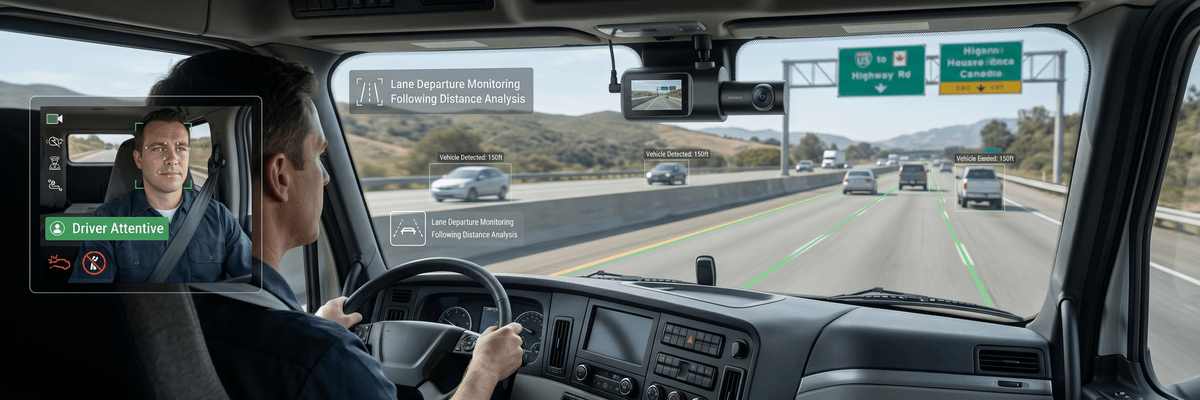
Key Takeaways
- AI dash cams with edge computing have shifted fleet safety from reactive accident recording to real-time, proactive risk prevention across the USA and Canada.
- Event validation engines eliminate up to 85% of false alerts by combining cloud AI screening with professional human-in-the-loop video review.
- Driver buy-in is the single biggest challenge; excessive false positives destroy safety culture and accelerate driver turnover.
- AI cameras cannot replace DVIR inspections—they capture driving behavior but remain blind to pre-trip walk-around compliance and mechanical defect documentation.
- Combining video telematics with dedicated compliance platforms like pti4you.com creates a complete, audit-ready fleet safety ecosystem.
1. Introduction: The Modern Fleet Safety Landscape
In 2026, the implementation of an AI dash cam for trucks paired with a cloud-based event validation engine represents the gold standard for commercial asset protection across the United States and Canada. This integration shifts fleet risk management from reactive post-crash analysis to real-time, proactive compliance AI analytics, significantly reducing insurance premiums and shielding motor carriers from devastating litigation.
Commercial transportation networks operate under unprecedented economic and regulatory pressure. Fleet managers are navigating a turbulent operational landscape marked by skyrocketing commercial liability insurance premiums, persistent driver shortages, and heightened federal safety mandates. Across both the USA and Canada, the financial consequences of a single highway collision can threaten the survival of small-to-medium-sized motor carriers.
This economic exposure is intensified by the phenomenon of "nuclear verdicts"—jury awards exceeding $10 million—where plaintiff attorneys systematically employ Reptile Theory litigation tactics to target systemic corporate negligence. In response, the transportation industry is experiencing a massive technological shift. Fleet safety management has fundamentally transitioned away from static, retrospective auditing toward automated, predictive prevention ecosystems. At the center of this transformation is the combination of artificial intelligence, advanced computer vision, and specialized event validation technologies designed to mitigate risk before vehicles ever leave the yard.
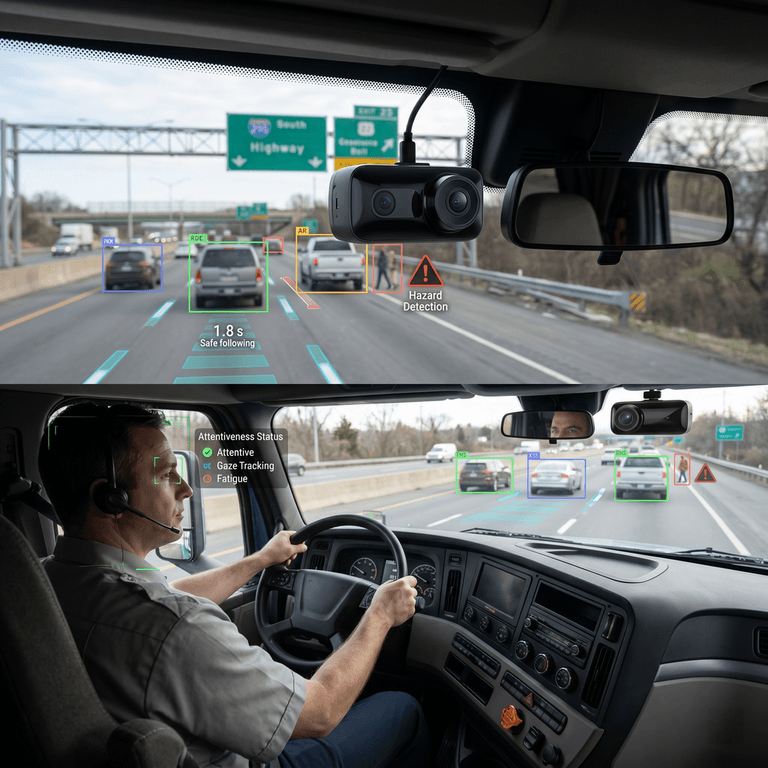
Forward-facing and driver-facing AI dash cam mounted on a commercial truck windshield, using edge computing to scan road conditions and track driver posture in real time.
2. How Fleet Safety Technology Has Evolved
The Reactive Era: Retrospective Post-Incident Analysis
For decades, commercial fleet risk management operated almost entirely in a reactive posture. Early truck dash camera system infrastructure relied on legacy hardware that recorded continuously to localized physical media, such as onboard SD cards. These devices possessed zero operational intelligence; they functioned as passive video recorders. Fleet managers could review video footage only after a severe safety event, roadside collision, or vehicle damage claim had already transpired.
This retrospective methodology meant post-incident investigations were bogged down by operational blind spots. Video data was frequently lost due to card corruption, overwrite cycles, or physical tampering. More importantly, legacy video tools yielded no preventive value. They provided evidence to assign blame during insurance disputes, but they did nothing to fix underlying unsafe driving behavior or eliminate systemic hazards across the mobile workforce.
The Proactive Era: Computer Vision and Agentic AI Architecture
The dawn of integrated fleet video telematics introduced the proactive era. In 2026, modern commercial fleet safety software doesn't just record collisions; it actively intercepts them. Leveraging advanced computer vision models, real-time edge AI processing, and advanced machine learning analytics, today's hardware turns raw visual information into actionable data points immediately.
This paradigm shift has accelerated with the integration of Agentic AI systems into fleet operations. Unlike early automated triggers that relied on basic, rigid rules, Agentic AI architectures possess contextual reasoning capabilities. These systems dynamically analyze environmental variables—such as matching a truck's braking patterns with real-time local weather feeds, lane positioning, and driver fatigue indicators—to execute context-aware proactive safety coaching. This intelligent system evaluates risk autonomously, tailoring inside-the-cab voice feedback to preserve driver safety without interrupting operations over minor anomalies.
| Feature Category | The Reactive Era (Legacy Systems) | The Proactive Era (Agentic AI - 2026) |
|---|---|---|
| Hardware Intelligence | Passive continuous loop recording via local SD cards. Zero real-time data interpretation. | Edge AI computing via localized graphics processing units running real-time computer vision models. |
| Primary Function | Evidence collection for insurance defense after an accident has occurred. | Real-time safety event detection, active driver monitoring, and predictive risk mitigation. |
| Driver Interaction | None. Behavior checked only during performance reviews or following an explicit complaint. | Instant inside-the-cab audio notifications and real-time proactive safety coaching workflows. |
| Workflow Automation | Manual sorting through hours of hard drives or cloud footage following an incident. | Cloud-based event validation engines filtering alerts for immediate fleet manager review. |
3. What Are AI Dash Cams?
An AI dash cam for trucks represents a major hardware leap over traditional video telematics recorders. At its core, the device functions as an intelligent, high-speed edge computing node that continuously scans multiple video fields using custom-trained neural network models.
Dual-Lens Configurations: Contextual Vision
Modern AI hardware utilizes high-definition dual-lens recording systems to capture a complete picture of operational risks:
- Forward-Facing Lenses: These cameras monitor everything happening outside the vehicle. They track lane boundary positioning, look for traffic signal compliance, calculate distance to surrounding vehicles, and measure rapid acceleration or deceleration changes relative to surrounding vehicles.
- Driver-Facing Lenses: These cameras utilize specialized infrared illumination fields to monitor driver behavior analytics inside the cab, regardless of ambient lighting conditions. By mapping facial landmarks, gaze direction, and posture patterns, the driver monitoring technology identifies unsafe driving behavior the moment it starts.
Edge AI Processing & High-Risk Behavior Detection
Rather than uploading raw, unparsed video streams to cloud servers—which consumes unsustainable cellular data bandwidth—the AI hardware runs localized computer vision directly on the device. The camera parses frames locally, looking for specific hazard signatures across several critical areas:
Critical AI Detection Use Cases:
- Distracted Driving Detection: Tracks prolonged gaze deviations away from the forward roadway, such as when a driver looks down at an unmounted device or a mobile phone screen for more than two seconds.
- Cell Phone Use: Identifies the explicit visual signature of a mobile device held near the driver's ear or directly in front of their line of sight.
- Following Too Closely (Tailgating): Calculates vehicle speed relative to the forward vehicle's mass to flag unsafe time-to-collision thresholds.
- Lane Departure Tracking: Monitors continuous white and yellow pavement markers to detect drifting patterns caused by micro-sleeps or distraction.
- Fatigue Indicators: Evaluates yawn frequency, prolonged eyelid closure duration, and head dropping to warn drivers before a fatigue-related accident occurs.
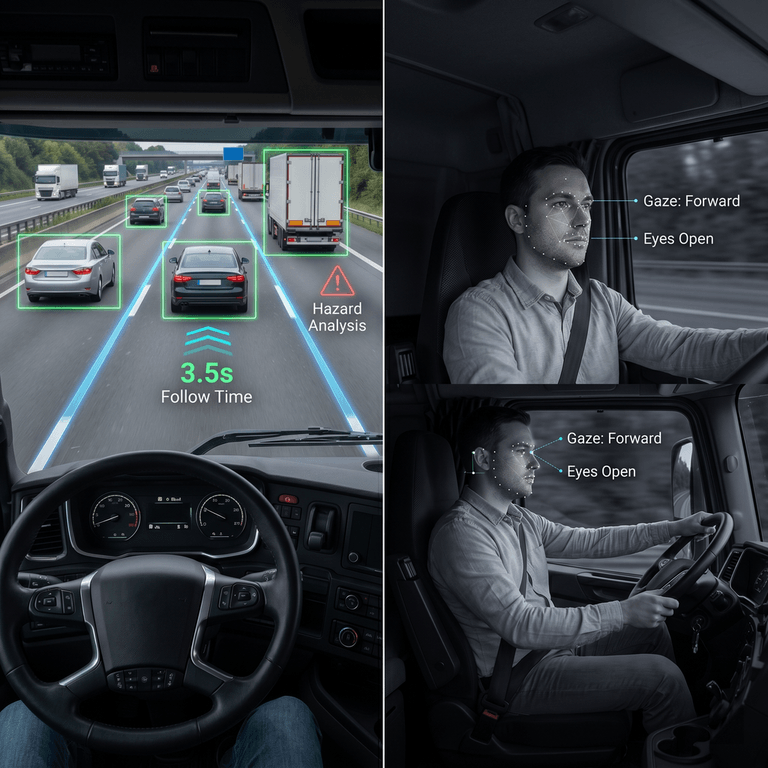
Split-view from an AI dash cam: the forward-facing lens detects vehicles with bounding boxes while the driver-facing lens maps facial landmarks and gaze direction via infrared.
4. The Biggest Challenge: Driver Buy-In
Why Drivers Resist AI Fleet Safety Technology
Despite the undeniable safety benefits, the introduction of AI fleet safety technology often encounters intense resistance from commercial drivers. Frontline workers frequently view driver-facing lenses as an invasive threat to their privacy, interpreting the tool as an expression of corporate distrust or an intrusive "Big Brother" mechanism monitoring their every move. This structural friction can severely damage driver retention rates if implemented poorly, especially during a time when qualified commercial drivers are at a premium across North America.
Furthermore, constant inside-the-cab audio feedback can trigger severe coaching fatigue. Drivers who feel relentlessly corrected by a synthetic voice over minor errors can become frustrated, leading to intentional camera tampering, lens obstruction, or friction with fleet management teams.
The False Positive Problem: Culture and Alert Fatigue
The single greatest driver of resistance is the problem of false alerts. If the edge AI platform incorrectly flags benign habits as safety violations, it can cause significant operational friction. Common false alerts include:
- Mistaking a driver drinking a beverage or eating a quick snack on an extended shift for an illegal cell phone infraction.
- Triggering "distracted driving" warnings when a driver is simply scanning their side-view mirrors during a complex turn.
- Flagging sudden G-force variations caused by unavoidable road infrastructure flaws—such as hitting a deep pothole, crossing a railroad track, or driving over uneven construction zones—as aggressive driving or hard braking.
When false alerts flood the cab, they trigger severe alert fatigue. Drivers quickly learn to tune out the audio warnings completely, eroding trust in the technology and pushing safety culture into a downward spiral. For management, these inaccuracies create an administrative nightmare, burying safety directors under a mountain of junk notifications that obscure actual, high-risk safety threats.
5. What Is an Event Validation Engine?
To eliminate the friction caused by false positives, modern video telematics architectures utilize an Event Validation Engine. This multi-layered verification system processes alerts in the cloud, filtering out inaccurate or low-risk data before it reaches the fleet manager's dashboard. This system prevents safety directors from wasting hours sorting through benign driving clips.
The 5-Step Validation Workflow
An event validation engine acts as a smart filter, following a structured five-step workflow to ensure data integrity:
-
Safety Event Detected at the Edge:
The camera's onboard edge processor detects a potential violation—such as a sudden deceleration spike or a suspected distracted driving gaze deviation.
-
Targeted Video Upload:
The device automatically isolates a short clip (typically 10 to 20 seconds long) surrounding the trigger point and uploads the video, along with engine telematics data, to a secure cloud platform.
-
Cloud AI Screening and Classification:
Advanced cloud-based neural networks analyze the clip with greater processing power than the edge device could provide. The cloud models evaluate lighting, environmental variables, and vehicle telemetry to confirm or dismiss the initial alert.
-
Human-in-the-Loop Validation:
If the cloud AI detects ambiguity, the clip is sent to a dedicated network of professional human reviewers. These specialists evaluate the true operational context, filtering out benign behaviors like a driver adjusting their steering wheel or reacting safely to avoid an aggressive third-party vehicle.
-
Verified Fleet Manager Review:
Only verified, actionable safety infractions are delivered to the fleet manager's dashboard. The alert arrives pre-sorted by severity level and fully integrated into video-based coaching workflows.
The Strategic Impact: By implementing an event validation engine, motor carriers routinely eliminate up to 85% of false alerts. This structural protection guarantees that high-performing commercial drivers are shielded from unfair reprimands or unnecessary coaching sessions. By prioritizing human-reviewed alerts, fleet managers can protect driver morale, validate high performers, and focus their attention on drivers who genuinely need coaching.
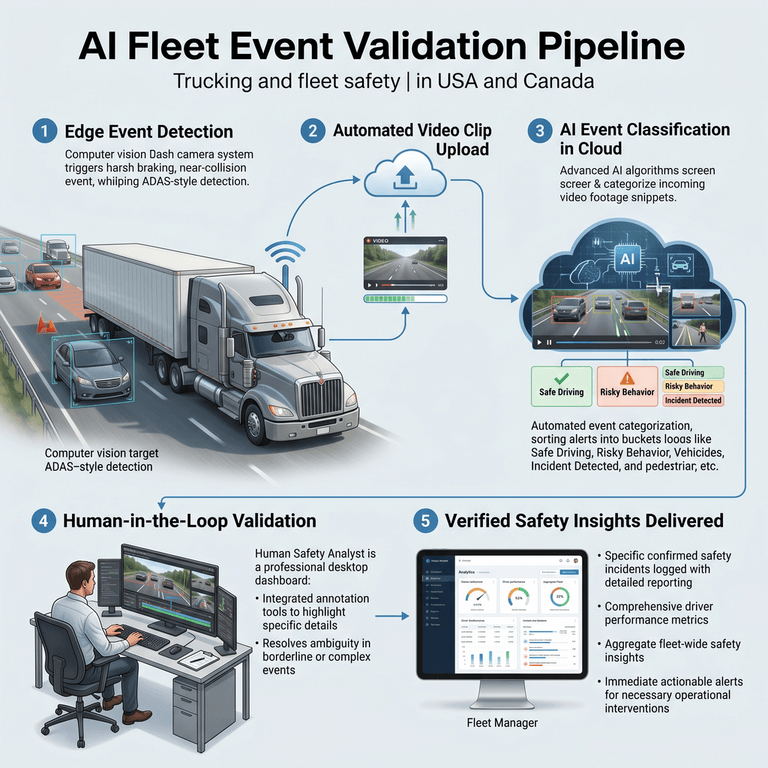
Five-step event validation workflow: edge detection triggers a video clip upload, cloud AI screens and classifies the alert, human reviewers validate ambiguous events, and only verified safety infractions reach the fleet manager's dashboard.
6. AI Dash Cam Platforms Compared
When building a comprehensive fleet safety program, evaluating the technical differences between top enterprise video telematics systems is essential.
Motive (Formerly KeepTruckin)
Motive provides an accessible and deeply integrated fleet safety ecosystem that is highly favored by small-to-medium fleets and expanding regional operators.
- AI Camera Features: The Motive AI Dash Cam leverages a high-performance OmniVision sensor configuration to deliver real-time inside-the-cab behavior parsing and lane monitoring.
- Driver Coaching Architecture: Features automated in-cab audio alerts combined with an integrated mobile app where drivers can review their own safety scorecards and event logs independently.
- Telematics Integration: Connects directly into the Motive Vehicle Gateway to seamlessly link engine diagnostic codes, hours-of-service status, and ELD profiles.
- Strengths: Highly intuitive user interface, streamlined driver onboarding, and robust automated workflows designed for single-manager operations.
- Weaknesses: High-tier features require upgrading to premium subscriptions; historical reporting can slow down during complex data mining queries across large fleets.
- Pricing Insights: Subscription fees generally range between $30 and $50 per vehicle per month, along with upfront hardware costs that depend on the contract length.
Samsara
Samsara is a major player in the enterprise fleet telematics landscape, offering a complex, data-rich IoT ecosystem for large organizations.
- AI Event Detection: Features advanced dual-lens configurations paired with high-capacity cloud models designed to parse high-frequency data inputs.
- Safety Analytics & Coaching: Provides detailed dashboard analytics, comprehensive driver scorecards, and highly customizable coaching workflows tailored for multi-tier management teams.
- Platform Strengths: Exceptional data visualization tools, an extensive application marketplace, and robust APIs built for custom enterprise software development.
- Platform Weaknesses: The software's complexity can overwhelm smaller operations; the pricing is premium, and long-term multi-year commitments are typically required.
- Pricing Insights: Enterprise pricing is highly customized, but often averages around $40 to $50 per asset per month, with hardware costs billed separately upfront.
Other Enterprise Video Telematics Contenders
Several other specialized platforms provide alternative risk management approaches across North America:
- Lytx (DriveCam): An industry pioneer with a massive database of human-reviewed driving footage. Lytx excels at human-in-the-loop validation workflows, making it ideal for large transit, passenger bus, and waste management fleets looking to reduce liability.
- Netradyne (Driveri): Differentiates itself by deploying four separate cameras to capture a 360-degree view of the vehicle. Netradyne processes 100% of the driving day using edge computing, rewarding drivers for positive behaviors rather than just flagging infractions. This approach makes it a strong fit for fleets focused on driver morale.
- Verizon Connect: A reliable choice for mid-sized operations looking for a stable fleet management platform. It bundles basic AI camera features into its established telematics suite, making it a natural fit for businesses that already rely on Verizon network infrastructure.
7. Why Video Alone Is Not Enough
Investing heavily in an AI dash cam system can create a false sense of security for fleet operators. While video telematics are unmatched at capturing dynamic driving behavior and highway incidents, they remain fundamentally blind to what happens before the truck ever goes into gear.
An AI camera cannot see mechanical defects hidden beneath the chassis or deep inside the engine compartment. It cannot verify if a driver actually completed a physical walk-around inspection, used a tire pressure gauge, checked brake adjustments, or verified trailer coupling security. For example, if a truck leaves the terminal yard with a severely worn brake line or a deep tire puncture, the camera will only record the catastrophic failure after it happens on the highway.
Furthermore, video telematics platforms do not act as formal document storage engines for DOT regulatory reviews. When a federal auditor requests maintenance tracking files, driver sign-offs, or historical inspection logs, video clips provide no protection against costly compliance fines. True fleet safety requires a balanced approach that pairs real-time video telematics with digital inspection tracking.
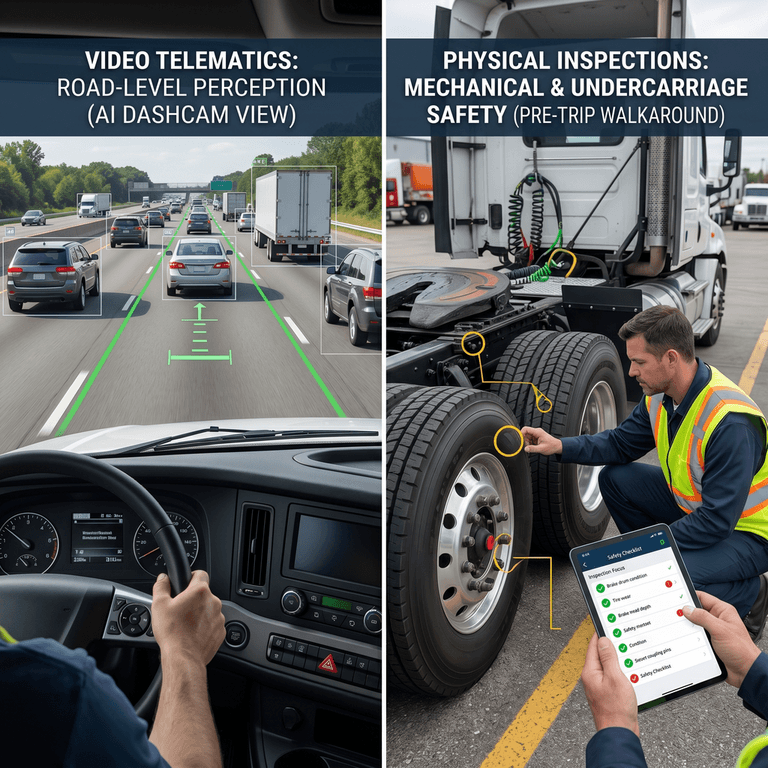
AI cameras capture highway driving behavior but cannot see beneath the chassis — a physical walkaround is the only way to verify brake wear, tire damage, and coupling security before departure.
8. Integrating Video Telematics with Digital DVIR Workflows
To eliminate operational blind spots, smart fleet managers are connecting their real-time video telematics with electronic Driver Vehicle Inspection Report (eDVIR) workflows. This integration ensures that active over-the-road driver monitoring is anchored by verifiable, pre-trip safety compliance.
Cross-Border Compliance: USA vs. Canada
For cross-border transport companies, connecting these workflows is critical to navigating differing federal safety laws seamlessly:
- In the United States: The FMCSA enforces strict pre-trip and post-trip rules under 49 CFR Part 396. This framework requires a closed-loop "three-signature cycle" whenever a safety defect is discovered, mandating formal sign-offs from the driver, the mechanic, and the next reviewing operator.
- In Canada: Fleets must comply with National Safety Code (NSC) Standard 13. While similar to US rules, Standard 13 requires drivers to carry a specific physical or electronic trip inspection report that must remain valid for 24 hours, paired with strict defect classifications (Major vs. Minor) that dictate whether a truck must be placed out-of-service immediately.
By connecting telematics alerts with digital DVIR entries, safety directors gain absolute visibility over their assets. For example, if an AI camera detects a subtle air loss warning during a trip, the system can automatically flag that specific air brake system on the driver's subsequent digital post-trip checklist. This cross-platform communication ensures mechanical issues are logged, tracked, and repaired long before they can lead to an out-of-service order or a roadside breakdown.
9. Why pti4you.com Complements AI Dash Cam Systems
pti4you.com is a dedicated, cloud-based fleet compliance software platform engineered specifically to automate DVIR tracking, regional DOT audit preparation, and maintenance verification workflows.
It is critical to clarify that pti4you.com does not compete with enterprise telematics providers or AI camera hardware. Instead, the platform is designed to seamlessly complement those systems, filling the compliance gaps that telematics platforms often leave unaddressed.
Strategic Corporate Positioning:
"AI cameras protect drivers on the road. pti4you.com protects fleets during DOT audits."
While premium AI camera systems excel at modifying driver behavior and recording over-the-road liabilities, pti4you.com focuses entirely on securing your fleet's regulatory records. The platform ensures compliance across several critical areas:
- Hardware-Agnostic Accountability: Drivers use their existing mobile devices to complete inspections, removing the need for expensive, proprietary hardware modifications or long-term contracts.
- GPS Verification & Timestamping: Automatically records exact location metrics and duration data for every pre-trip walk-around, creating an unalterable audit trail that proves inspections actually occurred. Learn more about how this eliminates pencil whipping.
- Mandatory Photo Verification: Forces drivers to capture live, real-time photos of critical safety components, preventing pencil whipping and faked checklists.
- Audit-Ready Cloud Archiving: Organizes, tracks, and backs up all 90 days of required DVIR history, making compliance reviews stress-free.
Required Integration Framework:
While expensive AI cameras help prevent accidents, pti4you.com helps prevent costly DOT violations. Combine digital DVIR inspections with your telematics ecosystem to achieve complete fleet safety and compliance visibility.
Protect Your Fleet During DOT Audits
AI cameras keep drivers safe on the road. PTI4YOU keeps your compliance records audit-ready. Automate DVIRs with GPS verification, photo evidence, and cloud archiving — no hardware required.
Start Your 15-Day Free Trial – No Credit Card RequiredZero setup fees. Zero hardware. 25-minute driver onboarding.
10. Fleet Manager Evaluation Checklist
Before committing to a long-term contract for an AI video telematics platform, fleet operations managers and safety directors should run through this ten-point evaluation checklist:
- How accurate are the alerts? Request real-world performance data demonstrating the camera's ability to differentiate between actual risks and benign behaviors under poor lighting or bad weather conditions.
- How are false positives handled? Verify whether the platform requires your team to manually sort through every trigger, or if it utilizes a smart filter to minimize dashboard clutter.
- Is human validation available? Determine if the subscription includes a dedicated, human-in-the-loop review team to verify safety events before they spark difficult coaching conversations with drivers.
- Can the system integrate with telematics? Ensure the camera hardware connects directly with your vehicle's engine gateway to link video clips with true speed, braking pressure, and diagnostic fault codes.
- Can it integrate with compliance workflows? Confirm whether safety alerts can share data with your digital inspection logs and preventative maintenance schedules.
- What is the total cost of ownership (TCO)? Calculate all hidden expenses, including upfront hardware fees, cellular data overage charges, camera replacement policies, and multi-tier feature subscription costs. Compare this with hidden cost analysis tools.
- Are long-term contracts required? Check for restrictive three-to-five-year agreements that can lock your fleet into outdated hardware as technology evolves.
- How will drivers be trained? Look for comprehensive onboarding materials that help frame the technology as a safety shield for drivers' CDLs, rather than a punitive surveillance tool.
- How will coaching be managed? Confirm that the platform provides clean, streamlined mobile workflows that allow drivers to review their own performance and fix bad habits independently.
- Does the system improve overall fleet safety culture? Ensure the platform focuses on long-term driver development and positive reinforcement, rather than just generating endless reprimands that can drive up turnover.
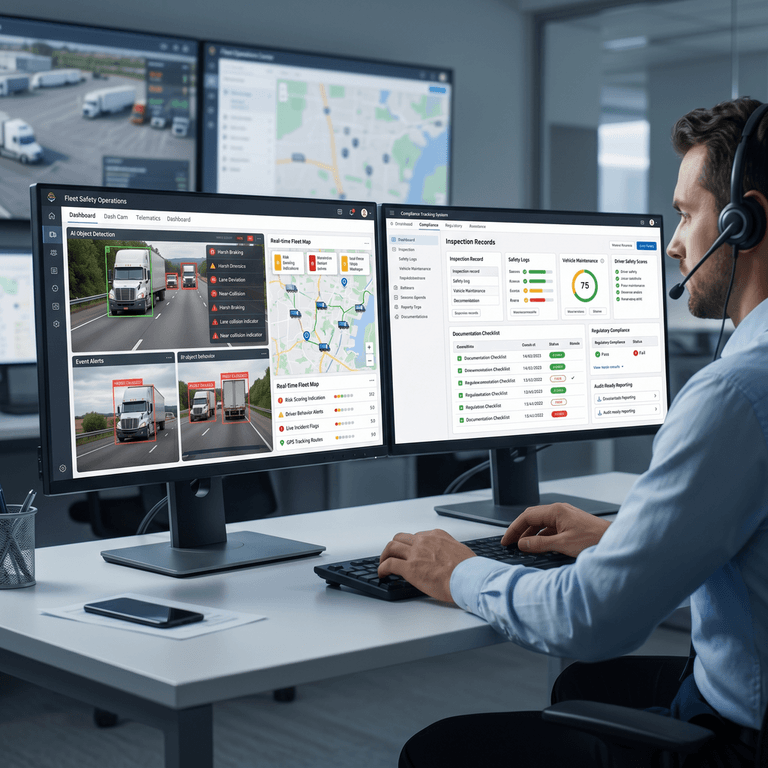
A fleet safety director's workstation displaying synchronized AI dash cam alerts on one monitor and pti4you.com compliance status on the other — the complete fleet safety ecosystem.
11. Frequently Asked Questions (FAQ)
What is an AI dash cam?
An AI dash cam is an advanced video telematics device that utilizes built-in edge computing and computer vision to analyze driving behaviors in real-time. Unlike traditional cameras that merely record video to an SD card, an AI dash cam actively detects risky behaviors such as distracted driving, tailgating, cell phone usage, and drowsiness, providing immediate inside-the-cab audio alerts to the driver.
How do AI dash cams work?
AI dash cams work by capturing raw video data via forward-facing and driver-facing lenses, which is instantly processed by local machine learning models embedded on the camera device (edge AI). When an unsafe driving behavior or sudden G-force spike matches an event trigger, a video clip is marked, uploaded to the cloud telematics platform, and reviewed for coaching workflows.
What is an event validation engine?
An event validation engine is a multi-layered verification system that filters out inaccurate or low-risk alerts generated by AI cameras before they reach the fleet manager's dashboard. This process combines advanced cloud-based machine learning algorithms with professional human-in-the-loop video review specialists to eliminate false positives.
Why are false positives a problem?
False positives create severe alert fatigue for both commercial drivers and fleet safety managers. Constant inaccurate in-cab warnings frustrate drivers, leading to technology resistance, low morale, and increased driver turnover. For safety directors, sorting through hundreds of false alerts wastes administrative hours and hides actual high-risk safety threats.
Are AI cameras legal in commercial fleets?
Yes, AI dash cameras are fully legal across the United States and Canada. They serve as essential assets for fleet risk management, safety event detection, and insurance underwriting optimization. Fleets operating in highly regulated jurisdictions, such as under California's BIT program or Canada's NSC Standard 13, rely on verified video footage to protect against predatory legal liabilities.
How much do AI dash cam systems cost?
In 2026, enterprise video telematics systems from providers like Samsara and Motive generally cost between $25 and $50 per vehicle per month for software subscriptions. Upfront hardware costs typically range from $99 to over $150 per camera unit, often requiring long-term contractual commitments.
Can AI cameras replace DVIR inspections?
No, AI dash cams cannot replace mandatory Driver Vehicle Inspection Reports (DVIR). While cameras excel at capturing dynamic driving behavior and highway incidents, they cannot verify if a driver performed a physical pre-trip walk-around, checked tire tread depth, verified brake adjustments, or documented structural deficiencies required under 49 CFR Part 396.
How can telematics and compliance software work together?
Telematics and compliance software work together by creating a unified, multi-layered safety ecosystem. The AI telematics system monitors, logs, and coaches real-time over-the-road driving habits, while dedicated compliance platforms like pti4you.com automate static inspection tracking, DVIR retention laws, and audit preparation. Together, they eliminate operational blind spots from terminal yard to destination highway.
Conclusion: Building a Complete Fleet Safety Ecosystem in 2026
The commercial transportation industry has entered a decisive era where reactive safety management is no longer viable. AI dash cams with edge computing deliver unprecedented real-time visibility into over-the-road driving behaviors. Event validation engines ensure that the data reaching fleet managers is accurate, actionable, and fair to drivers. Together, they represent the most powerful proactive safety tools available to motor carriers in 2026.
However, technology investment must be strategic. AI cameras are not a silver bullet. They cannot replace the physical pre-trip walk-around, the mechanic's sign-off on a repaired brake defect, or the 90-day audit trail that a federal investigator demands during a compliance review. Fleet operators who integrate their video telematics with dedicated electronic DVIR platforms like pti4you.com achieve complete safety visibility—from terminal yard to destination highway.
The fleets that will thrive in 2026 and beyond are those that embrace this layered approach: AI for real-time risk prevention, event validation for data integrity, and digital compliance software for regulatory protection. Start building your complete safety ecosystem today.
Complete Your Fleet Safety Ecosystem with PTI4YOU
AI cameras protect your drivers on the road. PTI4YOU protects your fleet during DOT audits. Automate your DVIR workflows, enforce physical inspections with GPS and photo verification, and maintain audit-ready compliance records—all without expensive hardware or long-term contracts.
Start Your 15-Day Free Trial – No Credit Card RequiredZero setup fees. Zero hardware. 25-minute driver onboarding.